
Most boring X posts are not boring because the topic is weak.
They are boring because the writing arrives half-awake. Soft opening. Vague point. No tension. No edge. No reason for anyone scrolling at speed to stop and care.
X is not very forgiving about that. People do not linger out of politeness. They do not reward “pretty solid thought, nicely phrased.” They keep moving.
If you want to know how to rewrite boring X posts, the fix usually is not “add more personality” or “be more authentic” or some other fog machine phrase. The fix is to make the post clearer, tighter, sharper, and more worth repeating.
Here’s how to take flat X posts and turn them into something with actual pulse, without sounding like a rage-bait intern or a wannabe philosopher posting from an airport lounge.
If you want the bigger picture, start with the parent guide.
Why X posts get boring so fast
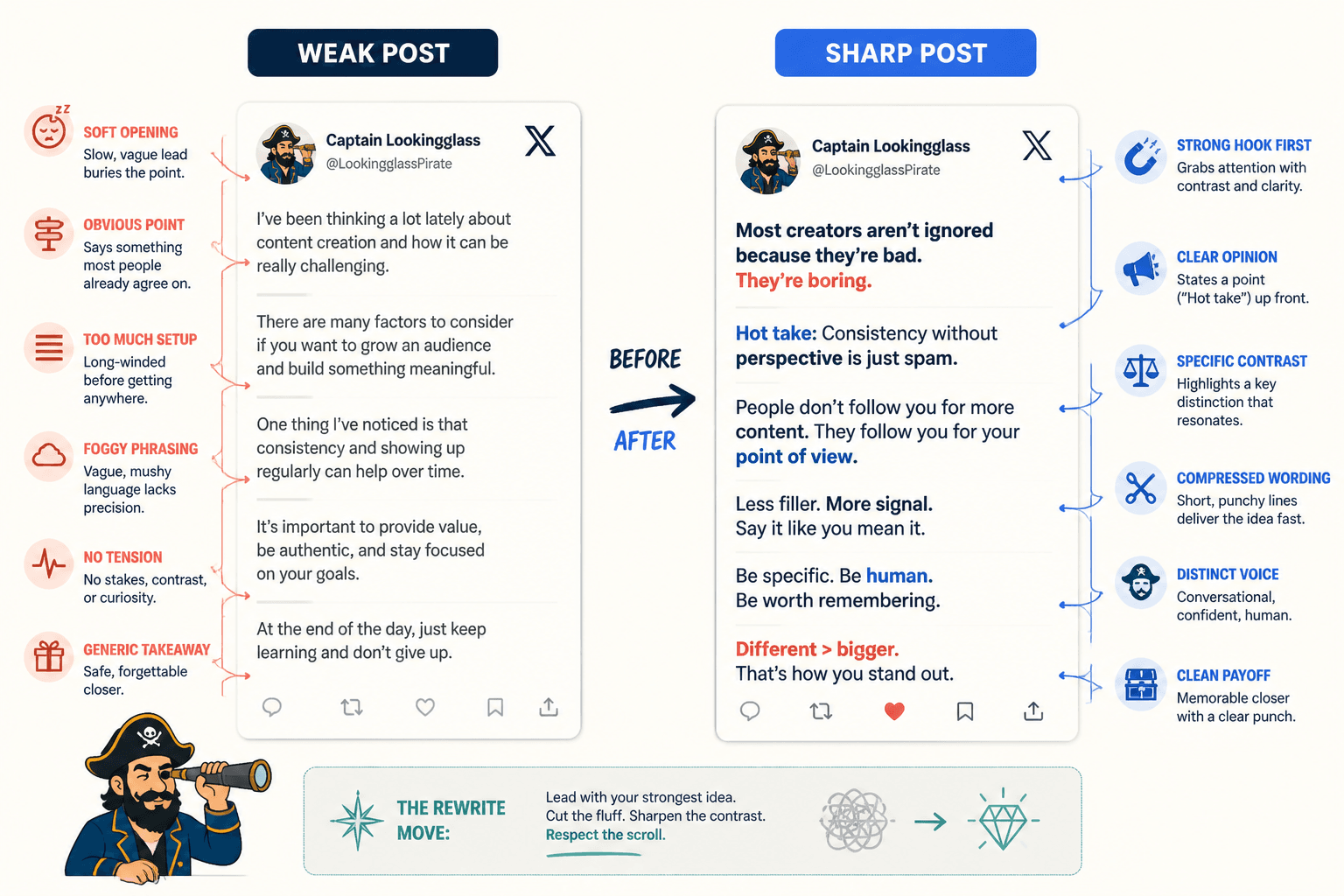
X rewards compression, contrast, and clean opinion. Boring posts usually fail on at least one of those.
- They start too gently
- They say something obvious in a decorative way
- They explain too much before making the point
- They sound interchangeable with 4,000 other accounts
- They aim for “wise” and land on “foggy”
- They have no tension, specificity, or payoff
In other words, they are not unfinished. They are unfocused.
A good rewrite is not about polishing the sentence until it shines. It’s about finding the live wire in the idea and putting that near the front.
How to spot the actual problem before you rewrite
Before changing words, figure out why the post is flat. Different problems need different edits.
Problem 1: The post has no real point
This is common. The post circles a topic but never lands a thought.
“Consistency matters a lot when building a brand online.”
That is not really a point. That is a bland truth wearing office shoes.
You need an angle. What about consistency? Most people misunderstand it? Overrate it? Use it as an excuse to post mediocre things? Now we are getting somewhere.
Problem 2: The point exists, but it is buried
Some posts make the reader hike through three warm-up lines to reach the only interesting sentence.
On X, that is usually fatal. Your strongest line should not be hiding at the bottom like it owes rent.
Problem 3: The post is too vague to matter
Words like better, valuable, important, quality, and growth often signal fluff unless they are tied to something concrete.
Specificity gives a post weight. Without it, the writing slides right off the timeline.
Problem 4: The tone is trying too hard
If the post sounds like it is auditioning for “top creator energy,” people feel that immediately. Fake gravitas, forced minimalism, startup chest-thumping, dramatic line breaks, mysterious one-liners with no substance. All of it gets old fast.
If this is happening in your posts, you might want to pair this with how to improve X posts with punchy lines without sounding generic.
The rewrite process that actually works
Here is the simplest way to rewrite boring X posts without turning them into clickbait soup.
- Find the real point
- Cut the slow opening
- Add tension, contrast, or specificity
- Tighten every line
- End on something that lands
That sounds simple because it is. It is also where most people get lazy.
1. Find the real point
Ask: what am I actually trying to say here that a smart person might repeat, debate, bookmark, or quote?
Not the topic. The point.
Example:
Boring version: “Posting every day is a good way to stay top of mind.”
The real point might be:
“Posting daily does not help if every post sounds like a draft you forgot to finish.”
That is sharper. It has an opinion. It creates friction. It sounds like someone means it.
2. Cut the slow opening
Weak X posts often begin with throat-clearing:
- “I’ve been thinking a lot about…”
- “One thing I’ve come to realize is…”
- “It’s interesting how…”
- “A reminder that…”
None of these help the reader. They only delay the point.
Open with the thing worth reading. If your first line can be deleted and the post gets stronger, delete it.
For a deeper fix on weak openers, read how to start X posts without a weak opening.
3. Add tension, contrast, or specificity
X likes posts that move. Tension gives movement.
That tension can come from:
- Expectation vs reality
- Popular belief vs your experience
- Bad advice vs what works better
- Simple claim vs specific proof
Examples:
| Weak | Stronger rewrite |
|---|---|
| “You should focus on quality over quantity.” | “Most people preaching quality over quantity are just posting rarely and calling it strategy.” |
| “Your content should be valuable.” | “If your post cannot help, surprise, clarify, or challenge someone, it is probably just decoration.” |
| “Building an audience takes time.” | “Audience growth is slow when every post sounds safe enough to offend absolutely no one.” |
You do not need manufactured controversy. You need shape.
4. Tighten every line
X is not the place for flabby phrasing. If five words do the job, ten are usually showing off.
Cut:
- repetition
- hedging
- filler transitions
- generic adjectives
- lines that only restate the previous line
Example:
Before: “I think one of the biggest mistakes that many people make when it comes to posting content online is that they often do not spend enough time thinking about the hook.”
After: “Most content flops before the second line. The hook was weak.”
Shorter is not automatically better. Clearer is better. On X, that often means shorter too.
5. End on something that lands
Do not let the post fade out like a meeting that should have been an email.
A decent ending usually does one of these:
- sharpens the point
- adds a final twist
- gives a useful takeaway
- invites a real response
Weak ending:
“Just something to think about.”
Better ending:
“If the first line is sleepy, the rest of the post never gets a chance.”
Before-and-after rewrites for boring X posts
Here is where this gets more useful. Let’s rewrite the kind of posts people keep publishing and then wondering why they disappear on contact.
Example 1: Generic advice post
Before: “If you want to grow on X, consistency and value are very important.”
What is wrong with it:
- too generic
- no angle
- no tension
- says nothing new
After: “Posting consistently does not fix weak ideas. It just helps more people ignore them on a schedule.”
That rewrite works because it takes a familiar topic and gives it contrast. It also sounds like a person with standards, not a recycled content calendar.
Example 2: Soft thought leadership
Before: “Leadership is really about listening and understanding people.”
Rewrite:
After: “A lot of people say they want honest feedback. What they actually want is agreement with better phrasing.”
This is more specific, more provocative, and much more likely to trigger thought or discussion.
Example 3: Boring personal brand post
Before: “Being yourself online is one of the best ways to build trust.”
Rewrite:
After: “ ‘Be yourself’ is lazy advice. Be legible. People cannot trust a brand they cannot understand.”
That gives the reader something to think with, not just nod at.
Example 4: Overexplained educational post
Before: “When you are writing posts, it is always a good idea to think carefully about who your audience is and what they might need from you.”
Rewrite:
After: “If your post tries to help everyone, it usually connects with no one.”
Cleaner. More memorable. More quotable.

What to add when a post feels flat
Sometimes the post is technically fine, but still forgettable. In those cases, it usually needs one of these ingredients.
A stronger opinion
Not fake outrage. Just a clearer stance.
Instead of:
“There are many ways to approach content strategy.”
Try:
“Most content strategy advice is too broad to help and too polished to trust.”
A sharper image or detail
Concrete language beats abstract language almost every time.
Instead of:
“A lot of people post things that do not work.”
Try:
The bigger point is simple: clearer structure and clearer writing make the piece more useful. That is usually what makes the ending land better too.