
Most X posts do not sound robotic because the writer used AI. They sound robotic because they are trying too hard to perform competence, authority, insight, or sales intent in one cramped little post.
And salesy posts usually are not failing because selling is bad. They fail because the pitch arrives before trust, before specificity, and before the reader has any reason to care.
If you want to learn How to Write X Posts Without Sounding Salesy or Robotic, the fix is not “be more authentic.” That advice has ruined enough timelines already. The fix is to write with more clarity, more compression, and a little more human texture. X rewards sharp thinking. It does not reward polished mush.
Here’s how to make your posts feel like a real person with a point wrote them, not a growth bot wearing your profile photo.
If you want the bigger picture, start with the parent guide.
Why X posts start sounding stiff in the first place
X is a weird platform. It moves fast, rewards punch, and punishes waffle. That makes people overcorrect.
They try to sound smart in as few words as possible, and end up sounding like a quote generator with invoices. Or they try to sell without “being too salesy,” so they hide the pitch under vague inspiration, soft-posting, or fake insight. Same problem. Different perfume.
The usual causes are pretty boring:
- Writing to impress instead of to communicate
- Using vague business language instead of actual observations
- Trying to cram a whole funnel into one post
- Copying popular creators whose style does not fit your voice
- Starting too softly and ending too desperately
- Using AI output without editing out the oatmeal
X posts work best when they feel like one clear thought, stated cleanly, by someone who has earned the right to say it.
Write one sharp idea, not a tiny seminar
A lot of robotic posts are overpacked. The writer is trying to teach, persuade, signal credibility, tell a story, and sneak in a CTA all at once. On X, that usually creates a post that feels strained.
Good X posts tend to do one of these things well:
- Make a sharp observation
- Challenge a lazy assumption
- Share a useful lesson
- Frame a problem clearly
- Offer a specific tip
- State an opinion with backing
That is enough. You do not need a TED Talk in 280 characters.
If your post feels cramped, the problem is usually not the character limit. It is idea greed.
Before writing, ask:
- What is the actual point?
- What is the strongest version of that point?
- Can I say it in one sentence before trying to make it sound clever?
If you cannot answer those cleanly, the post is not ready yet.
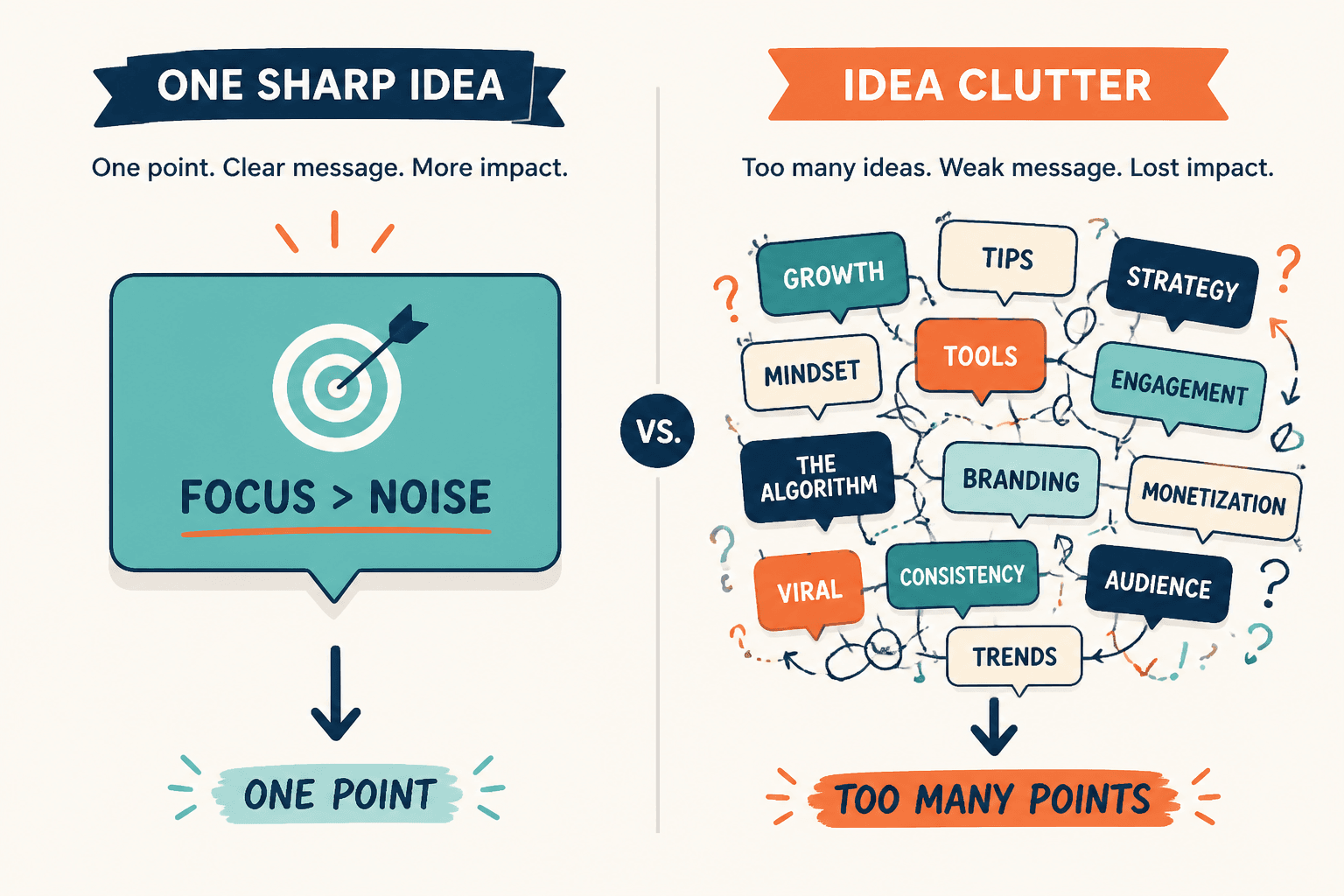
Weak vs stronger post concept
Weak: Building a business online is really about consistency, mindset, value, relationships, branding, and showing up even when it’s hard.
Stronger: Most people do not need more consistency. They need clearer positioning so their posts stop sounding interchangeable.
The second one has a spine. The first one has a headache.
Stop using language nobody says out loud
If you want to know how to write X posts without sounding salesy or robotic, start by deleting phrases that belong in a stale webinar deck.
Stuff like:
- “I help founders scale with ease”
- “Leverage content to unlock growth”
- “Transform your mindset around success”
- “If this resonates…”
- “DM me to learn more”
None of that sounds human. It sounds pre-approved.
Plain English is harder to fake and easier to trust. Try saying what you mean like a person who has had coffee and deadlines.
Examples of robotic lines rewritten
- Robotic: I help coaches unlock authority-building content strategies.
Better: I help coaches turn their expertise into posts people actually read. - Robotic: Consistency is the key to long-term brand growth.
Better: Posting every day will not save weak ideas. - Robotic: Storytelling is essential for audience connection.
Better: People do not remember your lesson. They remember the moment that made it matter.
The goal is not to sound casual for the sake of it. The goal is to sound specific enough that people believe you know what you are talking about.
Salesy usually means the post is asking too much, too soon
A post becomes salesy when the reader feels handled.
You can absolutely sell on X. You should, if you have something worth selling. But the post needs to earn the right to point people anywhere. If the value is thin and the ask is heavy, people feel the grab immediately.
Common mistakes:
- Leading with the offer instead of the problem
- Posting generic advice followed by “DM me”
- Writing threads that exist only to funnel into a pitch
- Using urgency when no urgency exists
- Talking like every reader is one click away from hiring you
Better approach: give the reader a strong idea, a useful angle, or a clear insight first. Then, if there is a relevant next step, make it light and specific.
Bad CTA vs good CTA
Bad: Want to scale your brand with organic content? DM me “GROWTH” now.
Better: If your posts are useful but still getting ignored, that’s usually a positioning problem before it’s a consistency problem. I help fix that.
Also better: I’ve been working on a simple framework for tightening post angles. If you want it, it’s in my profile.
The better CTAs feel connected to the post. They do not slam into the room wearing too much cologne.
Use specificity, because vagueness sounds fake fast
Vague posts sound robotic even when a human wrote every word. Why? Because vague writing has no lived texture. It could have come from anyone.
X rewards compressed specificity. Small details. Clear contrast. Tight language. A real point.
Compare these:
- Vague: Many creators struggle with content strategy.
- Specific: A lot of smart creators are not short on ideas. They are short on angles that make those ideas worth stopping for.
- Vague: Selling on social media should feel natural.
- Specific: If every post ends in a pitch, your audience stops reading the first line like they already know where this is going.
Specificity does not mean stuffing in random details. It means naming the problem in a way your reader recognizes instantly.
Make the post sound like you, not like “content”
Some people hear “have a voice” and assume that means being quirky, loud, ultra-opinionated, or terminally online. It does not.
A strong voice on X usually comes from three things:
- Your preferred level of directness
- The kinds of distinctions you naturally make
- The words you actually use when explaining things well
That is why copying the format of a successful account often backfires. Their rhythm is not your rhythm. Their punch lines are not your punch lines. Their version of blunt may look forced on you.
One useful trick is to draft the post as if you are texting a smart client or peer. Then tighten it for public readability. That often removes the fake polish and leaves the signal.
For more help with tightening the style itself, these related pieces can help: how to write better X posts, how to improve X posts with punchy lines without sounding generic, and how to start X posts without a weak opening.
Open stronger, because weak openings trigger robotic everything else
On X, soft openings kill momentum. And once a post starts limp, writers often compensate by trying to sound smarter or more polished later. That is when the robot voice arrives to finish the job.
Skip openings like:
- I’ve been thinking a lot about this lately…
- Just a reminder that…
- Hot take:
- One thing I’ve learned on my journey…
- Can we talk about…
These are mostly throat-clearing. They announce that a point might be coming eventually.
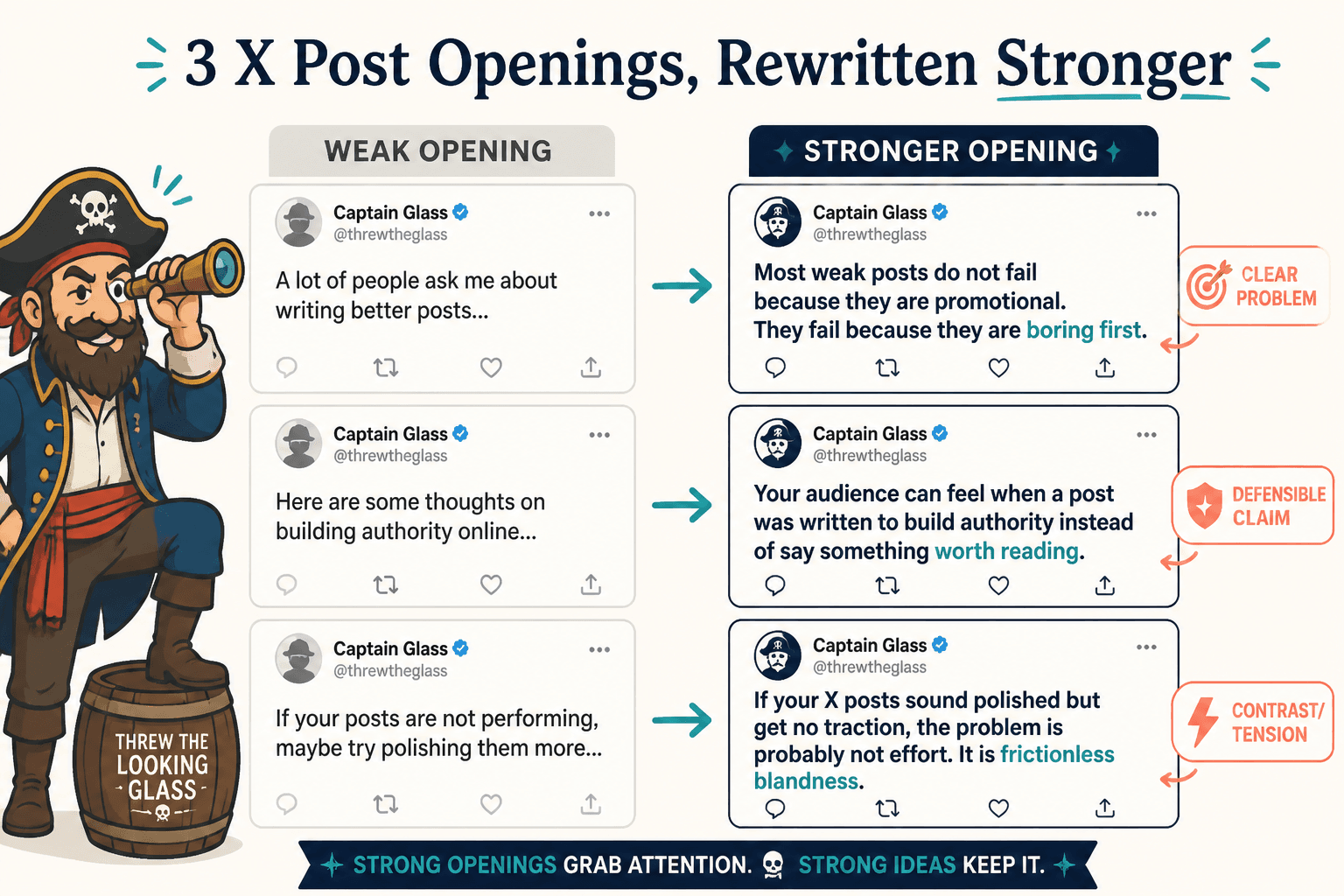
Stronger openings do one of three things quickly:
- Name a problem clearly
- Make a defensible claim
- Create tension through contrast
Examples of stronger openings
- Most salesy posts do not fail because they are promotional. They fail because they are boring first.
- Your audience can feel when a post was written to “build authority” instead of say something worth reading.
- If your X posts sound polished but get no traction, your problem is probably not effort. It is frictionless blandness.
Those lines move. They do not ask permission to exist.
A simple framework for writing cleaner X posts
If you tend to overthink your posts, use this four-part structure:
- Point: What do you actually believe?
- Tension: What do people get wrong about it?
- Proof or example: What makes the point credible?
- Next step: If there is a CTA, what is the lightest relevant one?
Example:
Point: Short posts do not need to sound shallow.
Tension: Most of them do because writers confuse brevity with vagueness.
Proof: A tight post with one strong observation will beat a fluffy mini-thread almost every time.
Next step: If your posts keep sounding flat, start by fixing the first line.
Compressed into a post:
Short posts are not weak because they are short.
They are weak because most writers use brevity as an excuse for saying nothing clearly.
One sharp observation beats five vague lines every time.
That works because it has a point, tension, and payoff. No fake grandeur needed.
How to sell without sounding like you’re circling the parking lot for leads
You do not need to hide the fact that you offer something. People are not allergic to selling. They are allergic to being treated like a conversion event.
A cleaner way to sell on X is to build your posts around these layers:
- Most posts: insight, clarity, usefulness, opinion, proof
- Some posts: direct relevance to your service or offer
- Occasional posts: explicit promotion with context and specificity
That rhythm matters. If every post sounds like pre-sales, readers stop trusting the feed version of you.
Three non-cringey ways to mention what you do
- Problem-linked: “I spend a lot of time fixing posts that are useful but packaged too vaguely to travel.”
- Process-linked: “One thing I do with clients is cut the first two lines almost every time. The real opening is usually buried underneath.”
- Resource-linked: “I put together a simple checklist for this because most people are overcomplicating it.”
Notice the difference: you are not lunging. You are contextualizing.
Edit for compression, not just correctness
A post can be grammatically perfect and still sound dead. X writing needs editing for force.
The bigger point is simple: clearer structure and clearer writing make the piece more useful. That is usually what makes the ending land better too.