
Long affiliate articles get treated like the default because “more helpful” sounds sensible. More details. More keywords. More chances to rank. More room to persuade.
And sometimes that’s true. Sometimes the best affiliate article really does need 2,500 words, comparison tables, objections, examples, caveats, and a clean recommendation.
But a lot of creators stretch a 600-word idea into a 2,200-word article and then wonder why nobody clicks, buys, or even finishes the thing. The problem is not that the article is “too short for SEO.” The problem is that it got padded into mush.
When Short Affiliate Articles Beat Long Ones comes down to fit. Short articles win when the reader wants a quick answer, the product is easy to understand, the buying decision is low-friction, and your article can remove doubt fast without turning into a beige swamp of recycled pros and cons.
Here’s how to know when shorter affiliate content works better, why it often converts better than people expect, and how to write short affiliate articles that actually earn clicks and sales instead of polite, useless pageviews.
If you want the bigger picture, start with the parent guide.
Why people keep making affiliate articles too long
Most overlong affiliate content is not long because the topic needs depth. It’s long because the writer is trying to satisfy too many goals at once.
- Rank for a broad keyword
- Teach the topic from scratch
- Review the product
- Compare it to alternatives
- Handle objections
- Sound authoritative
- Hit some imaginary “SEO word count” target
That is how you end up with an article called something like “Best Writing Tool for Solo Creators” that spends 900 words explaining what writing is, what creators are, why content matters, and how software has changed modern business. Riveting stuff, obviously.
Readers looking for affiliate recommendations usually are not asking for a ceremony. They want a decision made easier. If the article can do that faster, shorter often wins.
If you want the broader context on affiliate content strategy, it helps to start with the bigger monetization and funnels category, the money content section, and the main affiliate articles hub. This piece is about one specific decision inside that bigger system: when brevity does the job better.
What short affiliate articles are actually good at
A short affiliate article works best when it behaves like a sharp recommendation, not a mini textbook.
Its job is usually one of these:
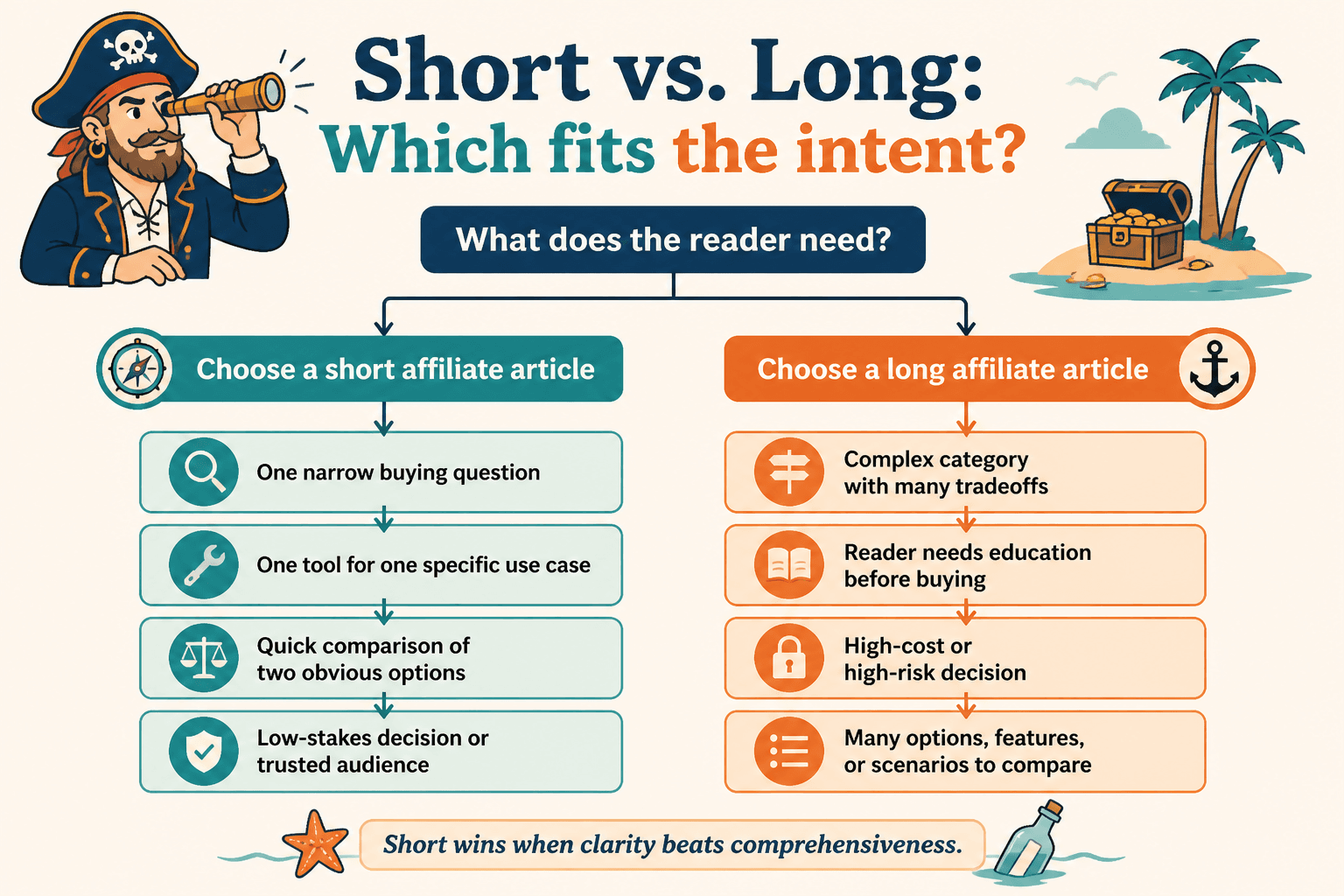
- Answer one narrow buying question
- Recommend one tool for one specific use case
- Compare two obvious options quickly
- Help readers choose based on situation, budget, or skill level
- Offer a practical shortcut to a low-stakes decision
That kind of article does not need theatrical depth. It needs clarity, specificity, and enough proof to make the click feel reasonable.
Short affiliate articles also tend to work well when your audience already trusts your judgment. If people already know you as the person who tests tools, writes clearly, or recommends practical stuff without acting like every app changed your life, they need less convincing. They need a useful nudge.
When short affiliate articles beat long ones
Here are the situations where shorter usually works better.
1. The search intent is narrow and practical
If someone searches for “best microphone for Zoom coaching” or “best email tool for one-person newsletter,” they usually are not asking for a 4,000-word history of audio engineering or email infrastructure.
They want a recommendation filtered through a specific use case. A shorter article can stay tightly aligned with that intent instead of wandering into adjacent topics no one asked for.
Good short angle: “If you coach on Zoom and want clean audio without fiddly setup, these are the three mics worth considering.”
Bad bloated angle: “Microphone technology has evolved dramatically over the last decade…”
2. The product is simple to understand
Some affiliate products need education. Others really do not.
A complex email platform, investment tool, or high-ticket software may need a long article because readers need setup context, pricing nuance, integration details, and tradeoffs.
But if you’re recommending a ring light, scheduling tool, basic writing app, call recorder, or template pack, there may not be enough complexity to justify a giant article. Trying to force depth where there is none just makes the article feel padded and weirdly defensive.
3. The buying decision is low-risk
The more expensive, technical, or irreversible the decision, the more readers tend to want detail.
Short affiliate articles beat long ones most often when the decision is:
- Low cost
- Easy to reverse
- Easy to test
- Familiar to the reader
- Not business-critical
If the reader can try the tool for free, cancel next week, or swap it out without disaster, they do not need an essay. They need enough confidence to take the next step.
4. You are writing for mobile readers
A lot of affiliate content gets consumed in spare moments: on a phone, between tasks, while someone is half-deciding what to buy.
That does not mean everything should be tiny. It does mean readability matters more than your attachment to “comprehensive.” A short article with a clear recommendation, a few decisive bullets, and a clean CTA often outperforms a longer article that feels like work.
5. The article exists to support another trust asset
Sometimes the article is not doing all the persuasion by itself.
If the reader already came from your newsletter, social content, case studies, demos, or personal recommendations, the affiliate article can stay compact. It only needs to bridge the decision.
In that case, the long-form trust building may already have happened somewhere else in your funnel. The article’s job is to make the next click easy, not reenact your entire authority arc from birth.
6. You only have one real point
This sounds obvious, yet people ignore it constantly.
If your genuine recommendation is “Tool A is best for most solo creators because it is cheap, easy, and good enough,” then write that article. Support it well. Explain the tradeoffs. Mention who should not use it. Done.
Do not inflate one useful point into a pseudo-epic just because affiliate content is supposed to be “long-form.” Underwritten is bad. Overwritten is bad too. Different outfit, same problem.
Why shorter affiliate articles often convert better
People like to talk about ranking, but conversion deserves equal attention. A shorter affiliate article often converts better for a simple reason: it respects momentum.
The reader arrives with a question. The article answers it quickly. Doubt gets reduced. The click happens while intent is still warm.
Long articles can interrupt that momentum by introducing too much friction:
- Too much background
- Too many options
- Too many repeated points
- Too much hedging
- Too much generic explanation before the recommendation appears
There is a strange habit in affiliate writing where people think “more thorough” always means “more convincing.” Not necessarily. More convincing usually means the article answers the right concerns in the right order. That can take 700 words. It can also take 2,700. The point is not the number. The point is the fit.
If the reader is ready for a short answer and you hand them a long obstacle course, do not call that value. Call it friction.
What a strong short affiliate article includes
Short does not mean lazy. It still needs structure.
A strong short affiliate article usually includes these parts:
- A narrow promise: one use case, one audience, one problem
- A quick recommendation: do not hide the answer for 11 scrolls
- Reasoning: why this pick makes sense
- Tradeoffs: who it is not for
- Proof: experience, examples, comparisons, or logic
- A simple CTA: clear next click without weird pressure
That’s enough for a very solid affiliate article in the 600 to 1,200 word range, assuming the topic actually suits that length.
If you want to tighten the writing quality itself, pair this with how to write better affiliate articles. Length decisions get easier when the sentences are not dragging furniture around.
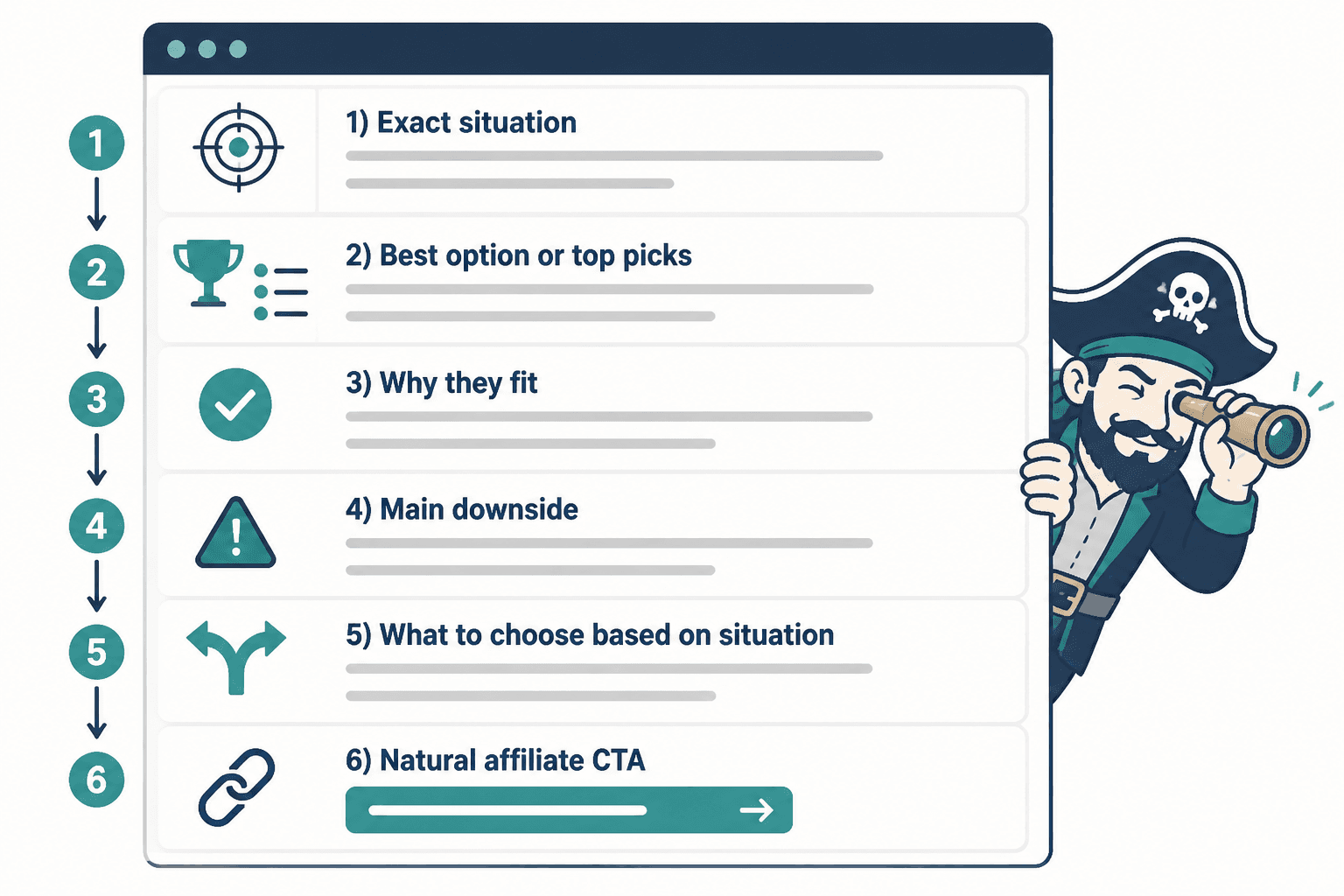
A simple structure you can use
- State the exact situation
- Name the best option or top few options
- Explain why they fit
- Flag the main downside or limitation
- Tell the reader what to choose based on their situation
- Add the affiliate CTA naturally
That structure works especially well for “best X for Y” and “X vs Y” style affiliate content.
When a short affiliate article is too short
There is, unfortunately, a difference between concise and undercooked.
A short affiliate article is too short when it leaves obvious buying questions unanswered.
- What exactly is this best for?
- Why this option over the alternatives?
- What are the tradeoffs?
- Who should skip it?
- Why should I trust this recommendation?
If your article skips those questions, it may feel neat, but it will not feel trustworthy. Thin affiliate content often reads like a drive-by recommendation with a commission link glued to the bottom. Readers can smell that from orbit.
Short works when it is efficient. It fails when it is vague.
How to decide between a short or long affiliate article
If you are stuck, use this quick filter.
| Question | If yes, shorter may win | If no, longer may help |
|---|---|---|
| Is the search intent narrow? | One problem, one use case, one fast decision | Broad topic with multiple stages or needs |
| Is the product simple? | Easy to explain in a few points | Needs context, setup, education, or objections handled |
| Is the buying risk low? | Cheap, reversible, easy to test | Expensive, technical, strategic, or hard to switch |
| Does the audience already trust you? | You need less persuasion inside the article | The article must build trust from scratch |
| Can one sharp recommendation solve it? | Clear winner for a clear situation | Nuanced decision with multiple valid paths |
If you need a broader answer on length, read how long affiliate articles should be in 2026. The short version is that there is no magic count, and anyone pretending otherwise is selling certainty they did not earn.
Examples of topics that often work better short
These are often strong candidates for shorter affiliate articles:
- Best budget tool for one narrow creator task
- Best beginner-friendly option in a familiar category
- Quick “A vs B” comparisons with obvious practical differences
- Single-tool recommendations for a specific audience
- Accessory and add-on products with low complexity
- “Best for most people” picks where deep nuance is not necessary
For example:
- Best webcam for solo consultants on Zoom
- Best low-cost writing app for newsletter creators
- Calendly vs TidyCal for freelancers
- Best ring light for talking-head videos
- Best simple CRM for coaches with a small client list
Notice the pattern. These are not giant category-defining searches. They are focused buying questions. That is where short affiliate content can be weirdly effective.
Examples of topics that usually need more depth
On the other hand, these usually benefit from longer articles:
- High-ticket software with multiple pricing tiers
- Complex platform comparisons
- Products with meaningful setup friction
- Tools where integrations and workflows matter a lot
- Topics where the audience needs education before they can choose
- Searches with broad intent like “best email marketing software”
Trying to compress those into a tiny article can make the recommendation feel flimsy. If the choice has meaningful consequences, depth stops being fluff and starts being service.
How to write a short affiliate article that still feels trustworthy
Lead with the recommendation earlier
Do not bury the answer under a pile of scene-setting. A short affiliate article should reward the click quickly.
Instead of:
There are many options on the market today, and choosing the right one can feel overwhelming.
Try:
If you want a simple scheduling tool without a monthly bill that keeps growing teeth, this is probably the best pick for most solo creators.