
X quote posts can work ridiculously well when they add something sharp, useful, or worth reacting to.
They can also flop hard when they’re just recycled commentary, lazy agreement, or a thin excuse to stand near someone else’s better post and absorb a little attention by osmosis. A lot of creators treat quote posts like a shortcut. That’s usually the problem.
If you want better performance from quote posts on X, the fix is not more volume. It’s better contribution. The strongest quote posts do one of a few things well: they sharpen the original idea, challenge it, extend it, translate it, or apply it. The weak ones just hover nearby saying, “Yep.”
Here’s how to spot the X quote post mistakes that hurt performance, and what to do instead if you want more reach, stronger replies, and a better chance of being followed by people who actually care what you think.
If you want the bigger picture, start with the parent guide.
Why X quote posts underperform in the first place
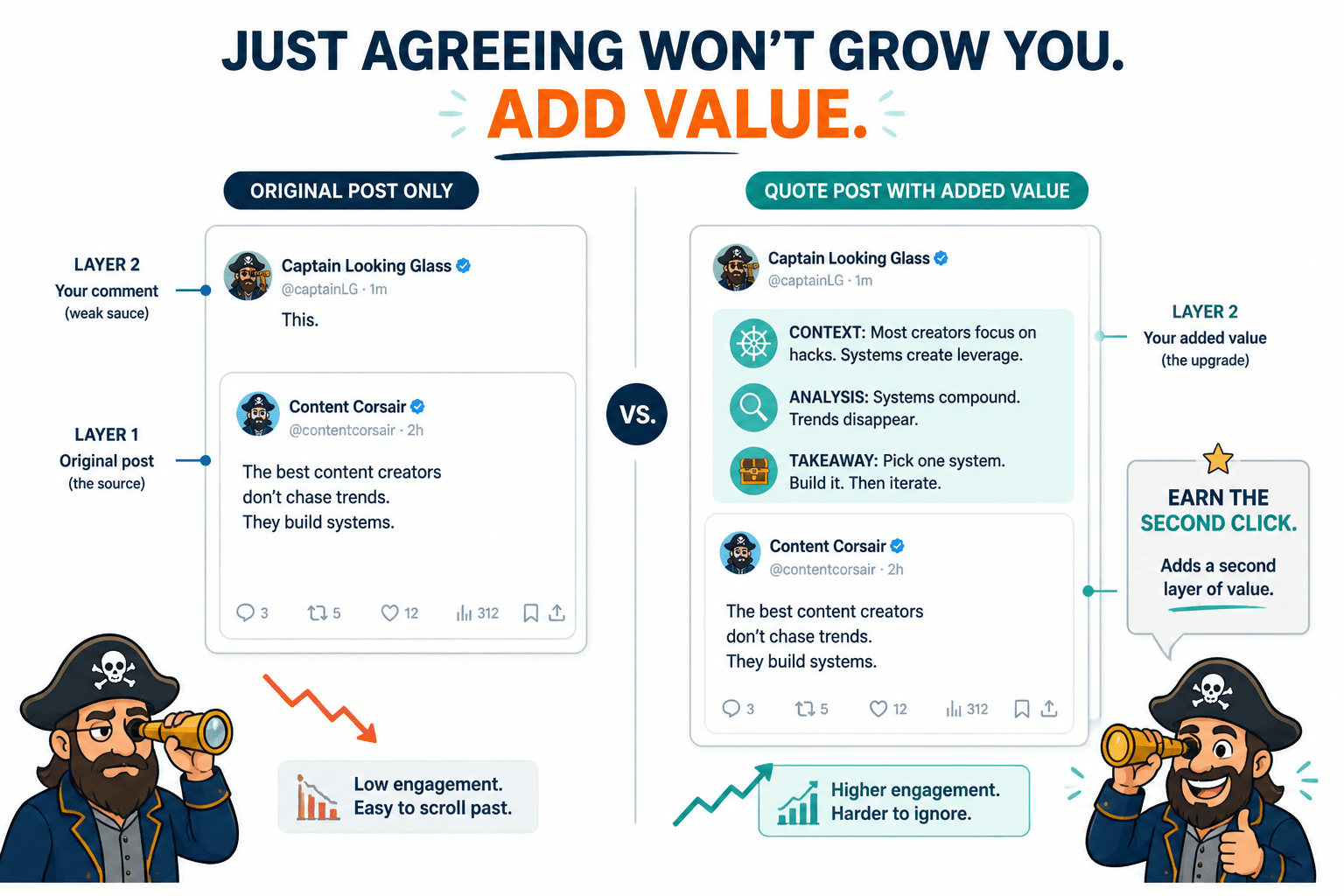
A quote post has a built-in disadvantage: the original post already got the first hit of attention. Your job is to justify the second click.
That means your added comment has to earn its place. Not with length. Not with fake intensity. Not with “this.” and a prayer. It has to create a second layer of value or tension. If it doesn’t, people either engage with the original post instead or keep scrolling because your addition changed nothing.
On X, where speed matters and attention is thin, weak quote posts are especially easy to ignore. People decide fast. If your quote post reads like social loitering, it won’t do much.
X Quote Post Mistakes That Hurt Performance
1. Adding nothing except agreement
This is the classic mistake.
You quote someone’s post and write:
- Exactly
- This
- So true
- Couldn’t agree more
- Say it louder
That is not commentary. That’s applause with Wi-Fi.
Unless the original post is already exploding and you’re a recognizable account with followers who care about your endorsement, this kind of quote post usually gives people no reason to engage with you. It also does nothing for your positioning. No one learns how you think.
Do this instead: add one useful layer.
- Explain why the point matters
- Add an exception
- Share a practical application
- Give a counterexample
- Translate the idea for a specific audience
Weak: “Exactly.”
Better: “Yes. Most people do not fail here because they lack effort. They fail because they confuse visibility with clarity.”
2. Restating the original post in slightly worse words
This is agreement’s more verbose cousin.
You quote a post, then paraphrase it without improving it. So now readers get the same idea twice, except your version has less punch and more filler. Not ideal.
If the original post says, “Consistency matters less than clarity,” and your quote post says, “This is a great reminder that clarity is very important and maybe even more important than consistency,” you haven’t added interpretation. You’ve made an echo.
Do this instead: push the idea forward.
- What does this mean in practice?
- Where do people misapply it?
- What nuance is missing?
- What does this look like on X specifically?
Better: “Yes, and this is where creators get stuck: they stay consistent with weak packaging, then blame the platform when nobody cares.”
3. Using quote posts only to borrow bigger creators’ attention
People can smell clout-chasing. Usually from space.
If your quote-post strategy is basically “find large accounts, attach self to discourse,” your posts often feel opportunistic rather than insightful. Even when the take is decent, the pattern gets obvious fast. You stop looking thoughtful and start looking like you’re networking in public with a megaphone.
There’s nothing wrong with quote-posting bigger accounts. The issue is doing it without a real point. If every quote post sounds like you’re trying to be seen by the original poster rather than useful to your own audience, performance tends to flatten.
Better approach: quote posts should serve your positioning first.
- Pick posts connected to your niche
- Add a perspective your audience would care about
- Make the quote post make sense even if the original author never sees it
That shift matters. You’re not trying to stand near attention. You’re trying to show how you think when attention passes by.
4. Being too vague to create reaction
Quote posts do well when they create a clean reason to respond. Vague commentary kills that.
Stuff like:
- “A lot to think about here.”
- “Interesting perspective.”
- “This is important.”
- “More people need to understand this.”
None of that gives the reader anything to grab onto. There is no tension, no specificity, no angle. It feels safe because it is safe. Unfortunately, safe and forgettable often travel together.
Do this instead: make one precise point.
Weak: “Interesting perspective.”
Better: “The useful part here is the timing point. Most offers do not fail because they are bad. They fail because the audience has not trusted you long enough yet.”
5. Turning every quote post into a sermon
X rewards compression. A quote post is not always the place for a wandering mini-essay with six disclaimers, three side quests, and a conclusion that sounds like softened corporate oatmeal.
Yes, some longer quote posts can work. But a lot of them drag because the writer is trying to sound thoughtful instead of being clear. The more you bury the point, the more likely people are to skip it.
Do this instead: keep your addition tight unless the idea genuinely needs development.
- One strong sentence is enough if it lands
- Two to four lines often works well
- If it needs a bigger explanation, consider writing your own original post instead
A good rule: if the quote post only works after the fourth sentence, it probably needs editing.
6. Sounding performative instead of honest
There’s a certain quote-post voice that shows up a lot on X. It’s dramatic, polished, and weirdly self-aware in the most tiring way possible.
It often sounds like this:
- “People are not ready for this conversation…”
- “I’ve been saying this for years.”
- “Unpopular opinion, but…”
- “Some of you will hate this, and that’s okay.”
Usually, people are ready. The opinion is popular. And nobody was gearing up to hate it until you added the pre-game trailer.
Performative framing can hurt performance because it makes readers feel managed. They can sense when a post is trying too hard to manufacture tension instead of simply making a point.
Do this instead: state the thought cleanly. If it’s sharp, it won’t need stage lighting.
7. Missing the chance to disagree well
Many creators only quote-post things they agree with. That leaves a lot of value on the table.
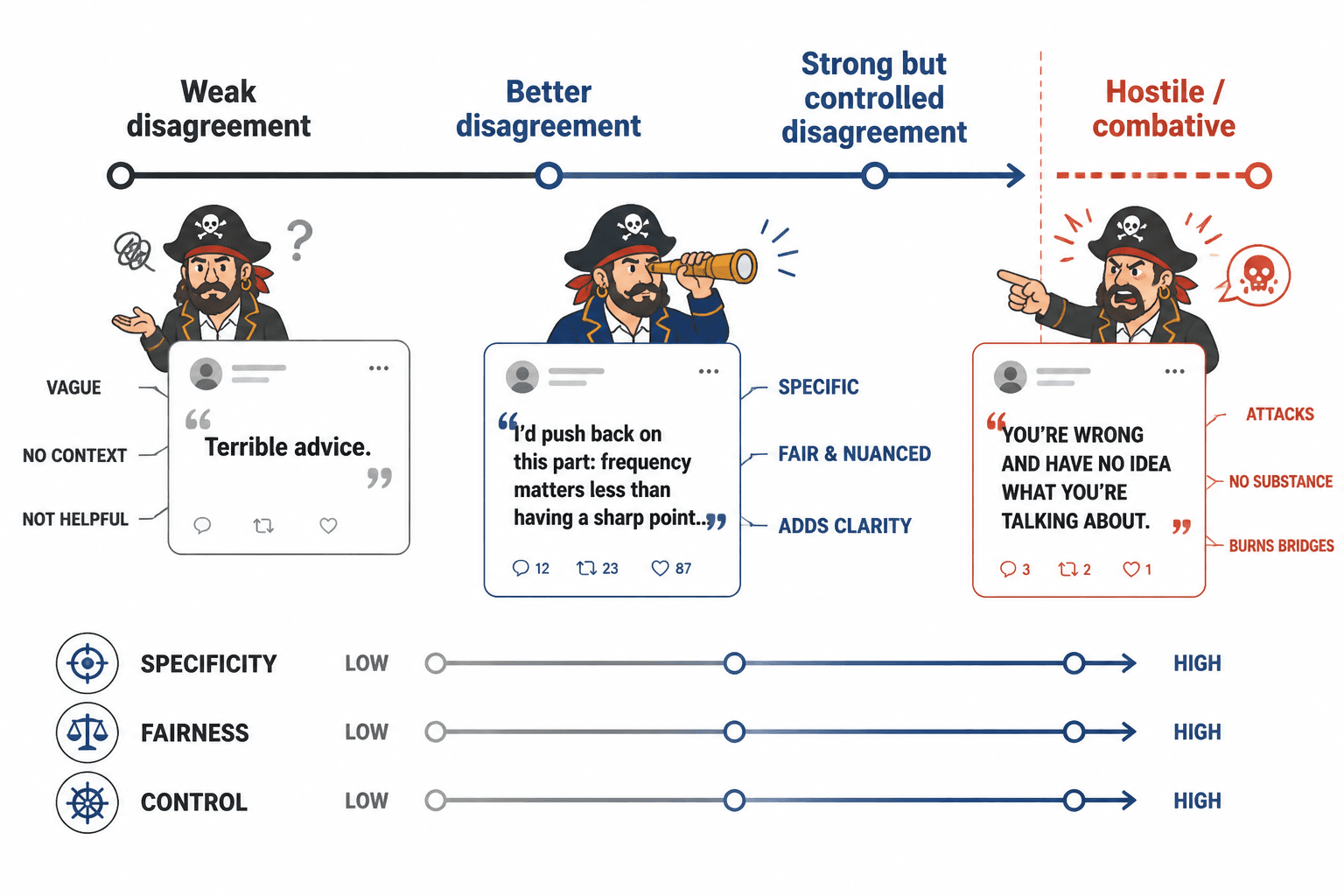
Thoughtful disagreement can perform very well on X because it creates tension, discussion, and clarity. The problem is people often handle disagreement badly. They either go too soft and say nothing, or too hard and sound like they’re spoiling for a fight.
The best disagreement quote posts are specific, fair, and controlled.
Weak: “Terrible advice.”
Better: “I’d push back on this part: frequency matters less on X than having a point sharp enough to travel. More posts does not fix weak ideas.”
That kind of disagreement gives people something useful to think about without turning the feed into a public food fight.
8. Forgetting that your audience may not know the original context
Sometimes quote posts underperform because they rely too heavily on the original post to carry meaning. If your comment only makes sense with context, and the context is thin, niche, or confusing, people bounce.
This happens a lot when creators respond with an inside-baseball take that assumes everyone understands the debate already. They don’t.
Do this instead: make your quote post understandable on its own.
You do not need to restate the original post fully. Just write your addition in a way that gives enough signal for a passing reader to understand your angle.
Example: “This is true for coaches too. Better content usually doesn’t come from posting more tips. It comes from making your point more specific and easier to remember.”
9. Chasing cleverness over clarity
X does reward punchy writing. It does not reward confusing writing nearly as much as people hope.
Some quote posts are trying so hard to sound crisp, ironic, devastating, or hyper-online that they stop being clear. The line may feel smart to the writer, but if readers have to decode it, performance often drops.
Clarity wins more often than stylish fog.
Weak: “Many such cases.”
Better: “This happens when creators optimize for sounding insightful instead of making one usable point.”
10. Making the quote post about you too fast
There is a subtle difference between adding perspective and hijacking the post.
Some creators quote a post, then immediately pivot into their own offer, their own story, their own product, or their own recycled talking point. The result feels transactional. Like they used someone else’s post as a launch ramp for self-promotion.
People usually resist that move because it feels like bait. The post begins as commentary and ends as an ad wearing fake glasses.
Do this instead: earn the pivot.
- Start with an actual response
- Add a useful angle
- Only connect it to your work if the connection is natural and brief
If your quote posts constantly end by steering attention back to your thing, readers start expecting the trick.
11. Ignoring formatting and readability
X is a fast-scan platform. If your quote post is visually annoying, people will skip it even if the idea is decent.
Common formatting issues include:
- one giant dense block of text
- too many chopped-up lines that make the post feel breathless
- all lowercase in a way that hurts readability
- awkward punctuation that muddies the point
You don’t need immaculate formatting. You do need a post that can be understood quickly.
For more practical writing patterns, these simple X posts reaction post templates for busy creators can help you build stronger responses without sounding canned.
12. Not knowing what kind of quote post you are writing
This one matters more than people think.
Strong quote posts usually fall into a few useful categories. If you don’t know which one you’re trying to write, the post often ends up muddy.
Common quote post types:
The bigger point is simple: clearer structure and clearer writing make the piece more useful. That is usually what makes the ending land better too.