Most product and service descriptions do one job reasonably well and completely ignore the job right next to it.
They explain the offer. Fine. Helpful. Necessary.
But then what?
If the next step is vague, too aggressive, or missing entirely, even a solid description can quietly waste attention. People read. They nod. They leave. Not because the offer was bad, but because the path forward was clunky, premature, or weirdly absent.
The best funnel ideas to pair with product and service descriptions are not complicated little internet labyrinths. They are simple next-step systems that match buyer intent. That is the whole game. Someone reading a service page does not always want to “book now.” Someone reading a product description does not always need a seven-email nurture opera either.
This is about pairing the right funnel with the right kind of description, so your page does more than sit there looking informative. You want it to move the right people forward without making the whole experience feel like a trap disguised as helpful copy.
If your descriptions already get some traffic but not enough leads or sales, the issue may not be the paragraph about features. It may be the missing bridge after it. And if your audience is small, this matters even more, because you do not have infinite traffic to waste. For broader help with the page itself, see product and service descriptions and the guide for creators who want better results.
If you want the bigger picture, start with the parent guide.
What a good funnel does after someone reads your description
A product or service description handles understanding. A funnel handles movement.
That movement might be immediate, like buying, booking, or applying. It might also be slower, like joining your email list, requesting details, reading a case study, or comparing options. The point is not to force speed. The point is to remove dead ends.
Good funnel pairing depends on a few things:
- How expensive or complex the offer is
- How much trust the buyer needs before acting
- Whether the reader is problem-aware, solution-aware, or ready to buy
- How much friction your audience can reasonably tolerate
- Whether the page is attracting cold traffic, warm traffic, or existing audience attention
A £29 template pack and a £3,000 service package should not send people into the same funnel. That should be obvious, but the internet remains committed to pretending everything needs either one giant “Buy Now” button or a 14-step nurture sequence built by someone who just discovered automation.
Usually, the right answer is simpler than that.
The best funnel ideas to pair with product and service descriptions
Here are the most useful funnel formats, when they work best, and what they should actually include.
1. Description → direct purchase
This is the cleanest option and the one people either overuse or under-execute.
It works best when the offer is low friction:
- Lower-priced digital products
- Simple one-time offers
- Clear, easy-to-grasp services
- Products with obvious outcomes and little setup anxiety
Your description needs to do enough selling that the reader can move straight to checkout without needing a committee meeting in their own head.
What to include after the description:
- A clear CTA button
- Short reassurance copy near the CTA
- What happens after purchase
- Any key objection handling, like format, refund policy, access, timing, or support
Example CTA: Get the template pack and start rewriting your service page today.
This funnel falls apart when the description is thin, vague, or too clever. If people still have basic questions, direct purchase is too abrupt.
2. Description → lead magnet → nurture emails → offer
This is one of the best funnel ideas to pair with product and service descriptions when the offer needs more trust, more education, or a longer buying cycle.
It works especially well for:
- Coaching
- Consulting
- Done-for-you services
- High-ticket creative work
- Offers that solve a meaningful but non-urgent problem
The key is relevance. The lead magnet should not be some random freebie you made because “email list growth” sounded productive. It should connect directly to the description they just read.
If your service description is about rewriting website copy, your lead magnet could be:
- A homepage messaging checklist
- A before/after copy teardown
- A short guide to fixing common conversion mistakes
- A self-audit worksheet
Then your emails should keep doing three jobs:
- Clarify the problem
- Show your thinking and proof
- Present the offer as the next logical step
Not every email needs a dramatic confession or a fake “just checking in” tone. Most nurture emails work better when they are useful, specific, and written by someone who respects the reader’s time.
3. Description → case study or proof page → consultation
This is ideal for services that need evidence before conversion.
A lot of service descriptions explain what you do but fail to prove you do it well. That is where a proof step earns its keep. Instead of sending people straight from “here is my service” to “book a call,” send them to a page that makes the decision easier.
That page might include:
- Short case studies
- Before/after examples
- Client results
- Your process in plain English
- Who the service is best for and not for
Then invite the reader to book a consultation, apply, or request a proposal.
This works well because it respects natural buyer behavior. Many people are not resisting your offer. They just need enough proof to stop hesitating.
If your current descriptions feel decent but still under-convert, this missing proof layer is often the culprit. You can also pair this approach with the advice in how to turn product and service descriptions into more leads or sales.
4. Description → quiz, selector, or recommendation path
This is useful when the reader may want your help but does not know which offer fits them.
It works well for businesses with:
- Multiple services
- Tiered packages
- Several product bundles
- Different audience segments with different needs
Instead of making people decode your offer architecture like it is an escape room, give them a clean decision tool.
Examples:
- Which copy package fits your stage?
- Find the right brand messaging option
- Not sure which template bundle you need? Start here
The output can lead to:
- A recommended offer page
- An email opt-in with tailored follow-up
- A booking page for the right service type
- A product collection page
Done well, this reduces friction. Done badly, it adds friction for no reason. Keep it short. Make the questions useful. Do not turn a simple choice into a personality test with delusions of grandeur.
5. Description → low-ticket entry offer → core offer
This is a strong move when your main offer needs more trust, but you want something more committed than a freebie.
The low-ticket offer acts as a bridge. It lets people experience your thinking, process, or product quality without committing to the full thing.
Examples:
- Mini audit before a larger consulting package
- Starter template before a full bundle
- Paid workshop before a coaching program
- Strategy session before a retainer service
This works best when the entry offer solves a real problem on its own. If it just feels like a glorified preview designed to frustrate people into buying the expensive thing, trust drops fast.
Good low-ticket offers create momentum. Bad ones create suspicion.
6. Description → newsletter signup → authority sequence → offer mentions
Some readers are interested but not ready. They do not want a “sales sequence.” They want to keep hearing from someone useful.
That makes a newsletter funnel a smart pairing for descriptions tied to expertise-heavy offers, especially for creators, consultants, writers, educators, and solo businesses.
This works when your newsletter is genuinely relevant to the offer. The content should help the same audience solve adjacent problems, build trust in your judgment, and keep your offer in view without making every email feel like a nudge from a thirsty salesperson.
Good post-description newsletter CTA examples:
- Not ready to hire yet? Get weekly conversion copy notes instead.
- Want more examples like this? Join the newsletter for practical website copy breakdowns.
- If this offer is on your radar for later, subscribe and I’ll send the sharp stuff, not fluff.
7. Description → booking page
Sometimes direct is correct.
If the service is clear, the audience is warm, and the commitment is reasonable, sending readers straight to a booking page can work beautifully. This is especially true for repeatable services with straightforward scope, like audits, consultations, reviews, or fixed packages.
But your booking page has to finish the job. It should not just be a calendar floating in emotional darkness.
Include:
- What the session is for
- Who it is for
- Expected outcome
- Pricing or at least pricing clarity
- What happens after booking
- Any prep required
If you are asking people to commit time before they fully trust you, make the page feel sane and specific.
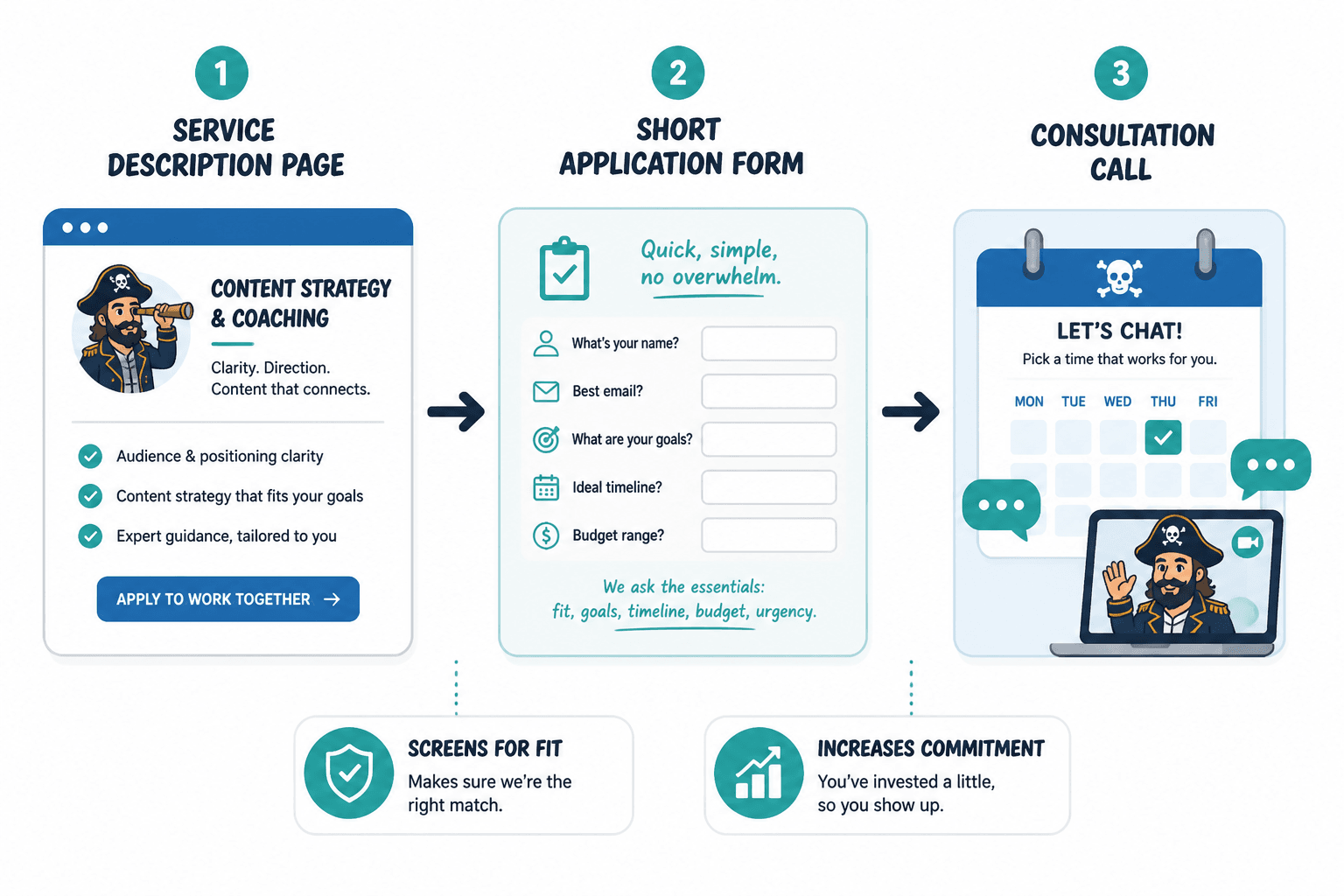
8. Description → application form → qualification sequence
This is useful for high-ticket, custom, capacity-limited, or hands-on services.
An application funnel does two things at once:
- It screens for fit
- It increases commitment from serious leads
This pairing works best when your service description already creates enough desire and clarity to make the reader think, “Yes, I should probably talk to this person.” The form then collects context before the call or proposal stage.
Just do not make the application ridiculous. Five useful questions? Fine. A 23-field emotional obstacle course? Absolutely not.
Ask only what you need to qualify, prepare, and understand urgency.
How to choose the right funnel for your description
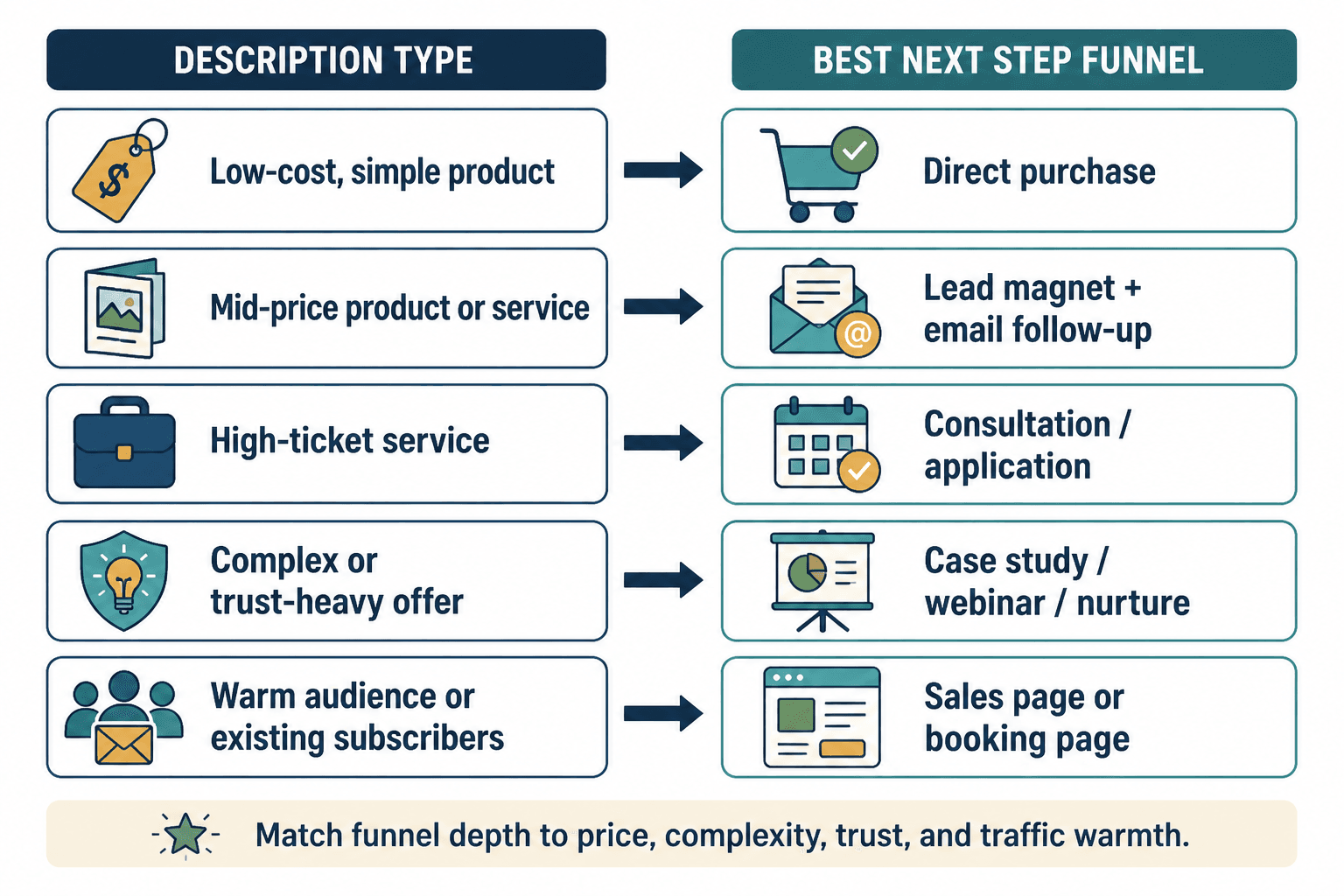
If you want the short version, match the funnel to the decision difficulty.
| Offer type | Best next step | Why it works |
|---|---|---|
| Low-cost, simple product | Direct purchase | Low friction, fast decision |
| Mid-ticket digital offer | Purchase or low-ticket entry offer | May need a bit more trust |
| Service with moderate trust needs | Booking page or lead magnet | Helps readers move without pressure |
| High-ticket or custom service | Case study, application, or consultation | Proof and fit matter more |
| Multiple offers or unclear fit | Quiz or recommendation path | Reduces confusion |
| Slow-burn authority offer | Newsletter signup | Keeps trust building over time |
You can also use a simple selection filter:
- If the reader is ready to decide: use a direct CTA
- If the reader needs trust: use proof, a nurture path, or a low-ticket step
- If the reader is confused: use a selector or recommendation path
- If the reader is interested but early: use a newsletter or relevant lead magnet
Notice what is missing from that list: “use the fanciest automation stack you can afford.” Because that is usually not the problem.
What product and service descriptions need before any funnel will work
A good funnel cannot rescue a weak description forever. It can cushion the fall a bit, but it cannot manufacture desire from muddled copy.
Before you bolt on a funnel, make sure your description covers the basics clearly:
- What the offer is
- Who it is for
- What problem it solves
- What outcome the buyer gets
- What is included
- What makes this offer meaningfully different or more useful
- Why someone should trust you
If your copy says a lot without making the offer easier to understand, your funnel will just move confused people to the next page faster. Very efficient. Not very helpful.
For stronger page examples, check best product and service descriptions ideas and examples for creators.
Best CTA types to use after a description
Your CTA should match the funnel and the reader’s level of readiness. This is where a lot of pages get weirdly pushy or weirdly passive.
Here are stronger CTA directions by funnel type:
- Direct purchase: Buy the guide, Get the template, Start now
- Lead magnet: Get the checklist, Download the audit, Grab the free guide
- Consultation: Book a call, Request a consult, Talk through your project
- Application: Apply to work together, Start your application, Tell me about your project
- Newsletter: Join the newsletter, Get weekly copy notes, Subscribe for practical updates
- Selector path: Find your best-fit option, See which package fits, Start here
What usually works best is plain language with a clear benefit nearby. Not button copy that sounds like it came from a conversion-rate cult meeting.
For example:
Weak: Unlock Your Transformation
Better: Book a 30-minute strategy call
Funnel mistakes people keep making with product and service descriptions
Sending everyone to the same next step
Not all readers are equally ready. A page that only offers “Buy Now” or only offers “Join my list” can miss a lot of good-fit people.
In many cases, a primary CTA and a secondary CTA work better. For example:
- Primary: Book a consultation
- Secondary: Read client results first
Using a lead magnet with no relationship to the offer
If the description is about one thing and the freebie is about something loosely adjacent, your funnel gets sloppy fast. Relevance is not optional.
Pitching too hard too early
If someone just found you, read a service description, and then gets shoved into a sequence acting like they are one email away from spiritual breakthrough, they are probably leaving. Calm down.
Earn the next step. Do not ambush it.
Adding friction because funnels feel more “serious”
More steps do not equal better strategy. Sometimes they equal more abandonment.
If a direct purchase or booking page would do the job, use that. You do not need a maze to look legitimate.
Treating the funnel like a substitute for positioning
No funnel can fix an offer that is vague, generic, or badly positioned. If the reader still cannot tell whether this is for them, no amount of email sequencing will magically create fit.
Best funnel ideas for creators and small-audience businesses
If your audience is small, your funnel should usually be simpler, more relevant, and more personal.
You do not need enterprise-level complexity. You need a path that turns the right attention into conversations, trust, and sales without wasting people.
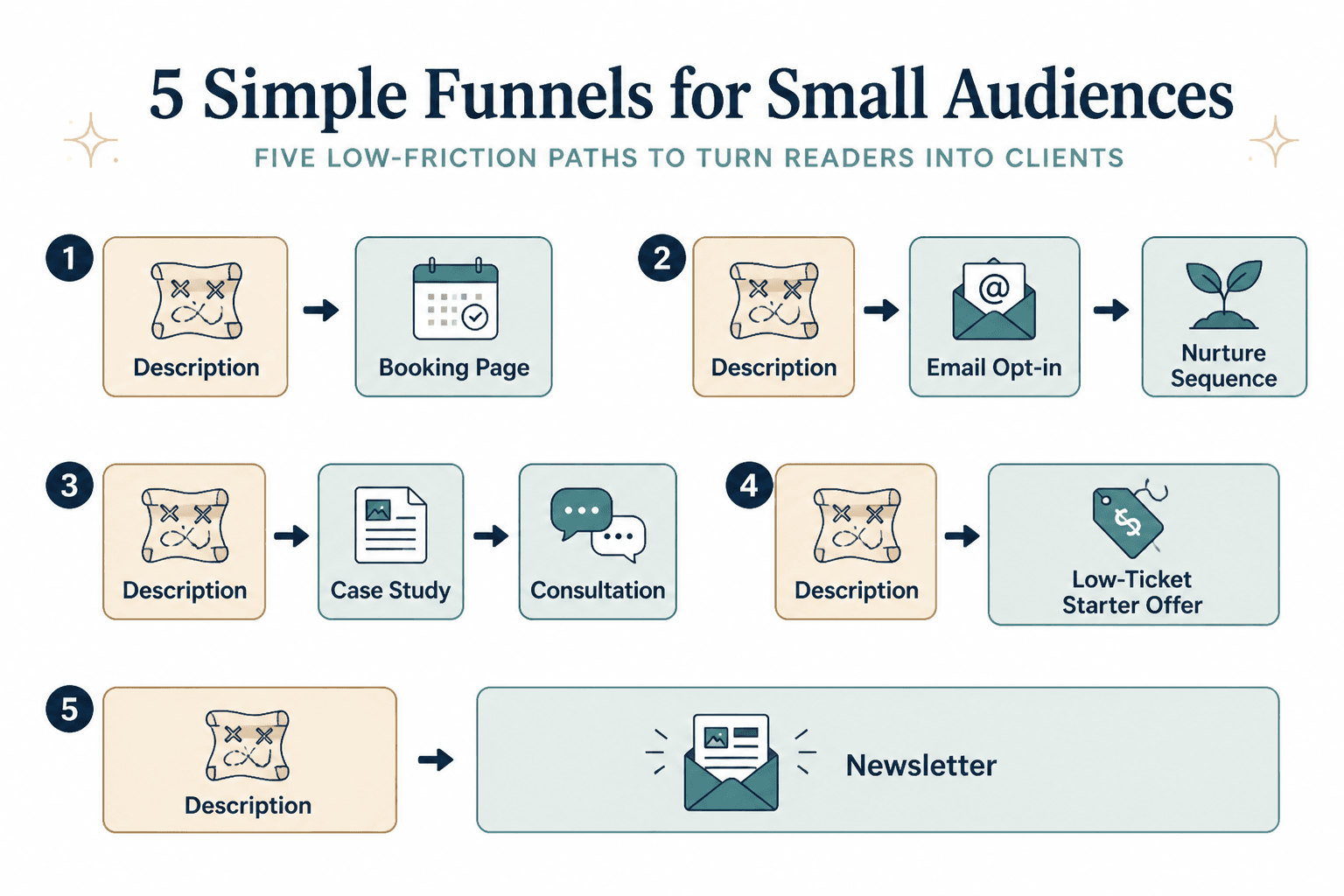
Strong options for smaller creators and solo businesses:
- Description → booking page
- Description → email opt-in → useful nurture sequence
- Description → case study → consultation
- Description → low-ticket starter offer
- Description → newsletter
These work because they do not require huge traffic numbers to be useful. They respect the reality that a smaller audience often needs clearer trust signals, not more funnel theatre.
If that is your situation, read product and service descriptions for creators with small audiences. It is a better model than copying giant brands with giant traffic and very different buying dynamics.
The bigger point is simple: clearer structure and clearer writing make the piece more useful. That is usually what makes the ending land better too.