
If you have a small audience, your product and service descriptions cannot afford to be lazy.
Big creators can get away with vague copy because attention is already flowing. People know their name, trust their face, and sometimes buy things that are frankly held together by branding and confidence. Small creators do not have that luxury. Your description has to do real work.
It needs to explain what the thing is, who it is for, why it matters, and what happens next. Fast. Without sounding like you swallowed a funnel template from 2019.
Good product and service descriptions for creators with small audiences are not about sounding bigger. They are about being clearer, more specific, and more believable than people expect. That is what builds trust when you do not yet have massive reach, a swarm of testimonials, or a brand name doing half the selling for you.
So if your current description says things like “I help purpose-driven entrepreneurs elevate their presence” and then wonders why nobody clicks, books, or buys, yes, we need to fix that.
To see how this fits into the wider strategy, open the parent guide.
Why small audiences need better descriptions, not louder ones
A small audience is not the problem. A confused audience is.
When you do not have huge traffic numbers, every visitor matters more. Which means your copy cannot waste time on vague positioning, generic promises, or fluffy features that sound impressive but mean absolutely nothing in practice.
People with small audiences often make one of two mistakes:
- They write tiny, underexplained descriptions because they assume nobody reads.
- They write bloated, dramatic descriptions trying to sound “premium,” and end up sounding suspicious.
Neither works. You do not need more hype. You need less friction.
The best descriptions reduce uncertainty. They help the right person quickly think:
- This is for me.
- This solves a problem I actually care about.
- This person seems like they know what they are doing.
- I understand what I get.
- I know what to do next.
That is the job.
If you want a broader foundation for this kind of copy, it helps to read the main product and service descriptions guide alongside this one. But here, we are focusing on the small-audience version of the problem: how to convert trust when you do not yet have scale doing it for you.
What a strong description needs to do
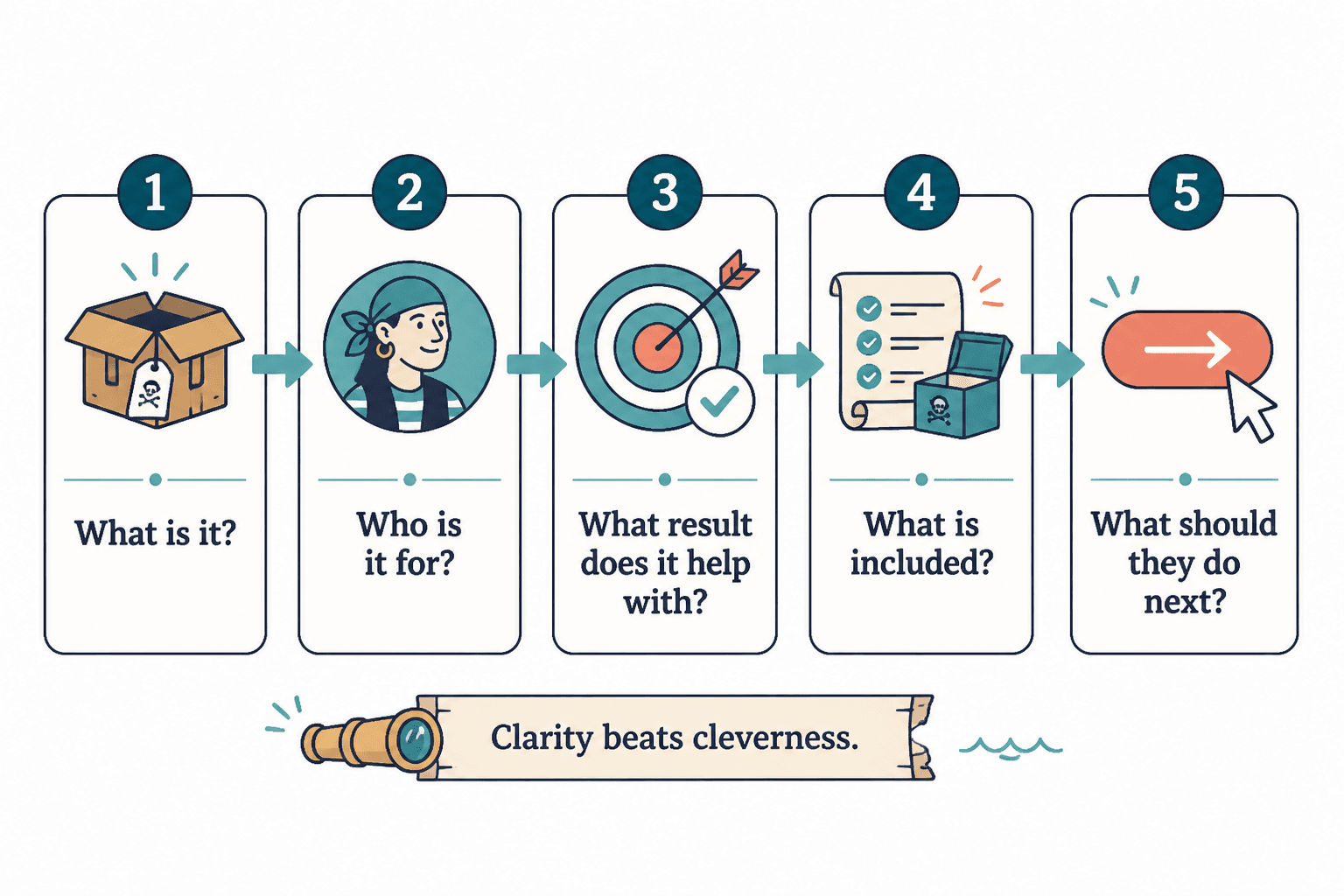
At minimum, your description should answer five things clearly.
- What is it? A service, package, product, offer, session, template, audit, membership, or something else.
- Who is it for? Not “everyone ready to grow.” An actual type of person with an actual need.
- What result does it help with? Not a grand life transformation. A useful, believable outcome.
- What is included? So people can picture the value, not just infer it.
- What should they do next? Buy, apply, book, message, download, or join.
That sounds obvious, yet a lot of creator descriptions miss at least three of those. They lean on tone, aesthetics, or ambition and skip clarity. Which is a very stylish way to lose money.
The small-audience advantage
Here is the part people overlook: small creators can often write better descriptions than bigger ones because they are closer to the actual customer conversation.
You are still hearing the objections directly. You know what prospects ask before buying. You know where they hesitate. You know which promises feel too fluffy because you have watched real people squint at them.
Use that. Your copy should sound like it came from actual interactions, not from “best practices” cleaned so aggressively they stopped sounding human.
Common description mistakes creators with small audiences make
Before writing better copy, it helps to spot what keeps making your descriptions weaker than they need to be.
1. Leading with abstract identity language
Stuff like:
I help visionary founders align their brand with their mission.
That sounds polished. It also says almost nothing.
Try this instead:
I help solo founders rewrite messy website copy so visitors understand the offer, trust the brand, and book more calls.
One version sounds expensive and unclear. The other sounds useful.
2. Describing the format but not the value
People do not buy “three calls, a workbook, and Voxer support.” They buy what those things help them do.
Format matters, yes. But if your description is just a list of delivery details, it reads like admin notes with lipstick on.
3. Promising too much because you feel behind
Small creators sometimes overcompensate. If they do not have a huge following, they try to sound more transformative, more premium, more all-encompassing.
So a straightforward offer turns into “a revolutionary container for total business expansion.” Which is a phrase that deserves a short timeout.
Believable beats grand. Especially when trust is still being built.
4. Hiding the audience
If your copy never clearly says who the offer is for, the right people will not feel chosen and the wrong people will not filter themselves out.
“For coaches” is fine. “For career coaches with decent expertise but weak website conversion” is much better.
5. Ending with no next step
You explained the offer. Great. Now what?
A lot of creators stop right before the part that matters. Do not make people guess whether they should book a call, send an inquiry, buy now, or wander off to your Instagram and forget you existed.
A simple structure for better product and service descriptions
If you want a clean starting point, use this structure:
- Name the offer clearly
- Say who it is for
- Explain the main problem it helps solve
- Describe the result or outcome
- Show what is included
- Add proof or credibility signals
- Give a clear next step
That structure works for service pages, product listings, checkout pages, sales pages, booking pages, and even short homepage sections.
A quick example
Weak version:
A high-touch brand intensive designed to elevate your message, clarify your purpose, and create alignment across your digital presence.
Better version:
This brand messaging intensive is for creators and consultants whose website copy sounds polished but does not actually explain what they do. In one focused session, we tighten your positioning, rewrite your core message, and give you cleaner copy for the pages people see first, so your offer feels easier to understand and easier to buy.
Notice what changed:
- The audience is visible.
- The problem is specific.
- The result is practical.
- The language sounds human.
If you want more examples to model from, these product and service description ideas and examples for creators will give you more patterns worth stealing responsibly.
How to write descriptions that build trust when you do not have big proof yet
This is where many small creators get stuck. They think, “I would write stronger copy if I had more testimonials, more sales, more case studies, more audience.” Fair enough. But waiting for proof to appear before improving the page is backwards.
You can still create trust without pretending to be more established than you are. In fact, that usually works better.
Use grounded specificity
Specificity is trust. Vague copy creates doubt.
Instead of saying:
Get clarity and confidence in your brand.
Say:
Walk away with a clearer homepage message, a tighter service description, and a practical way to explain your work without rambling for three minutes.
One is a mood. The other is a result.
Show your process
When you do not have piles of proof yet, a clear process helps. It shows people you are not making it up as you go.
For example:
- We audit your current copy first.
- We identify the friction points killing clarity.
- We rewrite the core message around audience, problem, and outcome.
- We tighten the CTA so readers know what to do next.
That kind of structure reassures people. It also makes the offer easier to picture.
Use modest proof honestly
You do not need a giant “As seen in” banner if you have not been seen in those places. You can use smaller trust markers:
- Relevant past work
- Client feedback, even if brief
- A niche focus
- A clear method
- Examples of your thinking
- A polished, coherent page that does not look stitched together at 1:14 a.m.
Small proof still counts if it is relevant. Ten good-fit clients are more convincing than a giant audience full of the wrong people and several bots with anime avatars.
What to include in the middle of the description
A lot of creators write a decent opening sentence and then fall apart in the middle. This is where they either start listing random features or repeat the same promise five different ways.
The middle should make the offer feel tangible.
Good things to include
- What is inside the offer
- How the process works
- Who it is best suited for
- What kind of outcome to expect
- Any important boundaries or filters
That last one matters. Being willing to say who something is not for can increase trust fast.
Example:
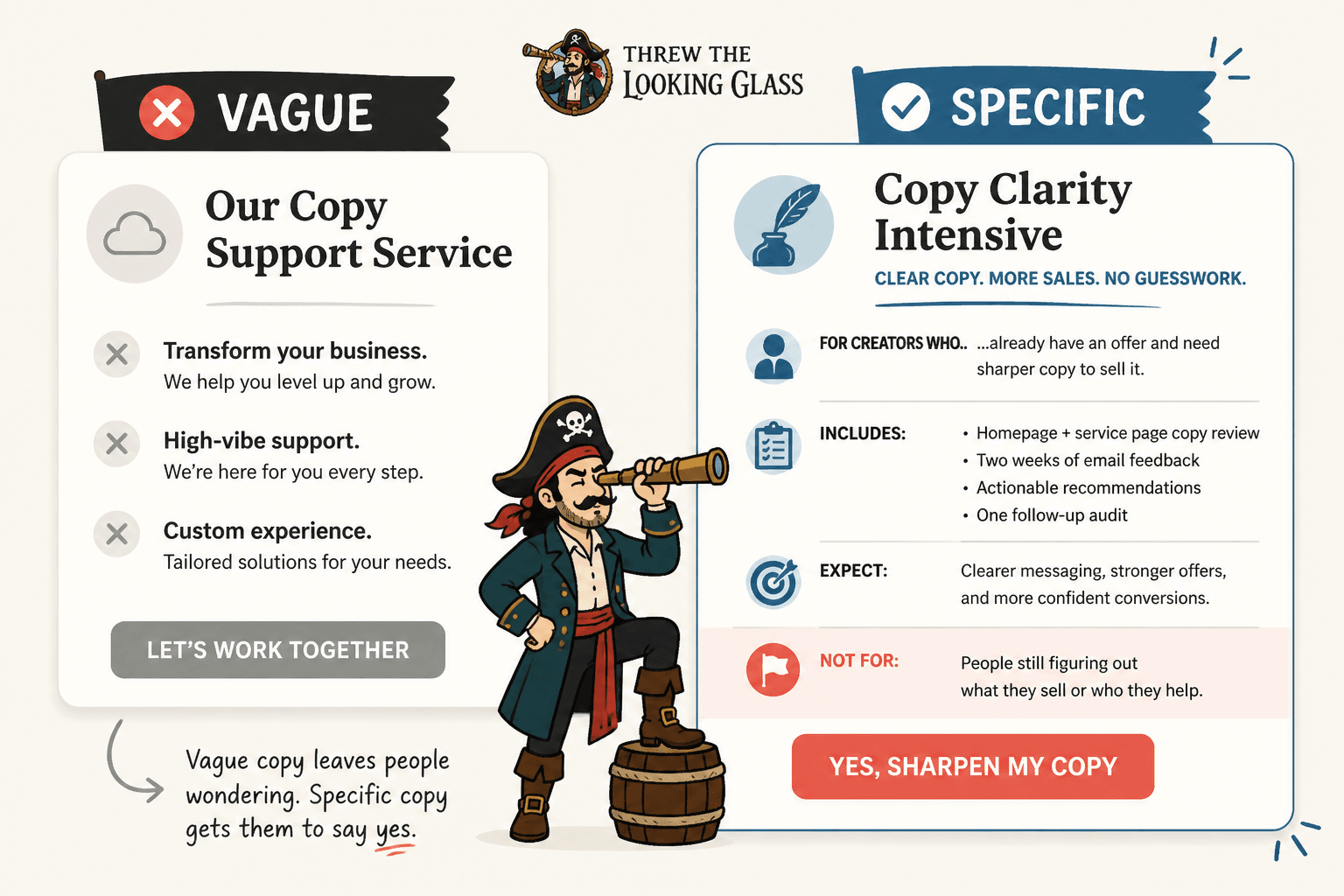
This is best for creators who already have an offer and need sharper copy to sell it. It is not the right fit if you still are not sure what you are selling.
That kind of line filters bad-fit leads and makes good-fit leads feel safer.
For practical ways to build these sections quickly, these simple feature section templates for busy creators can save you from staring at a blank page like it personally offended you.
Better wording choices for small creators
You do not need tiny words. You need accurate words.
Here are a few swaps that usually improve descriptions immediately:
| Weak wording | Stronger wording |
|---|---|
| Transform your business | Make your offer easier to understand and buy |
| High-vibe support | Ongoing feedback by email for two weeks |
| Clarity and alignment | A clearer message, tighter positioning, and cleaner page copy |
| Custom experience | Tailored recommendations based on your offer and audience |
| Scale with ease | Improve conversion before trying to drive more traffic |
The pattern is simple: replace broad emotional claims with practical outcomes people can picture.
How to write the CTA without sounding pushy or vague
The CTA is where many otherwise decent descriptions quietly collapse.
A weak CTA often does one of two annoying things:
- It says nothing useful: “Learn more.”
- It asks for too much too fast: “Book your transformation now.”
Small audiences respond better to clear, low-friction next steps. You are not trying to pressure people. You are trying to guide them.
Better CTA examples
- Book a discovery call to see if this is the right fit.
- Send an inquiry and I will reply with next steps.
- Buy the template and start rewriting your page today.
- Apply for the service if you already have an offer and want sharper copy.
- Read the full breakdown and decide if this solves the problem you actually have.
Notice how each one gives direction and context. It tells the reader what happens next and who that next step is for.
If your bigger goal is leads or sales, pair the description with a clean conversion path. This guide on turning product and service descriptions into more leads or sales will help with that part.
A simple rewrite process for your existing descriptions
If you already have a page up, do not start from scratch unless it is truly unsalvageable. Most descriptions improve quickly with a focused rewrite.
- Find the actual point. What is this offer really helping someone do?
- Name the audience. Who is most likely to need this now?
- Cut vague claims. Remove anything that sounds polished but says little.
- Add specifics. Include outcomes, process, deliverables, or examples.
- Check for trust gaps. Where might a reader hesitate or doubt?
- Tighten the CTA. Make the next step obvious.
That process works especially well if your current copy feels “fine” but not convincing. Fine is often just unclear wearing decent shoes.
The bigger point is simple: clearer structure and clearer writing make the piece more useful. That is usually what makes the ending land better too.