
Most product and service descriptions do not lose people in the middle.
They lose them in the first few lines, when the copy opens with some foggy little shrug like “We offer high-quality solutions tailored to your needs” or “Our service is designed to help businesses grow.” That is not an opening. That is laminated brochure wallpaper.
If you want to know how to start product and service descriptions without a weak opening, the fix is not to sound fancier. It is to get sharper, faster. Your opening needs to tell the reader what this thing is, why it matters, and why they should keep reading before their attention wanders off to a Slack ping or a half-eaten protein bar.
This is where a lot of otherwise decent businesses sabotage themselves. The offer might be good. The proof might exist. The page might even look nice. But the opening sounds like it was assembled by committee and lightly sedated.
Here’s how to fix that. We’ll cover what weak openings do wrong, what strong ones do instead, and how to write first lines that make your product or service sound clear, useful, and worth someone’s time.
If you want the broader foundation first, this product and service descriptions guide is a useful companion. But for now, we are focusing on the part that usually collapses first: the opening.
Want the broader roadmap? Start with the parent guide.
Why weak openings fail so hard
A weak opening does not just sound bland. It creates friction.
The reader lands on your page with a very basic question: “Is this relevant to me?” Your opening should answer that quickly. Instead, weak openings stall. They use abstract claims, padded language, and generic promises that could apply to almost anything.
That forces the reader to do extra work. They have to figure out what you mean, who this is for, and whether it solves the problem they actually care about. Most people do not reward that effort. They bounce.
Common weak-opening habits include:
- Leading with vague quality claims
- Starting with company-centered fluff
- Using broad benefit language with no context
- Hiding the actual offer behind euphemisms
- Trying to sound premium instead of clear
- Writing an intro that could fit 500 other businesses
Bad opening copy often sounds “professional” in the same way airport carpet looks “designed.” Technically, yes. Memorable, no.
What a strong opening actually needs to do
A strong opening does not need to be clever. Clever is optional. Clarity is not.
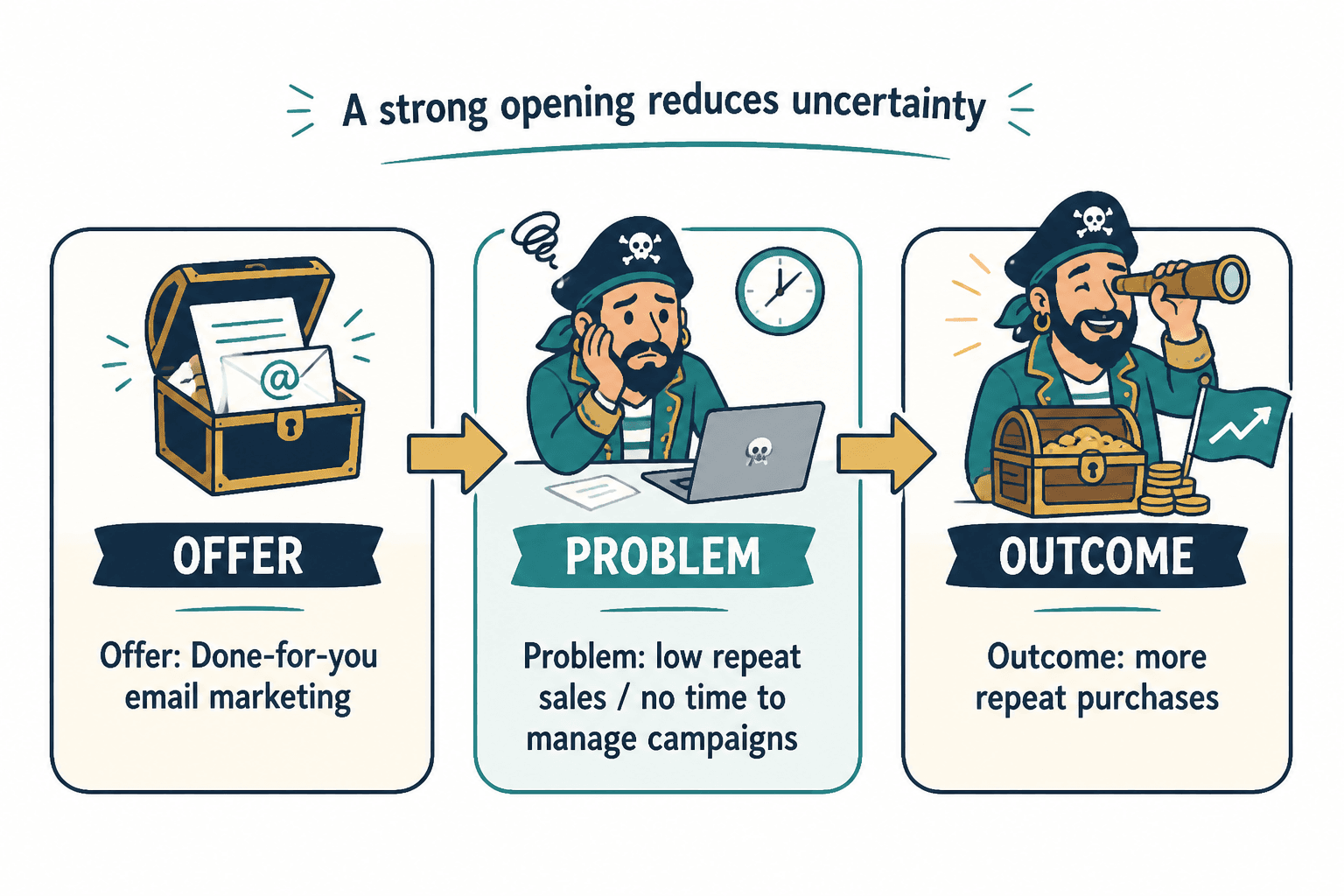
The first lines of a product or service description should usually do at least two of these three things:
- State what the offer is
- Name the problem it solves
- Show the outcome or value of solving that problem
That is it. Not a dramatic monologue. Not a mini brand manifesto. Just enough specificity to make the reader think, “Yes, this looks like it might be for me.”
In other words, your opening should reduce uncertainty, not increase it.
A simple opening formula that works
Try this:
[Offer] for [specific audience] who want to [specific result] without [friction/problem].
You do not need to use that exact sentence every time, but it gives you a solid shape. It forces you to stop hiding behind broad language and say what the thing actually does.
For example:
- Weak: “We provide tailored marketing solutions for modern businesses.”
- Stronger: “Done-for-you email marketing for ecommerce brands that need more repeat sales without writing every campaign from scratch.”
The second one is not poetry. Good. It is useful.
How to start product and service descriptions without a weak opening
If you want a practical process, use this one before you write a single first line.
1. Find the actual point of the offer
Most weak openings happen because the writer has not decided what matters most yet.
Ask:
- What is this offer, plainly?
- Who is it for?
- What problem makes them want it?
- What result are they hoping for?
- What makes this offer easier, faster, safer, smarter, or more effective than the obvious alternatives?
If you cannot answer those cleanly, the opening will wobble. The issue is not wordsmithing. The issue is strategy wearing a fake moustache and pretending to be a writing problem.
2. Cut the throat-clearing
Throat-clearing is all the stuff writers add before they get to the point because getting to the point feels scary.
It sounds like this:
- “At [Brand], we believe…”
- “In a fast-paced world…”
- “Businesses today need…”
- “Our mission is to provide…”
- “We are proud to offer…”
None of that helps the buyer decide anything. It just delays the useful part.
If your first sentence can be deleted and the copy gets stronger, it probably never deserved to be there.
3. Lead with the problem or result people care about
You do not always have to start with the offer itself. Sometimes the strongest opening starts with the pain, frustration, bottleneck, or desired result that makes the offer matter.
This works especially well when the audience already knows the problem very well.
- Offer-first: “Website copy audits for service businesses that are getting traffic but not enough inquiries.”
- Problem-first: “Getting website traffic but not enough inquiries? Your copy may be doing a lovely job of sounding fine and a terrible job of making people act.”
Both can work. The right choice depends on what your reader needs most in the first five seconds: recognition or explanation.
4. Replace adjectives with specifics
Weak openings are usually stuffed with adjectives doing the work that specifics should be doing.
Words like “innovative,” “high-quality,” “comprehensive,” “seamless,” and “effective” are not evil. They are just lazy when unsupported.
Compare these:
- Weak: “A comprehensive onboarding solution for growing teams.”
- Stronger: “An onboarding system that gives growing teams ready-to-use training docs, checklists, and workflows instead of making managers explain the same process 14 times.”
Specifics create credibility much faster than polished adjectives do.
5. Make sure the opening sounds like the page that follows
One underrated mistake: writing a punchy opening that promises one thing, then following it with copy that drifts into generic feature soup.
Your opening is not a slogan floating above unrelated content. It should set up the rest of the description. If you open with speed, ease, and clarity, the next sections should prove speed, ease, and clarity. If you open with premium customization, the copy should back that up with examples, process, and proof.
Otherwise the page feels like it changed writers halfway through.
4 strong ways to open a product or service description
You do not need one magic formula. You need a few reliable opening styles that fit different offers.
1. The plain-English offer opening
Best for: clear offers, practical buyers, low confusion
Format:
[Offer] for [audience] who want [result].
Example:
“Brand messaging strategy for founders who need clearer positioning before they redo their website, content, or sales pages.”
This is simple, but simple is not the enemy. Vague is.
2. The problem-first opening
Best for: painful, obvious, urgent problems
Format:
[Problem]? [Offer] helps you [result].
Example:
“Tired of leads ghosting after the first sales call? This follow-up email sequence helps consultants stay top of mind without sounding needy or robotic.”
This works because it opens on tension, then resolves it quickly.
3. The outcome-with-contrast opening
Best for: offers that remove friction or improve a frustrating process
Format:
Get [result] without [common frustration].
Example:
“Get a clear, conversion-focused homepage without spending three weeks trying to write it yourself between client calls.”
The contrast matters. It sharpens the value.
4. The use-case opening
Best for: niche offers, specific audience segments, higher relevance
Format:
Built for [specific situation/use case], this [offer] helps [audience] [result].
Example:
“Built for coaches selling premium offers, this sales page template helps you explain your process, handle objections, and drive more discovery calls without defaulting to funnel-guy nonsense.”
This one works because specificity pulls the right people in fast.
Before-and-after examples of weak openings fixed
Sometimes the easiest way to improve your own writing is to see where other openings go limp.
Example 1: generic service intro
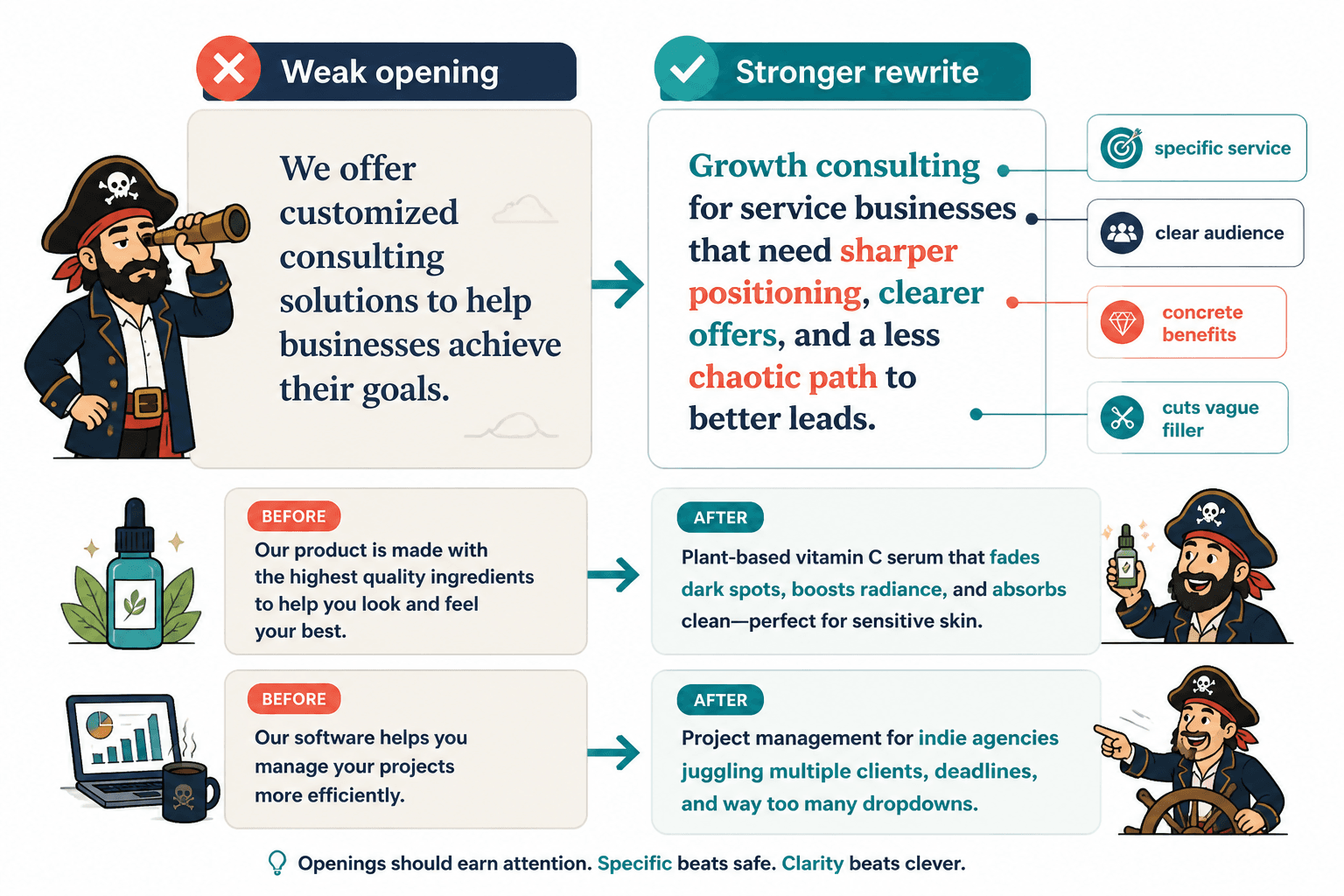
- Before: “We offer customized consulting solutions to help businesses achieve their goals.”
- After: “Growth consulting for service businesses that need sharper positioning, clearer offers, and a less chaotic path to better leads.”
What changed:
- The actual service is named
- The audience is clearer
- The benefits are more concrete
- “Achieve their goals” was politely escorted off the premises
Example 2: soft software description
- Before: “Our platform streamlines workflows and enhances productivity.”
- After: “A client workflow platform that helps small agencies track projects, approvals, and deadlines without stitching together six different tools.”
What changed:
- “Platform” is now tied to a real use case
- The audience is named
- The friction is visible
- The value is easier to picture
Example 3: polished but empty premium offer
- Before: “Experience luxury skincare designed to support your natural glow.”
- After: “Daily skincare for dry, sensitive skin that needs moisture and barrier support without heavy formulas or a 10-step routine.”
What changed:
- The buyer can identify themselves
- The benefit is grounded in a need
- The copy trades mood for usefulness
Example 4: agency page opening with too much self-focus
- Before: “At BrightPath, we pride ourselves on delivering excellence through innovative design.”
- After: “Web design for professional service firms that need a site that looks credible, explains the offer clearly, and turns more visitors into inquiries.”
The revised version respects the reader’s priorities. Which, bluntly, are not your pride.
If your existing copy needs heavier surgery, read how to rewrite boring product and service descriptions. Sometimes the opening is weak because the whole description is built on vague framing.
A quick checklist for stronger opening lines
Before you finalize the first lines of your product or service description, check for this:
- Does the reader quickly understand what the offer is?
- Is the audience clear enough to feel seen?
- Does the opening name a real problem, result, or use case?
- Have you cut any company-first fluff?
- Are you using specifics instead of padded adjectives?
- Would this opening still make sense if your brand name were removed?
- Could the same line appear on a competitor’s page? If yes, it is still too generic.
That last test matters more than people think. If your opening could be copied onto 40 other websites with almost no changes, it is not doing enough.
What to do if your offer is hard to explain
Some offers are naturally messier. Maybe you combine strategy and execution. Maybe the service is customized. Maybe the product has a few layers to it. Fine. That does not mean your opening gets to be vague.
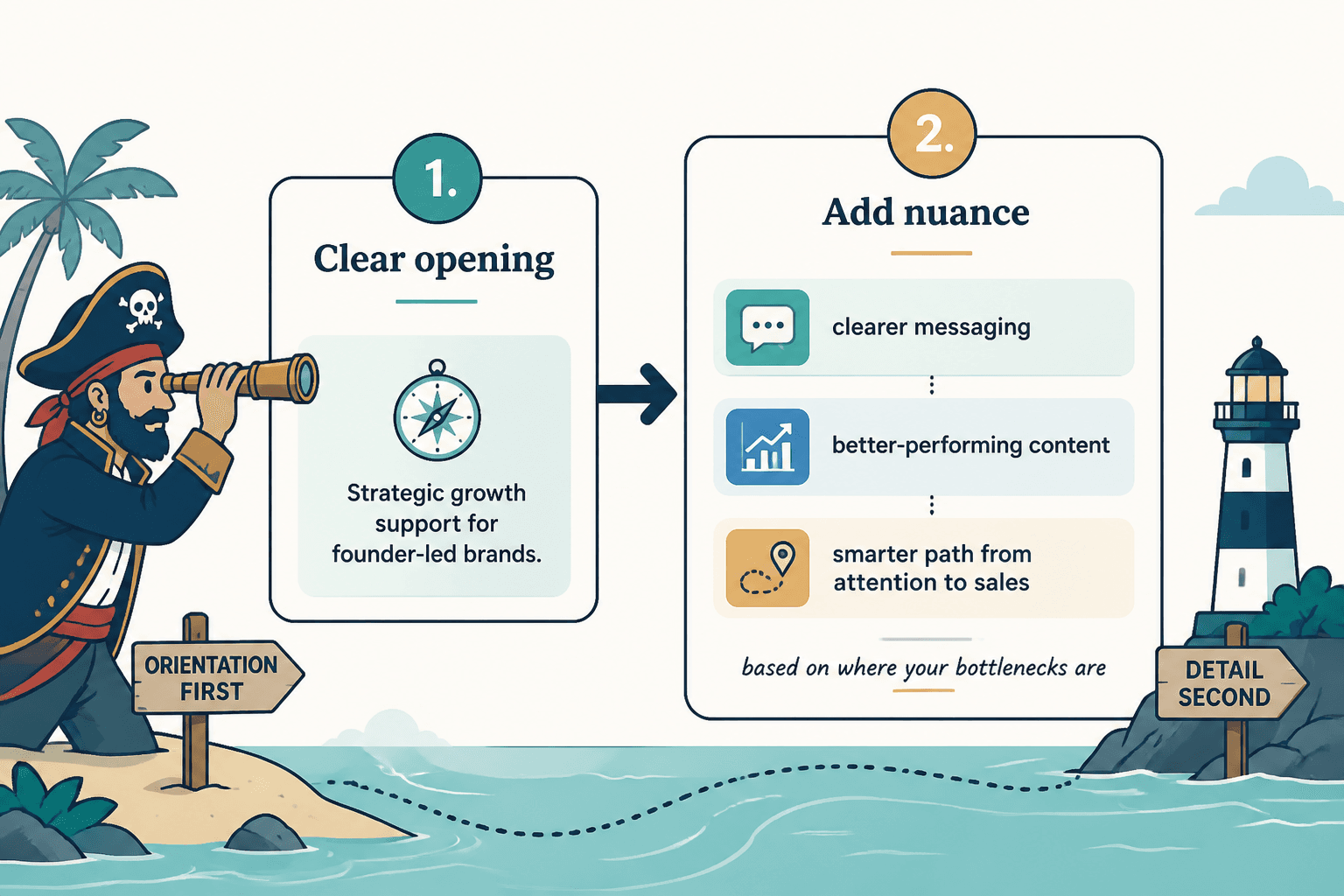
When the offer is complex, start with the clearest useful version first. You can add nuance in the next paragraph.
For example:
- Weak complex version: “A holistic growth engagement tailored to the unique needs of scaling founder-led brands.”
- Stronger layered version: “Strategic growth support for founder-led brands that need clearer messaging, better-performing content, and a smarter path from attention to sales. We combine positioning, content strategy, and conversion copy based on where your bottlenecks actually are.”
The first sentence gets the reader oriented. The second adds texture. That is a much better experience than making them decode jargon on arrival.
If your issue is not just the opening but the way the whole service is positioned, improving service framing without sounding generic will help.
How the opening connects to leads and sales
The bigger point is simple: clearer structure and clearer writing make the piece more useful. That is usually what makes the ending land better too.
The bigger point is simple: clearer structure and clearer writing make the piece more useful. That is usually what makes the ending land better too.