
Most weak product and service descriptions do not fail because the writing is technically bad. They fail because the framing is mushy.
The offer might be useful. The writer might be smart. The result still sounds like every other “strategic,” “tailored,” “high-impact” service page on the internet. Which means the reader cannot tell what the thing actually does, who it is for, or why they should care now instead of later.
If you want to know how to improve service framing in product and service descriptions, the fix is not adding fancier adjectives. It is describing the service around the buyer’s decision: the problem they recognize, the outcome they want, the way your approach is different, and what happens when they choose this instead of doing nothing.
That is the job. Not sounding “premium.” Not sounding “innovative.” Just making the offer easier to understand, trust, and buy.
If your current descriptions feel vague, flat, or suspiciously similar to everyone else’s, this will help you sharpen them without turning into a walking brochure.
If you want the bigger picture, start with the parent guide.
What service framing actually is
Service framing is the angle you use to present the offer.
It is not just what the service includes. It is how you help the reader understand the service in a way that feels relevant and concrete. Good framing answers questions like:
- What is this really helping me do?
- Why would I want this now?
- Is this for someone like me?
- How is this different from the other five offers that sound annoyingly similar?
- What kind of result should I expect?
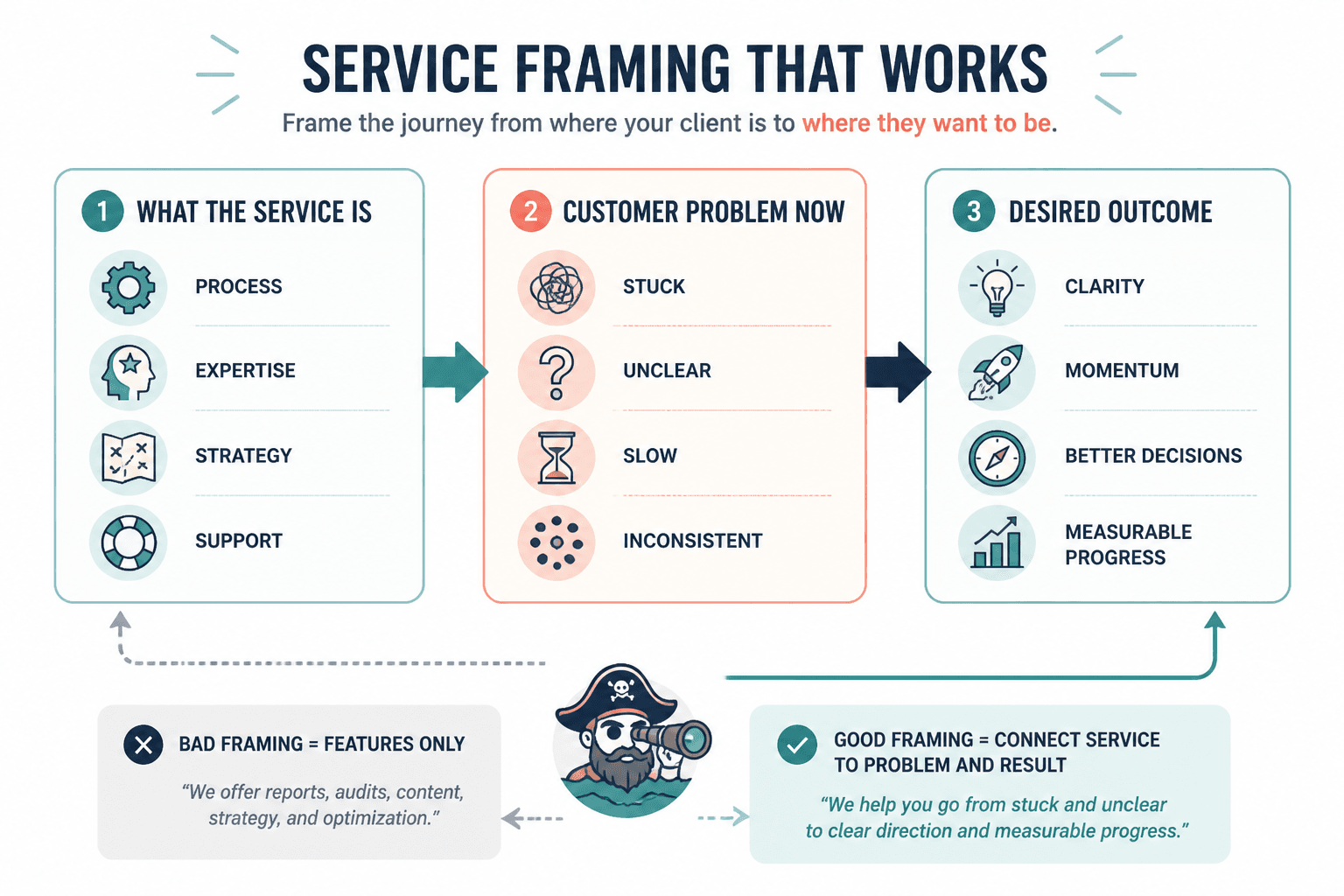
Bad framing lists features and hopes the reader will connect the dots. Good framing connects the dots for them.
That matters even more for service businesses, coaches, consultants, freelancers, and personal brands, because your offer is often partly intangible. People are not buying a toaster. They are buying judgment, process, expertise, access, strategy, momentum, clarity, or execution. If you frame that badly, the whole thing sounds expensive and foggy.
Why most service descriptions sound generic
Because they are built from the seller’s point of view, not the buyer’s decision process.
That usually creates copy like this:
I help brands grow through customized strategic solutions that align messaging, visibility, and audience engagement.
That sentence is doing a lot of work to avoid saying anything clear.
It sounds generic because it relies on abstract nouns instead of real buying context. “Strategic solutions” could mean nearly anything. “Visibility” is vague. “Audience engagement” is often code for “people liked the post but did not buy.” None of it helps the reader picture the service in action.
There are a few repeat offenders here:
- Overused adjectives: tailored, bespoke, premium, holistic, transformational, impactful
- Empty verbs: empower, elevate, unlock, optimize, leverage
- Feature-first writing: sessions, audits, deliverables, frameworks, support
- No buyer tension: no urgency, no consequence, no reason this matters now
- No specific fit: unclear audience, unclear problem, unclear use case
If the reader has to reverse-engineer what you mean, the framing is weak.
And yes, sometimes people hide behind generic language on purpose because being specific feels risky. Specificity rules some people out. True. It also helps the right people say yes faster, which is sort of the point.
How to improve service framing in product and service descriptions
Here is the practical version. If you want stronger service framing, build the description around five things: the buyer’s problem, the desired outcome, your mechanism, the fit, and the next step.
1. Start with the real problem, not the category label
“Brand strategy,” “copywriting support,” and “business coaching” are categories. They are not framing.
Start with the issue the buyer already notices. The thing they are frustrated by. The thing making them look for help.
For example:
- Not “LinkedIn ghostwriting”
- Try “LinkedIn content for founders who have expertise but keep posting forgettable beige mush”
- Not “website copy package”
- Try “website copy for consultants whose offers make sense in a sales call but fall apart on the page”
- Not “business coaching”
- Try “business coaching for solo service providers who are fully booked with random work and still somehow unclear on what they actually sell”
The point is not to be cute. The point is to match the reader’s lived problem closely enough that they feel understood without needing a decoder ring.
2. Frame the outcome in plain language
A lot of descriptions stop at “support,” “clarity,” or “growth.” That is too soft.
The outcome should help the buyer picture what gets better. Not in a fake guarantee way. In a useful, concrete way.
Weak:
Gain clarity and confidence in your messaging.
Stronger:
Walk away with messaging that explains what you do in seconds, makes your offer easier to trust, and gives you words you can actually use across your site, content, and sales conversations.
That second version works because it shows what “clarity” changes in practice.
One easy test: if your outcome could describe almost any service, it is probably still too generic.
3. Explain your mechanism, not just your deliverables
Deliverables matter. But they are not the reason people buy. The mechanism is the logic behind why your service works.
Instead of only saying what is included, explain how your approach solves the problem.
For example, compare these:
You will receive a 90-minute strategy session, workbook, and follow-up notes.
We use the session to find where your message gets fuzzy, which audience pain points you are skipping, and how to reframe the offer so people understand the value before they ever book a call.
The first describes the package. The second describes the mechanism. One sounds like admin. The other sounds like help.
This is especially important if you are selling expertise-based services. People need to see your thinking, not just your folder of PDFs.
4. Make the fit clear
Strong service framing says who the offer is for and, quietly, who it is not for.
You do not need a dramatic “this is not for everyone” speech. You just need enough specificity to help the right reader self-identify.
Useful fit signals include:
- business stage
- type of audience served
- problem sophistication
- content maturity
- sales model
- decision style
Example:
This is for coaches, consultants, and solo service businesses with a real offer already in motion, but weak framing on the page. If you are still changing your niche every twelve minutes, start there first.
That is clearer than saying “for purpose-driven entrepreneurs ready to scale,” which sounds like it was assembled in a hurry from leftover webinar slides.
5. Show the stakes of inaction
Not with fear mongering. Just with honesty.
People act when they understand the cost of staying stuck. If your service description only talks about the positive outcome and never mentions the ongoing problem, it can feel nice but forgettable.
For example:
Without stronger service framing, your page may still get polite traffic while the right buyers leave unsure what makes this worth paying for.
That lands because it names a frustrating, plausible consequence. No melodrama required.
6. End with a next step that fits the buying temperature
A service description should not close with a random CTA pasted on like an afterthought.
If the offer is high-trust and custom, a call might make sense. If the reader still needs warming up, a portfolio, case study, or examples page may be better. If the offer is straightforward, booking or buying may be the right move.
Weak CTA:
Contact us today to unlock your growth.
Better CTA:
If your offer is solid but the page still sounds blurrier than the work actually is, this service helps fix the framing. Start here if you want sharper messaging before you rewrite the whole site.
Specific beats dramatic. Almost every time.
A simple service framing formula you can actually use
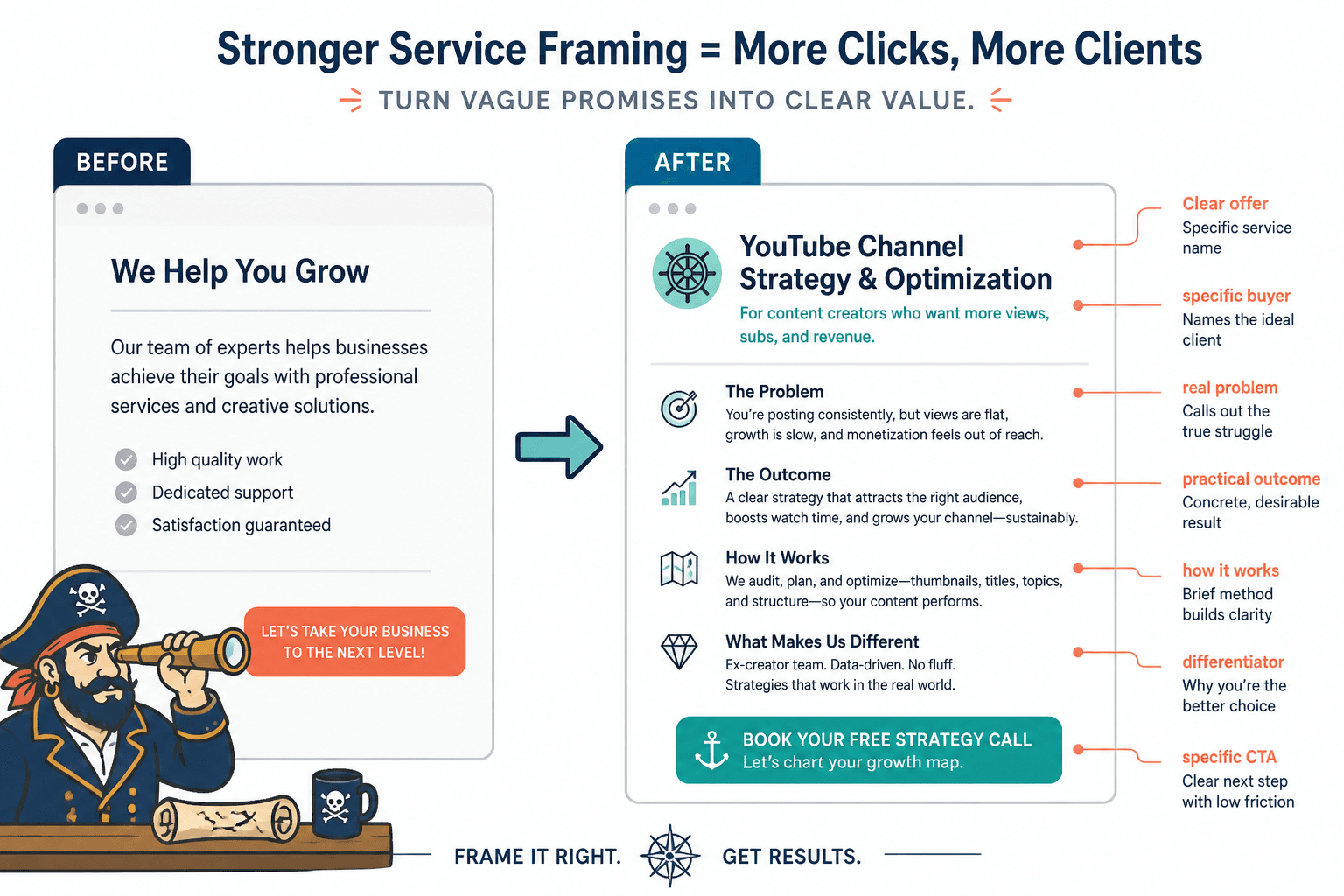
If you want a practical structure, use this:
- What it is: Name the service clearly
- Who it is for: Define the buyer in real terms
- What problem it solves: Name the visible frustration
- What changes: State the practical outcome
- How it works: Explain the mechanism or approach
- Why this version is different: Add a positioning detail, proof point, or philosophy
- What to do next: Give a CTA that fits the offer
Here is a filled-in example for a messaging strategist:
Messaging Strategy Intensive
This service is for consultants, coaches, and personal brands whose offers are good, but whose websites and sales pages still sound vague, interchangeable, or too polished to trust.
We fix the framing first: what the offer really helps with, how to explain it fast, and where your current copy is losing clarity or credibility.
You leave with sharper positioning, cleaner language, and a clearer message for your site, content, and sales conversations.
Instead of handing you a generic brand worksheet and wishing you luck, we go line by line through the parts that actually shape buyer decisions.
If people keep saying “this sounds interesting” without taking the next step, this is probably where the problem lives.
That is not magic. It is just clear framing.
Before and after: generic service framing versus stronger service framing
Example 1: Copywriting service
Before:
I provide strategic copywriting services designed to elevate your brand voice and drive conversions.
After:
I write website and offer copy for service businesses that have real expertise but weak wording on the page. The goal is not to make you sound fancier. It is to make the right people understand the value fast enough to keep reading, trust you, and take the next step.
Example 2: Coaching offer
Before:
This transformational coaching experience helps ambitious entrepreneurs unlock their fullest potential.
After:
This coaching is for solo business owners who are getting pulled in ten directions, second-guessing every decision, and building a business that feels busier than it does coherent. We work on focus, offer decisions, and cleaner priorities so the business gets easier to run, not just louder to market.
Example 3: Design service
Before:
Custom design solutions tailored to your unique brand needs.
After:
Brand and website design for experts whose business has outgrown the DIY look. The focus is not decoration. It is creating a visual identity and site experience that makes the offer feel credible, coherent, and worth paying attention to before a sales call ever happens.
Notice the pattern. The stronger versions do not just say the service is good. They frame the buyer, the problem, and the practical value.
What to remove if your descriptions still feel bland
Sometimes improvement is less about adding stronger lines and more about deleting the fluff that is diluting them.
Cut or rewrite:
- generic adjectives with no proof
- broad claims that could describe any offer
- throat-clearing intros that take forever to say the point
- lists of deliverables with no explanation of why they matter
- jargon that sounds impressive but weakens comprehension
- empty phrases like “results-driven,” “client-centered,” or “done with excellence”
The bigger point is simple: clearer structure and clearer writing make the piece more useful. That is usually what makes the ending land better too.