
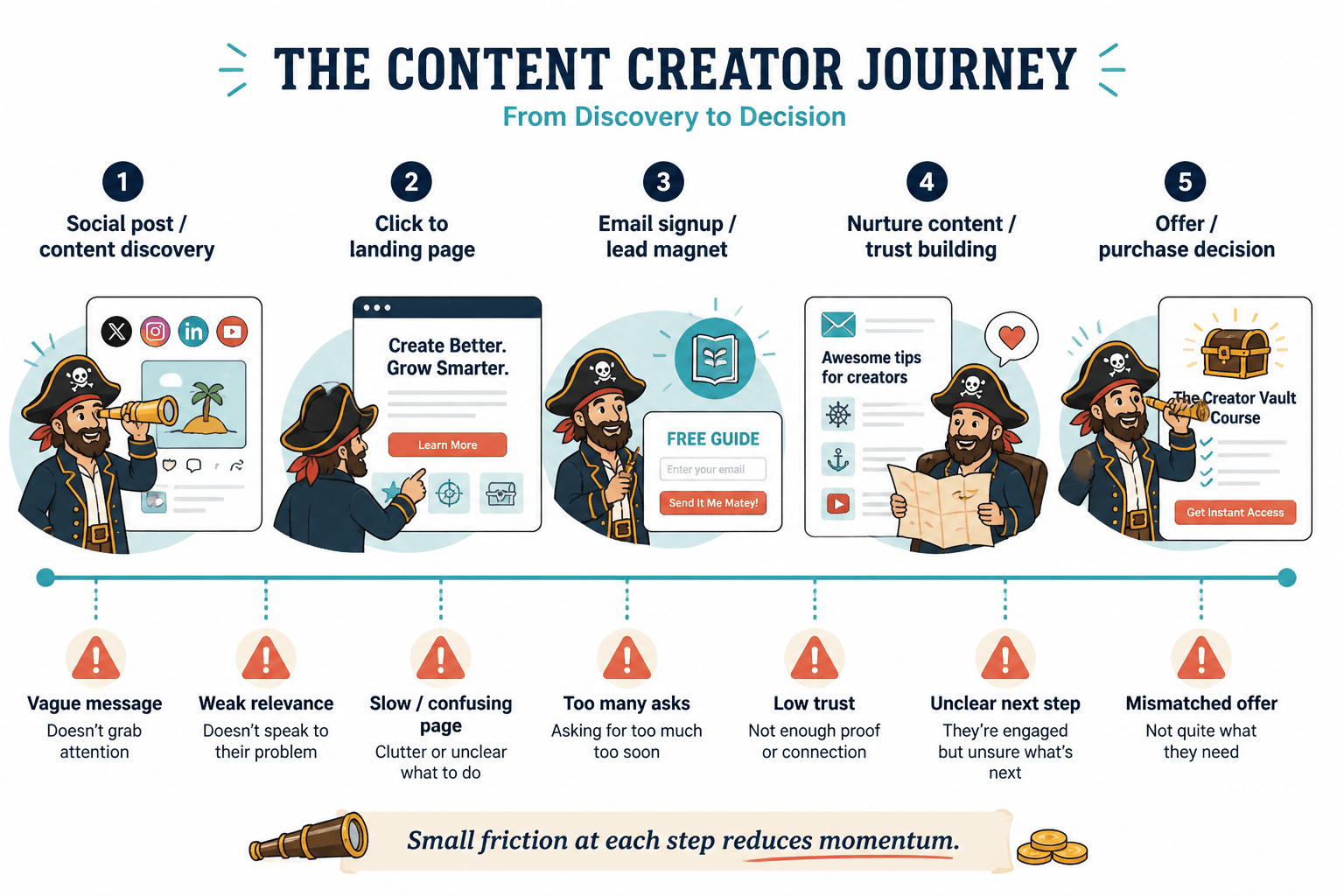
Most audience-to-offer journeys do not fail because the offer is terrible. They fail because the path to the offer is messy, rushed, vague, or weirdly self-centered.
People see a post, click a link, skim a page, maybe join an email list, maybe read a few more things, and then decide whether you seem useful enough to trust. That whole chain matters. If one step creates friction, confusion, or mild suspicion, performance drops. Quietly. And usually without anyone admitting that the funnel is the problem.
If you are dealing with audience-to-offer journey conversion step mistakes that hurt performance, the fix is rarely “post more” or “sell harder.” It is usually about making each step clearer, more relevant, and less annoying. Here’s how to spot the mistakes that keep killing momentum between attention and action, and what to do instead.
To see how this fits into the wider strategy, open the parent guide.
The real job of an audience-to-offer journey
An audience-to-offer journey is not just “content, then link, then sale.” That is the toddler version.
The real job is to move someone from mild awareness to enough trust, clarity, and desire that taking the next step feels reasonable. Not forced. Not manipulative. Not like they just fell through a trapdoor into a funnel built by someone who read three launch tweets and got overconfident.
Each step should answer one quiet question in the reader’s mind:
- Why should I care?
- Why should I trust you?
- Is this for someone like me?
- What exactly happens next?
- Is this worth my time, attention, money, or inbox space?
If your journey skips those answers, conversion usually gets stuck long before the sales page ever has a chance.
If you want the broader framework first, it helps to read audience-to-offer journeys alongside this piece. This article is about the mistakes inside those steps.
Mistake 1: The first step attracts attention from the wrong people
A lot of creators think top-of-funnel content is doing its job if it gets attention. Not quite. Attention from people who will never want, need, buy, or refer your offer is not a win. It is decorative traffic.
If your opening content is too broad, too entertaining, too generic, or too disconnected from the problem your offer solves, you create a weak journey from the start. You may grow an audience. You may even get engagement. But the audience-to-offer handoff gets awkward because the audience was never aligned with the offer in the first place.
What this looks like
- Posting broad motivational content, then trying to sell a specific service
- Going viral on hot takes that have nothing to do with your expertise
- Teaching tiny disconnected tips with no link to a larger paid outcome
- Building an audience around personality alone, then wondering why conversions are soft
Better move
Create content that attracts people who will logically care about the next step. Not every post needs to mention your offer. It does need to train the audience to associate you with the category of problem you solve.
That means your content should consistently signal:
- The type of person you help
- The problem you help them solve
- Your way of thinking about that problem
- The kinds of outcomes you care about
It is much easier to convert a smaller, relevant audience than a large crowd of vaguely interested strangers and hobby lurkers.
Mistake 2: There is no clean next step
Sometimes the content is solid, the audience is relevant, and then the journey falls apart because the next step is muddy.
The reader finishes your post and gets one of these experiences:
- No CTA at all
- A CTA that asks for too much too soon
- Five different links and no clear priority
- A “DM me” line with no reason to bother
- A vague prompt like “check out my stuff”
People need direction. Not a massive push, just a clean next move. If the next step is unclear, they do what most people do online: nothing.
Bad CTA
If this resonated, check out my website, subscribe, follow for more, and message me if you want support.
That is not a CTA. That is you outsourcing decision-making to an already distracted reader.
Better CTA
If you want a cleaner path from content to clients, start with this guide on turning audience-to-offer journeys into more leads or sales.
One next step. Clear payoff. Lower friction.
Mistake 3: The lead magnet or bridge offer does not match the content that brought people in
This one hurts performance constantly.
Someone reads a post about fixing weak conversion paths. They click through expecting a relevant next step. Instead they get a generic “30 content prompts” freebie, a random newsletter pitch, or a workshop that solves a different problem entirely.
That mismatch breaks momentum. The person was ready for one conversation, and you dragged them into another.
Good conversion journeys feel continuous. One step should naturally deepen the interest created by the last one. A bad bridge feels like a bait-and-switch, even when the resource itself is decent.
A simple match test
Ask this question: if someone loved this post, what is the most logical next thing they would want?
Usually it is one of these:
- A more detailed guide on the same issue
- A template to implement the idea
- A case-study-style breakdown
- A diagnostic or checklist
- A small offer that helps them apply the lesson faster
If your bridge step does not feel like a natural continuation, it is probably leaking conversions.
For help refining weak messaging between steps, rewriting boring audience-to-offer journeys is worth your time.
Mistake 4: You ask for commitment before earning trust
A lot of funnels are impatient. They try to cash the relationship before it has actually formed.
This shows up as:
- Cold audiences being pushed straight to high-ticket calls
- First-touch content ending in hard sell CTAs
- Email sequences that pitch before proving anything
- Profile pages that rush into “book now” without establishing relevance or credibility
Trust is not built by insisting that people trust you. It is built by reducing uncertainty. That means your journey needs proof, specificity, useful thinking, and signs that you understand the reader’s situation.
In practical terms, the step before the sale often needs to do one or more of these jobs:
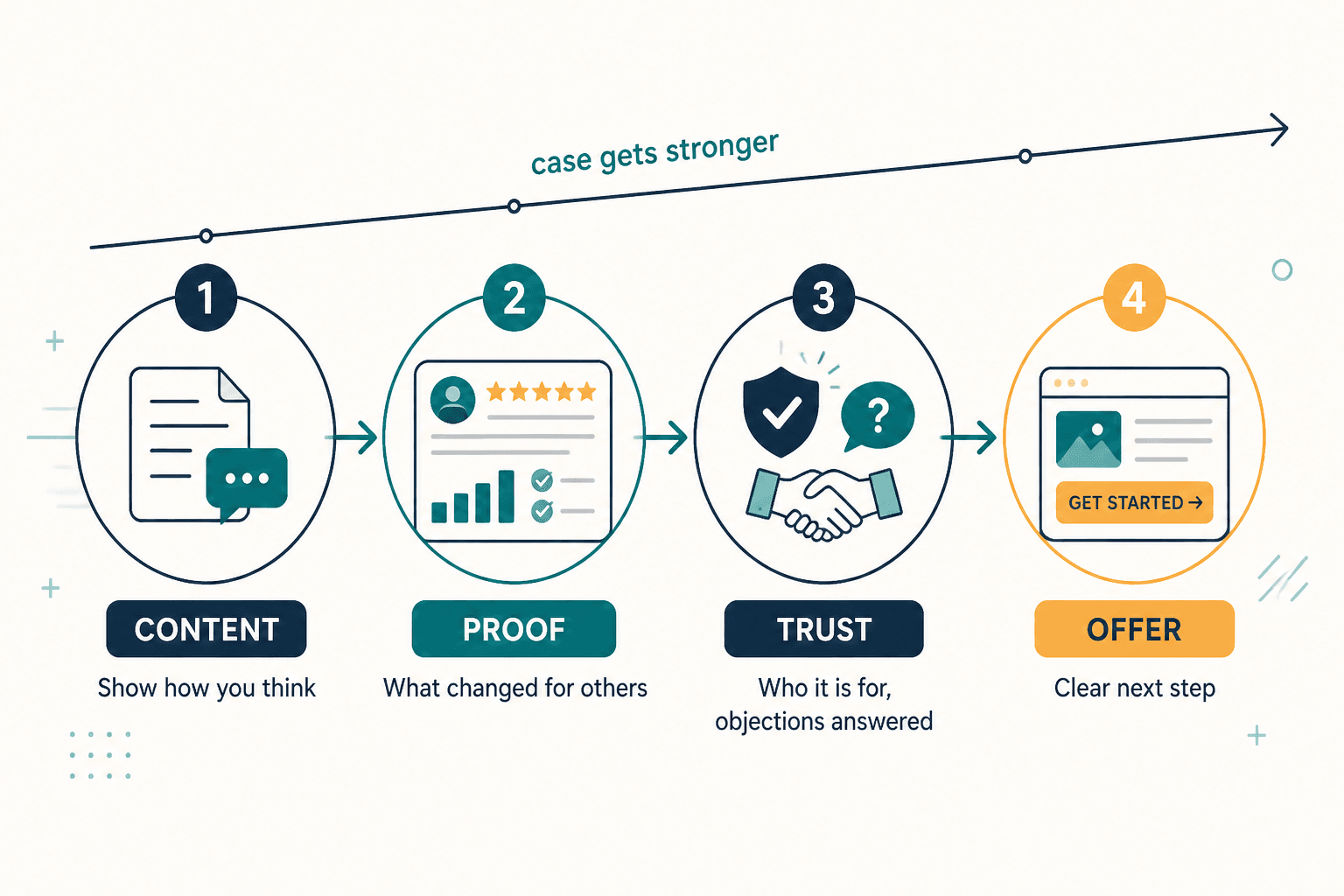
- Show how you think
- Show what changed for others
- Clarify who the offer is for and not for
- Answer objections quietly
- Make the result feel real and grounded
That is why trust sequences matter. Not because they sound fancy, but because people are not idiots. Most of them can smell rushed selling from across the room.
If you need examples, read audience-to-offer journeys trust sequences examples creators can adapt fast.
Mistake 5: Each step repeats the same message instead of deepening it
Repetition is useful. Redundancy is not.
A lot of creators build funnels where every step says the same broad promise in slightly different clothes. The post says you help people grow. The lead magnet says you help people grow. The emails say you help people grow. The sales page says you help people grow. Congratulations, you have built a journey made entirely of fog.
Each conversion step should deepen the case, not just restate it.
A better progression
- Content: Name the problem sharply
- Lead magnet: Organize the problem into a usable framework
- Email sequence: Add proof, examples, and common mistakes
- Offer page: Show the method, fit, outcome, and next step
That sequence works because every touchpoint adds a missing piece. The reader keeps moving because the journey keeps earning the next click.
Mistake 6: The timing is off
Conversion steps do not just need the right message. They need the right timing.
Push too early and people back away. Wait too long and momentum dies. Keep nurturing forever and your audience starts to feel like they are trapped in a polite waiting room with no actual door to the thing you sell.
This is one reason audience-to-offer journey conversion step mistakes that hurt performance are often timing mistakes in disguise. The content may be good. The offer may be solid. But the invitation shows up at the wrong moment.
Signs your timing is wrong
- Strong content engagement, weak click-through
- Lots of freebie signups, very few qualified replies or bookings
- People consume several emails but vanish when the offer appears
- Sales CTAs perform only when heavily discounted or urgency-driven
Good timing usually means the offer appears when the reader has enough context to care and enough trust to consider action. Not before. Not three weeks after the original interest cooled off.
If this is your bottleneck, read how to improve audience-to-offer journeys offer timing without sounding generic.
Mistake 7: The journey has too much friction in tiny places
Big strategy errors are obvious. Tiny friction points are sneakier, and they wreck performance all the time.
People do not usually announce, “I abandoned this funnel because the page was slightly confusing and the CTA copy felt vague.” They just leave.
Common friction points
- The link destination does not match the promise in the post
- The landing page headline is generic
- The signup form asks for too much information
- The email subject lines do not make the sequence feel worth opening
- The booking page creates uncertainty about what happens next
- The offer page hides pricing, process, or fit details that serious buyers want
None of those issues sound dramatic. Together, they can absolutely tank conversions.
This is where creators often overestimate persuasion and underestimate ease. People are more likely to move forward when the path feels simple, clear, and low-friction. Not because they were “convinced” by some mystical copy trick.
Mistake 8: You are measuring the wrong thing at each step
If you only measure final sales, you miss the actual problem. If you only measure likes, you also miss the actual problem, just from the opposite direction.
Different conversion steps have different jobs, so they need different success signals.
| Step | Main job | Useful signal |
|---|---|---|
| Content | Earn relevant attention | Qualified engagement, profile clicks, link interest |
| Lead magnet or bridge | Capture and continue interest | Opt-in rate, relevance of subscribers, follow-through |
| Email or nurture sequence | Build trust and readiness | Opens, clicks, replies, page visits, retention |
| Offer page | Convert interest into action | Bookings, applications, purchases, reply quality |
If one stage underperforms, fix that stage. Do not keep rewriting the sales page when the audience coming into it is unqualified. Do not keep posting more top-of-funnel content when the middle of the journey is where people disappear.
Mistake 9: The offer appears disconnected from the content voice
This one is subtle but important. Your content voice creates expectations. If your posts are practical, grounded, and specific, but your sales page suddenly sounds like an overcaffeinated webinar ad from another decade, trust drops.
The same goes for audience fit. If your content respects the reader’s intelligence, the offer step should do the same. No fake urgency. No melodrama. No bizarre transformation claims. No “this one secret changed everything” nonsense.
Consistency matters. The offer should feel like the natural paid continuation of the same brain, same standards, same usefulness.
How to audit your journey without overcomplicating it
You do not need a giant dashboard and twelve color-coded funnel maps. You need a basic walkthrough with honest eyes.
Run this quick audit
The bigger point is simple: clearer structure and clearer writing make the piece more useful. That is usually what makes the ending land better too.
Audience-to-offer journeys work better when the next step feels like a natural continuation of the problem. Better alignment usually beats more pressure.