Most creators do not have an audience problem. They have a sequencing problem.
They post useful things. People nod politely. Maybe a few save the post. Maybe someone replies with “needed this.” Then nothing happens. No consults. No sales. No steady flow from attention to action.
That gap usually is not because the offer is terrible. It is because the audience-to-offer journey is either missing, rushed, or stitched together like a panic project at 11:47 p.m.
Audience-to-Offer Journey Trust Sequence Examples Creators Can Adapt Fast is really about one thing: how to move people from “I see your posts sometimes” to “I trust you enough to buy” without turning your content into a vending machine with captions.
Below, you will get practical trust sequence examples, simple journey structures, and fast ways to adapt them to your own business. Not theory soup. Stuff you can actually use this week.
For the broader learning path, visit our parent guide.
What an audience-to-offer journey actually needs
A good audience-to-offer journey does not shove people from a post straight into a sales page and then act confused when they disappear.
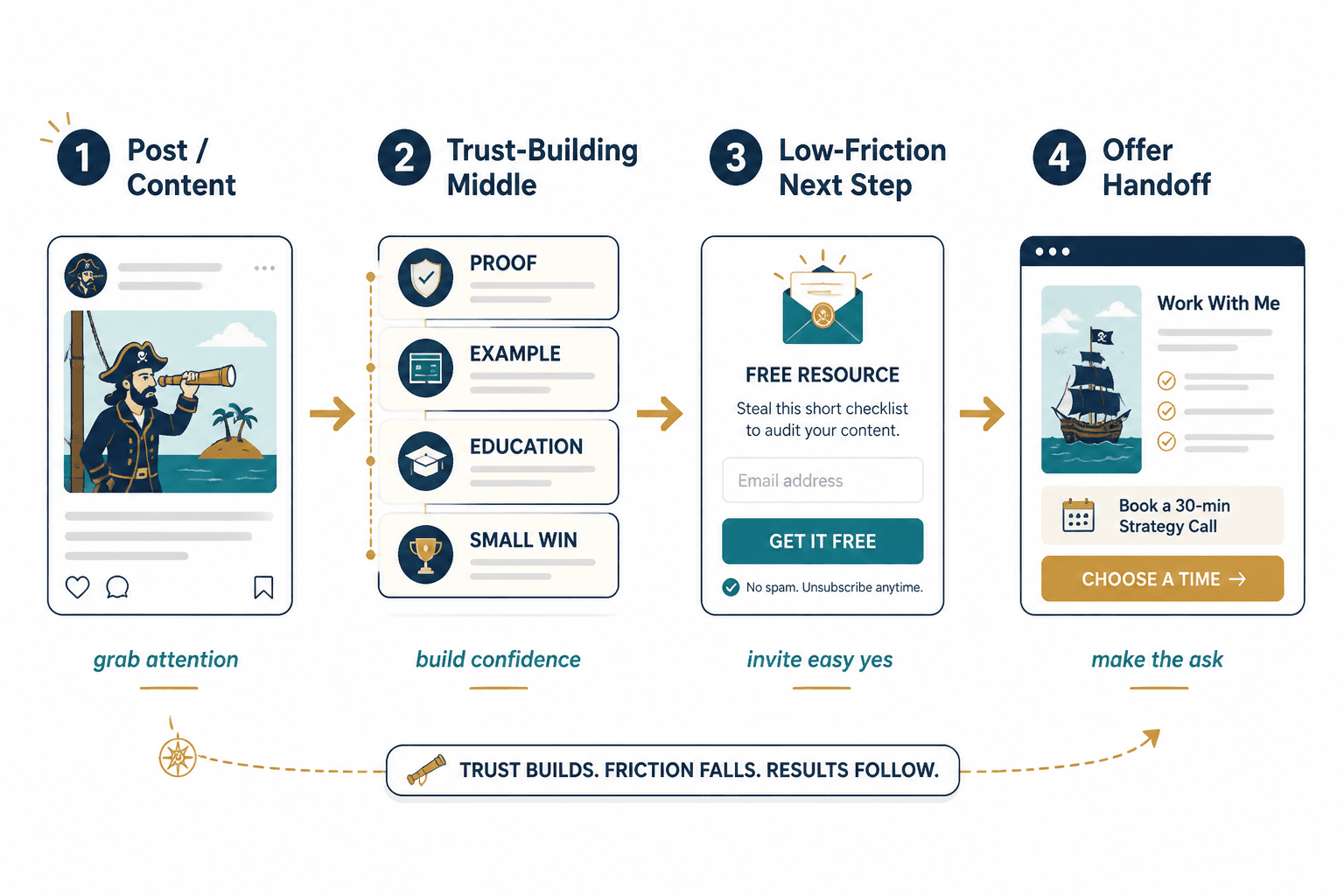
It creates a believable progression. Attention becomes interest. Interest becomes trust. Trust becomes action. That action might be a subscribe, reply, download, application, consult, or purchase. The format changes. The logic does not.
At minimum, your trust sequence needs four things:
- A relevant entry point: a post, thread, article, video, comment conversation, or profile visit
- A trust-building middle: proof, perspective, examples, useful education, or a small win
- A low-friction next step: newsletter, lead magnet, short audit, application, booking page, or product page
- A clear offer handoff: the moment where trust turns into a commercial ask without feeling abrupt
Miss one of those, and the whole thing gets weird. You either stay “valuable” forever and never ask, or you ask too early and burn the very trust you needed.
If you need the broader framework first, this guide on audience-to-offer journeys is the right foundation before you start refining the trust sequence itself.
Why most trust sequences fail
Most failed trust sequences are not evil. They are just clumsy.
Creators tend to make one of five mistakes:
- They jump from awareness to pitch with no bridge
- They over-educate and never give people a clear next move
- They use generic lead magnets that collect emails from the wrong people
- They build sequences around themselves instead of around buyer hesitation
- They treat trust like a vibe instead of something built through structure, proof, and consistency
Trust is not formed because you “showed up consistently.” That helps, sure. But consistency without clarity just means people consistently do not know why they should hire you.
What works better is a sequence that answers the quiet questions buyers are already asking:
- Is this person relevant to my problem?
- Do they understand the nuance?
- Can they explain things clearly?
- Do they have proof or practical thinking?
- What happens if I take the next step?
- Is the offer worth my time, money, or attention?
The simplest trust sequence framework creators can use fast
If you want something lean, use this five-step structure:
- Attract: publish a sharp, relevant piece of content
- Resonate: show you understand the problem better than generic advice does
- Prove: demonstrate method, example, result, or decision-making
- Invite: offer a small, sensible next step
- Convert: present the paid offer with context and low friction
This is not fancy. Good. Fancy is usually where people start making bad decisions.
The trick is adapting each step to your type of work. A coach, consultant, writer, designer, and course creator can all use the same skeleton, but the proof and invitation should look different.
5 audience-to-offer journey trust sequence examples creators can adapt fast
Here are five practical sequences. Steal the structure, not the exact wording.
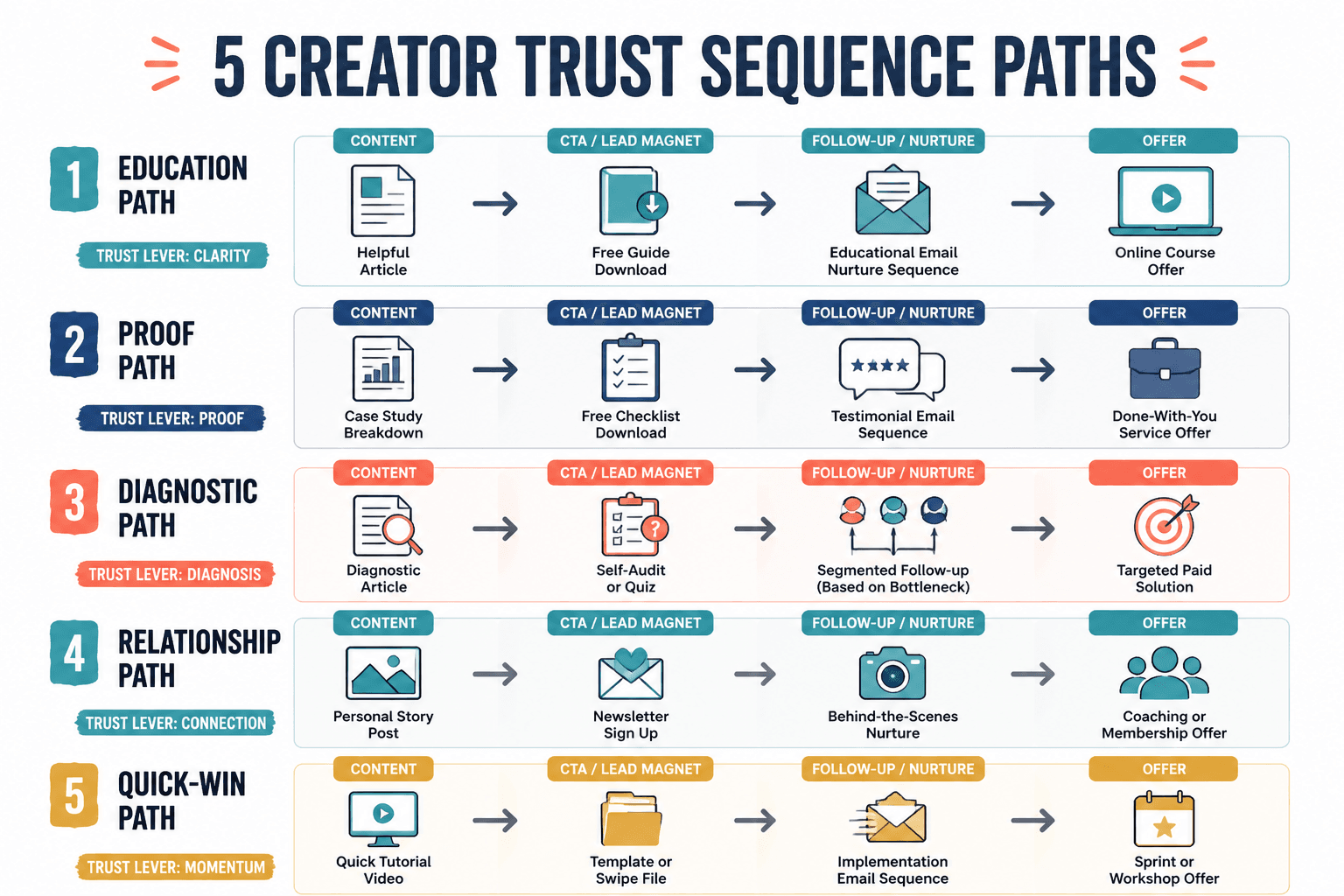
1. Content post to lead magnet to nurture emails to service offer
This is the classic creator-service path, and it still works when the lead magnet is specific and the emails are not dull little homework packets.
Best for: consultants, coaches, strategists, freelance specialists
- Entry content: a post calling out a common mistake with a clear point of view
- Trust bridge: a focused free resource solving one narrow part of the problem
- Nurture: 3 to 5 emails with practical teaching, examples, and one light case study
- Offer: audit, strategy session, retainer, done-for-you service
Example sequence:
- LinkedIn post: “Why your content gets compliments but no leads”
- CTA: “Comment GUIDE and I’ll send my 7-point trust-to-sale content checklist”
- Email 1: common trust gaps in creator funnels
- Email 2: before-and-after example of better sequencing
- Email 3: quick self-audit and what to fix first
- Email 4: invitation to book a paid strategy session
Why it works: the free resource earns the email because it is tied tightly to the pain the post raised. The emails continue the argument instead of resetting into “hello friend, here is my life story.” Then the offer appears as the logical next move for people who want help applying the process.
What to avoid: a generic PDF called “10 tips for growth.” That is not a trust bridge. That is a digital leaflet.
2. Problem-aware post to profile to case study article to consultation
This one works well when your buyers need more confidence before they book. Instead of forcing a direct CTA in every post, you let your profile and authority content do some of the lifting.
Best for: higher-ticket consultants, B2B freelancers, positioning experts, ghostwriters, copywriters
- Entry content: a post with a sharp opinion or practical diagnosis
- Trust bridge: optimized profile showing audience, value, proof, and next step
- Authority layer: article or case study breaking down a real problem and solution path
- Offer: consultation or application
Example sequence:
- X or LinkedIn post: “Most personal brand funnels fail because the offer appears before trust does”
- Reader checks profile and sees a clear promise plus case study link
- Case study article explains how a creator fixed that sequence and improved lead quality
- Article CTA: book a consult or apply for strategy help
Why it works: some people do not want your freebie. They want to know if you are the real thing. A strong profile plus one genuinely useful authority piece can do more than an email opt-in for serious buyers.
If you want more journey models like this, read best audience-to-offer journeys ideas and examples for creators.
3. Short-form content to newsletter to soft pitch sequence to productized offer
This one is ideal if you sell a lower-friction offer like a mini service, workshop, audit, template pack, or low-ticket product.
Best for: creators with regular short-form content and a warm newsletter
- Entry content: short posts with one useful observation each
- Trust bridge: newsletter signup promising practical, niche-specific help
- Nurture: consistent issues that teach, reframe, and occasionally show proof
- Offer: workshop, swipe file, office hours, productized service
Example sequence:
- Three posts over two weeks about weak offers, unclear bios, and soft CTAs
- Each points to newsletter: “I send one practical fix each week for creators who want better content-to-sale flow”
- Newsletter issues include one teardown, one framework, one client-style example
- Fourth issue introduces a paid CTA template pack or mini audit
Why it works: repetition builds familiarity without you saying the exact same thing. People start seeing your angle. Then when the paid offer appears, it feels earned because they already know how you think.
4. Comment conversation to DM resource to qualification step to offer
This is where a lot of creators get creepy fast, so let’s keep it clean.
The goal is not to pounce on every commenter like a networking raccoon. The goal is to continue relevant conversations with people who already showed intent.
Best for: service creators, consultants, niche experts with active social engagement
- Entry content: post that prompts relevant replies from the right audience
- Trust bridge: DM with a genuinely useful resource or answer
- Qualification: short back-and-forth about their situation
- Offer: call, audit, or tailored service invite
Example sequence:
- Post: “What part of turning content into leads feels clunky right now?”
- Someone replies: “I get profile views but no inquiries”
- DM: “You mentioned profile views not turning into inquiries. I have a short profile-to-offer checklist if useful”
- They engage with it and share more context
- You identify a fit issue and offer a paid profile/funnel audit
Why it works: the offer is based on context, not spam energy. You are not pretending the conversation is casual if it clearly has commercial potential, but you are also not skipping the part where you prove you can help.
If you monetize through conversations, you should also read how to monetize audience-to-offer journeys without wrecking trust.
5. Educational article to self-audit tool to segmented follow-up to tailored offer
This is one of the best trust sequences for thoughtful buyers. It works especially well when your audience has a more complex problem and needs help diagnosing where they are stuck.
Best for: strategists, coaches, systems consultants, funnel specialists, brand advisors
- Entry content: article or long-form post about a specific performance problem
- Trust bridge: self-assessment, mini quiz, checklist, or scoring tool
- Follow-up: segmented emails or messages based on likely bottleneck
- Offer: targeted service, program, or sprint
Example sequence:
- Article: “Why your audience grows but offers stall”
- CTA: “Use this 5-part trust sequence self-audit to spot the break”
- People identify one of three issues: weak entry content, weak nurture, weak offer handoff
- Follow-up content speaks directly to that issue
- Each segment gets a relevant paid solution
Why it works: diagnosis creates trust faster than generic teaching. When people feel understood with precision, the offer has more credibility.
How to adapt these trust sequences to your business
You do not need a giant funnel rebuild. You need a better match between your content, your buyer’s hesitation, and your offer type.
Start by answering these four questions:
- What makes someone buy from me? Speed, trust, proof, clarity, relationship, expertise, specificity?
- What usually stops them? Confusion, skepticism, low urgency, no clear next step, poor fit?
- What kind of offer am I selling? Low-ticket, productized, custom service, retainer, coaching, course?
- What kind of evidence matters most? Case studies, framework clarity, examples, personality, direct results, strategic thinking?
Then map your sequence around that, not around whatever funnel screenshot somebody posted last week.
For example, if you sell a high-trust service, you probably need more proof and more buyer-specific nuance before the ask. If you sell a low-ticket workshop, your sequence can be shorter because the risk is lower. If you sell strategy, your best trust builder may be diagnosis. If you sell execution, your best trust builder may be examples and outcomes.
That is why copy-paste funnels often fail. The structure might be fine. The buyer psychology match is not.
A simple trust sequence template you can fill in today
Use this plug-and-play template:
- Step 1: Entry content
Write a post, thread, or article that names a specific problem your ideal buyer already feels. - Step 2: Trust bridge
Offer one useful next resource that helps them think, decide, or act better. - Step 3: Reinforcement
Send 2 to 4 follow-ups with proof, examples, common mistakes, and practical advice. - Step 4: Offer handoff
Introduce the paid offer as the logical next step for people who want help applying the process. - Step 5: Conversion support
Reduce friction with a clear CTA, expectations, and fit guidance.
Filled example for a messaging consultant:
The bigger point is simple: clearer structure and clearer writing make the piece more useful. That is usually what makes the ending land better too.