
A draft sits open in one tab, the notes app has half-finished paths in another, and the offer itself is waiting to be introduced without sounding like it wandered in from a different article. That is usually the point where creators stop needing more inspiration and start needing examples that actually behave like a structure. A good audience-to-offer journey is not a vibe. It is a path that lets attention become trust, then trust become a next step, without making the reader do administrative work.
That is why examples matter here. They turn a vague idea like “move people toward the offer” into something you can build, test, and revise. If you also want the broader system behind this, start with how to write better audience-to-offer journeys, then come back to these examples when you want usable models instead of theory with better shoes.
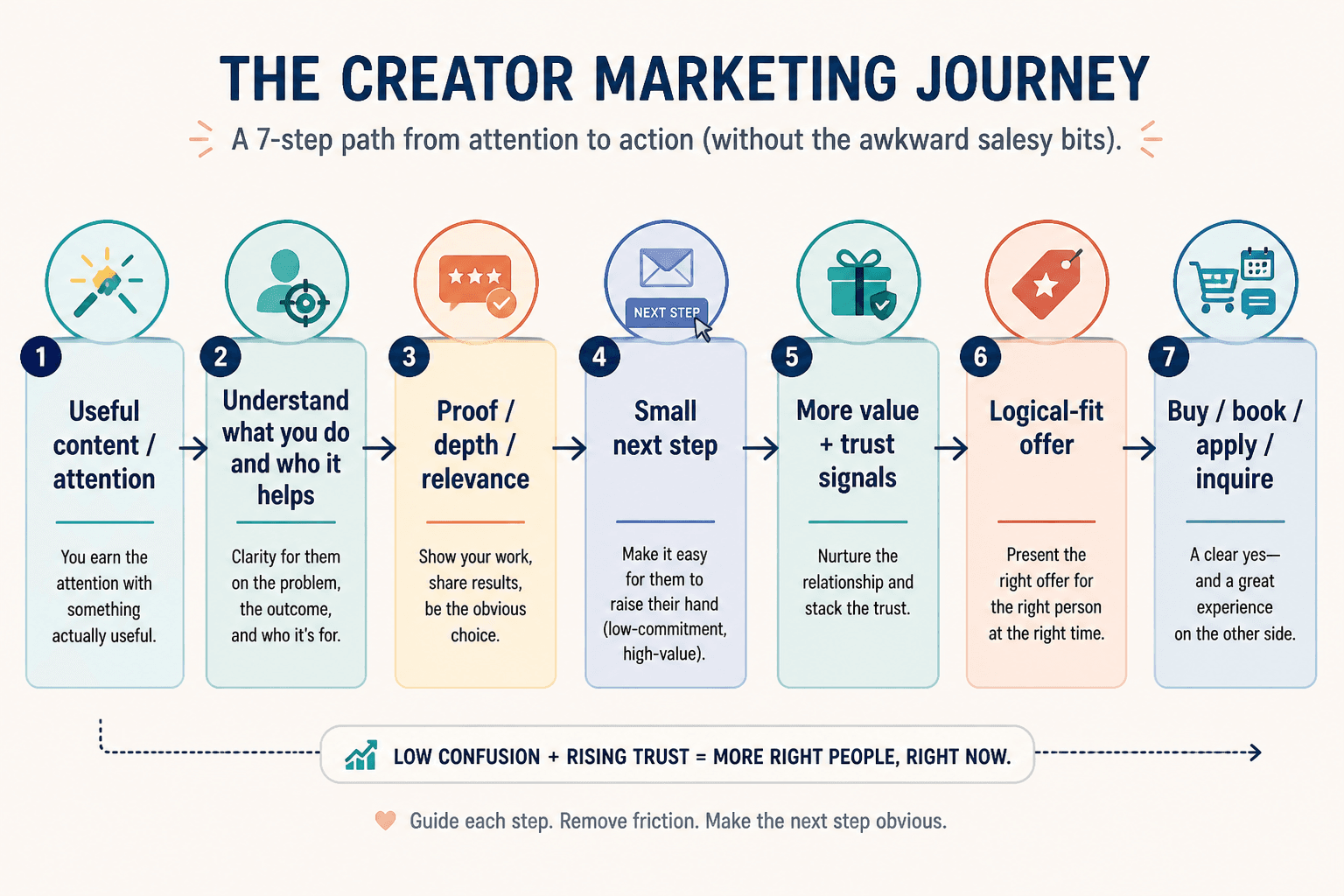
What an audience-to-offer journey actually needs
At minimum, the journey has to do four jobs in order:
- create attention with a relevant entry point
- build enough trust for the next step to feel safe
- make the next step feel proportionate, not dramatic
- introduce the offer as a logical continuation, not a jump scare
That sounds obvious until a journey is sitting in a draft and every step is trying to do three jobs at once. A post tries to educate, convert, and impress. A landing page tries to explain the offer, the creator’s life philosophy, and the history of civilization. Nothing flows. The reader gets tired and quietly leaves, which is the inbox equivalent of a shrug.
If you want the principle version of this, the parent guide on audience-to-offer journeys covers the structure. This article is about the workable versions.
What makes a journey work
The strongest journeys usually share the same traits:
1. The content and the offer match
If the audience came in for a beginner-friendly checklist, do not hit them with a high-commitment consulting pitch five seconds later. Matching topic, stage, and promise matters more than theatrical urgency.
2. The next step feels proportionate
A good journey does not ask for marriage after a first date. It asks for a small, reasonable action: download, subscribe, read, watch, reply, compare, book, buy.
3. Trust appears before pressure
People need evidence before they need persuasion. That evidence can be clarity, examples, specificity, proof, or a helpful resource that lowers uncertainty.
4. Friction gets removed before the offer shows up
Good journeys answer the unglamorous questions: What is this? Who is it for? Why now? What happens next? The best AI tools for audience-to-offer journeys can help draft variants, but the logic still has to be human.
5. The offer feels earned, not bolted on
The offer should feel like the obvious next stop after the reader has already seen the problem, the stakes, and the type of help available.
A simple creator journey framework
Most useful creator journeys can be mapped with this shape:
- Discovery – someone finds a useful post, reel, article, podcast clip, or thread
- Engagement – they click, save, read, watch, or subscribe
- Trust build – they get proof, clarity, examples, or a better understanding of the problem
- Consideration – they compare the offer to their current option, which is usually “keep guessing”
- Action – they opt in, reply, book, or buy
That framework is simple on purpose. It can support a lot of different creator businesses without pretending every audience behaves the same way. It also gives you a clean way to look at weak spots. If discovery is strong but action is weak, the issue is probably friction, mismatch, or timing. If trust is thin, the issue is likely the middle steps.
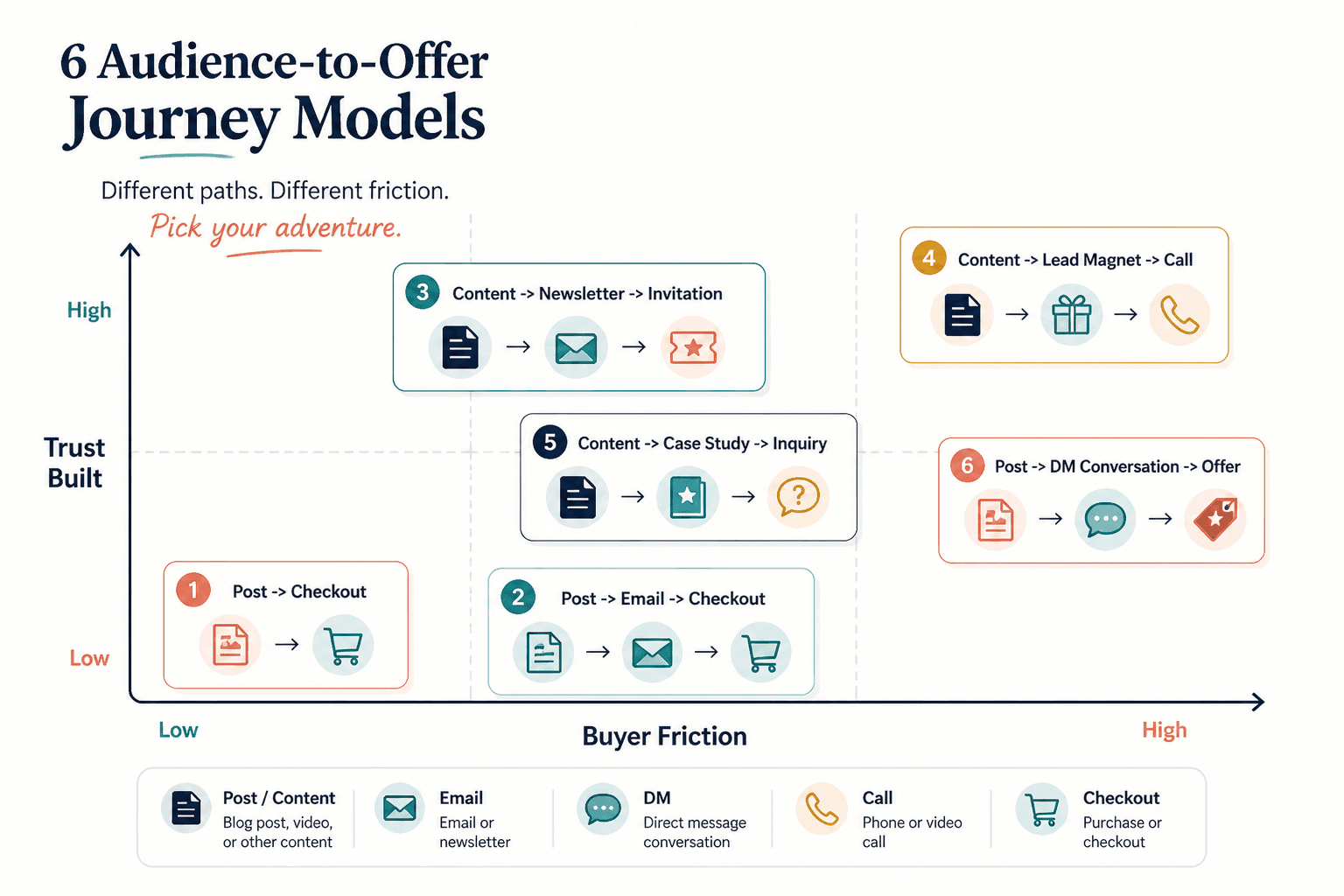
7 audience-to-offer journey ideas and examples you can adapt
These are not “real-world stories” in the personal-testimonial sense. They are practical composites: the kind of paths creators actually use when they want the content to lead somewhere useful.
1. Content post to lead magnet to nurture emails to service offer
This is one of the cleanest journeys for creators who teach a specific problem and sell a related service.
- Entry content: a post that names a painful, common issue
- Bridge: a lead magnet that helps diagnose or organize the problem
- Trust step: a short nurture sequence with examples, mistakes, and quick wins
- Offer: a service, audit, or done-for-you package
Example: a creator publishes “Why your content is getting saves but not sales.” The lead magnet is a funnel audit checklist. The email sequence explains three common leaks and shows how to fix each one. The final email introduces a strategy call or audit package as the next logical step.
This path works because it gives the reader a useful second layer before the ask appears. For a more conversion-focused angle, see how to turn audience-to-offer journeys into more leads or sales.
2. Problem-aware post to profile to case study article to consultation
This model works well when the creator’s audience already knows the problem but needs confidence in the solution.
- Entry content: a highly specific problem-aware post
- Bridge: a profile or landing page that explains who the creator helps
- Trust step: a case study, detailed example, or results article
- Offer: consultation, strategy session, or bespoke service
Example: a post on “Why your course sales email feels too vague” links to a profile that explains the creator’s positioning. From there, the reader reaches a case study article that walks through a better sequence. The consultation offer appears after the reader has enough context to understand why it would help.
This path is especially good when your offer needs explanation, not hype.
3. Short-form content to newsletter to soft pitch sequence to productized offer
This is a strong path for creators who want to turn lightweight attention into repeat exposure.
- Entry content: short-form post, thread, or clip
- Bridge: newsletter signup
- Trust step: a short series of practical emails
- Offer: productized service, toolkit, template pack, or small digital product
Example: a reel about “three content mistakes that make your offer sound too abstract” ends with a newsletter signup. The welcome sequence gives one concrete fix per email. The final email offers a compact template library or a low-friction product that helps the reader apply the advice immediately.
This is one of the best journeys when the initial content is broad but the paid offer is narrow and useful.
4. Comment conversation to DM resource to qualification step to offer
This path works when the audience is already engaged enough to talk back.
- Entry content: post that invites comments or replies
- Bridge: a direct resource sent after a real question or signal of interest
- Trust step: a short qualification conversation, form, or guided next step
- Offer: consultation, booking, or application-based service
Example: someone comments that they are stuck choosing between two offers. The creator sends a concise resource that compares the options, then invites the person to a short qualification form. If the fit is right, the offer becomes a conversation about next steps.
The benefit here is precision. The risk is getting too eager and turning a normal interaction into a miniature sales department. Resist that urge. It rarely has the charm one hopes for.
5. Retargeting path from article reader to case study to booked call
This is useful for creators with longer decision cycles or more considered services.
- Entry content: article, guide, or pillar page
- Bridge: retargeting ad or follow-up content aimed at readers who engaged
- Trust step: case study, example library, or FAQ page
- Offer: booked call or application
Example: a reader lands on a long article about audience-to-offer journeys and later sees a retargeting message that points to a case study page. The case study shows what changed, what the process looked like, and who the offer is for. The next page is a consultation CTA.
Retargeting should not just repeat the pitch louder. It should meet the reader at the stage they are actually in. That is the whole trick, and yes, it is annoyingly simple once it works.
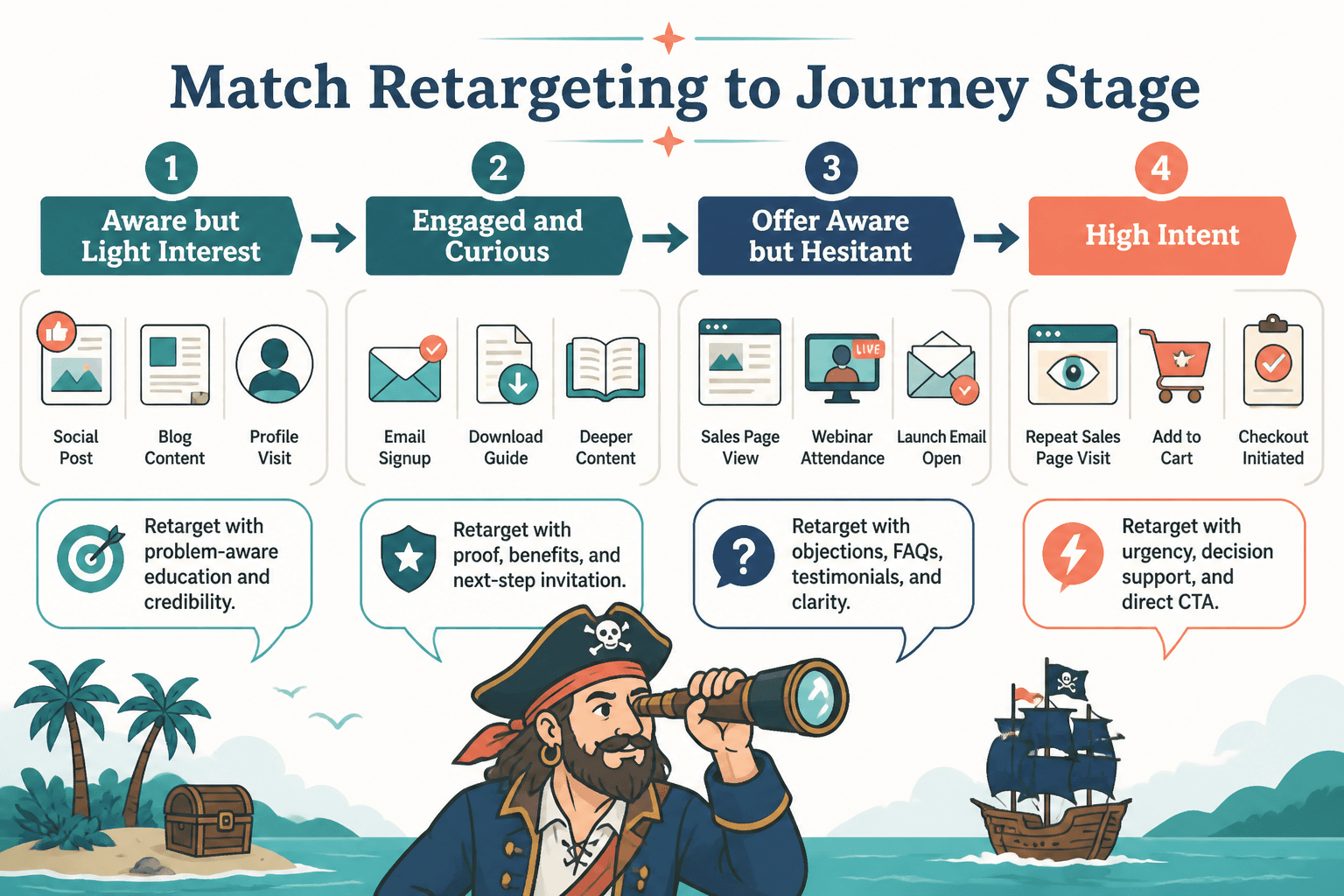
For a deeper version of this model, see better audience-to-offer journey retargeting ideas for personal brands.
6. Workshop or live event path to replay to low-friction offer
This is a strong fit for creators who teach live or want to create momentum around a limited-time event.
- Entry content: invite, announcement, or educational post
- Bridge: workshop registration or live event signup
- Trust step: replay, recap, or follow-up resource
- Offer: low-friction product, starter package, or next-step service
Example: a live session teaches a practical framework. The replay page includes a short summary and a related starter offer. The follow-up email explains how the offer helps people implement what they just learned without turning their week into a small disaster.
This works best when the live session genuinely creates movement, not just attendance.
7. Comparison or checklist content to decision page to purchase
This path is good when the audience is close to choosing but still needs a clearer distinction between options.
- Entry content: comparison post, checklist, or buyer’s guide
- Bridge: decision page that organizes the options
- Trust step: FAQ, examples, or proof section
- Offer: direct purchase or signup
Example: a creator publishes “How to choose the right audience-to-offer journey for your business.” The decision page shows which journey fits service providers, product creators, and newsletter-first creators. The page links directly to the relevant offer or resource.
This is one of the simplest journeys to maintain because it is mostly about clarity. Which, to be fair, is often the thing everyone keeps forgetting to build.
How to adapt a journey without making it weird
A lot of creators try to copy a model too literally. That is where the awkwardness starts. The useful approach is to adapt the sequence, not the wording.
- Keep the stage logic, change the format
- Keep the trust step, change the proof type
- Keep the offer match, change the entry content
- Keep the friction low, even if the funnel is longer
For example, a service business may use a post, a lead magnet, and a consult call. A product business may use a post, a newsletter, a comparison page, and a purchase. Same basic logic, different shape.
The useful question is not “What funnel do successful creators use?” It is “What path makes sense for this audience, at this stage, with this offer?” That question does more useful work than a dozen generic templates.
Common mistakes to avoid
- Making every step too promotional: the reader never gets a breather
- Skipping the trust step: the offer arrives before the reader is ready
- Using one journey for everyone: beginners and warm buyers are not the same audience
- Adding too many transitions: complexity is not the same thing as strategy
- Leaving the next step unclear: “learn more” is not a plan
One good way to spot problems is to map the journey on paper and ask where the reader would probably hesitate. If you can see three places where the page has to do emotional gymnastics, the journey probably needs a cleaner middle.
A quick audit checklist
Use this when you are reviewing a journey draft or fixing an underperforming one:
- Does the entry content clearly connect to the offer?
- Is the next step small enough to feel safe?
- Is there enough trust before the ask?
- Does each stage reduce uncertainty instead of adding it?
- Can the reader explain why the offer follows from the content?
- Is there a clean internal path from one step to the next?
You can also pair this with a structure review from the parent guide or with the example-heavy companion pages in this cluster. The page on audience-to-offer journey examples for coaches, consultants, and personal brands is especially useful if you want more applied variations.
Closing note
The best audience-to-offer journeys do not feel clever. They feel inevitable after the fact. The reader finds something useful, gets a better frame for the problem, and lands on an offer that seems like the sensible next move. Nothing mystical. Just a path that respects attention.
If you want to keep building the system, move next to the parent guide on audience-to-offer journeys, then branch into the other cluster pages as needed. That is usually enough structure to keep the whole thing from becoming polite chaos.