
When an audience-to-offer journey underperforms, the cost is not abstract. It wastes trust, creates weak leads, and leaves sales stuck behind a pile of polite attention. The reader showed up. The journey spent that attention on confusion, friction, or a sales step that arrived before the argument was ready.
The fix is usually not a louder offer. It is a better handoff. The path from content to profile to email to offer has to do real work, in the right order, without making the reader feel like they have been drafted into a small administrative trial.
This guide focuses on the conversion side of the journey: how to turn attention into leads or sales more reliably, without wrecking trust. If you want the broader structure first, start with how to write better audience-to-offer journeys or the parent guide on audience-to-offer journeys.
What actually has to happen before conversion improves
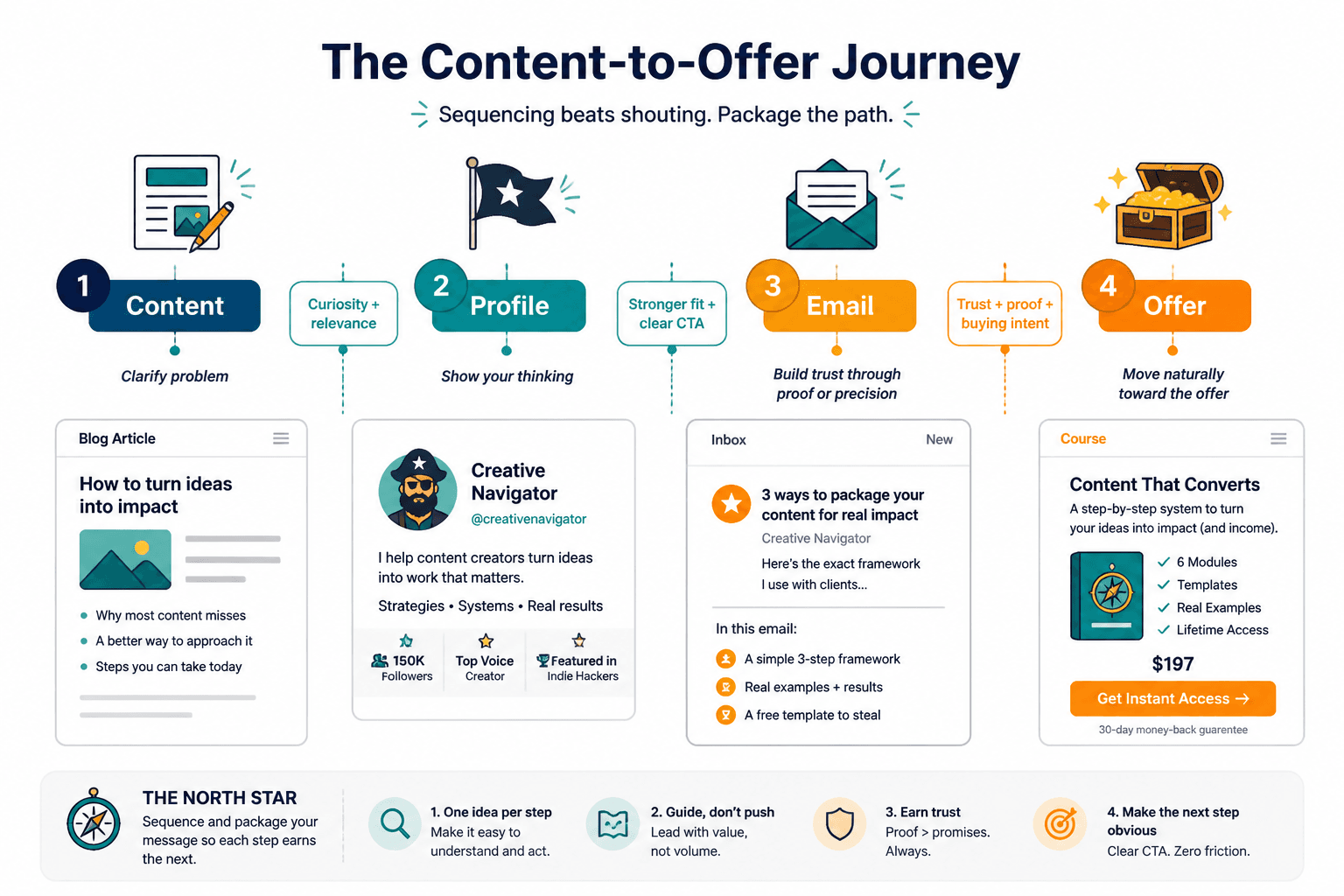
Conversions usually improve when the journey does four things in order:
- Earns attention. The content has a clear reason to exist.
- Builds trust. The reader gets useful, specific proof that the writer understands the problem.
- Signals fit. The audience can tell whether the offer is meant for them.
- Makes the next step obvious. The reader knows exactly what to do next and why that step is worth taking.
That sounds simple because it is. The hard part is that many journeys try to skip one of those jobs and then act surprised when the conversion rate behaves like it has seen a ghost.
Choose the right funnel shape for the audience and offer
Not every audience-to-offer journey should end in a sales page. Some should end in an opt-in. Some should end in a consultation. Some should move from content to profile to email before the offer shows up at all. The right shape depends on the audience, the commitment level, and how much proof the sale needs.
The related guide on best funnel ideas to pair with audience-to-offer journeys is useful here because it starts with the journey, not the tool. That matters. A funnel is not a decorative tube. It is a sequence that should move a specific reader toward a specific next step.
Ask five questions before you choose the funnel
- How aware is the audience? Are they problem-aware, solution-aware, or already looking for a provider?
- How expensive or commitment-heavy is the offer? A low-cost product needs less persuasion than a high-trust service.
- Is this best sold through content, conversation, or a sales page? Different offers need different handoffs.
- What does the audience need before they buy? Proof, clarity, comparison, reassurance, or a test drive?
- Where does the journey start? Social post, blog post, newsletter, referral, search, or a direct brand visit?
Those answers tell you whether the next step should be a lead magnet, an email sequence, a consultation, a landing page, or something more direct.
Use content to prepare the sale, not hide it
Content does not have to pretend the offer does not exist. That is usually where journeys get weird: the content becomes so careful and so open-ended that it never earns the right to ask for anything. The reader gets atmosphere instead of movement.
Preparation content should do at least one of these jobs:
- name the problem more clearly than the audience can name it themselves
- show what good looks like
- contrast the right approach with the wrong one
- build proof that the next step is worth taking
- reduce the fear of the offer by making the process feel understandable
If the journey is working, the content and the offer stop competing with each other. The content earns attention; the offer collects the consequence.
How to turn the journey into more leads
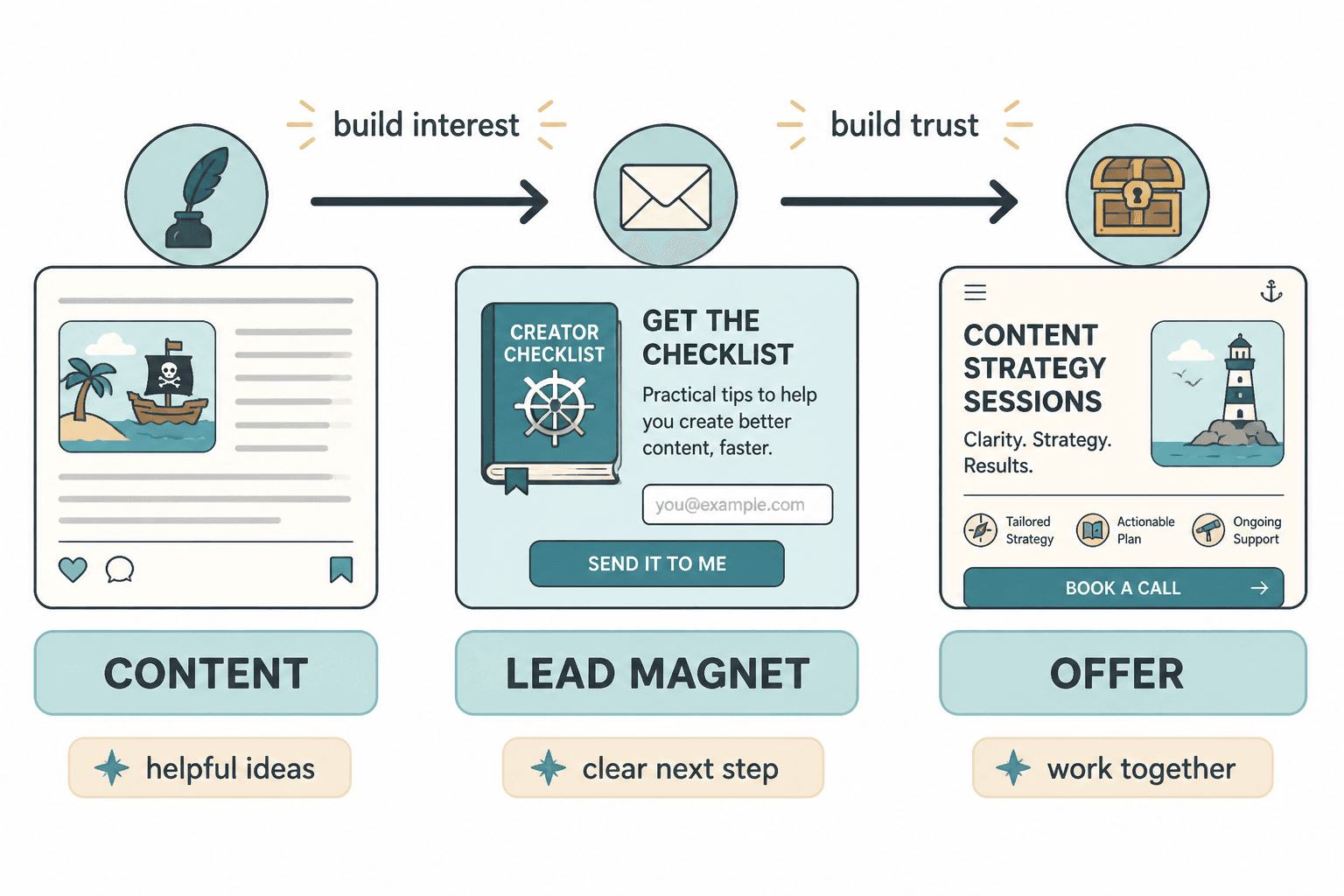
More leads usually come from making the first handoff easier and more specific. That does not always mean a bigger lead magnet. Sometimes it means a cleaner promise, a shorter form, or a better explanation of why the opt-in matters.
Lead-generating handoff patterns that tend to work
- Content → lead magnet → email sequence when the audience needs education before they are ready to buy.
- Content → consultation or discovery call when the offer is high-touch and trust-heavy.
- Content → landing page → email capture when the journey needs one focused conversion step.
- Content → profile → pinned offer → email when social proof and repeated exposure matter.
- Content → case study → resource page when the proof needs to show up before the sale.
The goal is not to create more steps for their own sake. The goal is to choose the smallest useful next action. Every extra click needs a reason to exist, or it becomes an expensive little mood.
Ways to improve lead conversion without changing the offer
- Make the lead magnet match the problem more closely.
- Use the same language in the content, opt-in, and email sequence.
- Reduce the number of fields on the form.
- Put the opt-in where the reader has enough context to say yes.
- Make the benefit concrete instead of clever.
If the audience is not converting to leads, the issue is often not traffic. It is fit, clarity, or timing.
How to turn the journey into more sales
Sales improve when the journey does a better job of pre-selling the offer before the offer appears. That means the reader should already understand what the offer solves, why it is relevant, and why now is the right moment.
For trust-heavy journeys, this is where the guide on how to monetize audience-to-offer journeys without wrecking trust fits nicely. Monetization should not feel like a trapdoor. It should feel like the obvious next step after a useful argument.
What strengthens the sales step
- Better proof. Not more hype. More evidence that this offer works for someone like the reader.
- Clearer positioning. The reader can tell who the offer is for and who it is not for.
- A stronger transition. The move from content to offer is explicit, not awkwardly hidden.
- Less distance. Fewer dead-end pages, fewer vague CTAs, fewer “learn more” buttons doing unpaid labor.
Sometimes the fastest path to more sales is to stop making the reader do interpretation work. A journey that asks for too much decoding is already charging a fee.
What trust-building usually needs before the offer
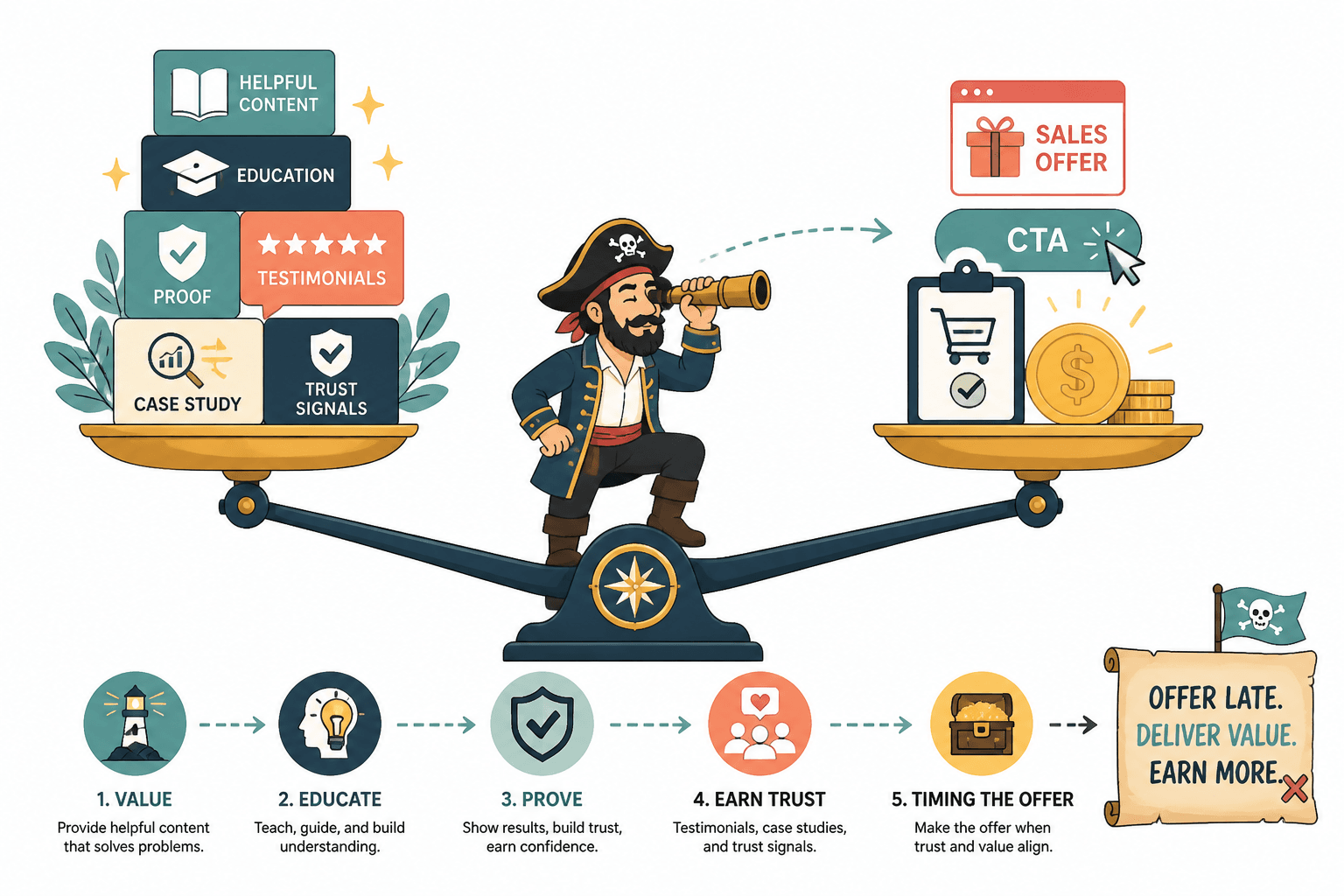
Trust is rarely built by one post. It usually accumulates through repeated proof that the writer understands the problem and can help solve it. That may come from examples, comparisons, frameworks, or a useful sequence of short pieces that each move the reader forward a little.
A simple trust sequence often looks like this:
- show the problem clearly
- explain why common fixes fall short
- demonstrate a better way
- offer the next step at the moment it makes sense
That sequence is not fancy. It is just ordered properly.
Common failure points that suppress leads or sales
1. The content is interesting but not directional
The reader enjoys it, but there is no movement toward a next step.
2. The offer appears too early
The journey asks for a sale before the reader has enough trust or proof.
3. The proof is generic
Vague claims and broad promises do not help a reader decide.
4. The next step is too complicated
Every extra decision lowers the odds of conversion.
5. The path is mismatched to the audience temperature
A cold audience may need education. A warm audience may be ready for a direct offer. Treating both the same is a tidy way to get mediocre results.
A practical audit for better conversion
Use this checklist to review a journey that should be producing more leads or sales:
- Is the audience clear on what problem this journey is addressing?
- Does each step earn the right to the next one?
- Is the CTA matched to the audience’s level of trust?
- Does the content build proof before it asks for action?
- Is the offer easy to understand in one pass?
- Are there any steps that add friction without adding value?
- Would a better funnel shape produce a stronger outcome?
If several answers are weak, the problem is usually not “more content.” It is sequence design.
Related resources
If you want to improve the journey itself before optimizing conversion, read how to write better audience-to-offer journeys. If you want a broader comparison of structures, see best audience-to-offer journeys ideas and examples for creators. If you are trying to choose a practical stack for the work, best AI tools for audience-to-offer journeys may help, as long as the tools stay in their lane.
For the surrounding strategy, the parent guide on audience-to-offer journeys and the companion article on best funnel ideas to pair with audience-to-offer journeys are the natural next reads.
Bottom line
More leads or sales rarely come from a heroic rewrite. They come from a cleaner journey: better fit, clearer proof, a smarter funnel shape, and a next step that makes sense at the moment it appears. Get the handoff right and the rest stops feeling like expensive busywork.
That is the whole game, unfortunately. No confetti cannon required.