
Most funnel advice falls apart for one simple reason: it starts with the tool, the page, or the tactic instead of the journey.
That is how people end up with a “funnel” that is really just a lonely landing page stapled to three panic emails and a Calendly link. Then they wonder why attention is not turning into leads, buyers, or anything remotely useful.
The best funnel ideas to pair with audience-to-offer journeys are the ones that match what your audience actually needs at each stage: awareness, trust, consideration, and action. Not every person who reads a post is ready to book. Not every subscriber needs a webinar. Not every offer deserves a 14-step nurture sequence wearing a fake mustache of sophistication.
Here’s the useful part: once you understand the type of journey your audience is on, choosing the right funnel gets much easier. You can stop forcing everyone through the same machine and start building paths that fit your content, offer, sales cycle, and level of trust.
If you are still tightening the bigger strategy behind this, read Audience-to-Offer Journeys Guide for Creators Who Want Better Results and the main audience-to-offer journeys hub. This article focuses on the practical part: which funnel structure makes sense for which kind of audience movement.
For the main guide behind this topic, visit the parent guide.
First: what a funnel is actually supposed to do
A funnel is not there to impress you with arrows.
Its job is simpler than that. A funnel should reduce friction between attention and action. It should help the right person go from “I’ve seen your content” to “I understand what you do, I trust you enough, and I know the next step.”
That means a good funnel usually does four things:
- Attracts the right kind of attention
- Organizes interest into a clearer next step
- Builds trust with proof, specificity, and relevance
- Makes the offer feel like the logical continuation, not a jump scare
When people say funnels feel sleazy, what they usually mean is this: the path moved faster than the trust did.
That is the real design problem.
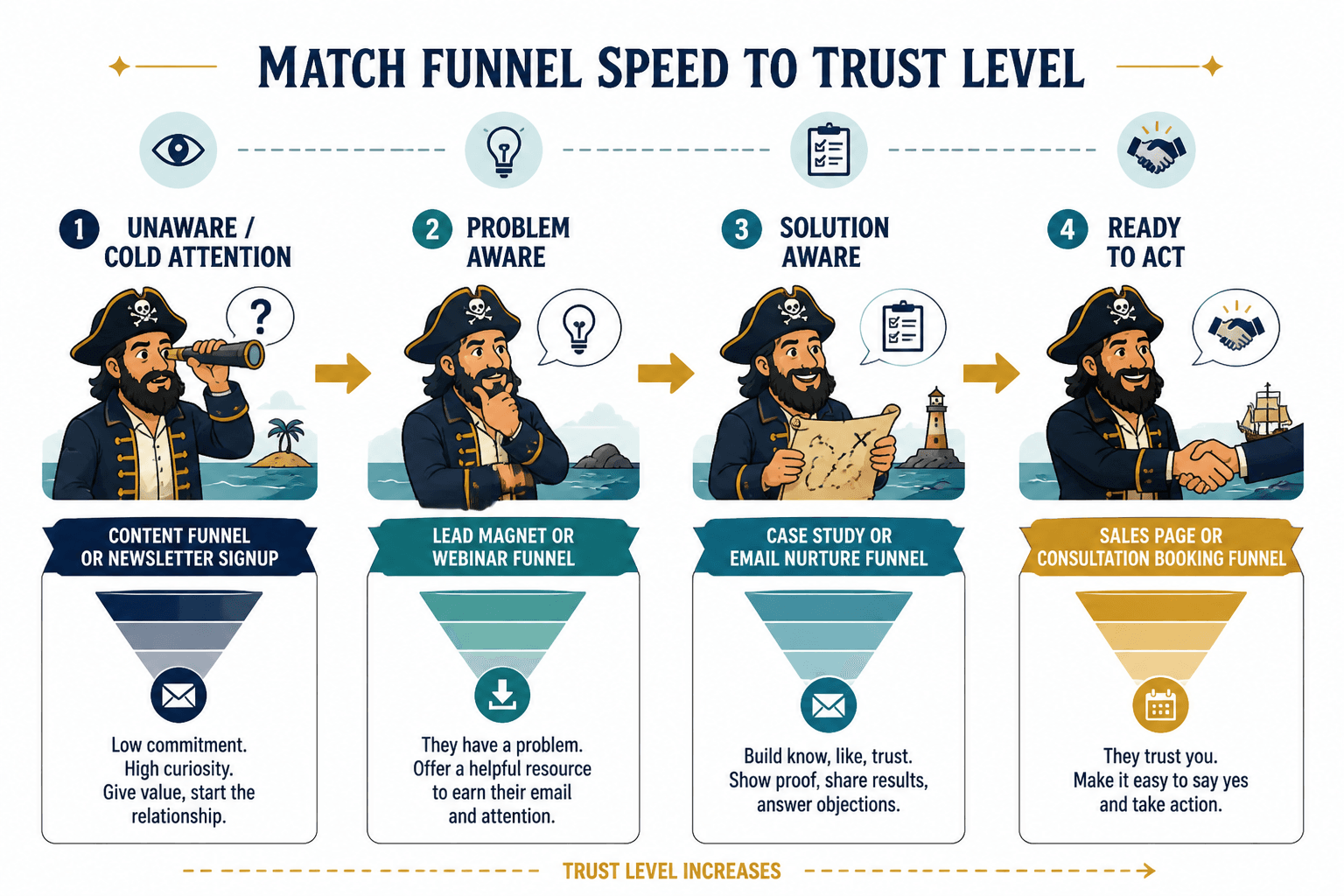
How to choose the right funnel for an audience-to-offer journey
Before picking a funnel, answer these five questions.
1. How aware is the audience?
If they barely know the problem exists, you need a softer trust-building path. If they already know the problem and are comparing solutions, you can move faster.
2. How expensive or commitment-heavy is the offer?
A $29 template pack does not need the same journey as a $5,000 consulting package. The more risk, cost, and commitment involved, the more proof and trust you need before asking for action.
3. Is the offer best sold through content, conversation, or a sales page?
Some offers convert well from a strong article and a clean checkout. Others need a call, a DM, or a nurture sequence because buyers have questions and context matters.
4. What does the audience need before they buy?
Do they need education? Examples? Proof? A quick win? Reassurance? Clarity on positioning? If you do not know this, your funnel will default to generic and annoying. Which, to be fair, is a very popular genre online.
5. Where is the journey starting?
A LinkedIn post, an article, a podcast clip, a referral, a webinar registration, and a profile visit all create different levels of intent. Different starting points need different funnel shapes.
If you want examples of how these journeys can look in practice, this guide to audience-to-offer journey ideas and examples is a useful companion piece.
Best funnel ideas to pair with audience-to-offer journeys
Below are the funnel structures that tend to work best for creators, coaches, consultants, solo founders, and personal brands. Not because they are trendy. Because they match real buying behavior better than “post harder and hope.”
1. Content to lead magnet to nurture to offer
This is one of the most reliable funnels for warm educational businesses. It works especially well when your audience knows they have a problem, but they are not yet sure your approach is the one they want.
Best for: coaches, consultants, service providers, creators with email-first strategies, and B2B personal brands.
Journey: post or article → free resource → email sequence → offer
Why it works: the lead magnet gives the audience a focused reason to step closer, and the nurture sequence lets you build trust gradually instead of trying to sell from one social post.
Good lead magnet types:
- Short frameworks
- Templates
- Checklists
- Diagnostic quizzes
- Mini case study breakdowns
- Tool stacks or resource lists
What people get wrong: they make the lead magnet too broad, too long, or too fluffy. Then the email sequence repeats the same generic advice and suddenly asks for a sale. That is not a funnel. That is a trust leak.
A better approach is to make the free resource narrowly useful and let the emails do one job each. One email clarifies the problem. One email teaches a better standard. One email shows proof. One email handles hesitation. One email points to the offer.
2. Content to profile to booking page
This is the simplest audience-to-offer funnel, and for many high-ticket service businesses, it is enough.
Best for: consultants, ghostwriters, strategists, fractional operators, and anyone selling a conversation-based service.
Journey: social post → profile → service page or booking link → call
Why it works: if the content is strong and the profile copy is clear, interested people often do not need a long nurture path. They just need confidence that you solve the right problem and a clean next step.
This works particularly well when:
- Your audience already understands the problem
- Your content demonstrates expertise clearly
- Your offer is custom or consultative
- Your profile and booking page do not look like they were assembled during a Wi-Fi outage
What to include on the booking page:
- Who the call is for
- What the call is about
- What happens after
- A few proof signals or outcomes
- A small filter so random people do not wander in asking for free consulting
If your content already builds trust well, adding a giant middle layer can actually lower conversions. More steps are not automatically smarter. Sometimes they are just more places for people to vanish.
3. Content to article to related offer
This is a great funnel when the buyer needs depth before they act. A post or thread sparks attention. A strong article does the heavier persuasion work. Then the offer appears as the natural next move.
Best for: expertise-driven creators, consultants, agencies, niche educators, and anyone with strong written content.
Journey: short-form content → long-form article → CTA to offer, lead magnet, or booking page
Why it works: articles let you explain nuance, show examples, and handle objections without sounding like a hungry sales page. This is especially useful when your audience is skeptical, analytical, or comparing several options.
For example, if you post about weak creator funnels on LinkedIn, the article could break down funnel structures by business model, include examples, and then link to your strategy service or resource.
The key is relevance. The offer should continue the exact conversation the article started. If your article is about lead magnets and your CTA suddenly points to a branding package, that disconnect will kill momentum.
4. Content to low-ticket product to higher-ticket offer
This is a strong journey if you have buyers who need a lower-risk first step before they trust you with something bigger.
Best for: creators with digital products, educators, consultants with DIY resources, and coaches with layered offers.
Journey: content → low-ticket product → customer nurture → premium offer
Why it works: buyers who have already paid you once are much warmer than subscribers who grabbed a freebie and disappeared into the woods.
Good low-ticket entry offers include:
- Templates
- Mini workshops
- Micro-courses
- Swipe files
- Diagnostic tools
- Resource bundles
But here is the catch: the low-ticket offer should actually relate to the higher-ticket one. If your $19 product attracts bargain hunters with no intent, it may create activity without creating qualified buyers.
The best version of this funnel gives people a quick result that makes them want the fuller transformation. It acts like a sample of your thinking, not a random side hustle product tossed into the mix.
5. Content to webinar or live training to offer
Yes, webinars still work. No, they do not need to feel like they escaped from 2018 internet marketing prison.
Best for: more complex offers, educational sales, group programs, cohort offers, or consulting services where buyers need more context.
Journey: content → webinar registration → live or evergreen training → offer
Why it works: a webinar gives you time to teach, position your method, address objections, and create momentum toward a clear offer.
What makes this funnel work now is not hype. It is clarity and restraint.
A good webinar:
- Solves part of the problem
- Shows a distinct point of view
- Uses examples and proof
- Makes the offer feel like the practical next step
A bad webinar spends 47 minutes inflating the pain, 8 minutes hinting at a secret framework, and 5 minutes making a pitch that feels emotionally dehydrated.
6. Content to soft DM conversation to offer
This is useful when the offer is high-trust, customized, or easier to sell through conversation than through a cold page.
Best for: consultants, service providers, coaches, and high-ticket B2B offers.
Journey: post → comment or reply → DM conversation → call or offer page
Why it works: some people do not want to book cold. They want to ask a question, test fit, and see if you understand their situation.
The phrase soft DM matters here. This is not “comment GUIDE and I’ll send you a pitch in disguise.” It is a conversation path for people showing genuine interest.
Use this when:
- You get thoughtful comments or replies already
- Your offer needs qualification
- Your buyers often have context-specific questions
- You can handle DM conversations without turning into an overcaffeinated chatbot
Done well, this funnel feels personal and useful. Done badly, it feels like networking with a trench coat full of hidden forms.
7. Content to email newsletter to recurring offers
This is one of the best long-game funnels for creators and personal brands. Instead of pushing one immediate conversion, you build an owned audience and create repeated chances to sell the right offer at the right time.
Best for: creators with multiple offers, educators, niche experts, writers, and service businesses with longer sales cycles.
Journey: social content → newsletter signup → ongoing value emails → periodic offers
Why it works: attention on social is rented. Email gives you repeat contact, more nuance, and better conversion opportunities over time.
This funnel shines when you do not want every post to carry the burden of immediate sales. Your posts earn attention. Your newsletter deepens trust. Your offers show up in a context where people are already used to hearing from you.
It also works well if you have several audience segments. You can use email tags, interests, or behavior to point people toward different offers more intelligently.
Tools can help here, especially when you need lead tracking, simple automation, and a sane way to manage moving parts. If you are comparing options, see best CRM tools and funnel builders for audience-to-offer journeys and best templates and tools for audience-to-offer journeys.
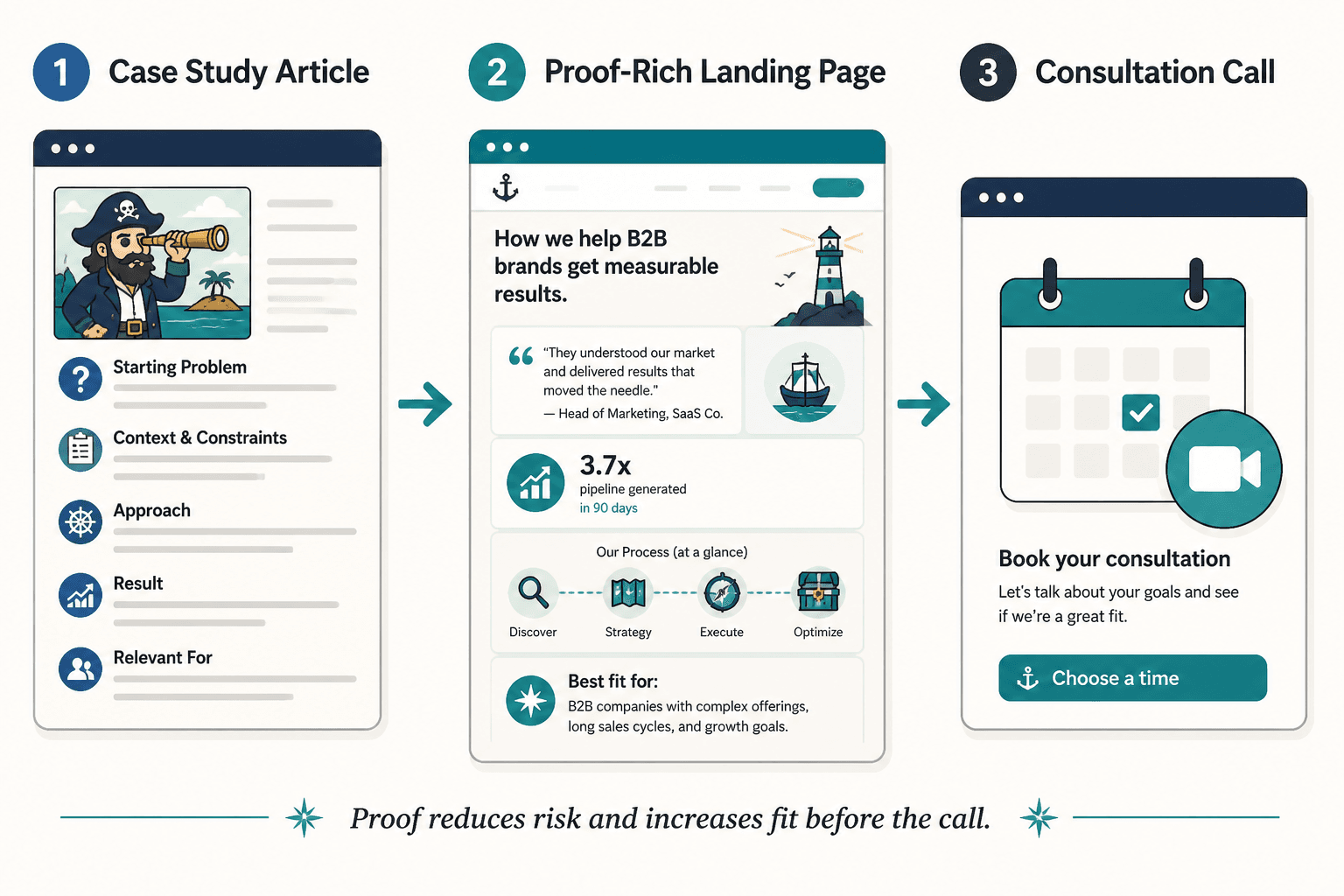
8. Case study to consultation funnel
If your audience buys when they see evidence, not inspiration, this one is excellent.
Best for: agencies, consultants, strategists, conversion specialists, copywriters, and operators selling measurable outcomes.
Journey: case study post or article → proof-rich landing page → consultation call
Why it works: proof reduces risk. A sharp case study gives people a concrete example of your process, your thinking, and the kind of result you help create.
The strongest case studies for this funnel usually include:
- The starting problem
- The context and constraints
- Your approach
- The result or progress made
- What kind of client this is relevant for
Do not make the mistake of writing case studies like polished fairy tales. The audience wants enough detail to trust the work, not a vague success montage with celebratory adjectives.
Which funnel fits which business model best?
| Business model | Best funnel options | Why they fit |
|---|---|---|
| High-ticket consulting | Content → profile → booking page; content → DM → call; case study → consultation | Trust and fit matter more than volume |
| Coaching | Content → lead magnet → nurture → offer; webinar → offer; newsletter → recurring offers | Buyers often need education and relationship |
| Digital products | Content → low-ticket product → upsell; content → article → offer; newsletter → launches | Clear value and relevance drive conversions |
| Agency services | Case study → consultation; content → booking page; article → service CTA | Proof and specificity reduce sales friction |
| Personal brand with multiple offers | Content → newsletter; content → lead magnet; segmented nurture paths | Different audience segments need different next steps |
How to avoid pairing the wrong funnel with the wrong journey
This is where a lot of creators quietly burn time.
They use a funnel built for a different trust level, a different offer type, or a different buyer mindset. Then they blame the CTA, the algorithm, or Mercury being emotionally unavailable.
Here are the mismatches to watch for.
Sending cold traffic straight to a high-commitment ask
If someone just discovered you through a post, asking them immediately to book a strategy call can work in some niches, but often it is too abrupt. They may need proof or a lower-friction next step first.
Using a long nurture sequence for a simple low-ticket offer
If the offer is inexpensive, obvious, and easy to understand, too much nurturing can actually slow buyers down. Not every sale needs a dramatic courtship.
Offering freebies that attract the wrong people
A free resource can grow your list while lowering lead quality if it solves a problem unrelated to your real offer. That kind of list growth looks nice until you try to sell.
Building one generic funnel for multiple audience segments
If you serve founders, consultants, and creators with different needs, one catch-all path may be too vague to convert any of them well. Segment where the differences actually matter.
Making the offer feel disconnected from the content
The best audience-to-offer journeys feel continuous. The content raises a relevant problem. The free or intermediate step deepens that conversation. The offer solves the next layer. If each stage feels like it came from a different marketing meeting, people drop.
A simple way to map your own funnel
If you want a practical way to build this without overengineering it, use this four-part mapping process.
- Pick one audience segment.
Do not start with everyone. Pick one clear buyer type with one main problem. - Define the offer and buying friction.
What is the offer, and what stops people from buying it sooner? - Choose the best bridge step.
What helps reduce that friction: a lead magnet, article, call, webinar, case study, DM, or low-ticket product? - Build the shortest believable path.
Not the fanciest path. The shortest one that still earns enough trust.
That last point matters. A lot of people build funnels as if every extra step makes them more legitimate. Usually it just gives people more opportunities to get distracted, confused, or mildly suspicious.
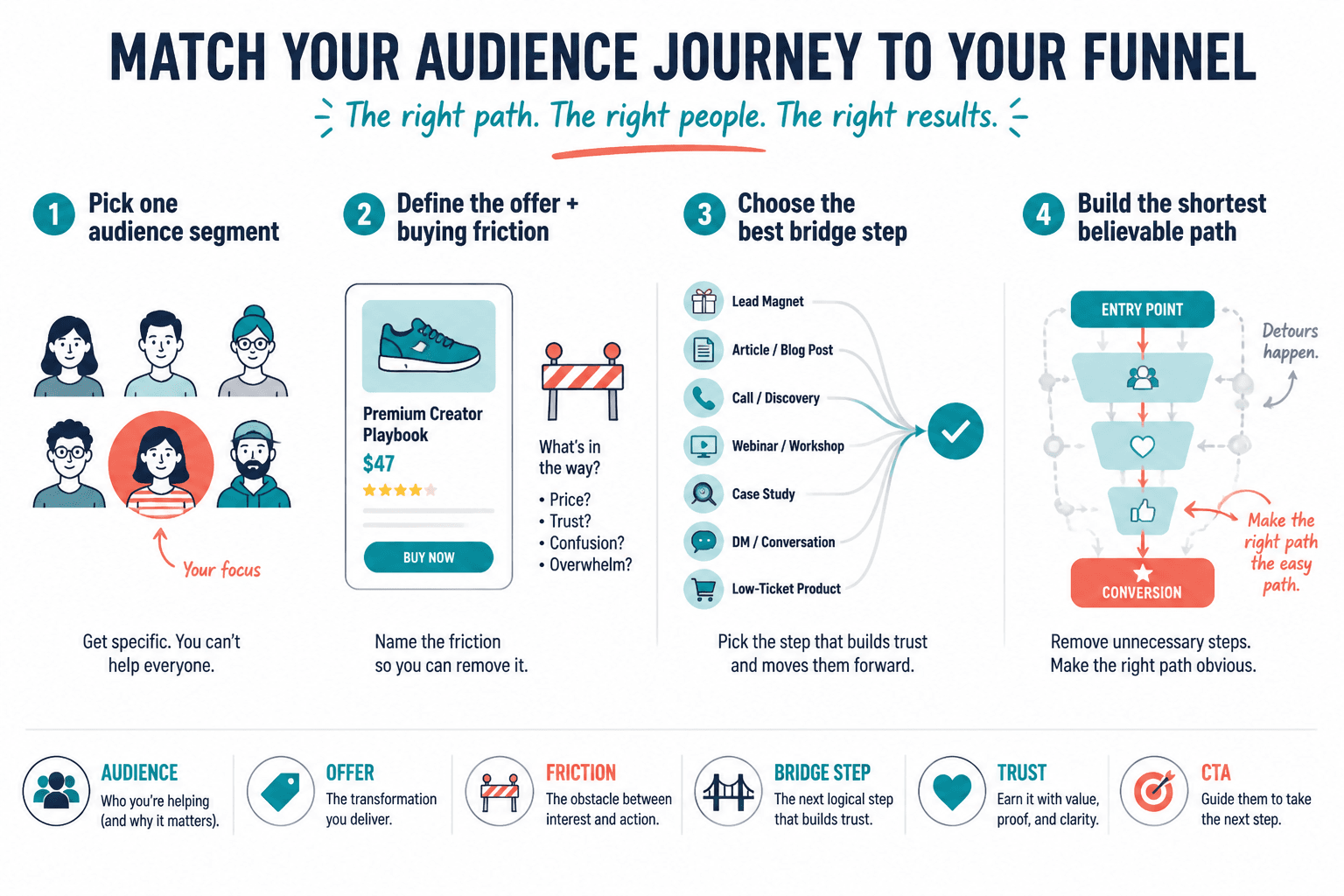
What a strong audience-to-offer funnel usually includes
Even though the structures vary, the best funnels tend to share a few traits.
- A clear entry point: a post, article, profile, referral page, or lead source with a specific message
- A relevant next step: not a random download or generic newsletter prompt
- Trust signals: proof, examples, process clarity, testimonials, or case studies
- Message consistency: the same core problem and promise across stages
- A low-friction CTA: easy to understand, easy to act on, easy to say yes to
- A sensible offer timing: not too early, not weirdly delayed
None of this requires a giant software stack. It requires clear thinking.
If you need a wider view of monetization pathways, the broader monetization funnels and funnel systems collection can help you map this in context.
FAQ
What is the best funnel for a small audience?
Usually one with a short trust path: content to profile to booking page, or content to lead magnet to nurture. Small audiences do better with relevance and conversations than with overbuilt automation.
Do I need a lead magnet for every funnel?
No. Lead magnets help when people need a reason to move off-platform, but they are not mandatory. Some offers convert better through articles, case studies, profile visits, or direct conversations.
How many steps should a funnel have?
As few as possible while still building enough trust. The right number depends on offer price, buyer awareness, and how much proof people need before acting.
Can social posts alone be the funnel?
Sometimes, especially for simple offers or highly trusted personal brands. But most businesses benefit from at least one bridge step: email, article, booking page, case study, or DM conversation.
Should I use one funnel for all my offers?
Usually no. Different offers have different buying friction. A low-ticket product, a group program, and a consulting package rarely need the exact same path.
Pick the funnel that matches the trust gap
The best funnel ideas to pair with audience-to-offer journeys are not the ones with the most steps, the most automation, or the most suspiciously enthusiastic copy.
They are the ones that match the trust gap between where your audience is now and what you are asking them to do next.
If the gap is small, keep the path short. If the gap is bigger, add a step that genuinely helps: education, proof, clarity, conversation, or a lower-risk entry point.
That is how you build a funnel that feels useful instead of pushy. It does not force people forward. It makes the next step make sense.
And frankly, that works better than pretending every reader is one countdown timer away from becoming your dream client.
The bigger point is simple: clearer structure and clearer writing make the piece more useful. That is usually what makes the ending land better too.