
Proof posts are supposed to make you more credible. Instead, a lot of them make people scroll faster.
That is the weird little tragedy of LinkedIn. Someone gets a good result, shares it badly, and turns what could have been trust-building content into a vague brag, a sales setup, or a screenshot with the strategic depth of a damp napkin.
LinkedIn Proof Post Mistakes That Hurt Performance usually are not about having weak results. They are about packaging those results in a way that feels self-congratulatory, confusing, thin, or suspiciously convenient. Readers do not hate proof. They hate proof posts that make them work too hard to understand the point, or worse, make them feel like they are being herded toward a pitch.
Here’s how to make your proof posts stronger, cleaner, and much more believable, without sounding like you stitched them together from three sales pages and a “thought leader” template pack.
To see how this fits into the wider strategy, open the parent guide.
What a proof post is actually supposed to do
A proof post is not just “look what happened.” It is content that uses evidence to reduce doubt.
That evidence can be a client win, a before-and-after, a process improvement, a revenue result, a lesson from live work, a testimonial, a campaign outcome, or even a small but meaningful shift in performance. The point is not the screenshot. The point is the reader thinking, “Okay, this person probably knows what they are doing.”
Good proof posts build trust because they connect four things clearly:
- the problem
- the action
- the result
- the reason it matters
Bad proof posts usually skip at least two of those, then act surprised when performance flops.
If you want a broader foundation for stronger posts in general, this is worth reading next: how to write better LinkedIn posts.
Mistake 1: Leading with the win instead of the relevance
A lot of proof posts open like this:
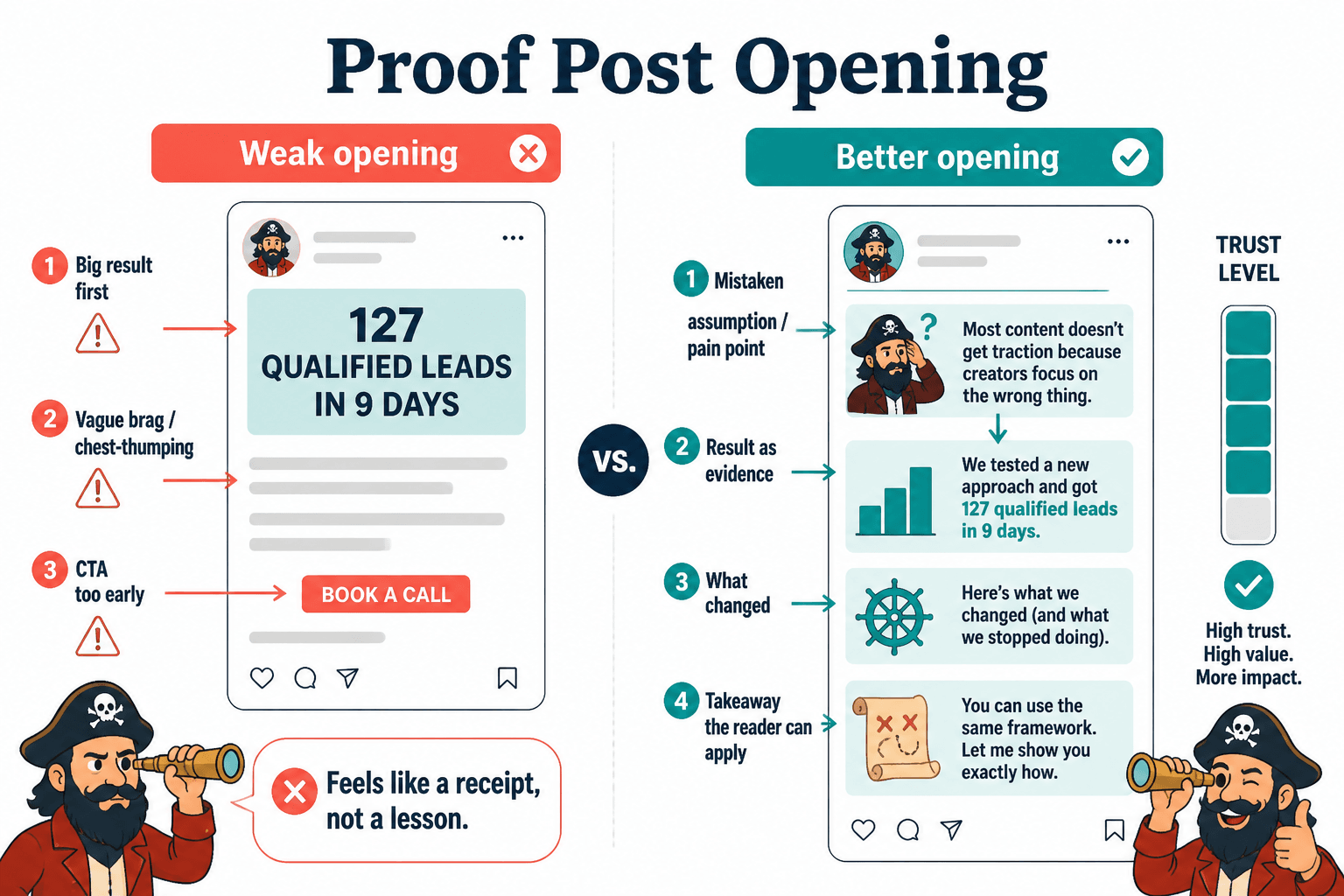
Just helped a client generate 127 leads in 9 days.
Is that impressive? Maybe. Is it automatically interesting? No.
Readers need context before they care. A raw number means very little without knowing who it was for, what changed, what kind of leads those were, how the result happened, or why this result is unusual. Big numbers with no framing often feel less credible, not more.
A stronger opening anchors the proof in a useful insight or relatable problem first.
Most LinkedIn lead gen posts fail before the CTA. They fail because the post never earns enough trust to make the CTA feel reasonable.
We fixed that for a client, and their next 9 days brought in 127 qualified leads.
Now the result has a frame. It is not just chest-thumping. It is attached to a point the reader can use.
Better way to structure the opening
- Start with the mistaken assumption, pain point, or bottleneck.
- Introduce the result as evidence.
- Show what changed.
- Translate the result into something the reader can apply.
Proof without relevance is just a receipt. And receipts are not automatically compelling content.
Mistake 2: Using screenshots as a substitute for explanation
People love posting screenshots because screenshots feel like evidence. Sometimes they are. Sometimes they are just tiny blurry rectangles asking strangers to do detective work.
A Stripe screenshot, dashboard clip, or testimonial crop does not explain itself. If the reader has to reverse-engineer what they are looking at, you are adding friction right where you should be building trust.
The screenshot should support the claim, not carry the whole post on its back.
What to explain around the proof
- What the result actually was
- What timeframe it happened in
- Who it was for, in a non-cringey way
- What changed to produce the result
- Why that matters beyond the number itself
For example, instead of posting a graph and saying “Good month,” say what the graph means:
This was not growth from posting more. It came from changing the offer framing in the post, tightening the profile CTA, and following up with people who commented with actual intent.
That gives the reader something useful. It also makes the proof more believable because you are showing the mechanism, not just the outcome.
Mistake 3: Making the post sound like a victory lap
There is a thin line between confidence and smugness. LinkedIn proof posts step on that rake all the time.
If the post reads like “look how brilliant I am,” people will quietly back away. Not because they hate success, but because self-congratulation creates distance. The reader stops seeing themselves in the post and starts feeling like they are trapped in someone else’s awards submission.
The best proof posts make the reader the hero of the lesson, not the author the star of the movie.
What this sounds like in practice
- Weak: Another client win. We keep crushing it.
- Better: One small messaging change helped this client convert more of the attention they were already getting.
- Weak: Proof that our framework works again.
- Better: This result came from fixing a mistake I see in a lot of LinkedIn posts: the content was solid, but the ask at the end was too abrupt.
You do not have to shrink the result. Just stop polishing it into a parade float.
If your proof posts keep sounding stiff or performative, it may help to study how to make them feel more human: how to improve LinkedIn posts story posts without sounding generic.
Mistake 4: Hiding the important part behind vague language
Vagueness kills proof posts faster than modest results do.
People will forgive a small win if it is clear and relevant. They will not trust a big win described in mushy language like:
- “scaled massively”
- “huge growth”
- “amazing results”
- “incredible engagement”
- “transformed their brand”
Those phrases say almost nothing. They sound inflated because they are inflated.
Specificity is what makes proof credible. Not hype. Not adjectives. Not the phrase “results speak for themselves,” which usually means the writer could not be bothered to explain them.
Weak vs stronger proof language
| Weak | Stronger |
|---|---|
| We increased engagement a lot | The post format change doubled comments from decision-makers over 3 weeks |
| The launch did really well | The launch brought in 18 qualified calls from one email plus three LinkedIn posts |
| The profile started converting | After rewriting the headline and CTA, profile visits turned into 11 inbound leads in a month |
You do not need to reveal private client data or write a forensic report. But you do need enough specificity for the reader to believe there is something real here.
Mistake 5: Sharing the result without the path
This is one of the biggest reasons proof posts underperform. They show the destination and skip the route.
Readers do not just want to know that something worked. They want to know why it worked, or at least what changed. Otherwise the post has no practical value beyond “someone somewhere had a nice Tuesday.”
You do not need to spill your entire process. But you should reveal enough to create insight.
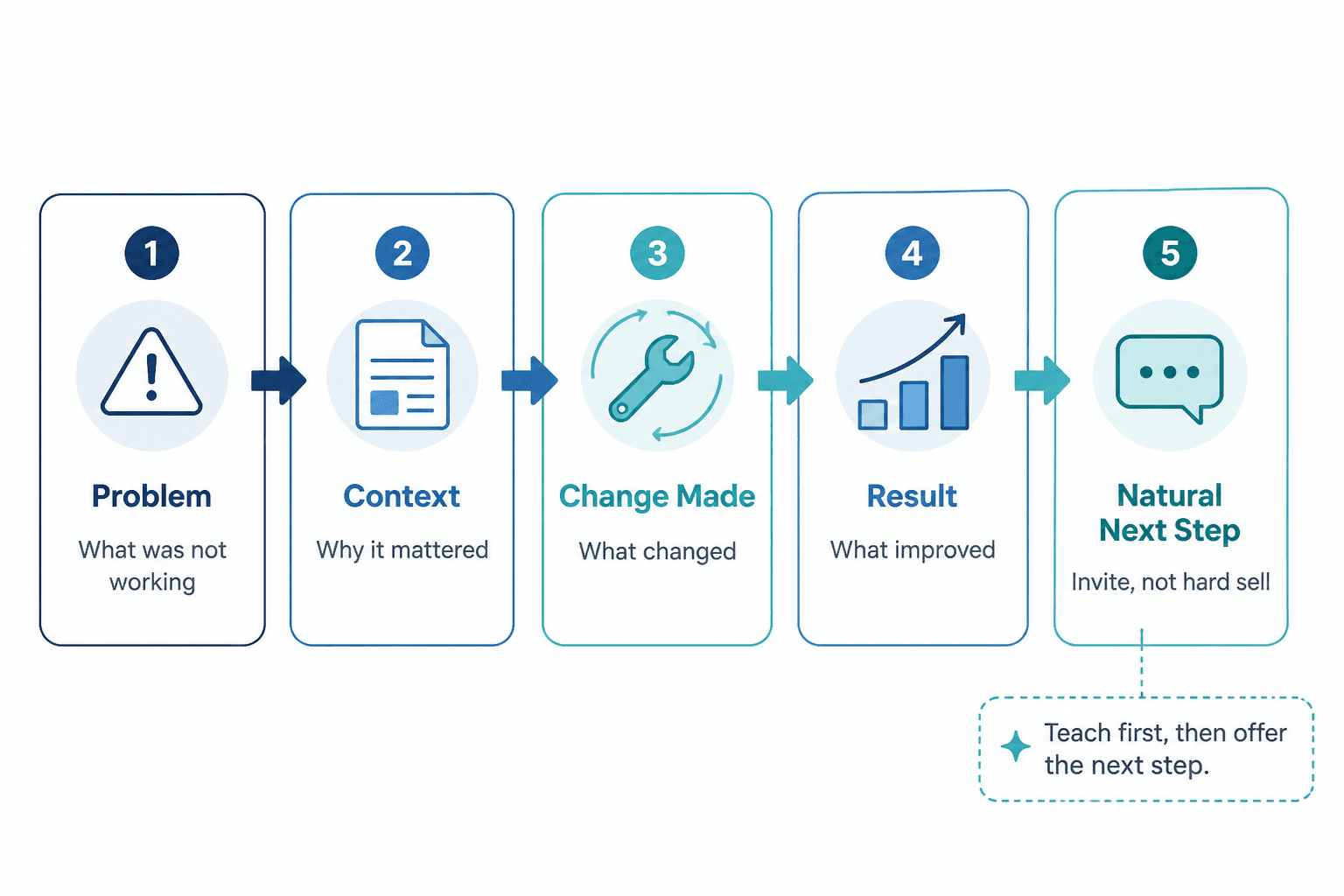
A simple proof post framework that works better
- Name the problem or bottleneck.
- Show the change you made.
- Share the result.
- Explain the lesson or principle.
- End with a next step, question, or soft CTA.
Here is a simple example:
A client’s LinkedIn posts were getting saves and likes but almost no inbound leads.
The problem was not reach. It was the jump from useful post to awkward CTA.
We changed the post endings to make the next step feel natural, not forced.
Over the next month, inbound inquiries increased without posting more often.
A lot of content does not need better ideas. It needs a better bridge between trust and action.
That works because it teaches while it proves.
If your endings are where your posts get weirdly salesy, this companion piece will help: better LinkedIn posts CTA endings for personal brands.
Mistake 6: Turning proof into a disguised pitch too fast
This one hurts performance because people can smell it immediately.
The post starts with a client result, then by paragraph three it is already shuffling the reader toward “DM me RESULTS” or “Comment GROWTH and I’ll send the framework.” That can work sometimes. It can also make the whole thing feel engineered, because it often is.
Proof posts should increase trust first. The pitch, if there is one, should feel like a logical next step, not the entire reason the post exists.
What to do instead
- Teach something small before asking for anything
- Use a soft CTA tied to the lesson
- Invite conversation rather than forcing a keyword gimmick
- Make sure the post still works even if nobody clicks or comments
A decent soft CTA might look like this:
If your posts get polite engagement but weak business results, the gap usually is not effort. It is structure.
I’ve written more about that here: how to rewrite boring LinkedIn posts.
That feels more useful and less like a trapdoor into a funnel.
Mistake 7: Using proof that your audience does not actually care about
Not all proof is persuasive to all people.
A creator may care about replies, shares, or inbound collaborations. A consultant may care more about booked calls, lead quality, and conversion rates. A founder might care about pipeline, retention, or trust with a specific niche. If your proof does not match your audience’s priorities, it will not land, even if the result is real.
This is where people get a bit lazy. They post the easiest available metric instead of the most meaningful one.
Choose proof that fits the reader’s intent
| If your audience is… | More useful proof often looks like… |
|---|---|
| Coaches and consultants | Booked calls, lead quality, sales conversations, authority signals |
| Writers and creators | Saves, replies, shares, subscriber growth, inbound opportunities |
| Founders | Pipeline movement, demand quality, sales cycle improvement, positioning clarity |
| Freelancers | Better-fit leads, higher rates, repeat work, easier referrals |
The more your proof connects to a real business outcome your audience already wants, the stronger the post becomes.
Mistake 8: Forgetting that proof posts still need to be good posts
This should be obvious, but LinkedIn is generous with reminders.
Some people seem to think that because a post contains proof, it no longer needs a strong hook, clean formatting, decent pacing, or a readable structure. It absolutely does. A result does not excuse bad writing.
If your first line is dull, the proof may never get seen. If the post is a heavy wall of text, fewer people will stick with it. If the sequence is messy, the proof feels weaker because the explanation feels weak.
Quick formatting fixes that help
The bigger point is simple: clearer structure and clearer writing make the piece more useful. That is usually what makes the ending land better too.
LinkedIn posts usually improve when the point gets clearer and the fluff gets shorter. Stronger usefulness tends to outperform polished vagueness.