
Better LinkedIn posts are not mostly a matter of posting more, sounding more polished, or sprinkling in the platform’s favorite buzzwords like confetti at a very dull parade. They usually improve when the post has one clear point, sounds like a person who has actually thought about the subject, and gives the reader a reason to keep going after the first line.
If you want the broader system around LinkedIn writing, start with the LinkedIn posts guide. This page is the practical version: how to make the posts themselves cleaner, sharper, and easier to finish.
What better LinkedIn posts actually do
A better LinkedIn post is not necessarily louder, longer, or more “engaging” in the abstract. It does a job.
That job is usually one of these:
- earn attention fast
- make a point the reader can use
- signal credibility without sounding like a plaque on a wall
- move the reader toward a next step
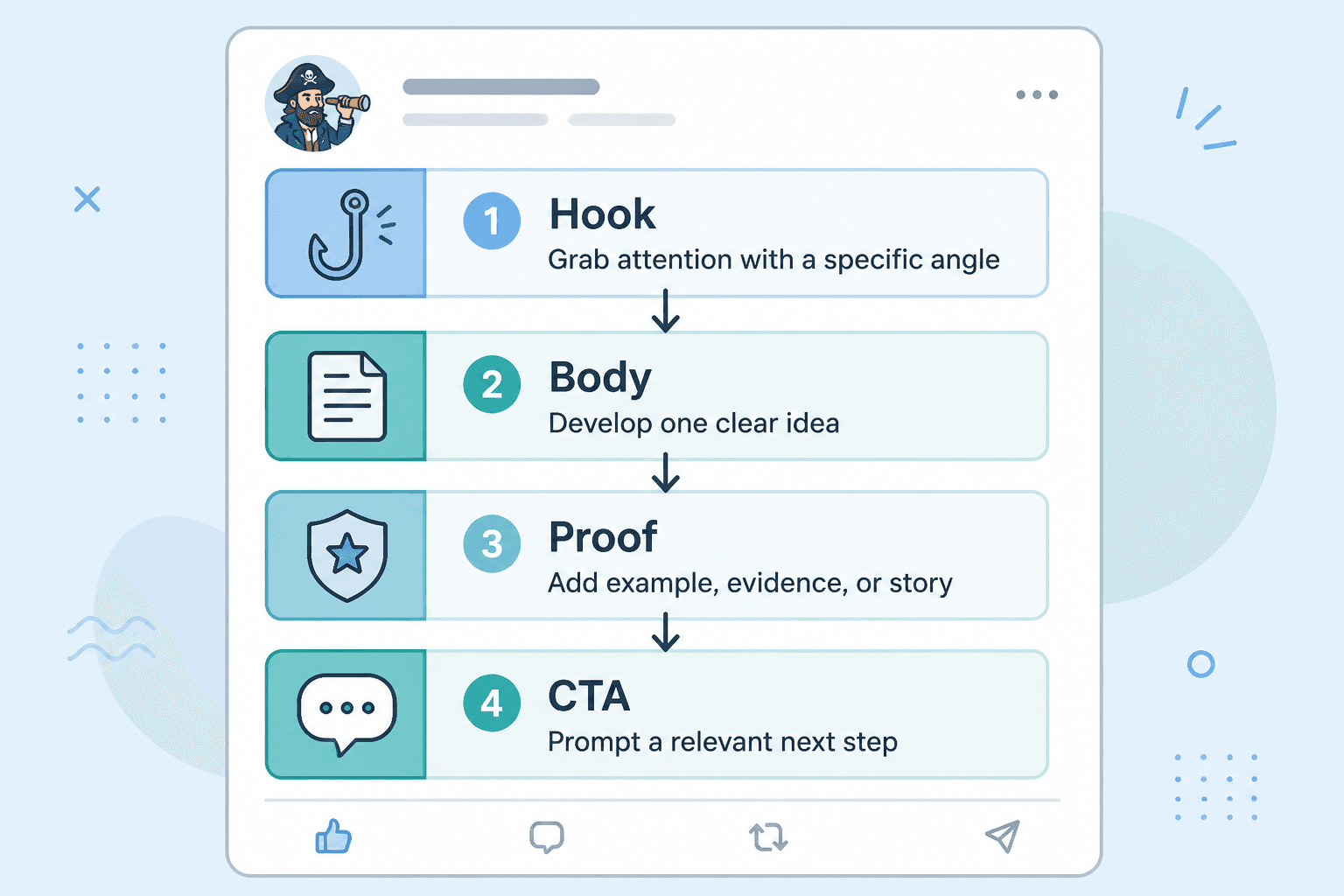
That is why writing better posts is less about creative fireworks and more about structure. A useful post usually has a clear hook, a body that stays on track, and an ending that does not suddenly sprint into a sales pitch wearing clown shoes.
Why most LinkedIn posts underperform
Most weak LinkedIn posts do not fail because the idea is terrible. They fail because the execution never gives the reader a reason to care.
They open with nothing
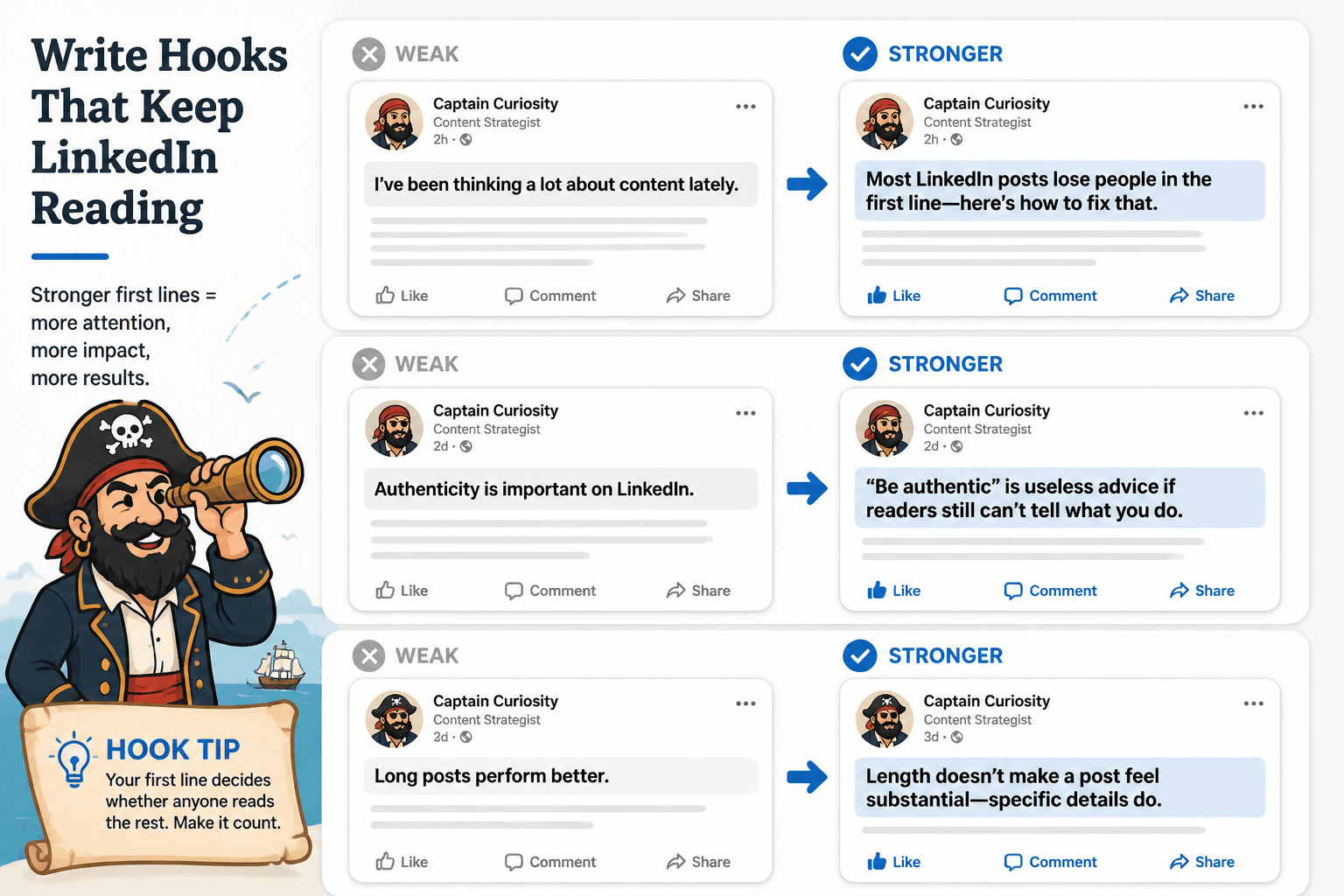
“Hope you’re all doing well” is not a hook. It is a hallway. The reader keeps walking.
Strong openings create tension, curiosity, contrast, or immediate relevance. They tell the reader, in effect: stay, this goes somewhere useful.
They are too generic to matter
Vague writing feels safer while drafting and weaker after publishing. “Lessons I’ve learned” and “thoughts on growth” can mean almost anything, which is another way of saying they mean very little.
Specificity gives a post weight. A concrete problem, a named mistake, or a narrow lesson is easier to trust than a foggy announcement of wisdom.
They sound polished in the worst way
There is a special strain of LinkedIn writing that reads like it was processed through a corporate mission statement before it reached the keyboard. It is technically smooth, but it has no pulse.
For a cleaner version of this problem, see how to write LinkedIn posts without sounding salesy or robotic.
They ask for too much too early
Some posts try to generate trust, interest, agreement, and a lead all in the first breath. That is a lot of emotional labor for one paragraph.
Better posts move in sequence: get attention, deliver something useful, then ask for the next step only if it fits.
Start with one sharp point
The best LinkedIn posts usually start with a single clear idea, not a summary of your entire professional worldview.
Before you write, ask:
- What is the one thing I want the reader to understand?
- What problem, tension, or mistake does this post address?
- Can I say it in one sentence without padding?
If the first sentence is carrying three jobs, it is probably doing none of them well. A sharp post gives the reader one reason to continue, not a committee memo with line breaks.
For more opening patterns, use how to start LinkedIn posts without a weak opening alongside this article.
Make the body easy to follow
Once the hook does its job, the body needs to earn the next few seconds of attention. That usually means simple structure, not dramatic prose.
Good body copy on LinkedIn tends to do a few things well:
- moves in a sensible order
- uses short paragraphs
- cuts the throat-clearing
- adds an example, reason, or detail before drifting
If the reader has to mentally rebuild the post while reading it, the post is working too hard against itself. Clarity beats cleverness more often than writers like to admit.
When a draft feels bloated or vague, it helps to run it through the same cleanup process used in how to rewrite boring LinkedIn posts. That page is useful when the problem is less “bad idea” and more “buried idea.”
Use specifics, proof, and useful contrast
Specificity is one of the fastest ways to make a LinkedIn post feel more credible. Not because details are decoration, but because details prove you are talking about something real.
Useful specifics can include:
- a narrow example
- a before-and-after comparison
- a mistake someone keeps making
- a small but telling result
- a practical constraint most readers will recognize
Proof works the same way. A screenshot, number, or concrete outcome helps only if you explain why it matters. Raw proof without context is just a trophy photo.
If your post is built around evidence or results, the companion piece LinkedIn proof post mistakes that hurt performance is worth a look.
A simple test for vague writing
- Could this line apply to almost anyone?
- Does it state a real observation or just a generic belief?
- Would a reader learn something specific from it?
If the answer is “not really,” tighten it. Broad language is often the draft version of a point that never finished forming.
Pick the right length for the job
Length matters, but mostly as a consequence of fit. A post should be as long as it needs to be to do its job, and not one paragraph longer out of habit or anxiety.
Short posts work well when:
- the point is simple
- the hook already does most of the work
- the reader does not need much context
Longer posts work better when:
- you need to explain a process
- the lesson depends on nuance
- the reader needs enough context to trust the point
That tradeoff is explored more fully in how long LinkedIn posts should be in 2026 and when short LinkedIn posts beat long ones.
End with a CTA that fits the post
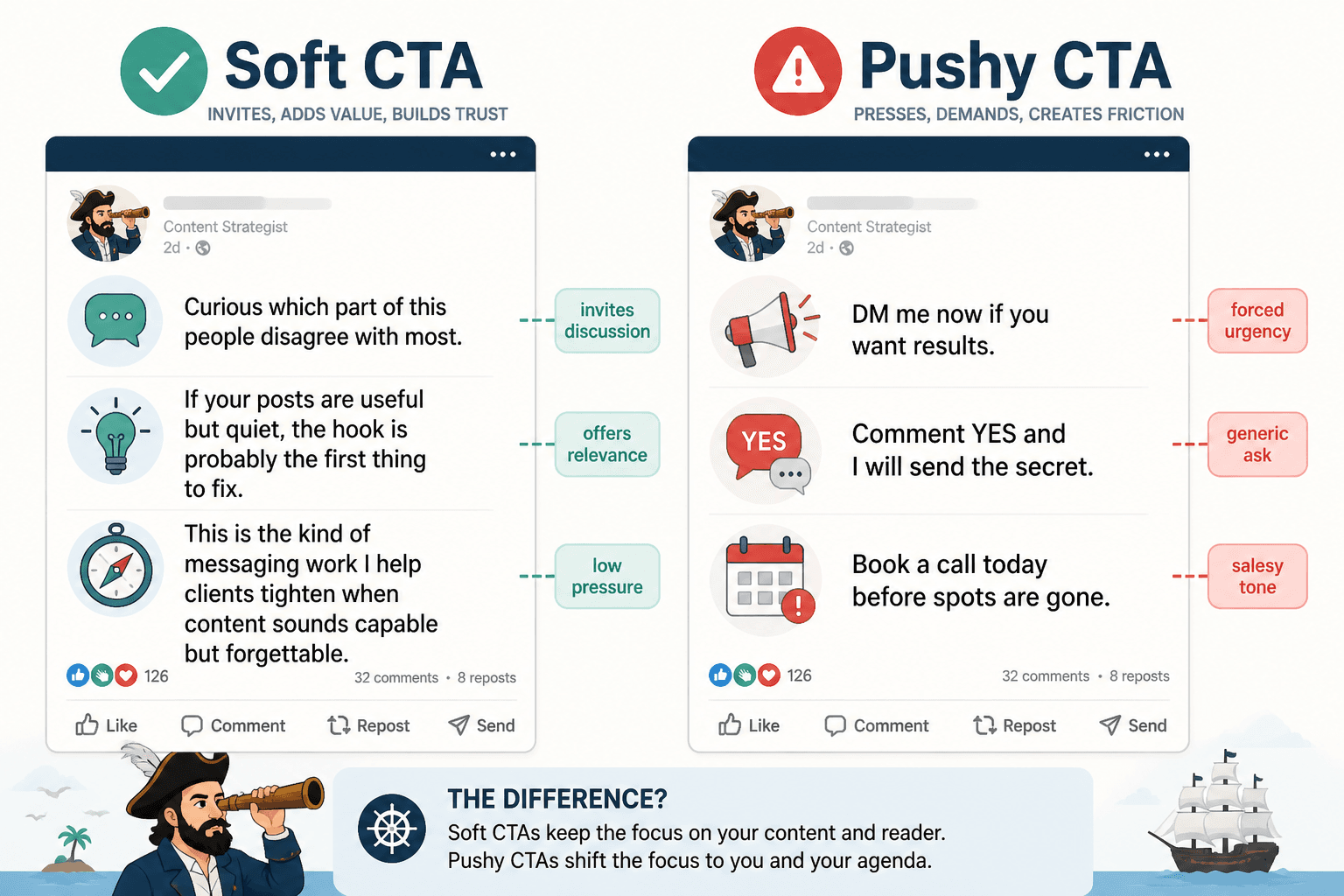
The ending should feel like a continuation of the post, not a separate personality disorder.
Strong LinkedIn CTAs are usually one of these:
- a next step for a reader who wants more
- a soft invitation to reply or connect
- a prompt to read something related
- a simple conversion step that matches the topic
Weak endings tend to be either too timid to matter or so aggressive they make the post feel like a trapdoor. Neither is ideal.
If you want the ending to do more of the heavy lifting, see better LinkedIn CTA endings for personal brands and how to turn LinkedIn posts into more leads or sales.
A practical editing checklist for better LinkedIn posts
Before you publish, run the post through this quick check:
- Does the first line create a reason to keep reading?
- Is there one clear point?
- Did I remove generic filler?
- Did I add at least one concrete detail, example, or proof point?
- Is the structure easy to scan?
- Does the ending match the purpose of the post?
If a draft fails two or more of those checks, it usually needs tightening, not more polishing. Polishing is for finished surfaces. A weak idea with shine is still a weak idea.
Where this fits in the larger LinkedIn system
Writing better posts is one piece of the larger workflow: choosing ideas, shaping them into the right format, and making sure they support whatever happens next. That is why the surrounding guides in the cluster matter.
Use this article for the writing part, then move outward as needed:
- LinkedIn post ideas and examples for creators when you need a stronger angle
- best AI tools for LinkedIn posts when you need help drafting or refining faster
- how to turn LinkedIn posts into more leads or sales when the post is part of a conversion path
The useful goal is not to make every post perfect. It is to make each one clearer, more useful, and less likely to disappear into the feed like a thoughtful note dropped behind the couch.