
If you are still looking for one perfect LinkedIn post length, you are looking for a rule that does not exist.
That is the annoying answer, but also the useful one. The right length depends on what the post is trying to do. Reach post? Different length. Story post? Different length. Proof-heavy authority post? Different again. A lot of creators do not have a length problem at all. They have a weak idea, a slow opening, or a post that needed editing and never got it.
So, how long should LinkedIn posts be in 2026? Long enough to make the point clearly. Short enough to keep momentum. That sounds simple because it is simple. It is just not easy if your posts ramble, hedge, or spend six lines warming up before saying anything useful.
This article will help you choose the right LinkedIn post length based on your goal, your idea, and how people actually read on the platform. We will cover practical ranges, when short posts beat long ones, when longer posts earn their keep, and how to stop writing posts that feel like they were inflated with recycled air.
To see how this fits into the wider strategy, open the parent guide.
How long should LinkedIn posts be in 2026? The practical answer
For most creators, consultants, coaches, and personal brands, strong LinkedIn posts usually land somewhere between 80 and 300 words.
That is the sweet spot for a lot of content because it gives you enough room to make a point, add a little proof or texture, and end with something worth responding to. Not every post should live there, but many of the best ones do.
Here is a cleaner way to think about it:
| Post length | Best for | Main risk |
|---|---|---|
| 30–80 words | Sharp opinions, quick observations, one strong insight | Too vague or underdeveloped |
| 80–150 words | Strong hooks, concise lessons, punchy authority posts | Rushing past proof |
| 150–300 words | Most practical advice, mini-stories, useful takeaways | Minor fluff and repetition |
| 300–600 words | Deeper storytelling, nuanced arguments, case-study style posts | Losing momentum |
| 600+ words | Rare posts with real substance, strong narrative, or dense insight | Padding, weak retention, self-importance |
If you want one default rule, use this: write the shortest post that still feels complete.
Most people do the opposite. They write until they feel like they have “covered everything,” which is how you end up with 480 words explaining an idea that had 130 words of actual value.
Length is not the main variable. Fit is.
People love asking about word count because it feels measurable. Neat. Spreadsheet-friendly. Weirdly comforting. But LinkedIn does not reward “274 words” as a magical category. Readers respond to posts that match the job they are trying to do.
A short post works when the idea is sharp enough to stand on its own. A longer post works when the extra length adds tension, proof, specificity, or a payoff worth staying for. Both fail when the post drifts, repeats itself, or opens like a timid email from middle management.
So before you ask how long the post should be, ask these instead:
- What is this post trying to do?
- How much proof does this idea need?
- Can the point be understood quickly?
- Is there a story here, or just an opinion?
- Will extra length deepen the post or dilute it?
That is the real decision-making framework. Length comes after that.
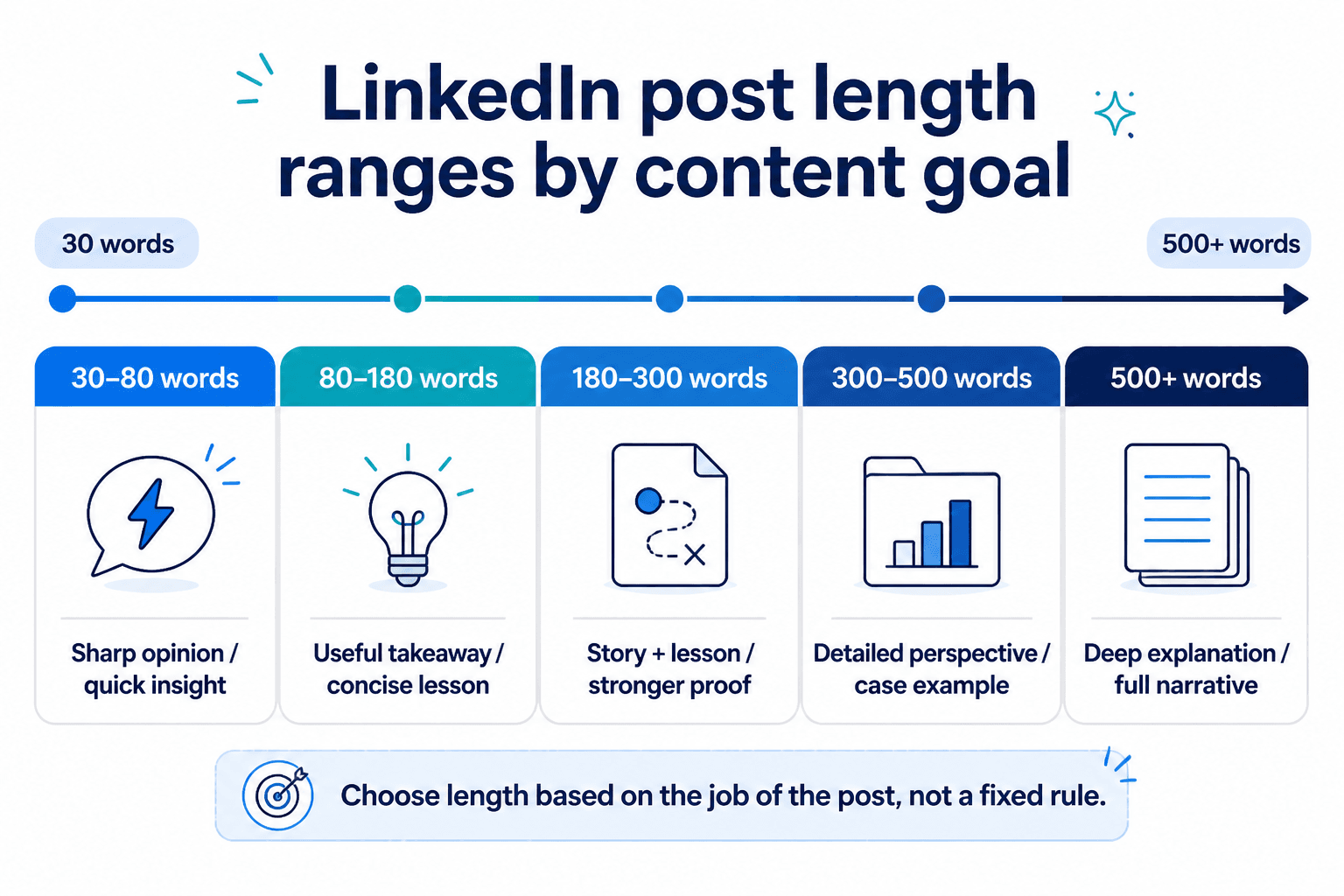
What different LinkedIn post lengths are actually good at
Very short posts: 30 to 80 words
These can work beautifully when you have one clean, useful thought and the discipline not to water it down.
Good use cases:
- A sharp opinion
- A surprising contrast
- A one-line lesson with a strong angle
- A quick pattern you keep noticing in clients, content, or marketing
Example:
Most LinkedIn posts do not fail because they are too short.
They fail because the writer spent the first four lines saying nothing, then wrapped the rest in vague advice.
Short works when the idea has a spine.
The catch is obvious. Short posts do not leave much room for proof. If the idea is generic, self-congratulatory, or weirdly dramatic, the whole thing collapses fast.
If you want to get better at this style, read when short LinkedIn posts beat long ones.
Short-to-medium posts: 80 to 150 words
This is one of the strongest ranges on LinkedIn. You have enough room to present a thought clearly, make it specific, and still keep the pace tight.
Good use cases:
- Quick lessons
- Mini contrarian takes
- Content about messaging, sales, positioning, or creator habits
- Short proof-based posts with one example
This range works especially well for people building authority without sounding like they are auditioning to become a quote graphic.
Medium posts: 150 to 300 words
If you publish regularly on LinkedIn, this is probably your most useful operating zone.
At this length, you can:
- Open with a strong hook
- Explain a real problem
- Add an example or mini-story
- Land a practical takeaway
- Use a non-annoying CTA
That combination is why so many good posts live here. There is room for substance, but not enough room to casually lose the plot unless you really insist on it.
If your posts tend to ramble, this is a very healthy constraint.
Longer posts: 300 to 600 words
Longer LinkedIn posts can work well, but they need a reason to exist.
A real one. Not “I had more thoughts.”
Good use cases:
- Stories with a clear business lesson
- Deeper frameworks
- Case studies
- Posts that need context, contrast, and proof
- Opinion pieces where nuance actually matters
At this length, pacing matters more. The hook has to earn attention. The middle has to move. The ending has to pay something off. If your long post could lose 35 percent of its words without changing the point, it was not a long post. It was an under-edited one.
Very long posts: 600+ words
These are not automatically bad. They are just easier to mess up.
Sometimes a post genuinely benefits from more depth. Maybe it is a strong founder story. Maybe it is a detailed breakdown of a launch, a content experiment, or a client lesson with useful specifics. Fine. But very long posts need unusually good structure and unusually strong payoff.
Most of them would be better as a tighter LinkedIn post, a proper article, or a repurposed email. LinkedIn is not allergic to long writing. Readers are allergic to wasted motion.
Choose LinkedIn post length based on the goal
If you are trying to answer “How Long Should LinkedIn Posts Be in 2026?” in a useful way, goal is the fastest way to do it.
| Goal | Recommended range | Why it works |
|---|---|---|
| Get attention fast | 40–120 words | Easy to scan, quick payoff, strong for sharp ideas |
| Build authority | 120–300 words | Enough room for specifics, proof, and a useful takeaway |
| Tell a story | 200–500 words | Gives room for setup, tension, and lesson |
| Drive comments | 80–220 words | Keeps the barrier low and leaves room for response |
| Show proof or case study | 200–450 words | Lets you add context without becoming a wall of text |
| Warm leads | 120–300 words | Enough substance to build trust without exhausting people |
This is not a rigid formula. It is a better starting point than guessing or copying the last viral post from someone with 200,000 followers and a suspiciously dramatic writing style.
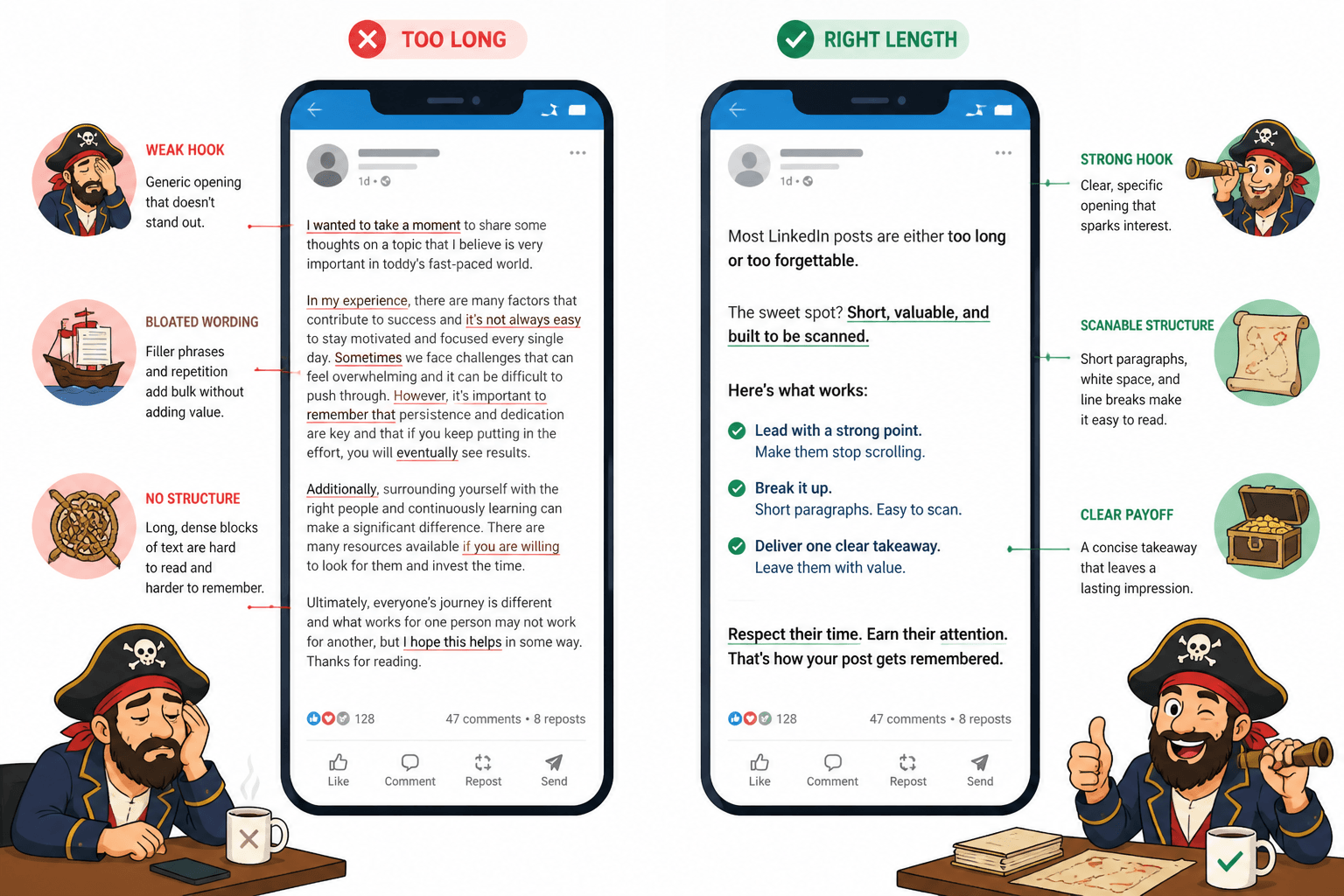
What actually makes a LinkedIn post feel “too long”
Length is often blamed for problems caused by something else. Usually one of these:
- A weak first line: if the opening drags, the whole post feels longer than it is
- Repetition: saying the same point three ways is not depth
- Generic ideas: readers will not stick around for advice they have seen 900 times
- No structure: if the post has no progression, it feels shapeless
- No payoff: people will tolerate length when the ending earns it
- Bloated wording: too many setup phrases, qualifiers, and softeners
A 90-word post can feel endless if it says nothing. A 450-word post can feel quick if it is well built.
This is why hooks matter so much. If your opening line is weak, no amount of strategic word count tinkering will save the post. Read how to start LinkedIn posts without a weak opening if that is the part that keeps tripping you up.
Short posts vs long posts on LinkedIn in 2026
Short posts usually win on speed, clarity, and scanability.
Longer posts usually win when they bring stronger proof, richer storytelling, or more layered thinking.
What does that mean in practice?
Short posts tend to work better when:
- The idea is simple and strong
- You want comments, shares, or quick engagement
- You are making one pointed observation
- You do not need much context
- Your writing is strongest when compressed
Longer posts tend to work better when:
- You need to show proof
- The lesson comes from a story
- The argument has real nuance
- You are unpacking a process, case, or framework
- The audience will benefit from more detail
The mistake is treating this like a fight with a winner. You do not need to pick Team Short or Team Long like this is a blood feud. You need range.
Creators who only post long often sound heavy. Creators who only post short often sound thin. A better mix usually looks like this:
- Mostly short-to-medium posts
- Regular concise opinion posts
- Occasional longer proof or story posts
- Very few true long-form posts unless they are genuinely excellent
A simple editing test for LinkedIn post length
Before publishing, run your draft through this quick filter:
- Can I state the main point in one sentence?
If not, the post is probably unfocused. - Does the opening get to the point fast?
If the first two lines are warm-up, cut them. - Is every section doing a job?
Setup, proof, example, takeaway, CTA. If a chunk does none of those, it is probably fluff. - Did I repeat the same point?
One strong point beats three softer versions of it. - Would this post improve if I cut 20 percent?
The answer is painfully often yes.
This is one of the cleanest ways to figure out your ideal post length. Not by chasing a number. By removing everything that does not earn its place.
Examples: same idea, different lengths
Here is how the same core point can work at different lengths.
The bigger point is simple: clearer structure and clearer writing make the piece more useful. That is usually what makes the ending land better too.