
Plenty of LinkedIn advice treats post length like it is a moral issue.
Short posts are framed as lazy. Long posts are framed as smart. Or the reverse, depending on which content bro had a good week.
Neither take is especially useful.
When short LinkedIn posts beat long ones, it is usually for a very boring reason: they fit the idea better. They get to the point faster, create less friction, and ask less from a scrolling reader who has not yet decided you are worth their attention.
That does not mean long posts are bad. Some of them work beautifully. But a lot of long LinkedIn posts are not “deep.” They are just stretched. Same point. More air. More throat-clearing. More self-importance.
If your posts keep getting polite silence, the issue may not be your expertise. It may be that you are using 220 words to say what would hit harder in 45.
Here’s how to tell when short LinkedIn posts are the smarter move, why they often outperform long ones, and how to write them so they feel sharp instead of undercooked.
For the main guide behind this topic, visit the parent guide.
Short does not mean shallow
This is where people get weird.
A short post is not automatically low-value. A long post is not automatically thoughtful. Length is not quality. It is just packaging.
On LinkedIn, short posts work when the idea is already clear, specific, and strong enough to stand on its own. They fail when the writer is hiding a weak point behind brevity and hoping “minimalist” will save it.
A good short post usually does one of these things:
- Makes one sharp observation
- States one useful opinion
- Offers one practical takeaway
- Highlights one mistake people keep making
- Presents one contrast that creates instant clarity
- Delivers one credible insight with no padding
That is enough. In fact, it is often better than trying to cram five half-developed lessons into one wandering mini-essay.
Short posts are not a shortcut around substance. They are what happens when substance has enough confidence to stop talking.
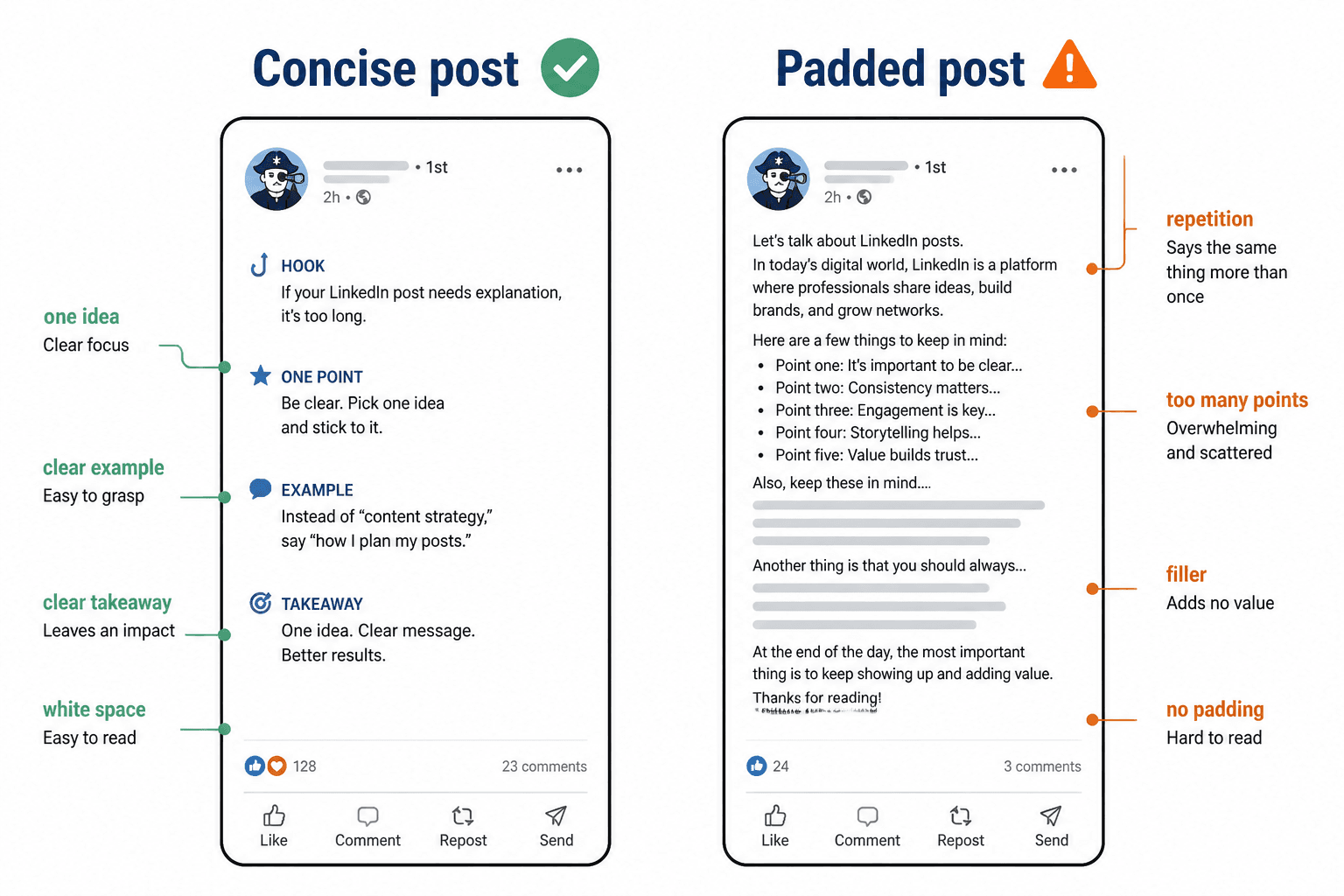
When short LinkedIn posts beat long ones
If you are wondering when short LinkedIn posts beat long ones, the answer is not “all the time.” It is more specific than that.
1. When the idea is simple and complete
Some points do not need a runway.
If your whole message is one useful sentence plus one example, writing 12 extra lines around it will usually weaken it. Readers can feel when a post is stretching to justify its own existence.
Example of a short-post idea that works:
Most consultants do not need better content calendars.
They need better angles.
Posting consistently about vague expertise just helps you become consistently forgettable.
That does not need a long setup. The punch is the point.
2. When the goal is attention, not full persuasion
Not every LinkedIn post needs to do the entire sales job.
Sometimes the post just needs to earn a pause, create interest, and make the right person curious enough to check your profile, read another post, or start noticing you.
Short posts are excellent for this. They lower the commitment. They are easier to scan. They can create a quick “that’s true” moment without asking the reader to marry your worldview before lunch.
That makes them especially useful for creators who are building familiarity, not trying to explain their entire framework in one shot.
3. When the hook is stronger than the explanation
Some posts win because the opening line lands hard and the follow-up supports it cleanly. If the explanation starts diluting the tension, stop earlier.
Writers often ruin a strong post by overexplaining what the reader already understood in line one.
For example:
Your content does not feel premium because of the design.
It feels premium because the thinking is expensive.
You could add one or two lines after that. You probably do not need nine.
4. When readers already know the context
If you are speaking to an audience that already understands the problem, you can be more compressed.
A consultant talking to other service providers does not always need to explain why weak positioning hurts conversions. The audience likely gets it. You can move straight to the useful angle.
Short posts do well when they respect the reader’s intelligence and skip the remedial lecture.
5. When the point is best delivered with contrast
Contrast is one of the easiest ways to make a short post work.
Old way vs better way. Common mistake vs smarter move. What people think matters vs what actually matters. That structure gives the post shape fast, without requiring a lot of setup.
Example:
Bad LinkedIn posts try to sound impressive.
Good LinkedIn posts try to be clear.
One gets polite likes.
The other gets remembered.
Short. Clean. No extra furniture.
6. When your long version is mostly filler
This one is less flattering, but it matters.
A lot of long LinkedIn posts are built from:
- throat-clearing intros
- obvious statements
- repeated points in slightly different clothes
- fake suspense
- forced personal reflection
- a CTA that arrives wearing a webinar headset from 2018
If removing all that leaves you with four useful lines, congratulations. You had a short post all along.
Why short posts often perform better on LinkedIn
Not because the algorithm is secretly in love with brevity. People need to calm down with that stuff.
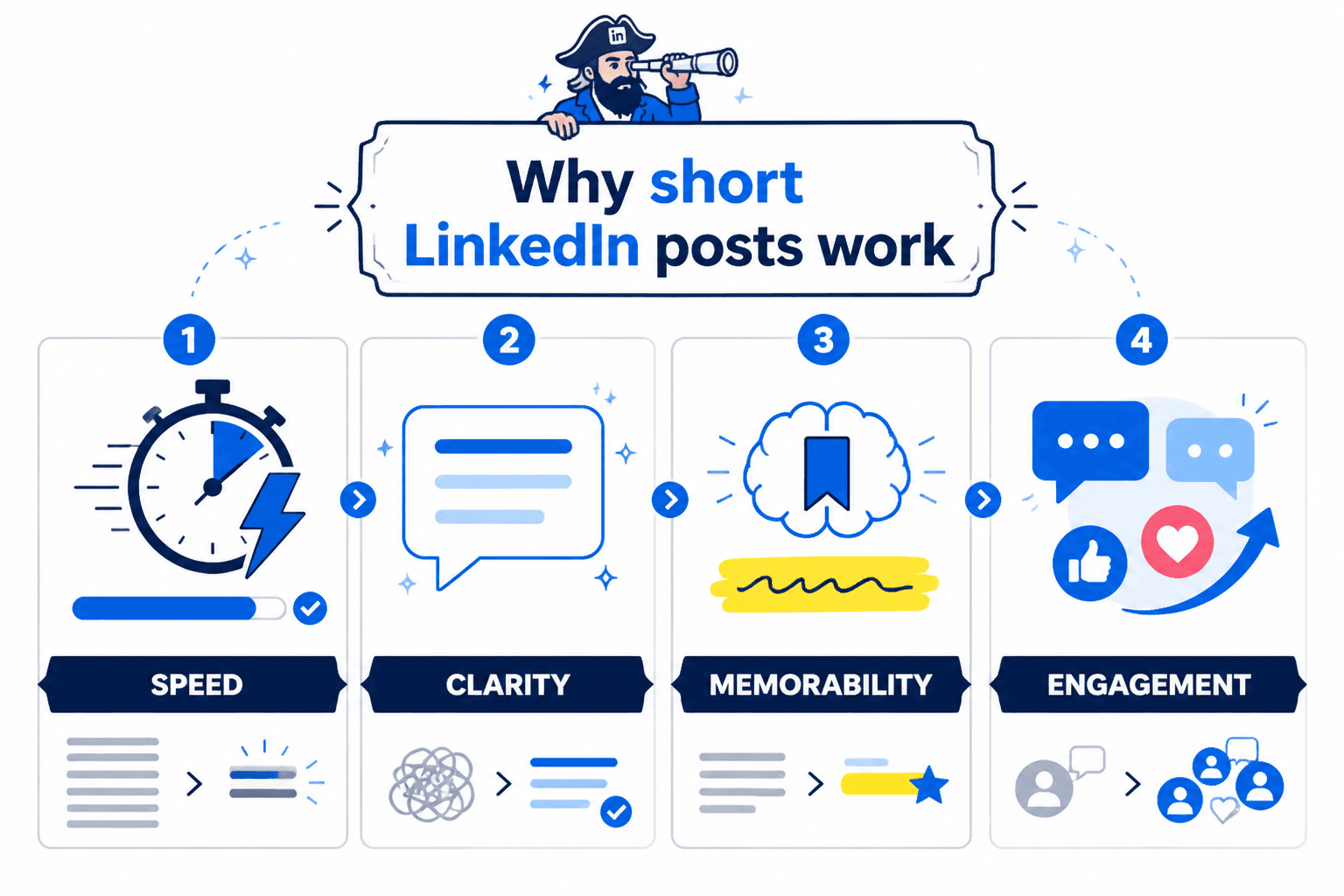
Short LinkedIn posts often do better because they match how attention works on a busy feed. A reader is making micro-decisions very quickly. Keep reading, skim, click away, maybe come back, maybe not.
Shorter posts can help because they:
- reduce friction at the start
- make the idea easier to grasp fast
- feel more confident when the point is sharp
- improve scannability on mobile
- leave less room for the post to sag in the middle
- increase the odds that the whole thing gets read
There is also a trust angle here. Concise writing signals control. It suggests you know what matters and what does not. Long writing can also do that, but only when it earns its length. Otherwise it reads like someone trying to sound substantial by refusing to end.
And yes, that happens a lot on LinkedIn.
What short LinkedIn posts do better than long ones
They sharpen one idea
One idea done well beats three ideas done vaguely.
When you force yourself to write short, you have to decide what the post is actually about. That alone improves quality. It cuts the “this is sort of about content and also mindset and maybe authenticity” nonsense that makes posts dissolve into beige paste.
They create stronger memorability
People remember crisp lines. They remember clean contrasts. They remember posts they can mentally repeat later.
They do not usually remember a 280-word reflection that could have been an 80-word observation.
They are easier to engage with
A short post often feels easier to respond to because the takeaway is obvious. The reader can agree, disagree, add nuance, or share their version without first excavating the point from a pile of formatting and self-regard.
They work well for busy authority-building
If you post regularly, short formats can help you publish more useful thoughts without turning every post into a weekend writing project. That matters for consistency.
Not because volume magically wins, but because regular visibility plus strong ideas usually beats rare visibility plus overworked essays no one finishes.
If you want more examples of strong post structures, these LinkedIn post ideas and examples for creators are a helpful next stop.
When long LinkedIn posts are still the better choice
This is the part people skip when they turn “write shorter” into a religion.
Long posts are better when the idea needs development, proof, story, or nuance. If the reader needs to understand a process, a case study, a sequence of mistakes, or a layered argument, short may underserve the point.
Longer LinkedIn posts make more sense when you are:
- telling a story with a clear lesson
- breaking down a process step by step
- sharing a case study with proof
- explaining a nuanced opinion that could be misunderstood if compressed
- teaching something practical that needs examples
- building deeper authority with experienced readers
The key is that the length has to earn itself. Every section should add meaning, proof, tension, or clarity. If it is just there to make the post feel more important, cut it.
If you are trying to decide between lengths more broadly, this guide on how long LinkedIn posts should be can help you choose based on the goal of the post rather than random folklore.
How to tell if your post should be short
Use this quick test before you publish.
- Can you state the core point in one sentence? If yes, short may work very well.
- Does the reader need context to get it? If no, go shorter.
- Are your extra lines adding proof or just repeating the claim? Repetition is usually your cue to cut.
- Would the post be stronger as a clean opinion, contrast, or takeaway? If yes, short is likely the better format.
- Is the current draft trying to sound deep instead of being clear? Be honest here. Brutally honest is even better.
A practical editing move: remove the first two lines and the last three lines of your draft. Then read what remains. LinkedIn posts often improve immediately when the warm-up and fake ending are gone.
3 short LinkedIn post formats that actually work
1. The sharp observation
Best for: credibility, attention, memorability
Structure:
- State the observation
- Add one clarifying line
- Optional: add one implication
Example:
Most “thought leadership” fails for a simple reason:
it is all thought, no leadership.
No stance. No specificity. No useful direction.
2. The contrast post
Best for: teaching quickly, correcting bad assumptions
Structure:
- What people think
- What actually works
- Optional payoff line
Example:
People think better LinkedIn content starts with better writing.
Usually, it starts with a better point.
Writing can polish a weak idea.
It cannot rescue one.
3. The micro-lesson
Best for: creators, consultants, coaches, and service providers sharing expertise
Structure:
The bigger point is simple: clearer structure and clearer writing make the piece more useful. That is usually what makes the ending land better too.