
Most creator funnels are not underperforming because they are too short.
They are underperforming because they are too complicated, too premature, or too disconnected from how people actually buy from creators, consultants, coaches, and solo businesses. Someone reads a post, clicks a link, lands on a page, gets asked to watch a 19-minute video, then gets invited to a webinar, then gets pitched a call, then gets a countdown timer like they are trying to escape a low-budget marketing dungeon. No wonder they leave.
When Short Creator Funnels Beat Long Ones comes down to one boring but useful truth: less friction usually wins when trust is already present, the offer is clear, and the next step does not need a full Broadway production.
If you are a creator or personal brand selling expertise, services, low-ticket products, workshops, audits, digital offers, or simple consulting packages, a shorter funnel can often get you more leads and sales with less drop-off. Not always. But often enough that it should probably be your default until complexity earns its place.
Here is how to know when a short funnel makes more sense, what kinds of short funnels work best, and where people accidentally make them too thin to convert.
For the main guide behind this topic, visit the parent guide.
What a short creator funnel actually is
A short funnel is not “no funnel.” It is just a tighter path between attention and action.
Usually, that means fewer steps between the content somebody sees and the next meaningful move you want them to make.
- Post → profile → booking page
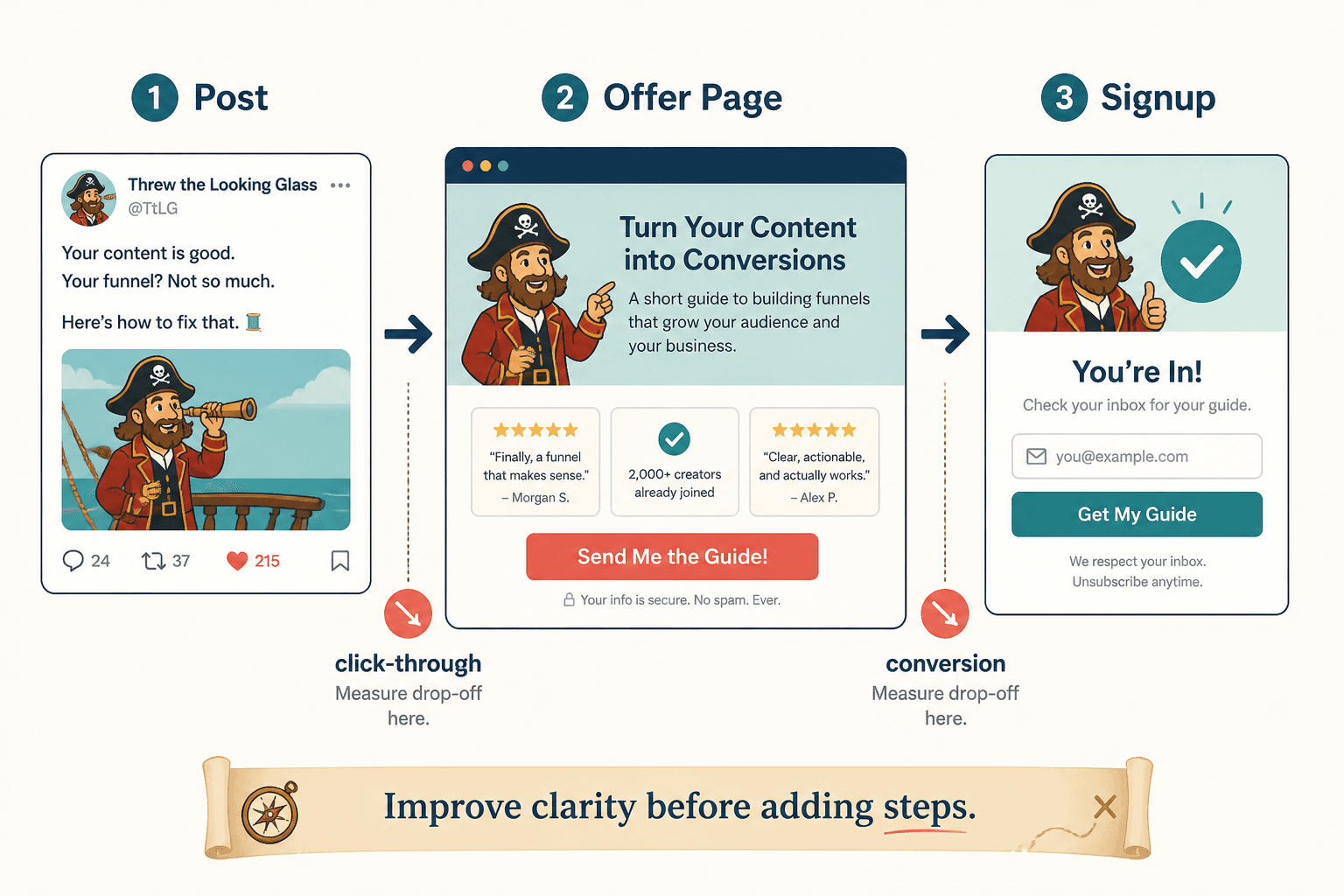
- Post → landing page → email signup
- Thread → lead magnet → nurture emails
- Article → service page → inquiry form
- Bio → product page → checkout
- Comment conversation → soft DM → call or sale
A long funnel adds more education, qualification, warming, objection handling, segmentation, and sequencing before the ask.
- Post → opt-in page → thank-you page → email sequence → webinar → replay → sales page → call booking → follow-up emails
That can work. Sometimes it should work. But creators often borrow that structure from larger businesses selling colder traffic, higher-priced offers, or more complex transformations. Then they slap it onto an offer that could have been sold with one strong post, one credible page, and one clear CTA.
That is not sophisticated. That is just adding stairs where a door would do.
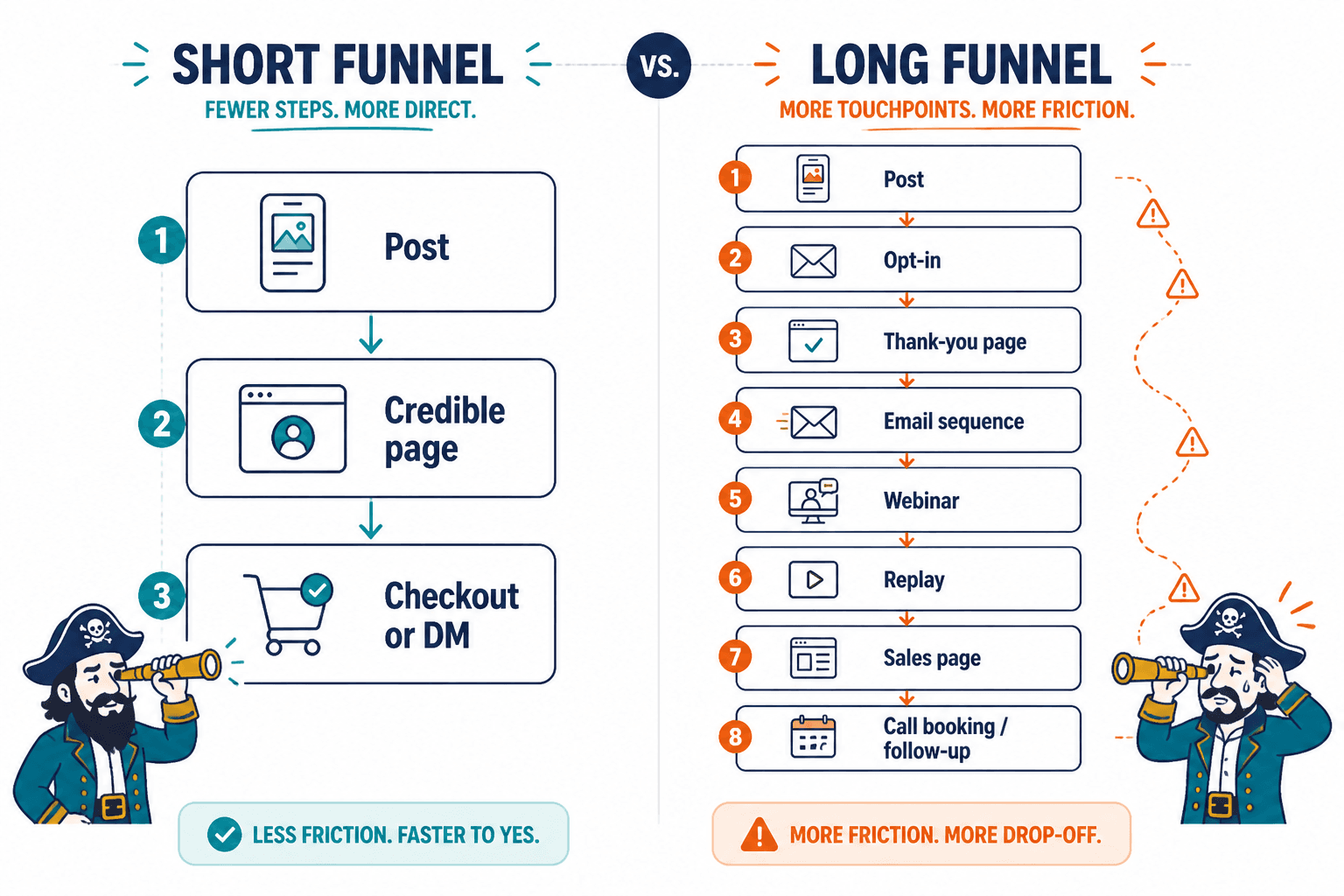
When short creator funnels beat long ones
Short funnels tend to win under a few predictable conditions. If several of these are true for your business, you probably do not need more steps. You need better ones.
1. When the offer is easy to understand
If people can quickly understand what you do, who it is for, and why it matters, they do not need a long educational obstacle course.
Examples:
- A profile audit for founders
- A messaging workshop for coaches
- A content strategy session for consultants
- A template bundle for creators
- A monthly ghostwriting service with a clear deliverable
These offers are not mysterious. They may still need proof and positioning, but they usually do not need seven layers of nurturing just so someone can understand the menu.
2. When trust is already doing half the work
Creators often forget this part. If somebody has already been reading your posts, emails, threads, or articles for a while, they are not cold traffic in the usual sense. They have context. They know your tone. They have seen your thinking. They may already believe you are credible enough to help them.
In that case, making them sit through a longer funnel can actually lower conversions. It delays the action they were already ready to take.
Trust shortens the path.
3. When the audience is small but relevant
If you have a smaller audience of the right people, a short funnel often beats a long one because the relationship is tighter and the signal is cleaner. You do not need enterprise-grade funnel architecture for 900 followers when 120 of them are solid fits.
In fact, smaller-audience creators usually get hurt more by long funnels because every extra step leaks a meaningful percentage of their already limited attention. If this is your situation, creator funnels for creators with small audiences is worth reading next.
4. When the sale depends on clarity more than persuasion
Some offers do not fail because buyers lack motivation. They fail because the creator is being vague.
If somebody is already trying to solve the problem you address, your job is often to make the path obvious, not endlessly persuasive. A short funnel works well when the buyer already has intent and just needs:
- a clear offer
- a believable reason to trust you
- a simple next step
- low friction
That is why “better sales page” often beats “longer funnel.”
5. When the offer is lower risk or lower complexity
A $29 template pack, a $99 mini-course, a paid workshop, a strategy hour, or a simple service package usually does not require the same funnel structure as a major consulting engagement or high-ticket transformation.
The more risk, complexity, price, or commitment involved, the more a longer funnel might help. But if the decision is relatively simple, longer funnels can feel weirdly dramatic. Like asking someone to complete a government form before buying your Notion template.
6. When speed matters
Short funnels are often stronger when you want to test offers, validate positioning, get fast market feedback, or turn fresh attention into action while the interest is still warm.
This matters more than people think. Attention decays. Intent cools off. Curiosity expires. A short funnel lets you catch momentum instead of filing it for later and hoping your follow-up sequence performs CPR.
Why long funnels often underperform for creators
Long funnels are not bad. But creators use them badly all the time.
Usually, the problem is not the length itself. It is that the extra steps are doing weak work.
They add friction without adding conviction
Every extra page, email, form, or delay needs a reason to exist. If it does not build trust, answer objections, improve fit, or increase buyer confidence, it is just another chance for someone to wander off and remember they needed to buy dishwasher tablets.
They copy business models that do not match creator businesses
A lot of funnel advice comes from software companies, agencies, ad-driven businesses, or giant info-marketing setups. Their traffic quality, buying context, and economics are different.
A creator with direct audience trust can often sell with simpler systems because content itself is doing pre-sell work. That changes the funnel math.
They hide weak offers under more process
If the offer is fuzzy, no sequence will save it for long. If the positioning is weak, adding webinar slides does not magically create demand. Sometimes a long funnel is just a decorative cover placed over an unclear proposition.
Harsh, sure. Also useful.
They burn time you could spend improving better leverage points
Many creators would get better results by improving:
- their offer positioning
- their profile clarity
- their sales page
- their proof
- their content-to-CTA alignment
- their follow-up messages
Instead, they spend three weeks stitching together automations that route four leads per month through a maze.
What short funnels need in order to work
You cannot just make a funnel shorter and expect it to convert. A short path works when the missing steps have been replaced by stronger clarity.
1. A very clear offer
If your offer takes three paragraphs to explain, a short funnel will struggle. The reader needs to grasp the value fast.
Good short-funnel offers usually answer these quickly:
- What is it?
- Who is it for?
- What result does it help with?
- What happens next?
2. Enough proof to reduce hesitation
If you are removing steps, you need to make trust more visible earlier.
That can include:
- specific testimonials
- case studies
- sample outcomes
- clear expertise signals
- strong examples of your thinking
- past client categories or roles
Not vague “I help purpose-driven leaders thrive” fluff. Real proof. Real specificity. Adult words.
3. A next step that feels proportionate
If somebody reads a post and clicks through to learn more, asking them to book a 90-minute call right away may be too much. But asking them to grab a useful guide, reply to a short form, or book a quick fit call might make perfect sense.
The CTA should match the temperature of the relationship and the weight of the offer.
4. Strong content-to-offer alignment
Short funnels convert best when the content leading into them already attracts the right problem awareness.
If your content is broad, entertaining, or disconnected from the actual offer, a short funnel can feel abrupt. But when the post, thread, article, or email directly speaks to the problem your offer solves, the click feels natural.
That is why funnel performance is often really a content relevance issue wearing a conversion hat.
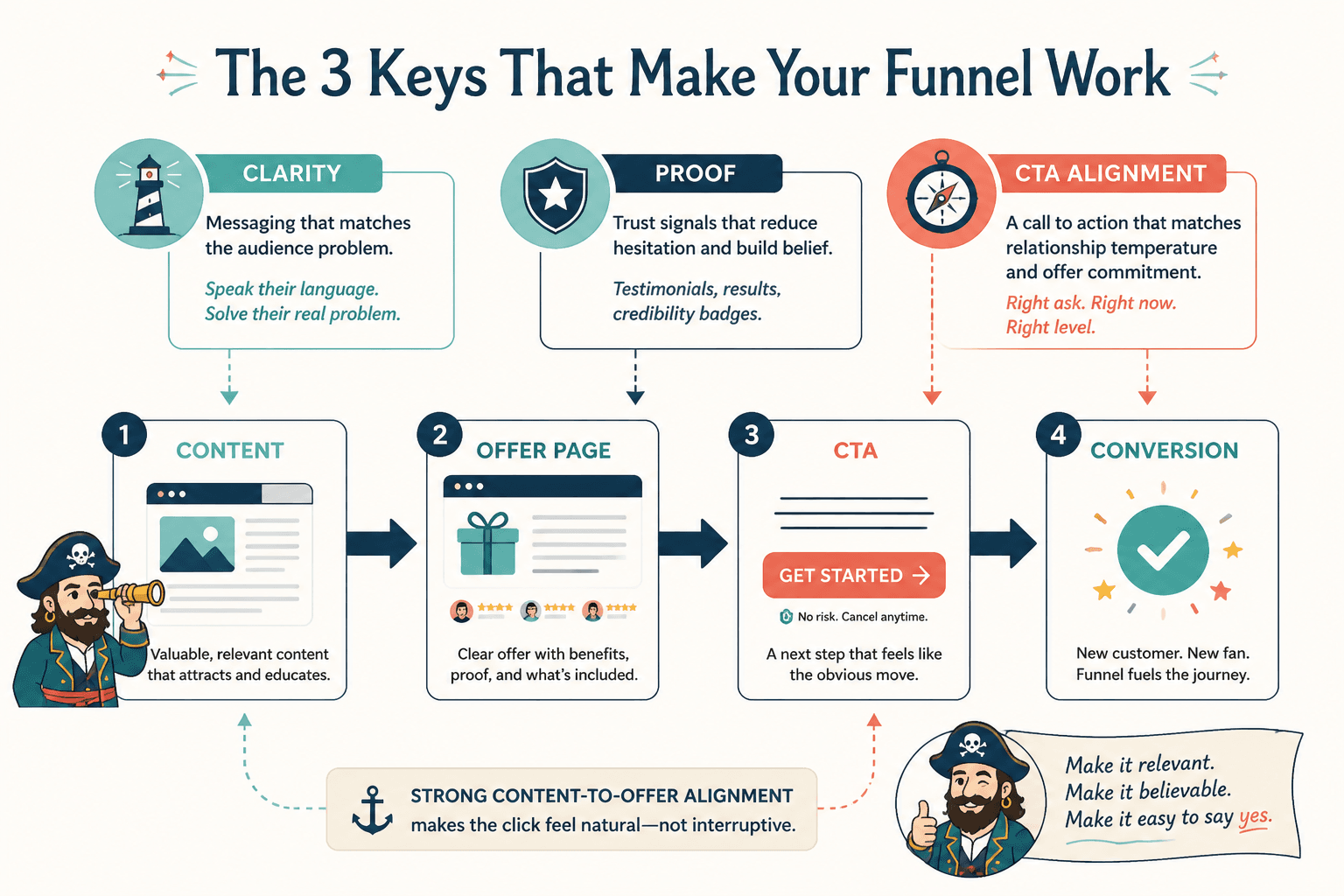
Short creator funnel formats that work well
If you want practical options, here are a few simple structures that often outperform bloated setups.
Post → profile → booking page
Best for service providers, consultants, coaches, strategists, and people selling expertise directly.
This works when your content builds trust well, your profile explains what you do clearly, and your booking page does not sound like it was written by a corporate receptionist during a hostage situation.
Post → landing page → lead magnet
Best for creators building an email list while keeping the path light.
The key here is relevance. The lead magnet should solve a real first-step problem tied to your paid offer, not just be random downloadable clutter.
Article → service page → inquiry form
Best for authority-based sales where deeper content pre-sells the reader.
This works well because the article itself does a lot of trust-building. By the time someone reaches the CTA, they are not guessing what you know.
Thread → newsletter → offer
Best for creators using X or LinkedIn to move people into an owned audience before selling.
This is still short, but it gives you one useful buffer step: email. Good for offers that need a little more warming without requiring a full funnel circus.
Bio → simple sales page → checkout
Best for digital products, workshops, and lower-friction offers.
When the value is clear and the audience already trusts you, this can work beautifully. It is also easier to maintain, which matters more than funnel Twitter likes to admit.
For more practical formats, see best creator funnels ideas and examples for creators and creator funnels simple funnels examples creators can adapt fast.
How to decide if your funnel should be shorter
Use this quick test.
- Look at where people drop off. If attention collapses between steps, the path may be too long or too weak.
- Ask what each step is doing. Is it building trust, improving fit, handling objections, or just existing because someone said funnels need layers?
- Check if your content already pre-sells well. Strong content can replace a surprising amount of funnel complexity.
- Check offer clarity. If people do not understand the offer quickly, shortening alone will not fix it.
- Match funnel length to buyer risk. The bigger the decision, the more support the path may need.
- Test removing one step. Do not rebuild from scratch first. Simplify one point of friction and watch what happens.
Often, the best answer is not “short” or “long.” It is “shorter than whatever nonsense is happening now.”
When a longer funnel still makes sense
Short funnels are powerful, but they are not automatically superior. A longer funnel can make sense when:
- the offer is expensive
- the transformation is complex
- buyers need more education
- the audience is relatively cold
- you need stronger qualification before calls
- you sell to teams or multiple decision-makers
- the buying cycle is naturally longer
If you are selling a high-ticket consulting engagement, certification program, or complex service with lots of moving parts, more steps may help. But those steps still need to earn their keep.
If you are still figuring out the right length, how long should creator funnels be in 2026 pairs well with this topic.
Common mistakes people make with short funnels
Making them short but not persuasive
Cutting steps is not the same as increasing clarity. If the page, post, or CTA is weak, a short funnel just gets people to “no” faster.
Asking for too much too fast
A short funnel still needs a sensible next step. If the ask feels bigger than the trust level, people hesitate.
Using generic lead magnets
If your freebie is broad, bland, or disconnected from your paid offer, the funnel might be short but it will attract low-intent subscribers who never convert.
No proof near the conversion point
People often click because they are interested and leave because they are unsure. Proof bridges that gap.
Treating a short funnel like a shortcut for weak strategy
A short funnel does not fix bad targeting, bland content, confusing offers, or poor audience fit. It simply removes unnecessary distance between those problems and your conversion rate.
Which, to be fair, can still be useful. At least the diagnosis gets faster.
A simple way to build a better short funnel
If you want a practical default, use this:
- Create one content pillar tied directly to one offer.
- Publish content that speaks to the buyer’s active problem.
- Use a CTA that fits the relationship stage.
- Send them to one page with a clear promise, proof, and action.
- Follow up simply. Email, reply, or DM based on context.
- Measure where hesitation happens.
- Improve clarity before adding steps.
That basic system is enough for a lot of creator businesses. If you want broader context, the main creator funnels guide and related monetization funnel resources can help you map the bigger picture.
FAQ
Are short funnels better for creators?
Often, yes, especially when trust is already present, the offer is clear, and the audience is warm or relevant.
Do short funnels only work for low-ticket offers?
No. They can also work for services and higher-value offers when the buyer already understands the problem and sees you as credible.
What is the biggest risk with a short funnel?
Removing too much. If you cut proof, clarity, or useful context, conversions can drop.
Creator funnels get better when the path feels simpler and the writing makes each next step obvious. A cleaner message usually fixes more than extra funnel complexity ever will.