
A creator funnel usually looks simple in a diagram and slightly feral in real life. One tab has the content idea, another has the landing page, the email draft is half-finished, and the “next step” somehow turned into a philosophical debate. Examples help because they turn that mess into a path you can actually use.
If you want the broader framework behind these examples, start with the creator funnels guide. This page is the practical version: what different funnels look like, when they work, and how to choose one without building a small cathedral of automation for a very ordinary offer.
What makes a creator funnel example actually useful
A useful funnel example does three things well. It shows the sequence, it shows the decision behind the sequence, and it keeps the offer path honest. A bad example is just a stack of tactics with a nicer label.
At the simplest level, a creator funnel moves someone from attention to trust to action. The content earns the first look. The middle step proves the promise. The final step asks for a specific yes. That is the whole game. The rest is decoration, and decoration has a terrible track record when it starts pretending to be strategy.
What a creator funnel actually is
A creator funnel is the route a person takes from discovering your content to taking a paid or committed action. That action might be joining a list, booking a call, buying a product, attending a workshop, or moving into a service offer.
The shape changes, but the logic stays the same: attention first, trust second, action last.
What good funnels do differently
- They match intent. A cold reader needs more context than a warm subscriber.
- They make one next step obvious. Not three. Not “choose your own adventure.”
- They build trust with relevance. The middle step should reduce doubt, not add admin.
- They respect the offer. The final step should feel like the natural next move, not a bait-and-switch with better lighting.
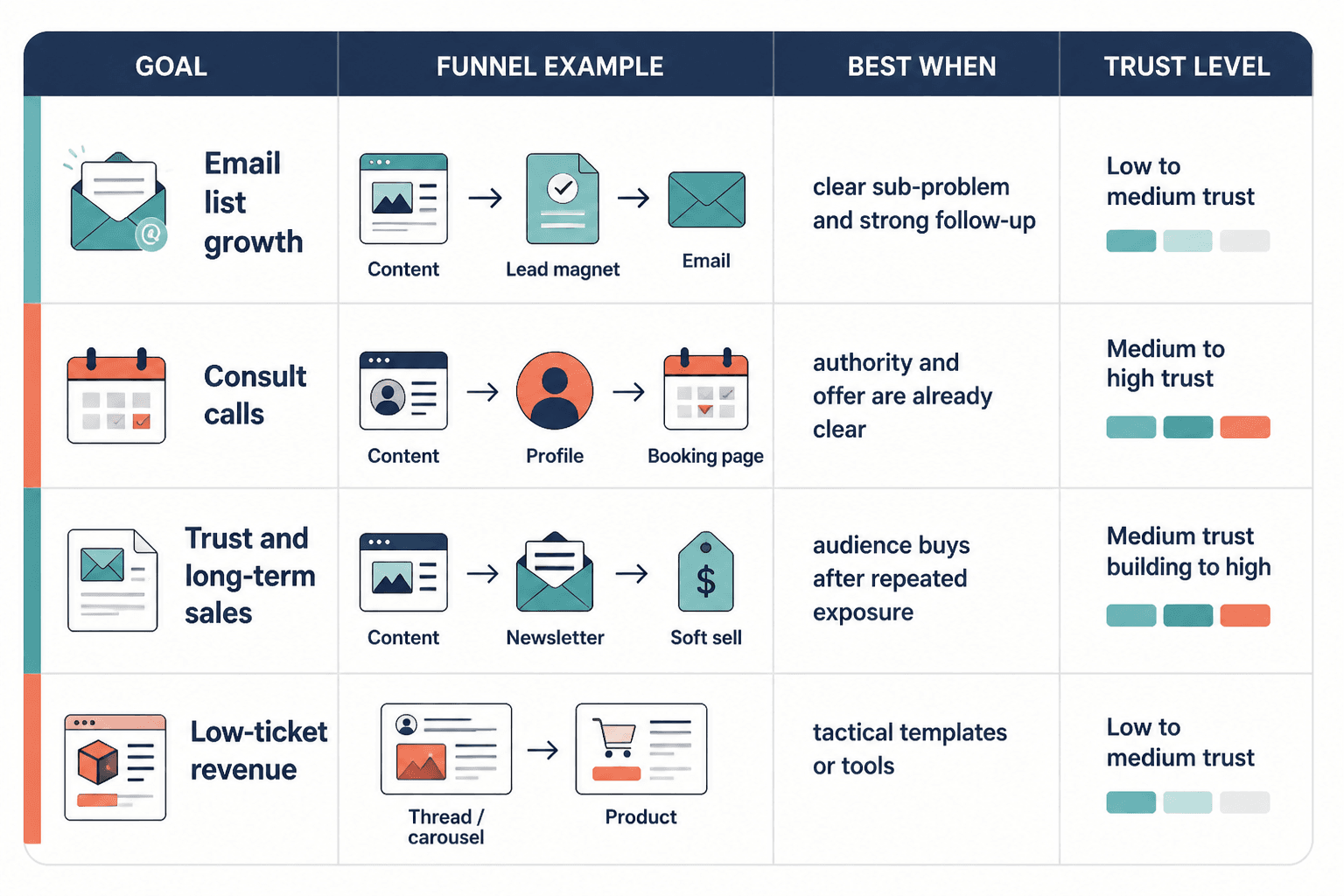
Before you copy any funnel example, decide these 3 things
Copying a funnel before you answer these questions is how people end up with a freebie funnel for a premium service or a webinar for an audience that only wanted a quick answer and a clean tab.
1. What are you selling?
Different offers need different paths. A low-cost digital product can often move from content to checkout with a light trust bridge. A consult, audit, or high-touch service usually needs more proof, more explanation, and a softer handoff.
2. How warm is your audience?
Cold traffic usually needs a clearer entry point, like a lead magnet, quiz, or workshop. Warm subscribers can often move faster if the next step is specific and relevant. The warmer the audience, the less explaining you need to do.
3. What is the next easiest yes?
Not the biggest yes. The easiest one. If asking for the sale is too abrupt, ask for a smaller commitment that logically leads there. That might be an email signup, a workshop registration, or a short assessment.
7 creator funnel examples you can adapt fast
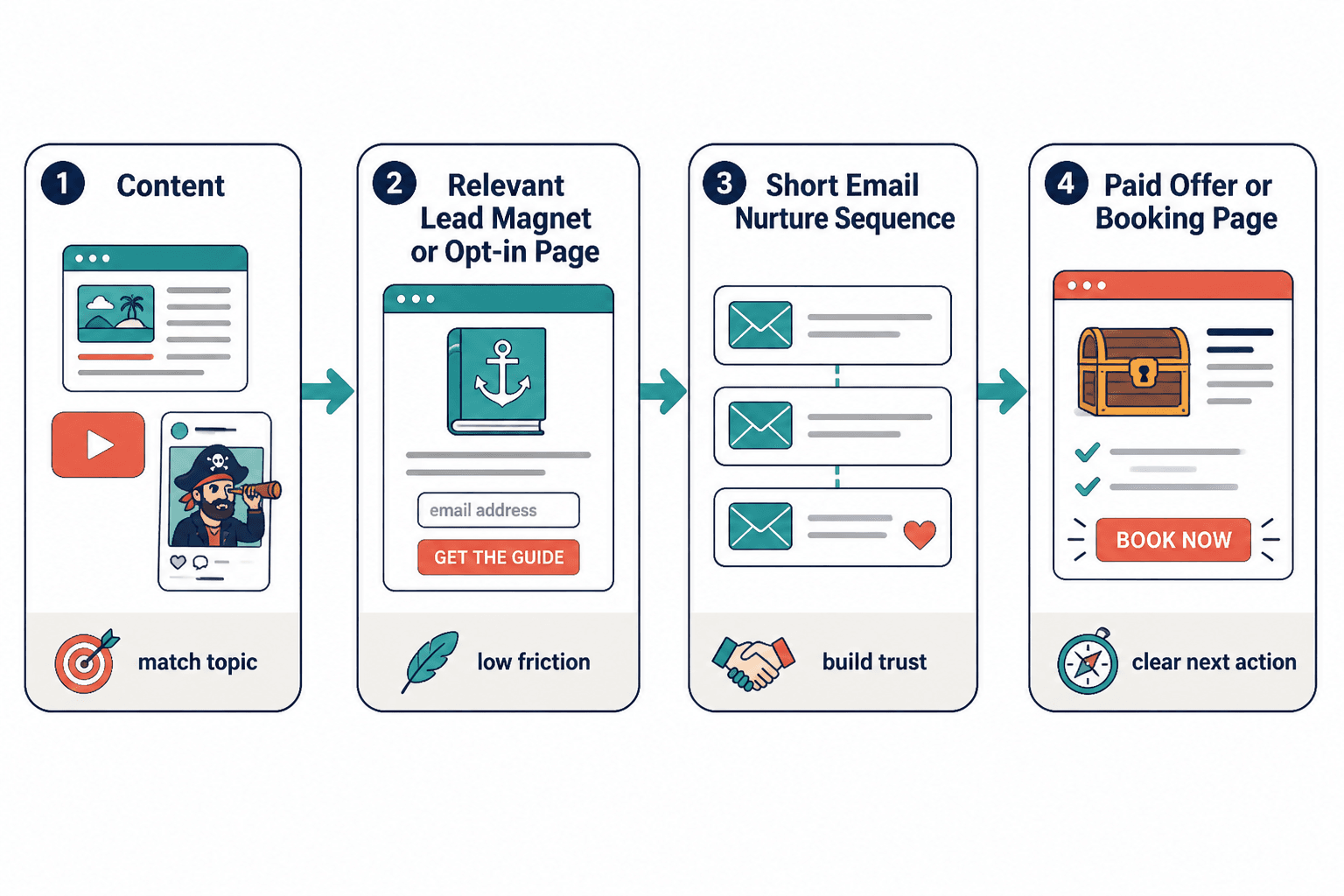
1. Content → profile → lead magnet → email nurture → offer
This is the classic creator funnel for a reason: it is straightforward, scalable, and easy to explain without using the phrase “ecosystem” too many times.
Use this when your content attracts broad interest, but the offer needs a little more context before it lands. The profile acts as a second proof point. The lead magnet gives the reader a useful win. The email sequence builds the case for the offer.
Best for: newsletters, digital products, courses, and service businesses that need a trust bridge.
Watch out for: lead magnets that are basically just longer blog posts with a download button.
2. Post → comments or conversation → soft DM → service offer
This funnel works when the audience is already engaged and the offer benefits from a short, human back-and-forth. The content creates interest. The comments or replies create a signal. A soft DM or direct conversation turns that signal into a specific next step.
This is useful for consultants, coaches, specialists, and creators selling custom work. It is not about spammy outreach. It is about using conversation to qualify intent before you waste everyone’s time pretending a cold call was destiny.
Best for: service offers, audits, advisory work, done-for-you work.
Watch out for: vague DMs that ask for a call before the person knows what the call is for.
3. Short video → landing page → workshop → paid program
This funnel gives people a quick teaching moment, then a deeper learning environment, then a paid next step. The short video creates curiosity. The landing page sets expectations. The workshop does the real trust-building. The paid program becomes the logical continuation.
It works especially well when the offer is educational or transformation-based and benefits from showing the method before asking for commitment.
Best for: courses, memberships, cohort programs, group offers.
Watch out for: workshops that teach everything except the actual decision the audience needs to make.
4. Newsletter → case study → consultation or audit
This is a clean path when the audience already trusts your thinking and just needs proof that your approach works in the real world. The newsletter warms the reader. The case study sharpens the promise. The consultation or audit is the action step.
It is especially effective for higher-trust services where the audience wants to see how you think before they hand over budget or attention.
Best for: strategists, consultants, operators, service providers.
Watch out for: case studies that are all outcomes and no process. People need to know how the result happened, not just admire it from a distance.
5. Free resource → quiz or assessment → segmented email path → product
This funnel is useful when the audience has different needs and you do not want everyone forced through the same generic sequence. The free resource attracts interest. The quiz or assessment segments it. The email path adapts the message based on what the reader actually needs.
It is a strong fit for products or educational offers where one-size-fits-all messaging turns into polite confusion.
Best for: courses, digital products, toolkit-style offers.
Watch out for: overcomplicated quizzes that feel like airport paperwork.
6. Webinar replay → deadline sequence → offer
This funnel works when the teaching moment has already happened and the job now is to move people toward action. The replay gives latecomers access. The deadline sequence creates a reason to decide. The offer closes the loop.
Use it when urgency is real, the offer window is limited, or the audience needs a clear decision point. Do not fake urgency. Readers can smell that from three paragraphs away.
Best for: launches, cohort programs, time-bound promotions.
Watch out for: endless “last chance” emails that make the deadline feel like it has a pension plan.
7. Carousel or thread → FAQ page → direct sale
This is a compact funnel for audiences that are already close to buying but still need clarity on scope, fit, or mechanics. The post creates interest. The FAQ page removes objections. The sale happens once the friction is gone.
This can work well for lower-priced offers or for offers whose main barrier is uncertainty, not desire.
Best for: digital products, entry-level services, simple offers.
Watch out for: FAQ pages that answer every question except the one the buyer is actually asking.
How to choose the right creator funnel path
Pick the funnel that matches the offer, the audience temperature, and the amount of proof you need to include. If the offer is simple and familiar, the path can be short. If the offer is more complex, the path should carry more trust-building weight.
- Use a shorter path when the audience is warm and the offer is easy to understand.
- Use a middle-step path when the audience needs proof but not a full education sequence.
- Use a longer path when the offer is higher-ticket, more nuanced, or requires a stronger trust bridge.
For a broader overview of how these systems connect, see the guide to writing better creator funnels and the parent page on creator funnel systems.
Common mistakes that break creator funnels
- Too many steps. Every extra handoff is another chance for the reader to wander off.
- Weak transitions. If the next step feels disconnected, the funnel leaks.
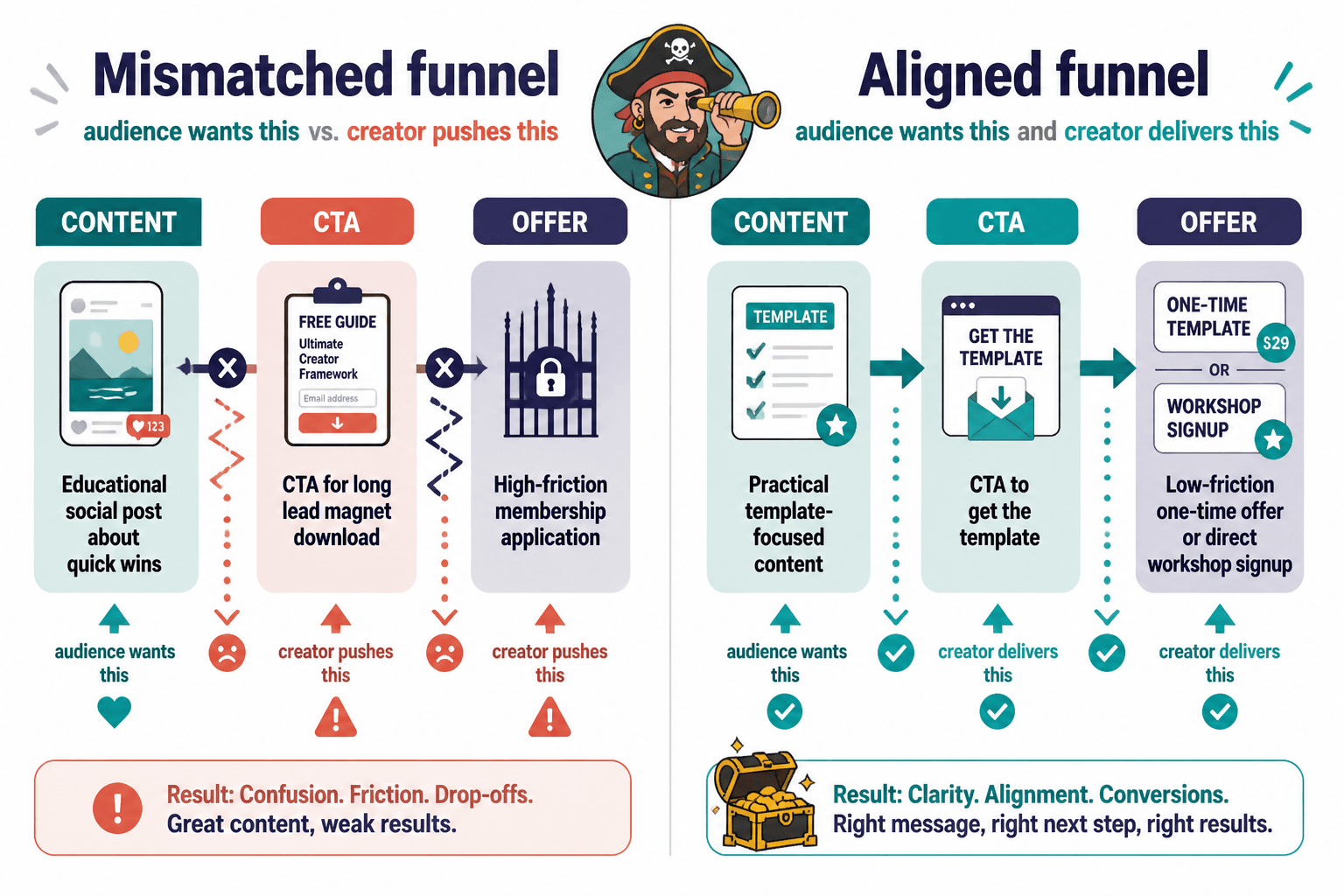
- Mismatch between content and offer. Helpful content can still set up the wrong sale.
- Asking for too much too soon. A reader who just met you does not need a full commitment ceremony.
- Generic CTAs. “Learn more” is not a plan. It is a shrug.
For a practical look at how friction shows up between content, CTA, and offer, the creator-funnel tools guide is helpful when you are deciding what to automate and what not to trust to software.
A quick way to map your own funnel
- Name the content that gets attention.
- Choose the smallest useful next step.
- Decide what proof or trust-building step belongs in the middle.
- Make the final offer specific and easy to recognize.
- Remove one unnecessary step before you publish.
If you can explain the path in one sentence, you are probably close. If you need a whiteboard, a second whiteboard, and a third tab labeled “strategy final final,” the funnel is doing too much.
Use examples as templates, not costumes
The point of creator funnel examples is not to copy the surface shape and call it strategic. It is to understand the job each step is doing. Once you know that, you can swap in your own content, your own proof, and your own offer without turning the whole thing into a Frankenstein with a lead magnet.
For more on the bigger framework, return to the creator funnels guide. If you need more tactical help, the sibling pages on writing better creator funnels and AI tools for creator funnels cover the next layer without pretending your process needs an enterprise makeover.