
A content doc is open in one tab, the landing page builder is waiting in another, the email platform wants a sequence, and the automation tool is asking for a rule nobody remembers defining. Meanwhile the actual offer is sitting there like the one sensible person in a room full of enthusiastic interns. That is the usual creator funnel toolchain problem: too many handoffs, too little judgment, and software trying hard to be helpful in the worst possible way.
The point is not to add more AI until the stack starts looking impressive in screenshots. The point is to choose a lean useful system where each tool does one job, the human makes the decisions, and the funnel moves from attention to action without turning every step into a maintenance project. If you want the bigger strategy behind that path, start with the creator funnels guide for creators who want better results.
What AI should do in a creator funnel
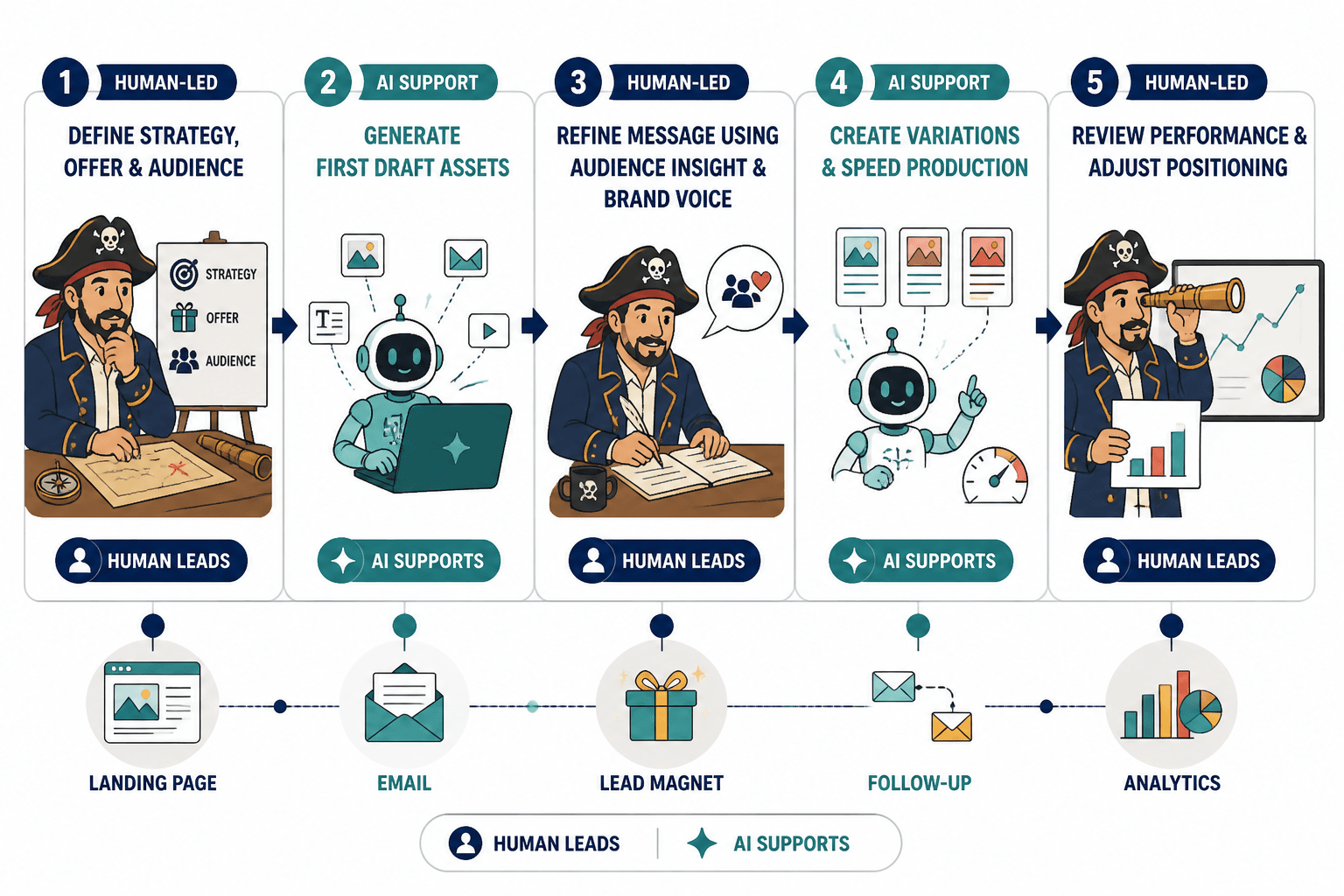
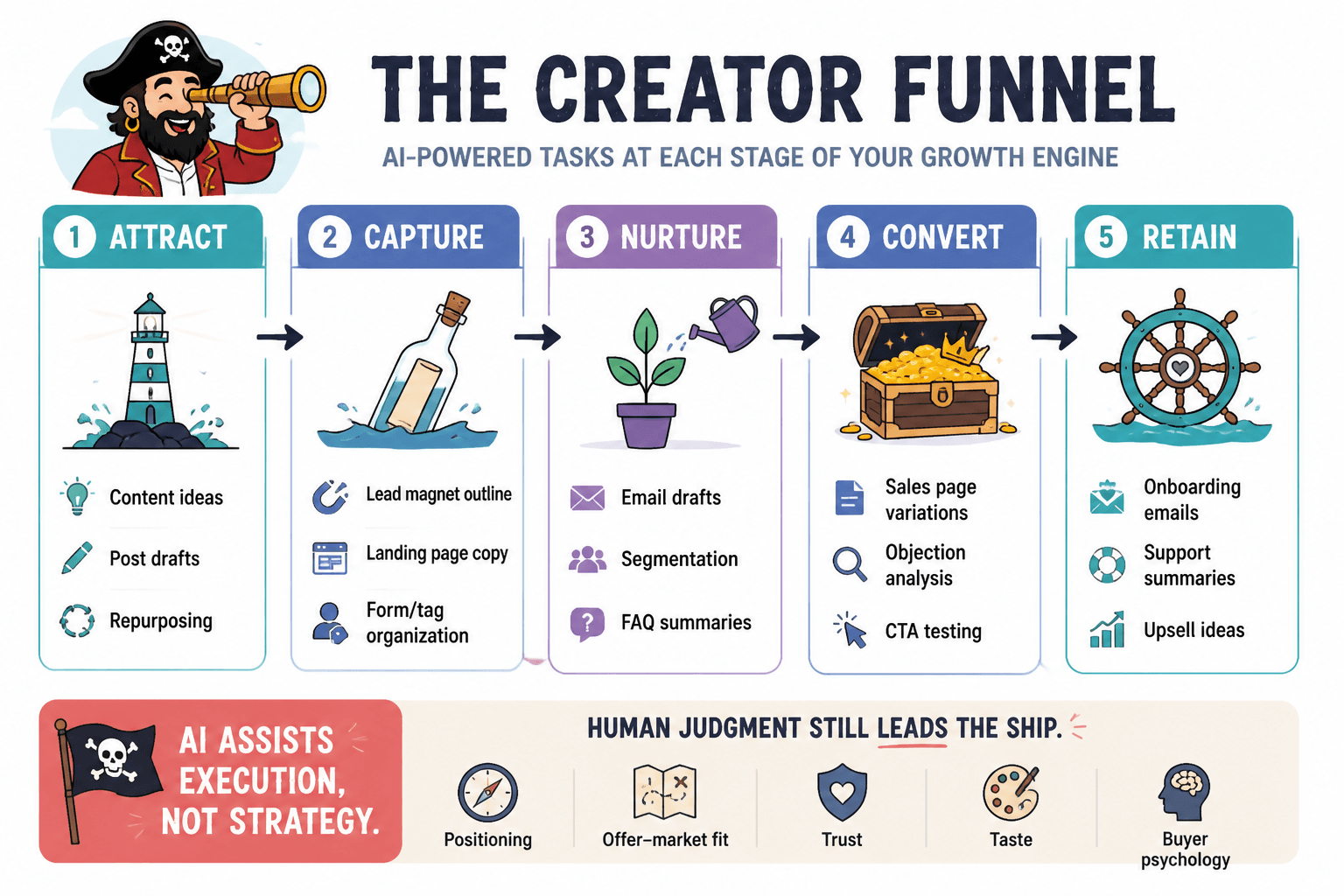
AI is useful in creator funnels when the task is structured enough to benefit from acceleration but still needs a human to judge fit, tone, and commercial sense. That usually means drafting, summarizing, comparing, testing variations, and spotting patterns across messages or data.
It is less useful when the job requires taste, positioning, or a decision about what is actually worth selling. That part still belongs to the creator, which is inconvenient for the tool vendors and refreshing for everyone else.
Good AI jobs in a funnel
- Turning rough notes into a first draft of a lead magnet, email, or landing page
- Generating headline, CTA, and subject line variations
- Summarizing audience feedback, support emails, or form responses
- Rewriting copy for different funnel stages without changing the core promise
- Identifying where a funnel is leaking based on basic performance data
Bad AI jobs in a funnel
- Choosing the offer for you
- Inventing a positioning angle from nothing
- Replacing a clear call to action with generic enthusiasm
- Building a whole funnel before the audience and offer are even aligned
This is why the best AI tools for creator funnels are not the flashiest ones. They are the ones that reduce friction at the exact handoff points where creators usually stall.
The lean AI stack for creator funnels
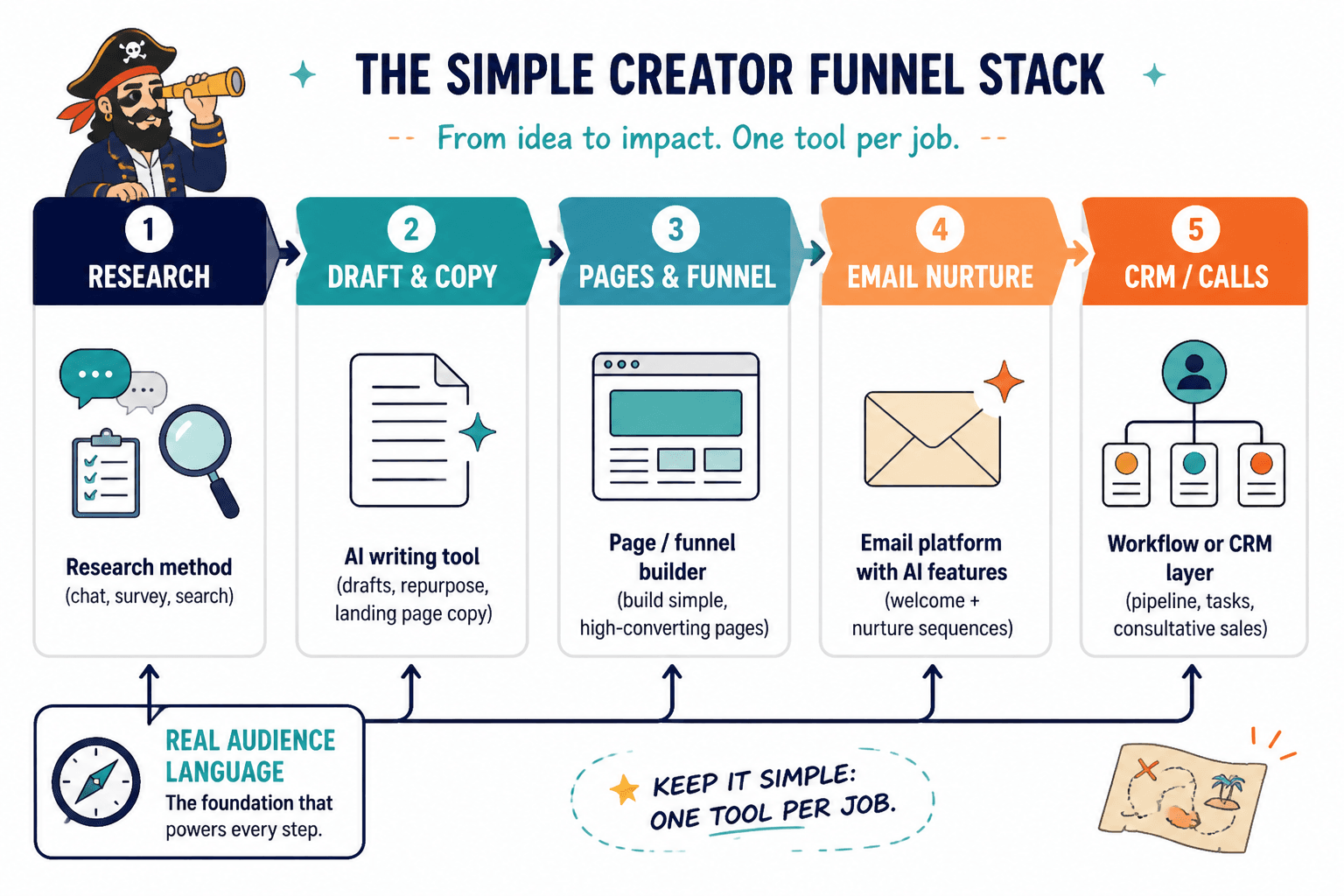
Most funnels need the same basic set of jobs covered, even if the tools differ. The smartest setup is usually a small stack with clear ownership:
1. Planning and positioning tool
Use AI here for idea sorting, audience refinement, offer framing, and first-pass messaging. This is where a tool like a strong general-purpose model helps you turn “I think people might want this” into something more explicit.
What it should produce:
- A clearer audience segment
- A specific problem statement
- One primary offer angle
- Supporting proof points or examples to test
If you need more examples of how creator funnels can be structured, the sibling guide on best creator funnels ideas and examples for creators is the better companion piece than another generic brainstorm doc.
2. Lead magnet and offer drafting tool
This is where AI earns its keep quickly. Give it a tightly framed outline, a clear audience, and a single outcome. Then use it to draft the asset, tighten sections, and produce a few alternate versions of the same core idea.
Helpful use cases:
- Outline a checklist, cheat sheet, or mini guide
- Draft a first version of an opt-in resource
- Create different headline options for the same asset
- Rewrite sections to be shorter and more specific
The sibling article on best templates and tools for creator funnels is useful here if the workflow also depends on reusable funnel structures rather than just writing assistance.
3. Landing page and page copy tool
Landing pages fail more often from vague copy than from ugly layout. AI is good at generating drafts for hero text, benefit bullets, FAQs, and CTAs, as long as you give it the actual promise and a few proof points.
Best use cases:
- Headline and subheadline variations
- Short benefit-led sections
- FAQ draft based on objections
- Microcopy for buttons and forms
For the broader tool stack behind pages, forms, and delivery, the companion page best funnel tools and website tools for creator funnels covers the non-AI parts that still need to work without drama.
4. Email nurture and follow-up tool
Email is where AI can help with sequencing, variation, and cleanup. It can draft welcome emails, write follow-up sequences, and adapt the tone so the series sounds like one person wrote it instead of a committee with a calendar reminder.
Useful jobs include:
- Writing a welcome sequence from a short outline
- Generating alternate subject lines
- Summarizing the purpose of each email in a sequence
- Creating soft pitch variations for different segments
For creator-specific funnel writing, the internal guide on how to write better creator funnels pairs well with this section because the copy still matters more than the automation.
5. Analysis and iteration tool
Once a funnel is live, AI becomes a decent assistant for reading patterns. Feed it open rates, clicks, replies, form responses, or notes from user calls, then ask what changed, what stayed flat, and what deserves testing next.
Good analysis tasks:
- Group feedback into themes
- Spot weak points in a sequence
- Suggest test ideas for a landing page or email flow
- Rewrite a section that is getting ignored
This is not mystical optimization. It is structured cleanup, which is less glamorous and far more useful.
How to choose the right AI tools
The best AI tools for creator funnels are the ones that reduce switching cost, keep the workflow understandable, and do not create a second job in the form of tool maintenance. A shiny app that requires a 40-minute onboarding ritual to write a headline is not a shortcut. It is a side quest.
Choose tools that do these things well
- Draft quickly: Useful output in minutes, not a ceremonial process
- Stay editable: Easy to revise without starting over
- Fit the workflow: Works with your docs, email platform, or landing page builder
- Keep context: Can handle audience, offer, and tone without constant re-explaining
- Support iteration: Makes comparison and testing easier, not harder
For a practical decision path, a simple rule helps: if a tool cannot save time on one specific funnel task, it is probably not a funnel tool. It is a subscription with a nice logo.
Practical AI tool categories for creator funnels
General AI writing assistant
Best for: brainstorming, rewrites, outlines, FAQs, subject lines, CTA variants, and quick edits.
Use it for the highest-volume writing tasks where speed matters more than a bespoke setup.
Design and layout support tool
Best for: page sections, visual hierarchy suggestions, and simple asset generation where the funnel needs a clean presentation more than art-direction heroics.
Keep it for support work, not for deciding the offer.
Email platform with AI features
Best for: sequence drafting, segmentation help, and resend or variation testing.
Use its AI features only if they genuinely speed up sending and refinement inside the same system.
Website or landing page builder with AI features
Best for: quick page drafts, headline testing, and copy suggestions tied to live pages.
Only worth using if the AI features do not clutter the core page-building workflow.
Analytics or CRM assistant
Best for: summarizing leads, spotting engagement patterns, and making follow-up more organized.
It should help you see the funnel, not bury you under another dashboard that behaves like a minor deity.
Simple workflows that actually work
Here are a few lean funnel workflows where AI helps without taking over the room.
Workflow 1: Content to lead magnet to email sequence
- Write one core content piece around a specific audience problem.
- Use AI to outline a small lead magnet from the same angle.
- Draft the landing page and opt-in copy.
- Generate a welcome sequence and one soft pitch.
- Review all steps for consistency before publishing.
Workflow 2: Newsletter to offer
- Publish a useful newsletter issue.
- Ask AI for 3 CTA variations that match the issue’s trust level.
- Draft a short bridge page or booking page.
- Build one follow-up email for readers who clicked but did not convert.
Workflow 3: Article or thread to consultation
- Start with a practical article or social thread.
- Use AI to produce a clear summary of the problem and outcome.
- Write a simple booking page and FAQ.
- Create follow-up messages for leads who need a little more context.
Common mistakes when using AI in creator funnels
- Using AI to widen the funnel before the offer is clear. That just creates more vague traffic.
- Letting every tool write in a different voice. The reader notices even if the dashboard does not.
- Automating before the copy works. Broken messaging gets more efficient at being broken.
- Picking tools for features you will never use. A funnel is not improved by the presence of everything.
- Skipping review because the draft looks finished. AI is fast, not accountable.
What a good creator funnel tool stack looks like
A good stack is small, deliberate, and boring in the best way. It has:
- One tool for thinking and drafting
- One tool for pages or assets
- One tool for email or follow-up
- One place to see results
That is enough for most creators. The rest is usually a coping mechanism with billing.
If your funnel is still unclear, go back to the parent guide at creator funnels and decide what the path is supposed to do before you add another app to the pile.
Useful sources for the technical side
For tool selection and implementation details, the primary documentation from major platforms is more useful than vendor-listicles pretending to be neutral.
- OpenAI: ChatGPT introduction – useful background on general AI writing and drafting workflows.
- Mailchimp Help Center – helpful for email sequence and automation basics.
- Google Analytics 4 documentation – useful for funnel measurement and traffic analysis.
Bottom line
The best AI tools for creator funnels are the ones that make the workflow cleaner, not louder. Use AI to draft, compare, summarize, and improve. Keep strategy human. Keep the stack small. And make sure every tool has one job before it starts volunteering for three more.
For related reading, the most useful next stops are best creator funnels ideas and examples for creators, best templates and tools for creator funnels, and how to improve creator platform funnels without sounding generic.