
Most landing pages do not have a landing-page problem.
They have a funnel problem.
You can polish the headline, tweak the button color, and lovingly rearrange your testimonials until your eyes glaze over. But if the page is connected to the wrong funnel, or no real funnel at all, it is still going to sit there like a very tidy brochure that does not pull its weight.
The best funnel ideas to pair with landing pages depend on one boring-but-important thing: what you are asking people to do, and how much trust they need before they do it. A cold visitor is not the same as a warm lead. A $29 template is not the same as a $3,000 consulting package. Yet people keep using the same page structure and same CTA for wildly different offers, then acting shocked when conversion rates look sad.
Here’s how to pair landing pages with funnels that actually fit the offer, the audience, and the level of commitment you are asking for. We’ll cover simple, practical funnel models you can use for creators, coaches, consultants, freelancers, service providers, and solo brands without turning your business into a duct-taped automation swamp.
If you need the page itself sorted first, start with this guide to landing pages for creators who want better results or browse the broader landing pages hub. If your main issue is conversion, not structure, this piece on turning landing pages into more leads or sales will help too.
To see how this fits into the wider strategy, open the parent guide.
What makes a good landing page funnel pairing
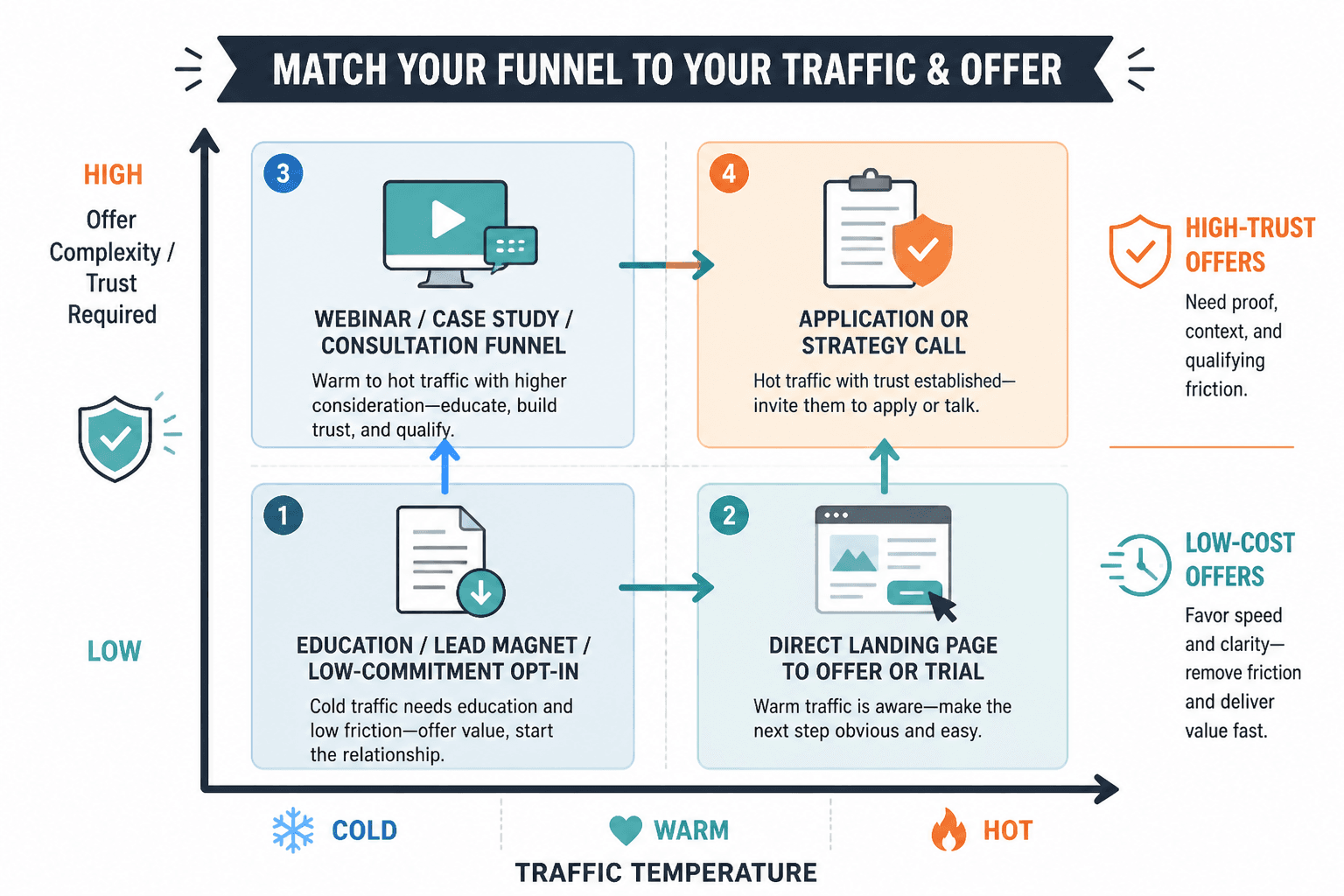
A landing page works best when it matches three things:
- Traffic temperature: cold, warm, or hot
- Offer complexity: simple purchase, qualified lead, consultation, application, newsletter, waitlist
- Trust requirement: low, medium, or high
That is the basic filter. Ignore it and you get weird mismatches. Like sending cold traffic straight to a “book a strategy call” page for an expensive offer with zero proof. Or making warm newsletter subscribers download a free checklist they do not need because apparently every funnel must begin with a PDF from 2019.
A smarter setup looks more like this:
- Cold traffic gets education, clarity, or a small commitment first
- Warm traffic gets a direct path to the next logical step
- High-trust offers get proof, context, and friction that qualifies people
- Low-cost offers get speed, clarity, and less ceremony
Simple enough. The hard part is choosing the right funnel instead of copying whatever some screenshot-heavy thread said was “crushing it.”
Best funnel ideas to pair with landing pages
These are not the only funnels worth using. They are the ones that tend to make sense for real businesses with real offers and finite patience.
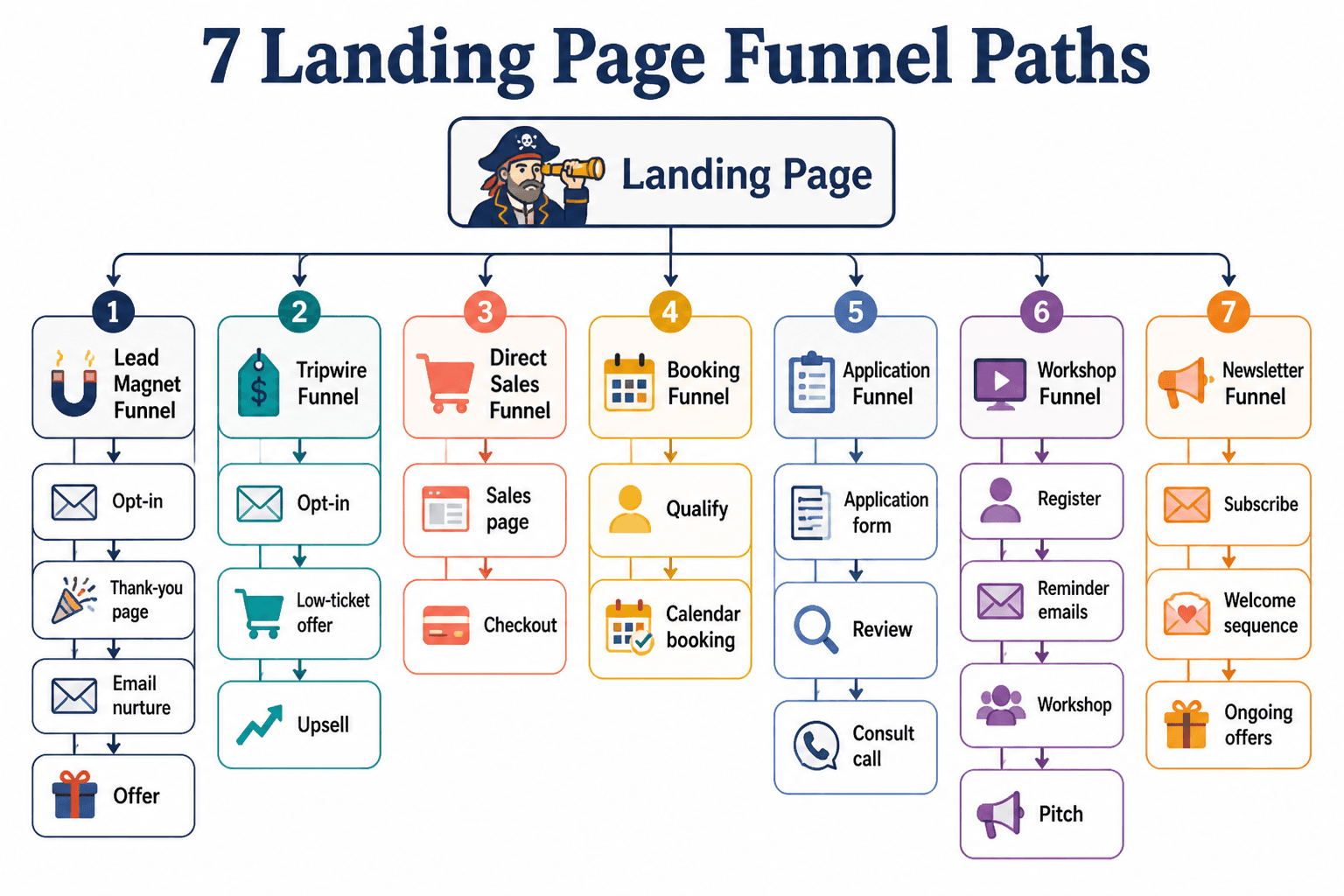
1. Content to lead magnet to nurture sequence to offer
This is the classic lead-gen funnel. It still works when the lead magnet is genuinely useful and the follow-up emails are not bland, robotic, or aggressively thirsty.
Best for: coaches, consultants, service providers, educators, personal brands, B2B experts
Funnel flow: post, article, podcast, thread, or ad → landing page → free resource opt-in → email sequence → offer
Why it works: it gives cold and semi-warm traffic a lower-friction first step. Instead of asking for a sale immediately, you earn permission to continue the conversation.
This is especially useful when your offer needs explanation or when your audience is skeptical, busy, or both. Which, to be fair, is most people.
Landing page job: sell the value of the free thing clearly, fast, and without pretending a 3-page checklist will change someone’s life.
Good lead magnet examples:
- A teardown
- A short template pack
- A niche checklist
- A mini email course
- A decision guide
- A swipe file
- A workshop replay with a clear takeaway
Don’t do this: create a vague freebie that sounds nice but solves nothing. “The Ultimate Mindset and Success Toolkit” is not a lead magnet. It is a red flag wearing Canva.
2. Content to sales page to checkout
This is the cleanest funnel for lower-priced, easier-to-understand offers.
Best for: templates, mini-products, digital downloads, low-ticket workshops, audits, small retainers with clear scope
Funnel flow: content or ad → landing page/sales page → checkout
Why it works: fewer steps, less leakage, faster decision-making.
If the offer is easy to understand, the price is not terrifying, and the buyer already sees the problem, you often do not need a complex nurture funnel. You need a sharper page and a more obvious reason to buy now.
Landing page job:
- State the problem clearly
- Show exactly what they get
- Explain who it is for and not for
- Handle key objections
- Make the CTA easy
This is where a lot of creators overcomplicate things. Not every offer needs a 14-email sequence and three “value bombs” before a purchase. Sometimes the buyer just wants to know if the thing is useful.
3. Content to webinar or workshop registration to offer
This funnel works well when your offer benefits from demonstration, teaching, and trust-building in real time or semi-live format.
Best for: courses, programs, group coaching, strategic services, higher-ticket educational offers
Funnel flow: content or ad → registration landing page → live or evergreen workshop → offer page or application
Why it works: it gives you more room to teach, frame the problem, handle objections, and prove you know what you are doing.
This funnel is useful when people need to understand your method before buying. It is also useful when the market is crowded and your offer needs clearer differentiation.
Landing page job: make the workshop feel worth attending even if the person never buys. If the registration page reads like a thinly disguised pitch ambush, people can smell it.
Promise a useful outcome. Be specific. “Learn how to build a landing page funnel that turns newsletter readers into qualified calls” is solid. “Transform your business with our powerful free masterclass” should be quietly escorted out.
4. Content to application page to sales call
This is a strong fit for premium services and offers that are not right for everyone.
Best for: consulting, done-for-you services, executive coaching, high-ticket strategy work, custom retainers
Funnel flow: content, referral, or warm traffic → landing page → application → sales call
Why it works: it pre-qualifies leads and filters out people who are curious but nowhere near ready.
This is where friction can actually help. Not all friction is bad. If your service is expensive, limited, or requires strong fit, a quick form can improve lead quality and save everyone time.
Landing page job:
- Explain the offer clearly
- Set expectations about who it is for
- Show proof and outcomes
- Make the next step feel worth the effort
The mistake here is trying to sound elite instead of useful. “Apply to work with me” only works if people understand what they are applying for, why it matters, and why you are credible.
5. Content to booking page to consultation
This looks similar to the application funnel, but it is lighter and better for simpler service offers.
Best for: freelancers, specialists, one-off audits, discovery calls, low-friction service consultations
Funnel flow: content or referral → landing page → calendar booking page → consultation
Why it works: it reduces steps and gets interested people into a conversation quickly.
This funnel usually works best when the audience is already reasonably warm or the service is easy to grasp. If the offer needs a lot of context, an application page or case-study step may be better.
Landing page job: answer the obvious questions before someone books:
- What is this call for?
- Who is it for?
- What happens on the call?
- Is this a pitch fest or actually useful?
- What kinds of problems do you solve?
If your booking page gets lots of calls that go nowhere, the issue is often upstream messaging, not the calendar tool.
6. Ad to quiz or assessment page to segmented landing page to offer
This funnel can work very well when your audience has different needs and one generic page would undersell the nuance.
Best for: coaches, consultants, educators, multi-path offers, service businesses with different buyer types
Funnel flow: ad or content → quiz/assessment landing page → segmented result page and email flow → relevant offer
Why it works: personalization can increase relevance, and relevance usually beats volume.
But this one is easy to overbuild. If your quiz is mostly a gimmick to collect email addresses while telling everyone they are a “visionary leader archetype,” maybe sit down for a minute.
Landing page job: make the assessment feel practical, specific, and worth completing. Then make sure the segmented follow-up actually changes based on the result.
7. Article or SEO content to landing page to newsletter
This is a strong long-game funnel for trust, authority, and consistent inbound leads.
Best for: writers, consultants, niche educators, creators with strong ideas, service businesses building search traffic
Funnel flow: search traffic → article → newsletter landing page or lead magnet page → email nurture → offer
Why it works: people who find you via search usually have a clear problem. If your article is useful, the next step should continue that usefulness.
This is often better than sending search visitors straight to a sales page unless their intent is strongly transactional. Many people need one more trust-building step first.
Landing page job: bridge article intent to email value. If the article is about landing page conversion, the opt-in should logically extend that topic, not swerve into some vague “creator confidence” newsletter promise.
If you want more examples of strong page structure, these landing page ideas and examples for creators are worth a look.
How to choose the right funnel for your landing page
If you are stuck between options, use this quick decision filter.
Choose based on offer type
- Low-ticket digital product: direct sales page funnel
- Service offer with moderate trust needs: booking page or lead magnet funnel
- High-ticket custom service: application funnel
- Program or course that needs explanation: workshop funnel
- Long sales cycle: lead magnet or newsletter funnel
Choose based on audience warmth
- Cold traffic: free resource, workshop, quiz, or newsletter
- Warm traffic: direct offer page, booking page, or application page
- Referral traffic: usually can go straight to an offer or call page if the fit is clear
Choose based on your sales process
If you personally close deals on calls, your funnel should help people arrive informed and pre-qualified.
If you sell self-serve products, your funnel should remove confusion and shorten the path.
If you rely on trust over time, build for follow-up, not instant conversion fantasies.
Common landing page funnel mistakes
A few things people keep doing wrong:
- Sending everyone to the same page. Cold social traffic and referred buyers are not the same.
- Asking for too much too soon. A stranger probably is not desperate to “book a free clarity call.”
- Using lead magnets with no strategic purpose. If the freebie does not lead naturally to the paid offer, the funnel is crooked.
- Adding steps because funnels are supposed to be elaborate. More steps usually mean more drop-off.
- No follow-up after the landing page conversion. Opt-ins without nurture are just email hoarding.
- Weak page-message match. If the post, ad, or article promises one thing and the landing page shifts tone or topic, trust drops fast.
- Pitching hard before proving anything. That approach is annoying at best and expensive at worst.
For creators with smaller audiences, this matters even more. You do not have unlimited traffic to burn on sloppy sequencing. This article on landing pages for creators with small audiences covers how to make fewer visitors count more.
A simple way to map your funnel before building the page
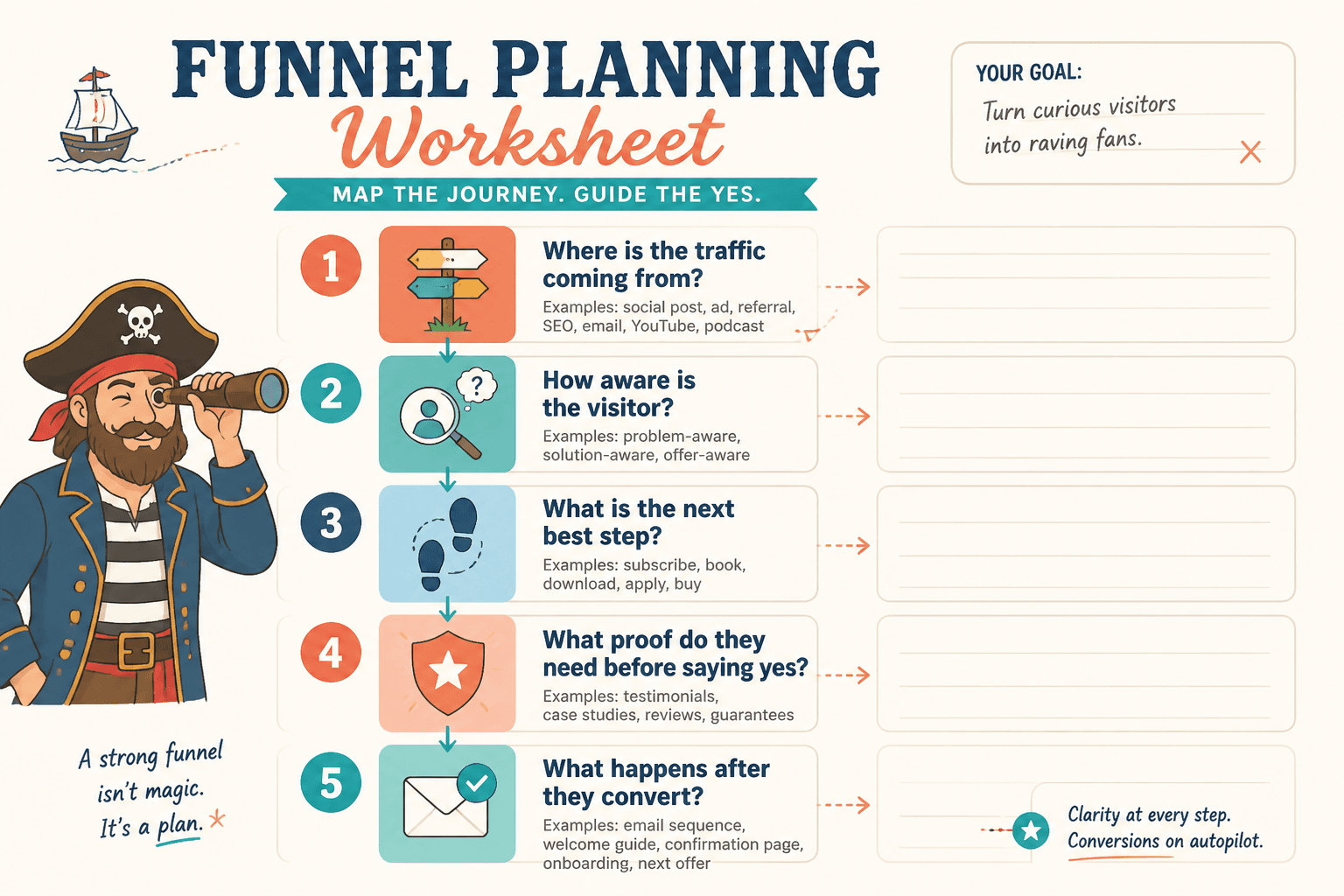
Before you write a landing page, answer these five questions:
- Where is the traffic coming from?
Social post, ad, referral, article, email, podcast, partner mention? - How aware is the visitor?
Do they know the problem, know you, know the offer, or none of the above? - What is the next best step?
Subscribe, book, buy, apply, register? - What proof do they need before saying yes?
Results, examples, testimonials, process clarity, case studies? - What happens after they convert?
Email sequence, confirmation page, direct checkout, scheduler, follow-up content?
If you cannot answer those clearly, your funnel is not ready. Your landing page copy will end up trying to compensate for missing strategy, which is unfair to the copy and frankly a bit rude.
Quick funnel pairings by business type
| Business type | Best landing page funnel pairing | Why it fits |
|---|---|---|
| Coach with high-ticket offer | Content → application page → call | Builds trust and filters fit |
| Consultant selling audits | Content → sales page → checkout | Simple offer, direct path |
| Freelancer booking discovery calls | Referral/content → booking page | Fast conversion for warm traffic |
| Creator selling templates | Post/article → sales page → checkout | Low friction, easy to understand |
| Educator launching program | Content/ad → workshop registration → offer | More room to teach and sell |
| Niche writer building authority | SEO article → newsletter page → nurture | Compounds trust over time |
| Service brand with varied customer types | Ad → quiz → segmented page → offer | Improves relevance and qualification |
The bigger point is simple: clearer structure and clearer writing make the piece more useful. That is usually what makes the ending land better too.