
Most creator AI research and ideation does not fail because the tool is weak. It fails because the raw material is bland, the prompts are lazy, and the output gets accepted way too early.
You ask AI for content ideas, and it hands back the usual suspects: tips, mistakes, trends, hacks, ultimate guides, beginner advice, “what nobody tells you,” and some deeply uninspired thought leadership fluff wearing a nice blazer. Technically usable. Practically forgettable.
If you want to know how to rewrite boring creator AI research and ideation, the fix is not “use better tools” or “add more prompts” until your workflow looks like a haunted spreadsheet. The fix is to take vague research, generic angles, and padded idea lists and rewrite them into sharper inputs with stronger tension, clearer audience fit, and actual usefulness.
That is what this article will help you do: turn flat AI-assisted research into better content angles, stronger idea banks, and prompts that produce material you might actually want to publish. Not because the machine got magical. Because your thinking got less mushy.
For the main guide behind this topic, visit the parent guide.
Why creator AI research gets boring so fast
Boring ideation usually starts before AI writes a single word.
Most creators feed AI one of these:
- A huge topic with no angle
- A generic audience description
- A broad goal like “get leads” or “grow on social”
- A weak prompt asking for “50 content ideas”
- No examples of tone, taste, or positioning
Then they get back exactly what that input deserves: content oatmeal.
AI is pretty good at pattern recognition. It is less impressive at producing sharp originality from vague soup. If your inputs sound like every creator in your niche, your outputs will too. The issue is not just bland wording. It is bland thinking.
Good creator research and ideation has texture. It has friction. It notices what people believe, what they misunderstand, what they complain about, what they buy too early, what they ignore too long, and where common advice quietly falls apart.
If your research notes and idea lists do not contain any of that, AI cannot invent it for you in a convincing way.
What “rewriting” actually means here
Rewriting boring creator AI research and ideation does not mean polishing sentences so they sound fancier. It means improving the strategic material underneath.
You are rewriting:
- Research notes so they capture tension, not just topics
- Idea lists so they contain angles, not just categories
- Prompts so they produce perspective, not recycled filler
- Headlines and hooks so they signal a real payoff
- Audience framing so the content sounds like it is for someone specific
Think of it this way: bad ideation gives you nouns. Better ideation gives you arguments, contrasts, stakes, and outcomes.
A topic is “email funnels.” An angle is “why most creator email funnels feel overbuilt for audiences that barely trust you yet.” One of those can become content. The other is just a folder name.
If you need help tightening the prompt layer before the rewrite stage, this companion piece on improving creator AI research and ideation outline prompts without sounding generic will help.
The 5-step rewrite process that makes AI ideation more useful
Here is the practical process. It works whether you are brainstorming posts, articles, lead magnets, newsletter ideas, or a month of content.
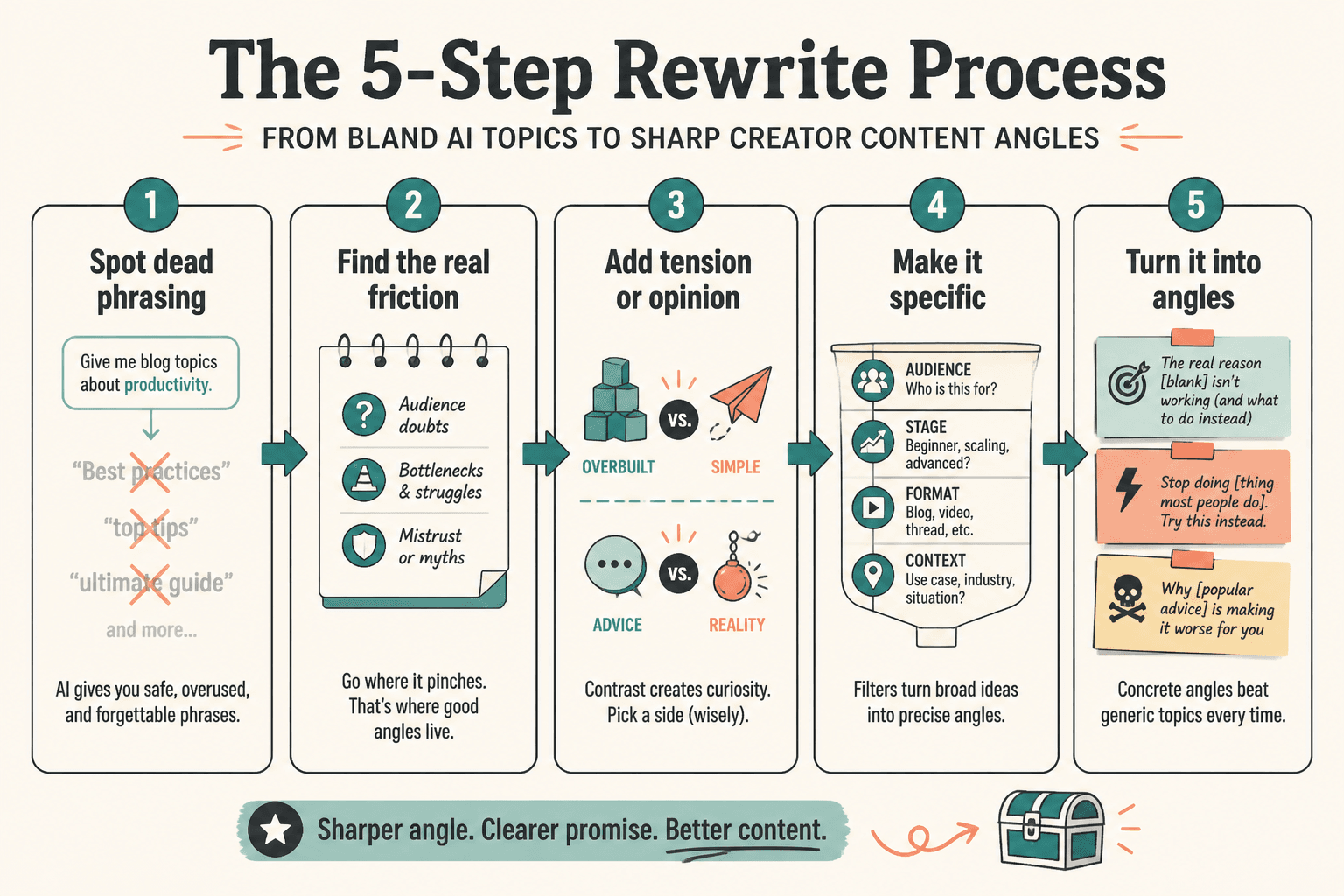
1. Find the dead phrasing
Start by highlighting anything in your research or AI output that sounds broad, bloodless, or instantly replaceable.
Usual offenders:
- Best practices
- Top tips
- Common mistakes
- Things to know
- How to grow
- Ways to improve
- Content strategy ideas
- Build your brand
- Increase engagement
None of these are illegal. They are just too weak on their own. They do not contain a perspective. They do not show where the reader is stuck. They do not hint at what makes your take different.
When you spot dead phrasing, do not merely swap in stronger adjectives. Replace the vague category with the actual issue.
| Boring version | Stronger rewrite |
|---|---|
| Content strategy tips | Why smart creators keep posting useful content that never turns into demand |
| Common mistakes in AI writing | Where AI-generated creator content starts sounding polished, empty, and weirdly interchangeable |
| Personal branding ideas | How to stop describing yourself in ways that sound impressive but tell buyers nothing |
| How to do audience research | What to look for in comments, calls, and DMs if you want content ideas people actually care about |
2. Add tension to the idea
Most bad AI ideation is missing tension. It presents topics as if the reader lives in a peaceful world where all advice agrees and effort always gets rewarded properly.
That is not the world your reader lives in.
Good content ideas usually have at least one of these built in:
- A common belief that needs challenging
- A mistake with consequences
- A tradeoff people avoid admitting
- A gap between effort and results
- A hidden reason something is not working
- A contrast between what looks smart and what works
Here is a simple rewrite formula:
Generic topic + specific audience + real friction + clear payoff
Example:
- Before: AI content ideas for coaches
- After: AI content idea prompts for coaches who have expertise but keep getting bland post topics that sound like everybody else
That second version gives the tool something to work with. More importantly, it gives you something to work with.
3. Replace topic lists with angle lists
This one matters a lot. Topic lists are easy to generate and often useless. Angle lists are harder and much better.
A topic list says:
- Email marketing
- Lead magnets
- Thought leadership
- Funnels
- Personal brand
An angle list says:
- Why “valuable content” often fails when the creator has weak positioning
- Lead magnets that attract freebie collectors instead of buyers
- The difference between sounding credible and sounding professionally overprocessed
- Funnels that are too complex for the trust level of the audience
- Personal brand advice that makes everyone’s profile sound like the same consultant in a navy blazer
See the difference? One is storage. The other is strategy.
When rewriting AI research and ideation, force every topic to earn its way into an angle. If it cannot become a useful argument, question, or observation, it probably is not ready yet.
4. Add audience specificity without making it stiff
Creators often write audience descriptions like this:
- Entrepreneurs
- Business owners
- Coaches and consultants
- Small business founders
That is not useless, but it is not enough to shape interesting ideation. A better audience line includes context.
Try adding one or two of these:
- Stage: new, growing, experienced, pivoting
- Problem: low leads, weak positioning, poor conversion, inconsistent content
- Behavior: overposting, overediting, relying on AI too much, stuck in research mode
- Goal: better inbound leads, cleaner authority, more trust, stronger newsletter growth
For example:
- Weak: content ideas for consultants
- Better: content ideas for consultants with solid expertise but weak online positioning
- Stronger: content ideas for consultants who know their work, hate fluffy marketing, and need smarter authority content that can lead to actual inquiries
The goal is not to write a tiny novel inside every prompt. It is to make the AI stop guessing which generic internet person you mean.
5. Rewrite the output before you keep it
This is where many people quit too early. They generate 40 ideas, copy them into Notion, and call it a content system.
No. That is a pile.
Before an AI-generated idea goes into your bank, rewrite it so it is specific enough to publish from later.
Use this quick filter:
- Would a smart person in my niche say this exact thing?
- Does this idea contain a real tension or just a topic area?
- Can I picture the reader who needs this?
- Is there a clear payoff?
- Would I click this, save this, or write from this?
If not, rewrite it until the answer is yes.
Before-and-after rewrites: boring AI ideation into usable content angles
Here is what this looks like in practice.
Example 1: Generic research summary
Before: “Creators struggle with consistency, audience growth, monetization, and content burnout.”
After: “A lot of creators are not struggling with consistency in the motivational sense. They are struggling because their content process is bloated, their idea generation is weak, and every post starts from scratch.”
The rewrite is better because it turns abstract pain points into operational problems. That gives you material for stronger content.
Example 2: Bland AI prompt
Before: “Give me 20 content ideas for personal branding.”
After: “Give me 20 content angles for creators, coaches, and consultants who are tired of vague personal branding advice and need clearer ways to explain what they do, who they help, and why their content is not converting attention into inquiries.”
That prompt has audience, frustration, desired outcome, and a bias against fluff. Much better.
Example 3: Weak content idea bank entry
Before: “How to use AI for content research”
After: “How to use AI for content research without collecting a giant pile of decent-sounding ideas you never publish because none of them are sharp enough”
Longer? Yes. Better? Also yes. At least now the idea has a pulse.
Example 4: Generic article angle
Before: “Mistakes creators make with AI”
After: “The quiet mistake creators make with AI research: using it to expand weak ideas instead of pressure-testing them”
This version gives you tension and a point of view. That is what makes content feel authored instead of assembled.
If your openings are also coming out flat, read how to start creator AI research and ideation without a weak opening. A better angle still needs a decent start.
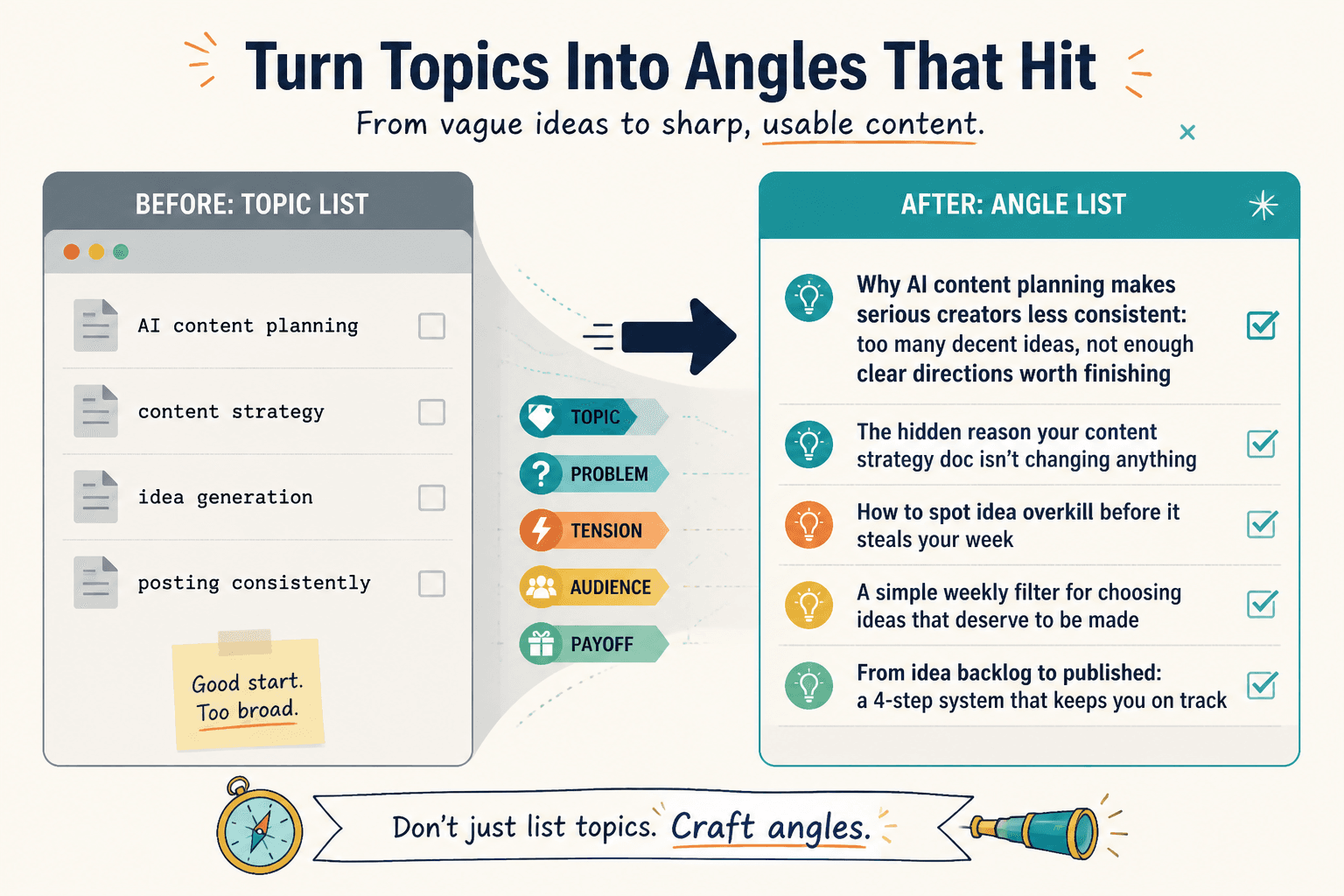
A simple rewrite framework for AI-generated idea lists
When AI gives you a list of content ideas, run each one through this mini framework:
- Topic: What is this about?
- Problem: What is going wrong?
- Tension: What belief, habit, or mismatch makes this interesting?
- Audience: Who specifically cares?
- Payoff: What would they get from reading or watching it?
For example:
| Layer | Rewrite |
|---|---|
| Topic | AI content planning |
| Problem | Too many ideas, not enough usable ones |
| Tension | More ideas feels productive but often creates more noise |
| Audience | Creators with expertise but inconsistent publishing |
| Payoff | A tighter system for generating fewer, better content directions |
That can become a much better working angle:
Why AI content planning often makes serious creators less consistent: too many decent ideas, not enough clear directions worth finishing
That is the level of specificity you want sitting inside your content bank.
What to cut from boring creator AI research immediately
If you want stronger ideation fast, start deleting more aggressively.
Cut research notes and idea lines that are:
- So broad they could fit any niche
- Obvious enough to be said by everyone already
- Full of trend-chasing language you do not even like
- Packed with jargon but empty of stakes
- Interesting only to other creators, not buyers
- Too polished to sound believable
- Basically just reworded search queries
This part matters because creators tend to overvalue volume. They want 100 ideas instead of 15 solid ones. But 100 weak ideas do not reduce friction. They create it. Now you have to sort through a swamp every time you want to publish.
A leaner bank of stronger ideas is easier to use, easier to repurpose, and more likely to become content that sounds like you. Strange concept, I know.
Better prompt rewrites that improve research quality
If your prompts are too generic, your rewrite work multiplies. So fix the upstream problem where you can.
Here are stronger prompt structures for creator AI research and ideation.
Prompt structure 1: challenge the obvious
Give me 15 content angles for [audience] about [topic]. Avoid generic beginner advice. Focus on mistaken assumptions, under-discussed friction, and places where popular advice sounds smart but works badly in practice.
Prompt structure 2: mine for tension
Analyze this topic for tensions, contradictions, and gaps between what creators think they need and what actually helps. Turn those tensions into article or post angles for [audience].
Prompt structure 3: improve weak outputs
Here is a list of content ideas. Rewrite each one to be more specific, more audience-aware, and less generic. Add a clearer problem, stronger point of view, and a more useful payoff. Keep them practical, not sensational.
Prompt structure 4: build an angle bank, not a topic bank
Do not give me broad topics. Give me 25 content angles with clear friction, a likely reader problem, and a concise explanation of why each angle matters.
If your tone keeps slipping into polished robot mode, this article on writing creator AI research and ideation without sounding salesy or robotic is worth keeping nearby.
How to know the rewrite is good enough
You do not need every angle to be brilliant. You do need it to be usable.
A rewritten research note or idea is probably strong enough when:
- You can imagine the post or article without doing another full brainstorm
- The audience is visible
- The problem feels real, not decorative
- The angle suggests a point of view
- The idea sounds like something you would actually say
- The output gives you momentum instead of making you stall
That last one matters more than people admit. Good ideation reduces resistance. Bad ideation creates a thousand tiny moments of “eh, maybe later.”
Use old content to sharpen new AI ideation
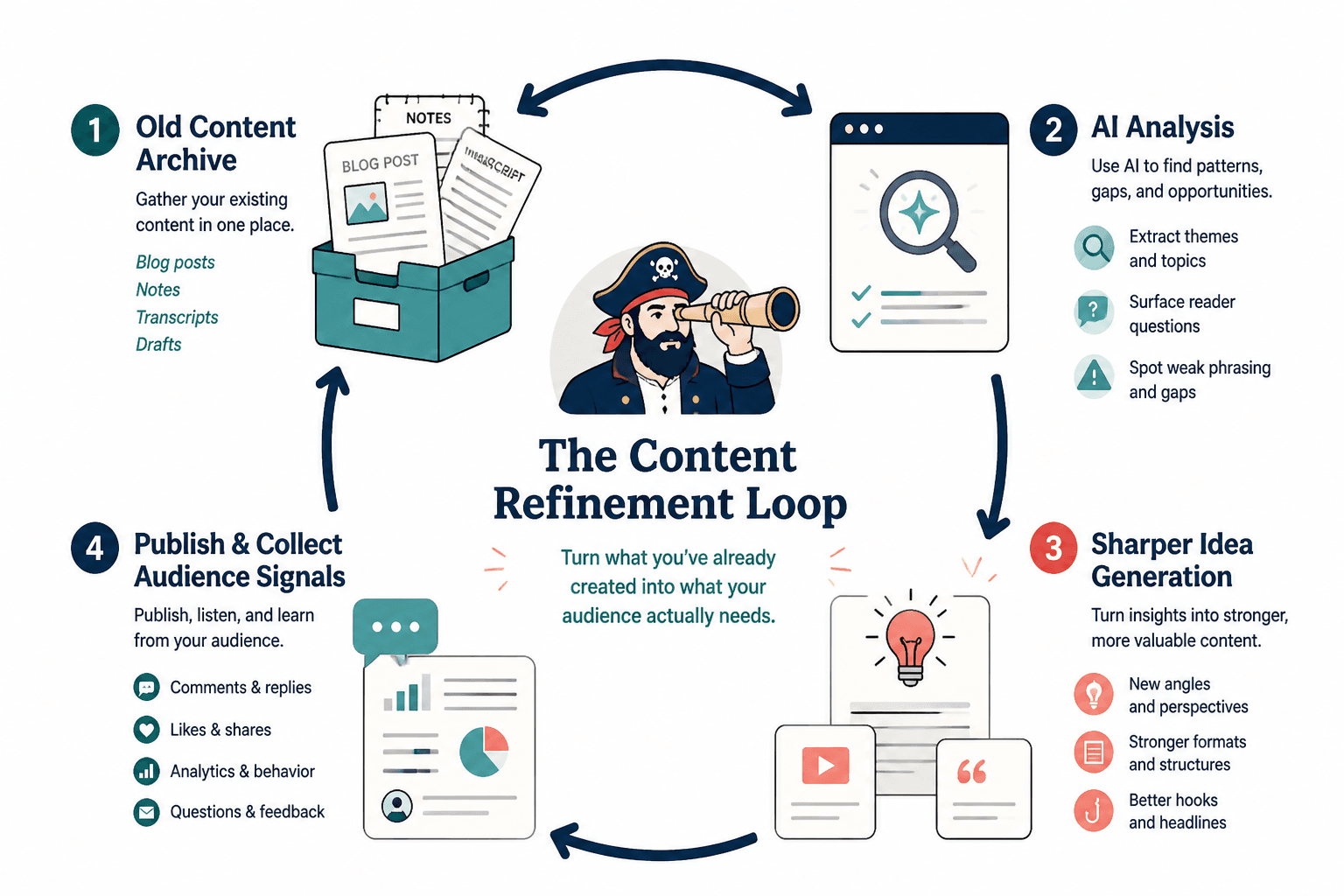
One of the easiest ways to stop AI ideation from going bland is to feed it your own stronger material. Old posts, client questions, call notes, newsletter replies, article sections, and half-finished drafts are all better fuel than generic internet summaries.
Why? Because they contain lived specificity. They reveal what you actually notice, what your audience actually asks, and where your language already has bite.
You can ask AI to do things like:
- Extract recurring themes from old posts
- Find patterns in reader questions
- Turn one useful article into 10 sharper angle variants
- Spot weak phrasing in your existing idea bank
- Rewrite your own best-performing topics into stronger new formats
If you want a workflow for that, read how to turn old content into better creator AI research and ideation.
A cleaner workflow for creator AI research and ideation
The bigger point is simple: clearer structure and clearer writing make the piece more useful. That is usually what makes the ending land better too.
The bigger point is simple: clearer structure and clearer writing make the piece more useful. That is usually what makes the ending land better too.