
Most people do not have an X posting problem. They have a “cool, now what?” problem.
They post sharp opinions, useful threads, decent one-liners, maybe even get some reach, and then absolutely nothing happens. No email signups. No qualified leads. No inquiries. No sales. Just a brief hit of attention followed by the usual internet dust.
That is usually not because X is useless. It is because the post is doing one job and the funnel is doing none.
The best funnel ideas to pair with X posts are not complicated. They are just aligned. Your post gets attention. Your profile gives context. Your next step makes sense. That’s the whole machine. Small machine, ideally. Not some bloated funnel map that looks like it was designed by a caffeinated octopus.
This article will help you match the right kind of funnel to the kind of X posts you publish, so your content can do more than collect likes from people who were never going to buy anyway.
For the main guide behind this topic, visit the parent guide.
Why most X post funnels fail
X moves fast. That is obvious. What matters more is this: people decide fast there, too.
If your post is strong but the next step is vague, too big, too salesy, or disconnected from what the post promised, people leave. Not because they hated it. Because friction won. Friction usually does.
Here is the usual mess:
- The post is about one sharp idea, but the bio links to a generic homepage
- The thread teaches something practical, then ends with a random pitch
- The CTA asks for too much too soon
- The landing page sounds nothing like the post
- The creator wants sales from people who barely know who they are
X rewards clarity and speed. Your funnel should do the same. A good X funnel does not interrupt momentum. It channels it.
If the post creates interest but the next step creates confusion, the funnel is broken.
What a good X funnel actually needs
You do not need seventeen steps, a mini-course, and three scarcity emails. You need a believable next move.
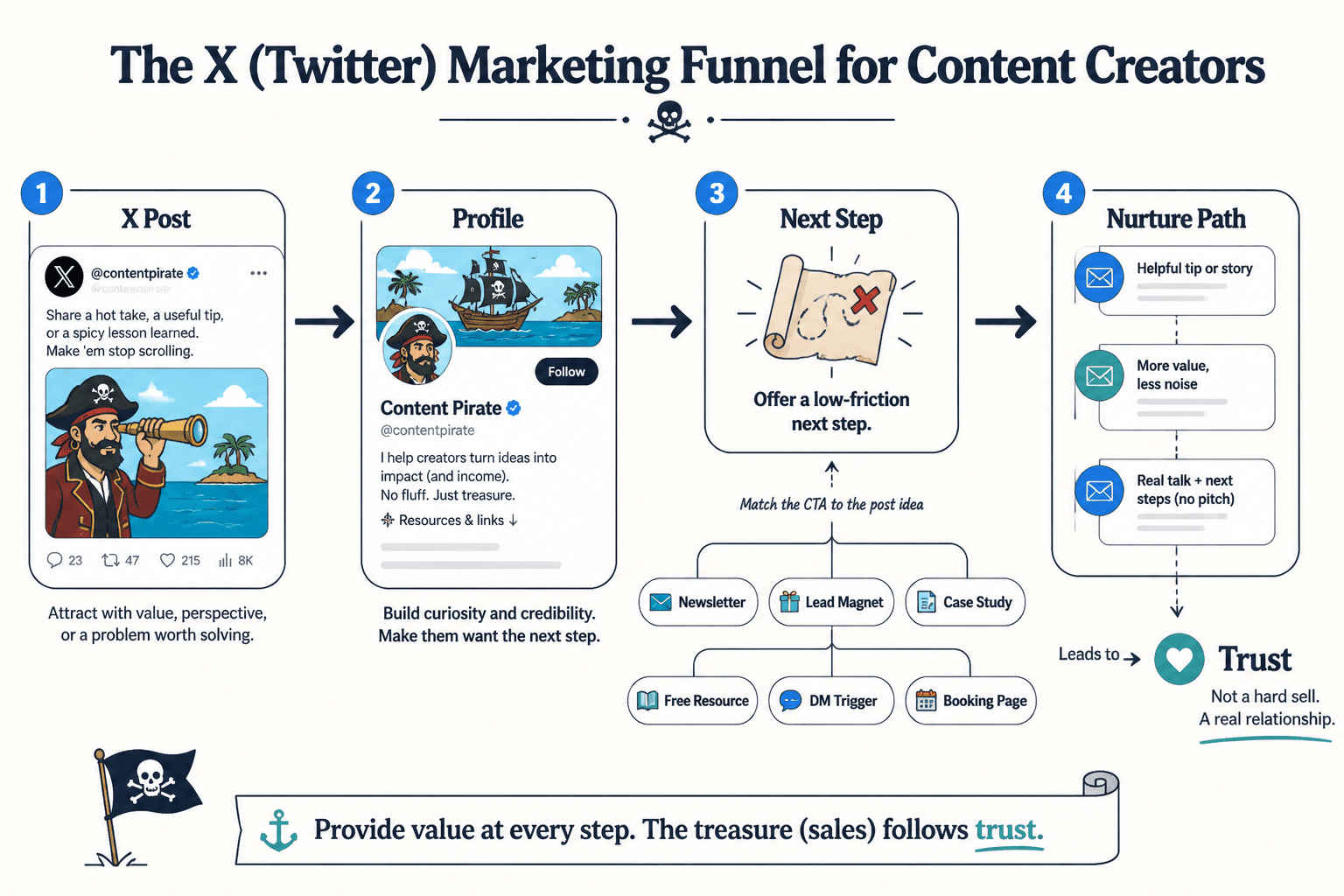
A strong funnel paired with X posts usually has four parts:
- A post with a clear angle that earns attention
- A profile that explains who you help and why you are worth following
- A next step with low enough friction for the attention level you have earned
- A nurture path that builds trust instead of lunging for the sale
That next step could be an email list, a lead magnet, a case study, a free resource, a booking page, a product page, or even a DM trigger if your audience and offer support it. But the key is fit.
An X post is often short, fast, and idea-driven. So the funnel that follows should feel like a natural continuation of that exact idea. Not a hard pivot into “and now please schedule a strategy call with my premium transformation framework.”
The best funnel ideas to pair with X posts
Here are the funnel models that tend to work best on X, especially for creators, consultants, coaches, solo founders, and service businesses.
1. X post → profile → newsletter signup
This is one of the cleanest and most durable options.
Your post earns attention. The profile confirms what you talk about. The newsletter gives people a slower, deeper place to stay connected. This works especially well if your posts are insight-driven, opinionated, educational, or part of a larger body of thinking.
Best for:
- Writers
- Consultants
- Coaches
- Founders building authority
- Creators with recurring ideas
Why it works on X:
- The ask is simple
- Email is a better trust-building environment than a cold sales page
- You can keep the relationship without depending on platform reach
Good CTA style:
If you like blunt breakdowns on content, positioning, and funnels, the newsletter is where I go deeper.
Bad CTA style:
DM me “GROWTH” for my proprietary audience ascension system.
One sounds like a real person. The other sounds like a funnel built in a cave by a marketer who has not spoken to sunlight in years.
2. X thread → lead magnet → nurture emails
If you are teaching practical stuff on X, this one makes sense fast.
A useful thread can create strong intent because the reader already spent more time with you than they would on a single post. That makes a lead magnet a natural next step, assuming it is closely related to the thread topic.
Example:
- Thread: 7 mistakes killing your X hooks
- Lead magnet: 25 proven hook templates with rewrites
- Nurture emails: examples, breakdowns, soft pitch for your offer
The lead magnet should not feel like bait. It should feel like the useful extension of what the thread started.
Best for:
- Educational creators
- Service providers
- Course sellers
- Coaches with a clear process
Common mistake: using a broad, generic freebie for every thread. That kills relevance. A thread about pricing should not lead to a general “50 business tips” PDF. That is not a funnel. That is content littering.
3. X post → profile → booking page
This can work beautifully if your audience already has strong buying intent and your post shows clear expertise.
But this is where people get greedy. They post one mildly decent thought, toss a Calendly link in the bio, and expect strangers to book a call. Usually they do not. Shocking, I know.
This funnel works best when:
- Your offer solves a clear business problem
- Your posts regularly demonstrate credibility
- Your profile is specific about who you help
- The booking page is for a clear use case, not a vague “pick my brain” chat
Good fit examples:
- Fractional marketer sharing teardown posts
- Messaging consultant posting before-and-after rewrites
- Sales coach posting practical objection-handling advice
If you use this funnel, your booking page needs to do three things fast:
- State who the call is for
- State what the call helps with
- Filter out poor fits
4. X post → case study or proof page → consultation
This is stronger than the straight-to-booking route for higher-ticket services.
Instead of asking people to jump from tweet to call, you give them a proof layer first. Smart move. Especially if your service requires trust, budget, and some seriousness from the buyer.
Example flow:
- Post about a common growth problem
- Bio or CTA points to a short case study
- Case study shows the problem, approach, and result
- Reader books a consultation if they see themselves in it
Best for:
- Consultants
- Agencies
- Strategists
- Done-for-you service providers
The case study does not need to be a novel. It just needs enough detail to answer the buyer’s silent questions:
- Have you solved this before?
- Was the problem similar to mine?
- Do you seem thoughtful or just loud online?
- What kind of result is even possible?
5. X post → free resource library → segmented nurture
This is a great option if you post on a few related topics and want a more flexible funnel.
Instead of pushing one lead magnet, you send people to a small resource hub where they can choose the thing that fits them best: templates, checklists, examples, teardown guides, prompt packs, mini-lessons.
That works especially well if your audience is mixed. Maybe some followers want writing help, others want funnel help, others want profile help. One narrow freebie may not catch enough of that demand. A small resource library can.
Just keep it tight. “Library” should not mean “junk drawer.”
Good resource hub categories might include:
- X post templates
- Hook examples
- Lead funnel checklists
- Profile rewrite prompts
- CTA swipe files
If you write regularly about X content strategy, it would be natural to pair that with related internal reads like X post ideas and examples, templates and tools for X posts, and AI tools for X posts.
6. X replies and conversations → soft DM → offer
This one is underrated because it is less scalable and more human. Which is exactly why it works.
X is conversational by nature. Sometimes the best funnel is not post to landing page. It is post to reply, reply to conversation, conversation to DM, DM to next step.
That said, this only works if you behave like a person and not a lead-hunting mosquito.
Good version:
- You post about a problem
- Someone replies with a real challenge
- You answer helpfully
- You continue the conversation in DM if relevant
- You offer a resource or suggest a call if there is clear fit
Bad version:
- Someone likes your post
- You instantly DM “Hey thanks for connecting, I help founders scale with strategic systems…”
That is not a funnel. That is spam wearing shoes.
7. X post → low-ticket product → upsell path
If your audience already trusts your thinking and your advice is practical, a low-ticket offer can work nicely as the next step.
This is especially useful for creators who do not want every funnel to depend on sales calls. Think templates, mini-guides, workshops, swipe files, audits, prompt packs, or tiny training products.
Example flow:
- Post: why most CTAs on X feel weirdly desperate
- Offer: $19 CTA template pack
- Upsell: email course or service offer
The key here is making the product specific enough to match the post topic. General digital products often underperform from X because they ask for too much mental sorting. Specific beats broad.
How to match the funnel to the type of X post
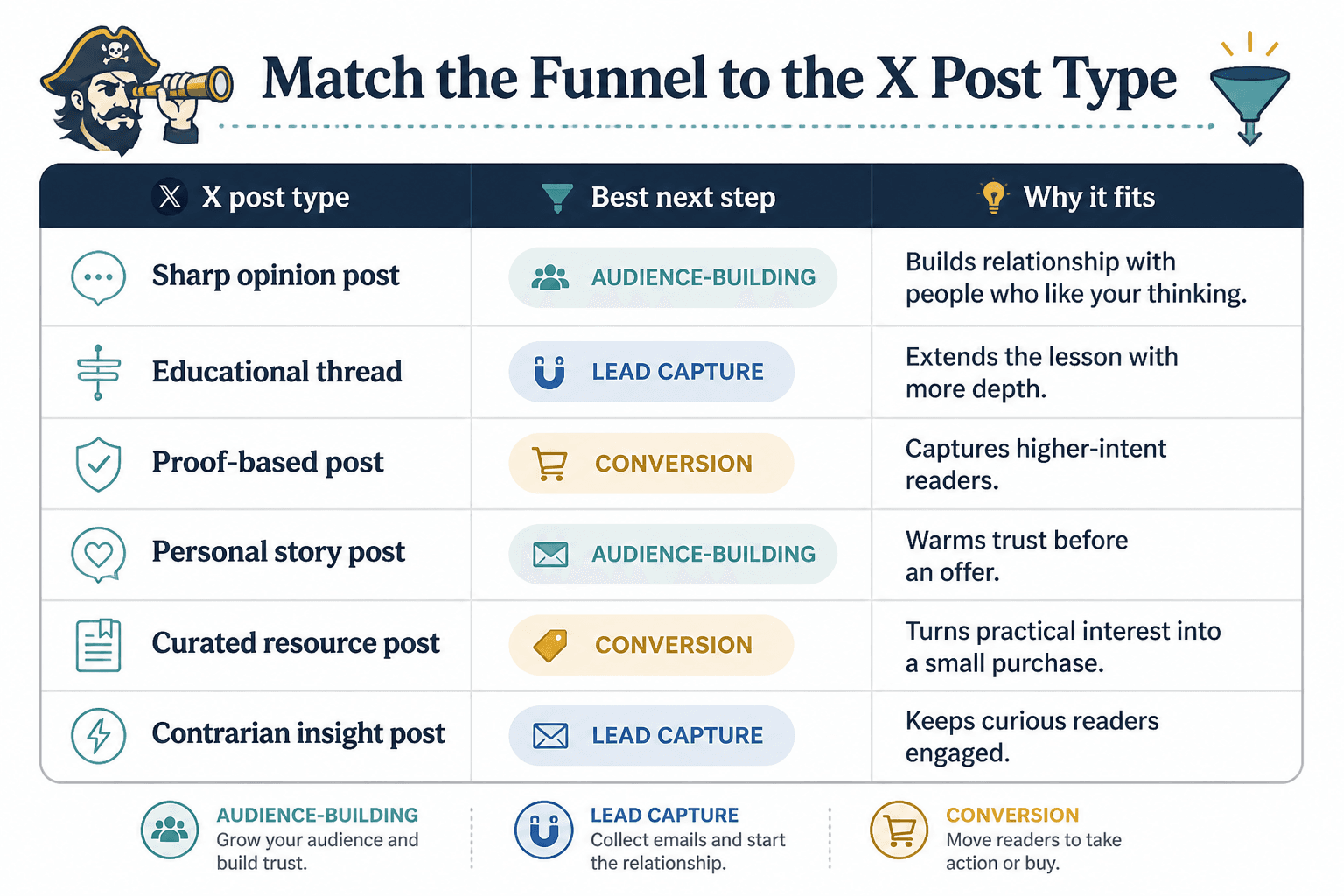
Not every post deserves the same CTA. In fact, forcing the same CTA onto every post is one of the fastest ways to make your content feel repetitive and oddly needy.
Use the post format and the reader’s intent to decide the funnel.
| X post type | Best next step | Why it fits |
|---|---|---|
| Sharp opinion post | Newsletter signup | Builds relationship with people who like your thinking |
| Educational thread | Lead magnet | Extends the lesson with more depth |
| Proof-based post | Case study or booking page | Captures higher-intent readers |
| Personal lesson with practical takeaway | Newsletter or resource hub | Keeps trust without overselling |
| Reply-heavy discussion post | Conversation to DM | Uses live interest while it exists |
| Tool or template post | Low-ticket product or free resource | Matches tactical buying intent |
If your X content strategy needs sharpening before you even think about funnels, it helps to work backward from what kinds of posts actually attract the right people. That is where a strong bank of post ideas and examples can save a lot of random effort.
Keep the CTA appropriate to the level of trust
This is where a lot of funnel advice goes off the rails.
Not every impression has earned a big ask. Someone who liked one post does not know you. Someone who read five threads and joined your email list knows you a bit. Someone who has been reading your emails for a month might be ready for an offer.
So match the CTA to trust level:
- Low trust: follow, profile visit, free resource, newsletter
- Medium trust: lead magnet, case study, workshop, low-ticket product
- Higher trust: booking page, consultation, application, service offer
Trying to force high-trust asks inside low-trust moments is one of the oldest content mistakes on the internet. It still does not work just because people put “organic funnel” in the caption.
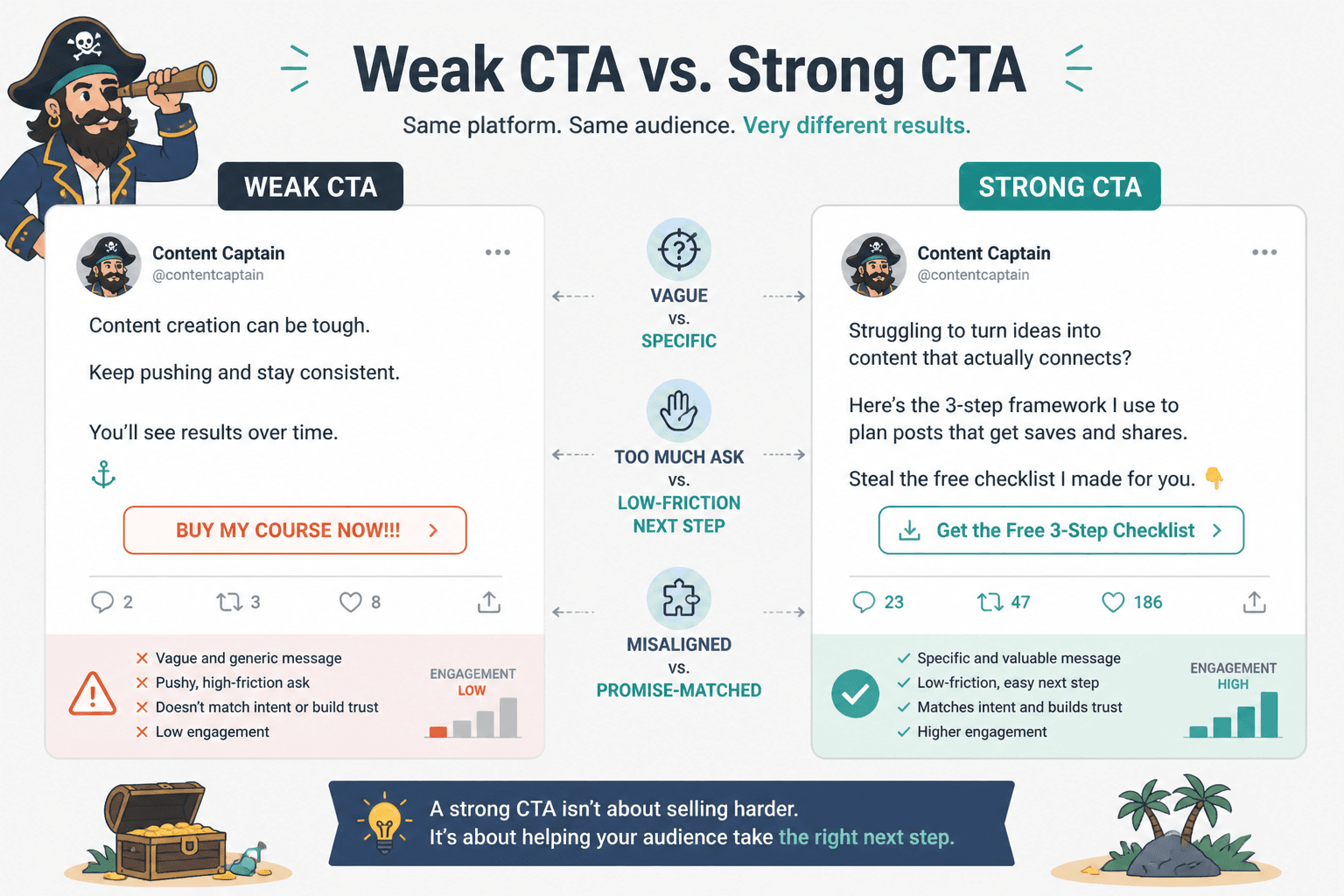
How to write X CTAs that do not sound awful
X rewards brevity, so your CTA needs to be tight. It also needs to sound like a natural continuation of the post, not a sudden drop into sales mode.
Here are better CTA patterns for X posts:
- For newsletters: If you want more of this without the character limit, the newsletter is in my bio.
- For lead magnets: I put the full checklist in a free resource if you want the practical version.
- For case studies: If you want to see how this looked in a real client situation, I broke it down here.
- For booking pages: If this is the exact problem you need solved, you can book a call through my profile.
- For low-ticket products: I turned this into a simple template pack if you want to steal the structure.
What to avoid:
- “DM me now” on every post
- “Comment interested” style bait imported from other platforms
- Vague asks like “check my stuff”
- Hard pitches after soft educational content
- Sounding like a webinar registration page with a pulse
Three simple funnel setups that work for different business models
For service providers
- Post about a painful problem
- Link to a case study or proof page
- Offer a focused consultation
- Follow up with a proposal or audit
This works because the content shows relevance, the proof page shows credibility, and the call is only for people already feeling the pain.
For creators and educators
- Post useful insights or threads
- Drive to newsletter or free resource
- Nurture with examples, stories, and lessons
- Pitch a product, membership, or course later
This is slower than direct-response selling, but usually much stronger for trust-based audiences.
For coaches and consultants with small audiences
- Post specific observations that attract the right people
- Start conversations in replies
- Move good-fit people into DM naturally
- Offer a call, resource, or next step based on actual need
If your audience is still small, this is often smarter than trying to build some giant automated machine. Small audience funnels work best when they are specific, trust-heavy, and conversational.
What to fix before you build a funnel from X posts
If the funnel is not working, the problem may not be the funnel itself.
Check these first:
- Your posts: Are they clear, specific, and aimed at the right people?
- Your profile: Does it explain who you help and what to do next?
- Your offer: Is it actually attractive and understandable?
- Your link destination: Does it match the promise of the post?
- Your CTA: Is it reasonable for the level of trust?
A lot of creators try to solve weak positioning with stronger funnel tactics. That is like trying to fix bland soup by buying a more aggressive spoon.
If you need help tightening the actual content side, it is worth exploring the broader X posts hub along with practical support pieces like templates and tools for X posts and AI writing and scheduler tools for X posts. Tools will not create trust for you, but they can make testing, drafting, and organizing much less annoying.
The bigger point is simple: clearer structure and clearer writing make the piece more useful. That is usually what makes the ending land better too.