
Most people do not have a monetization problem on X. They have a trust problem wearing a monetization hat.
They post decent ideas for a while, get a little attention, then suddenly every post starts smelling like a funnel. The tone shifts. The replies get thirstier. The “value” becomes suspiciously designed to push people toward a product, call, template, or DM script. And just like that, the account feels less like a smart person to follow and more like a pop-up ad with opinions.
If you want to learn How to Monetize X Posts Without Wrecking Trust, the trick is not hiding the fact that you sell. It is making sure the selling feels proportional, relevant, and earned. People on X do not mind being sold to nearly as much as they mind being manipulated, rushed, or fed the same recycled “content to cash” sludge for the 900th time.
Here’s how to turn X posts into leads, clients, and sales without making your account feel like a badly disguised checkout page.
Want the broader roadmap? Start with the parent guide.
Why trust breaks so fast on X
X is a fast platform. People make snap judgments there. One weak post can vanish in an hour. One weird pitch can stain your whole account for weeks.
That is partly because the platform rewards compression. You do not have much room to explain yourself. So people fill in the blanks. If your posts start sounding overly strategic, self-serving, vague, or weirdly urgent, readers assume the worst. Usually correctly.
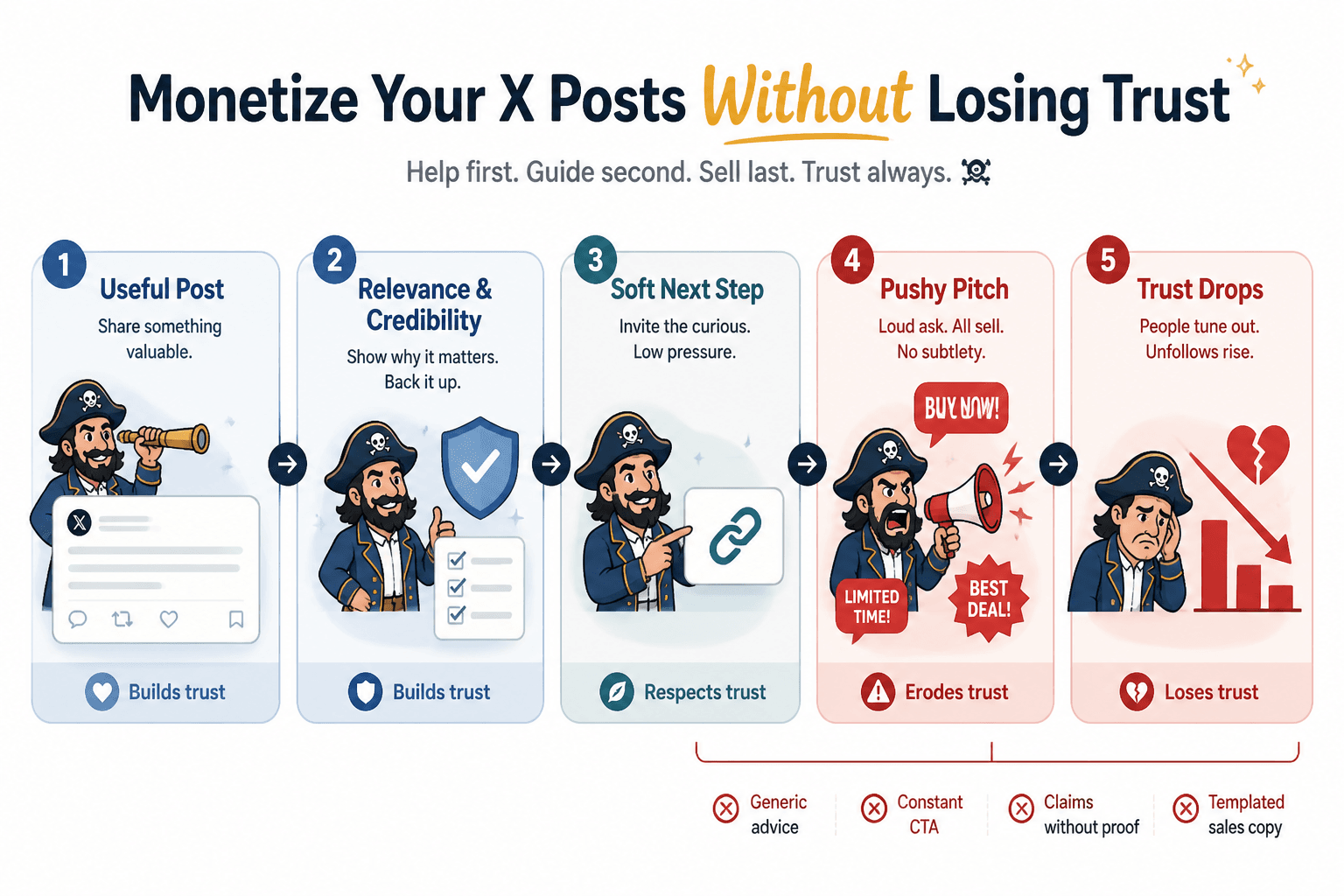
Trust on X tends to break in a few predictable ways:
- You give generic advice, then pitch a premium offer.
- You post “insights” that only exist to lead into a CTA.
- You act like every reply is an excuse to sell.
- You use threads as bait, not as useful content.
- You make claims without proof.
- You switch from sharp, human posts to templated sales copy.
- You ask for too much attention before earning enough credibility.
The annoying part is that none of this is necessary. You can absolutely make money from X. You just need a cleaner model.
What monetizing X posts should actually look like
A healthy monetization setup on X is not “post constantly, slip in an offer, hope strangers buy.” That is lazy and usually ineffective.
A better model looks more like this:
- Post ideas that are genuinely useful, interesting, sharp, or credible.
- Make it obvious who you help and what you help with.
- Connect the content to a relevant next step.
- Give people low-friction ways to go deeper.
- Pitch sometimes, not constantly.
- Back your offer with proof, clarity, and restraint.
That middle part matters. You are not trying to make each individual post do all the work. The post earns attention. Your profile builds context. Your offer gives the right people a next move.
This is also why your post quality matters so much. If you need help sharpening the actual writing, start with how to write X posts without sounding salesy or robotic and how to start X posts without a weak opening. Monetization gets much easier when the posts themselves do not sound like stale funnel fumes.
The simplest monetization paths that do not feel gross
You do not need a complicated funnel map with 17 automations and a morally questionable countdown timer. On X, simple usually works better because the platform is conversational and fast-moving.
These paths tend to work well:
| Path | How it works | Why it keeps trust intact |
|---|---|---|
| Post → Profile → Offer | A strong post makes someone curious, your profile clarifies what you do, and the offer is easy to find. | No forced CTA in every post. |
| Post → Lead magnet | A useful post leads to a free resource tied to the same problem. | The next step feels relevant, not random. |
| Post → Newsletter | You use X to earn attention, then move interested people to email. | Email gives you space to build trust more slowly. |
| Thread → Case study → Call | A thread teaches something specific, then points to a relevant case study or booking page. | Proof comes before pitch. |
| Reply conversation → Soft DM | Someone shows real interest in replies, and you continue privately if invited. | It feels natural, not predatory. |
The point is not to hide monetization. It is to make the path make sense.
Good fit beats aggressive timing
A lot of creators pitch too early because they are afraid attention will disappear. Fair fear. Bad strategy.
If someone reads one post from you and immediately gets hit with “DM me ‘GROWTH’ for my premium system,” you are asking them to skip about six trust stages. That can work if the post is exceptional, the offer is tightly matched, and the reader already wants the thing. Most of the time, though, it just makes you sound impatient.
Monetization works better when the ask matches the relationship. Cold readers need clarity and usefulness. Warm readers need proof and relevance. Hot readers need an easy next step. That is it. No acrobatics required.
Use content types that naturally support monetization
Not every X post should sell. But some types of posts make monetization easier without feeling forced.
1. Problem-framing posts
These posts name an expensive mistake, hidden bottleneck, or common misunderstanding your audience keeps dealing with.
Example:
Most people think their content problem is consistency.
It is usually positioning.
If your posts are clear but still attracting the wrong people, you do not need a better calendar.
You need a better signal.
This works because it creates demand for your expertise without sounding like an ad. It shows you understand the deeper problem.
2. Specific teaching posts
Teach one useful thing well. Not five vague things badly.
Specificity builds trust because it proves you actually know your craft. Generic advice builds very little because everybody can produce it, including people who have never helped anyone do anything.
Instead of this:
3 ways to grow on X:
1. Be consistent
2. Provide value
3. Engage with others
Do this:
If your X posts get likes but no leads, check your last 20 posts for this problem:
You are sharing useful ideas, but none of them point toward the problem your offer solves.
Attention without relevance is just a vanity metric in a nice jacket.
That kind of post teaches and qualifies at the same time.
3. Proof posts
Proof is one of the least cringe ways to monetize, as long as you do not turn every result into a trumpet solo.
Proof can include:
- A short client result with context
- A before/after rewrite
- A lesson from a real campaign or offer
- A mistake you fixed that improved conversion
- A pattern you keep seeing in paid work
The key is to make the post useful beyond the flex. Readers should learn something from the example, not just stare at your victory lap.
4. Opinion posts with stakes
Strong opinions can monetize well because they sharpen your positioning. People understand what you stand for, what you reject, and whether your approach fits them.
For example:
“Just post every day” is lazy advice.
If the message is off, daily posting only scales the confusion.
More content does not fix weak positioning. It just gives the weak positioning more chances to embarrass itself.
That kind of post attracts people who agree with your method and repels people who want cheap clichés. Good. Repelling the wrong fit is part of monetization too.
How to pitch on X without sounding like a vending machine
The easiest way to wreck trust is to make every CTA feel disconnected from the post that came before it.
A strong pitch on X usually does three things:
- It matches the topic of the post.
- It asks for a reasonable next step.
- It sounds like a person, not a launch page.
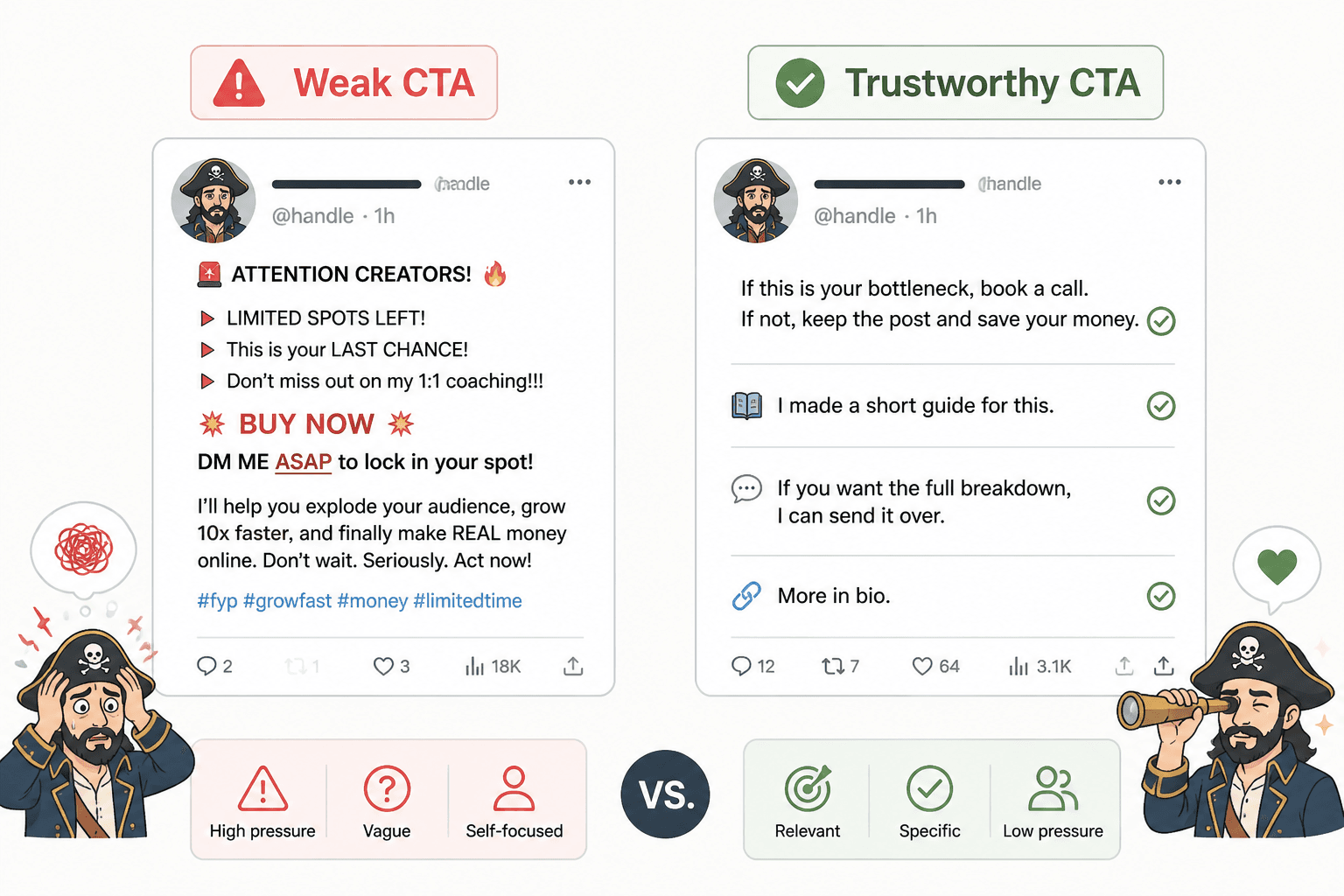
Weak CTA vs stronger CTA
Weak: Want to scale your brand fast? DM me “GROW” and I’ll show you my proven system.
Why it fails: Vague benefit, pushy wording, no context, smells copied.
Stronger: If your posts are getting attention but not turning into qualified leads, that is the kind of thing I help clients fix. Details are in my profile if you want the boring grown-up version.
Why it works: It matches the problem, sounds human, and gives the reader space.
Simple CTA formats that keep trust
- Profile CTA: “I help consultants turn smart content into qualified leads. More in bio.”
- Soft offer CTA: “If you want help applying this to your own content, that is literally my job.”
- Resource CTA: “I made a short guide for this because repeating it 40 times got old.”
- Case study CTA: “If you want the full breakdown, I can send it over.”
- Booking CTA: “If this is your bottleneck, book a call. If not, keep the post and save your money.”
That last one works because it does something many sales posts forget to do: it lowers pressure. Pressure is not persuasion. It is often just insecurity in a blazer.
What to sell from X in the first place
Some offers fit X better than others. The platform is fast, conversational, and public. That means offers with a clear problem, simple outcome, and low explanation burden tend to convert better.
Good fits often include:
- Consulting or strategy calls
- Done-for-you services
- Audits or reviews
- Templates, guides, or playbooks
- Newsletters
- Small digital products
- Workshops tied to a clear pain point
Harder sells include vague coaching, broad memberships, abstract personal brand offers, and expensive services explained with fluffy promises. If your offer needs a paragraph of decoding, X is probably not where the sale should happen directly. Use X to create interest and move people somewhere better suited for depth.
Your offer should feel like the next logical step
If you post mostly about writing hooks and then pitch executive leadership coaching, expect friction. If you post mostly about founder positioning and then offer a positioning audit, much cleaner.
This sounds obvious, yet loads of people ignore it because they want one account to sell six unrelated things. That usually creates weak trust and weaker conversion.
How often should you sell?
There is no magic ratio, and anyone selling one is usually trying to sell you another ratio right after.
Still, some practical guidance helps.
If your account is small or your trust is still developing, keep direct selling lighter. Focus more on:
- Clear positioning
- Useful posts
- Strong profile copy
- Proof
- Conversation in replies
If your audience is warmer and your offer is already validated, you can sell more often because the relationship can handle it.
A reasonable rule of thumb: most of your posts should create value, clarity, proof, or resonance. A smaller portion should directly invite action. If every other post is a pitch, people will notice. They are not stupid. They are just busy.
And remember, not all monetization signals have to be explicit sales posts. Your bio, pinned post, profile header, case-study mentions, and soft CTAs all contribute. You can be monetizable without being relentlessly promotional.
Build the trust layer outside the post itself
One reason people oversell on X is that they expect each post to do too much. Better move: make the rest of your profile carry some weight.
Your monetization system gets cleaner when these pieces are in place:
- Clear bio: Who you help, what you help with, and why someone should care.
- Pinned post: A strong intro, useful thread, case study, or resource.
- Offer clarity: Not “I help you unlock your voice.” Something a real buyer can understand.
- Proof signals: Results, examples, specificity, client context.
- Consistent themes: Your posts should make your offer feel coherent, not random.
If you want a stronger foundation for that, browse the broader X posts section and the wider social media writing resources. The selling part gets much easier when the positioning part is not a mess.
Common ways people monetize X posts badly
Some mistakes are so common they deserve public shaming. Light public shaming, but still.
Turning every thread into a hidden sales page
If the thread only exists to funnel readers into a pitch, people can feel it. The thread gets padded. The points get thinner. The final tweet starts sweating.
Better: make the thread worth reading even if nobody buys.
Using fake generosity as a sales tactic
“Giving away all my secrets for free” is rarely as noble as advertised, especially when the “secrets” are advice people have seen 400 times already. Readers can smell performative value from space.
Better: share useful things because they are useful. Then mention the offer when it naturally fits.
Pitching in replies with no invitation
Some people treat every reply like a trapdoor into DMs. That is a quick way to look needy.
Better: have real conversations. If someone signals interest, then you can offer a next step.
Trying to sound bigger than you are
Readers do not require celebrity status. They do require coherence. If you overinflate your authority, your monetization gets shakier because the trust layer is built on borrowed air.
Better: be specific about what you know, what you help with, and what results you have seen.
Making the audience feel like prey
If every post sounds engineered to “capture leads,” people feel that. You should think strategically. You should not sound like strategy speaking through human skin.
A practical posting mix that supports monetization
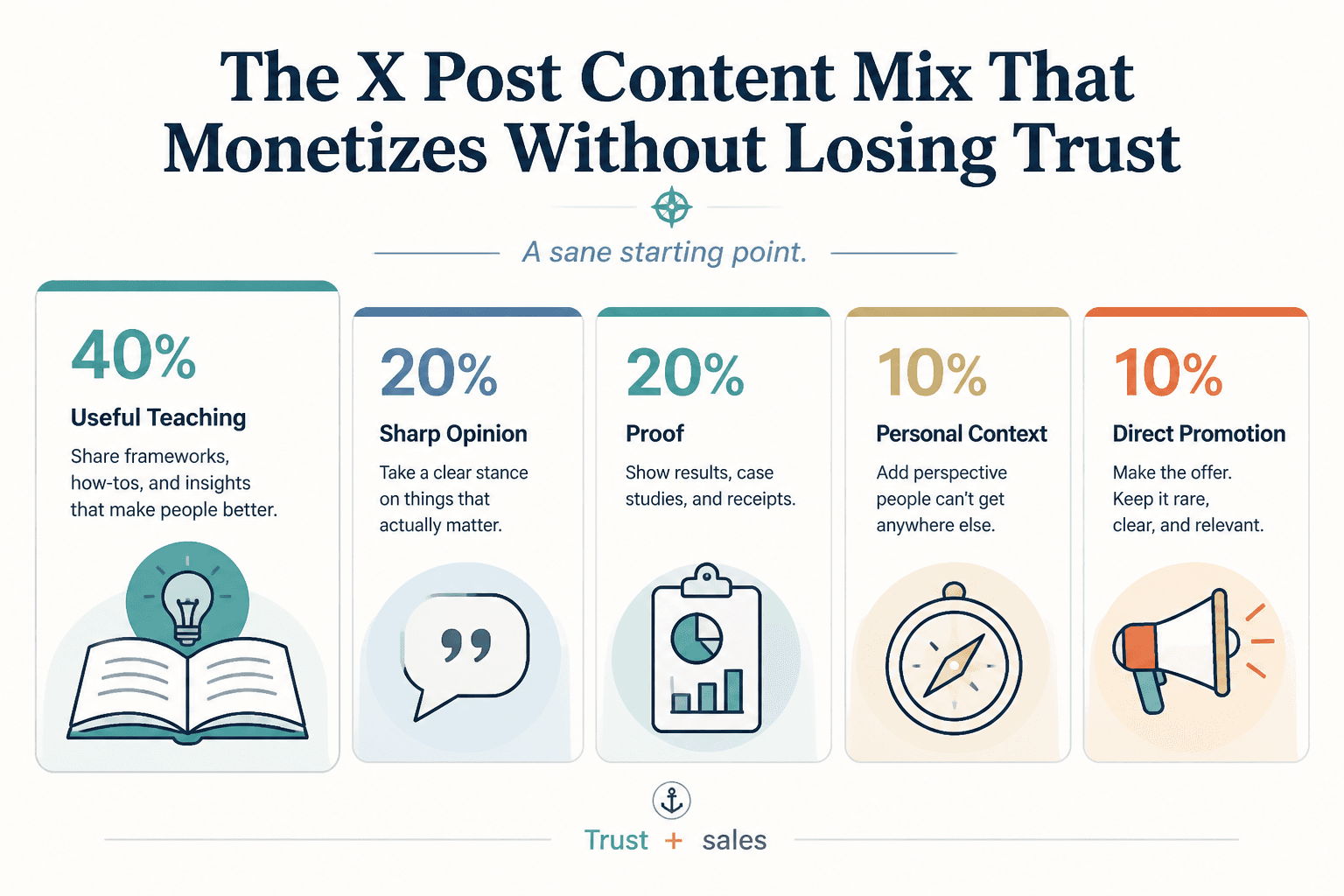
If you want a cleaner way to structure your content, use a mix like this over a couple of weeks:
- 40% useful teaching: specific lessons, frameworks, breakdowns
- 20% sharp opinion: what you believe, reject, or see differently
- 20% proof: examples, results, case-study fragments, before/after
- 10% personal context: perspective, story, behind-the-work observations
- 10% direct promotion: offers, resources, booking invites, launches
Not a law. Just a sane starting point.
This mix works because it gives your account texture. Readers get value, worldview, credibility, and enough invitation to act without feeling constantly cornered. It also helps your promotional posts convert better, because they arrive in an ecosystem that already supports them.
Examples of monetized X posts that still feel human
Example 1: Soft service CTA
A lot of “content strategy” problems are really offer clarity problems.
If people read your posts, nod politely, and still do nothing, your content may not be the issue.
Your audience might understand your ideas but not your actual service.
Fix that first.
I help consultants clean this up for a living. Profile has details if useful.
Why it works: useful idea first, offer second, no begging.
Example 2: Resource CTA
The bigger point is simple: clearer structure and clearer writing make the piece more useful. That is usually what makes the ending land better too.
X posts tend to work better when the line gets sharper and the ending earns the reaction. Cleaner payoff usually beats louder phrasing.