A bio draft can look fine at first glance and still fail the moment a real reader meets it. The name is there, the job title is there, maybe even a tidy sentence about helping people. Then the whole thing starts to wobble: too vague, too polished, too careful, too proud of itself. The fix is not more sparkle. It is better examples that show what useful website bio and profile copy actually has to do.
This article collects practical bio and profile copy examples for creators, freelancers, coaches, consultants, and personal brands. The point is not to hand you canned lines that sound borrowed from a conference badge. The point is to give you structures you can adapt without turning your site into a paragraph-shaped shrug. If you want the broader system behind these examples, start with the website bio and profile copy guide.
What strong website bio and profile copy needs to do
Good bio copy is not about sounding impressive for its own sake. It helps a visitor answer a few basic questions quickly:
- Who is this person?
- What do they do?
- Who do they help?
- Why should I trust them?
- What should I do next?
That is a practical checklist, not a branding horoscope. People skim bios fast, especially on About pages, sidebars, speaker pages, author bylines, and homepage intros. Nielsen Norman Group has long noted that web users scan rather than read line by line, which means vague bio copy tends to lose the room quickly. Source
For creator sites and personal brands, that usually means one sentence should establish identity, one should establish relevance, and one should establish credibility or next step. You do not need a novel. You need orientation.
A simple structure you can use for almost any website bio
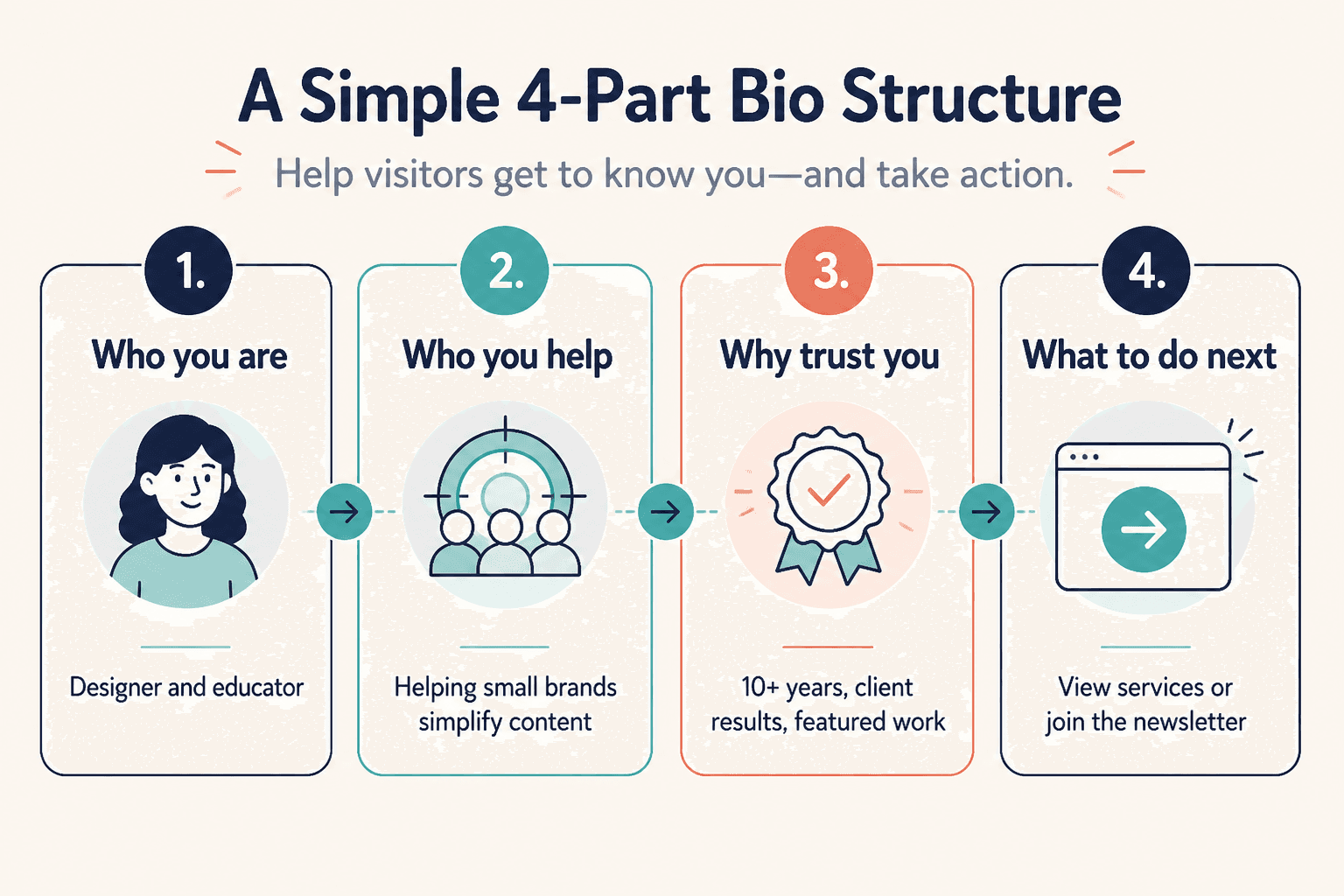
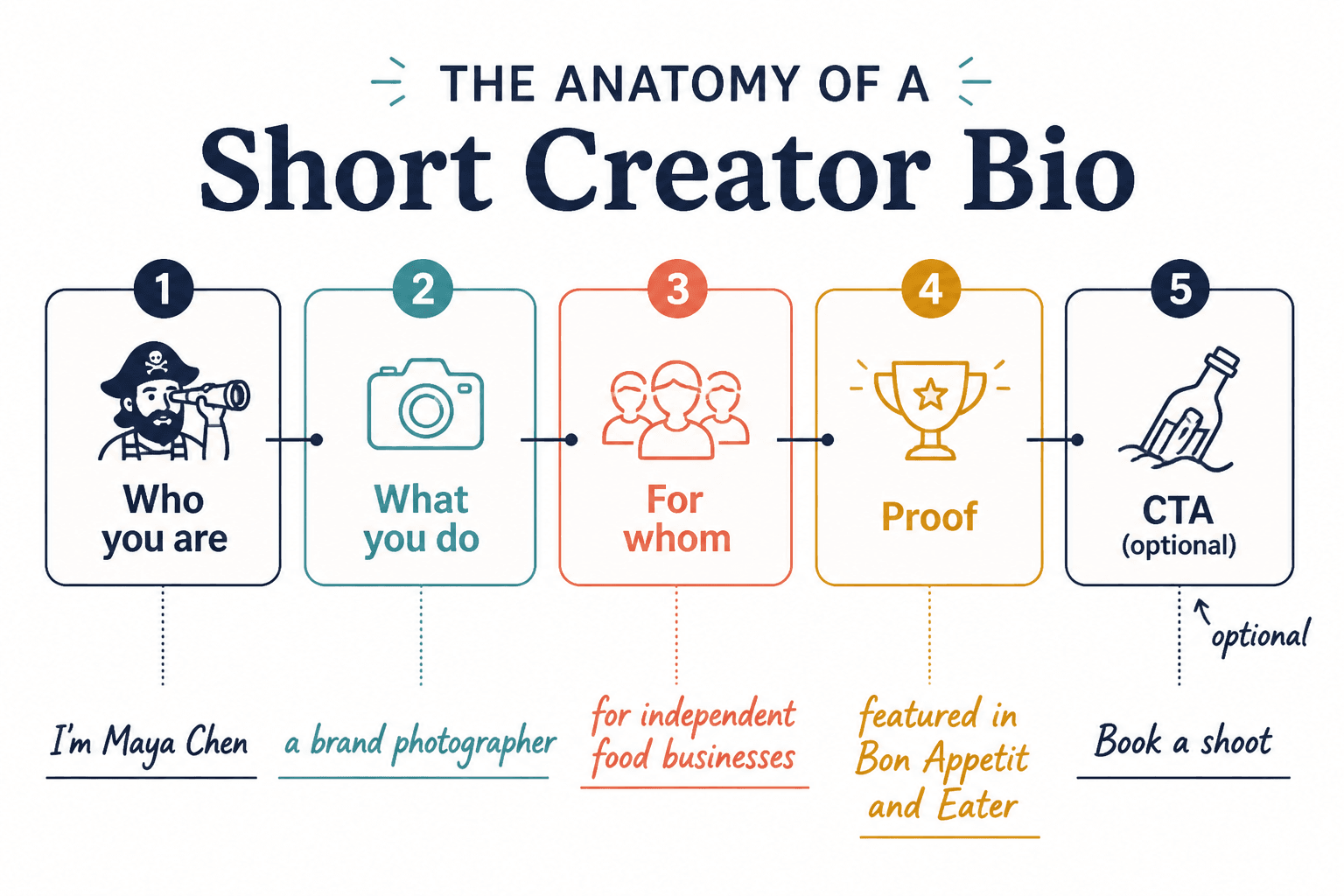
The cleanest bio structure is usually this:
- Who you are
- Who you help
- What you help them do
- Proof, context, or credibility
- Next step
That structure works because it gives the reader a path instead of a pile of details. It also scales well. A homepage hero bio can be short. An About page bio can add more context. An author bio can lean into expertise. The skeleton stays the same.
When you need a fuller framework, the parent guide breaks this down more completely in the bio profile copy for websites guide. This article stays on the examples and adaptation side.
Website bio and profile copy examples by type
1. Creator / educator bio
Example: I help creators turn messy ideas into useful content systems, clearer bios, and simpler website copy. I write practical resources for people who want their site to sound human, specific, and actually worth reading.
Why it works: It names the audience, the outcome, and the subject matter without trying to cosplay as a personal manifesto.
Adapt it by swapping in:
- your niche
- the transformation you help create
- the content format you use most
2. Freelancer / copywriter bio
Example: I write website copy for service providers who want fewer vague sentences and more qualified inquiries. My work focuses on bios, About pages, service pages, and the little bits of copy that quietly do the selling.
Why it works: It says what the writer does, who it is for, and which page types matter. No mystery fog. No “passionate storyteller” tax.
Best use: portfolio sites, service pages, freelance directories, and author bios where the goal is clarity and trust.
3. Coach / consultant bio
Example: I work with founders and small teams who need clearer messaging, stronger positioning, and a website that sounds like a real business instead of a committee note. My approach is direct, strategic, and built to help people decide faster.
Why it works: It sounds credible without stacking up empty claims. It also names the decision-making benefit, which matters on sales-oriented pages.
Useful tweak: add one specific proof point if you have it, such as years of experience, a specialty, or a recognizable type of work.
4. Personal brand / newsletter writer bio
Example: I write about building a useful online presence without turning every page into a personality page. Expect practical notes on bio copy, website content, and the difference between sounding polished and sounding clear.
Why it works: It tells the reader what they will get, and it does not waste time pretending to be louder than the subject.
Good fit for: newsletter headers, social profile bios, About page intros, and creator sites that rely on a point of view.
5. Short homepage or sidebar bio
Example: I help creators and service providers write website copy that is clear, useful, and easy to act on.
Why it works: It is short, direct, and easy to place in a sidebar, footer, homepage intro, or author box.
When to use it: anywhere space is tight and the page already has more context nearby.
A short bio formula that stays flexible
If you need a reusable formula, start here:
I help [audience] do [outcome] through [skill, service, or content]. I also [proof, perspective, or supporting detail].
Examples:
- I help creators write better website bios and profile copy through simple content systems and practical examples. I also publish guides that make the process less fiddly.
- I help coaches clarify their message through website copy that sounds confident without sounding inflated. I also work from strategy first, which keeps the writing from drifting.
- I help freelancers make their services easier to understand through cleaner bios, About pages, and page copy. I also care deeply about removing phrases that exist only to waste everyone’s time.
This formula is especially useful when you are editing a draft that already has a decent opening but weak middle. It gives you a way to replace filler with function.
What to change so the examples sound like you
Examples are useful only if you do not copy them like you found them under a floorboard. Adapt the parts that matter:
- Replace generic roles with your actual role or specialty.
- Swap broad audiences for the people you really serve.
- Use one real proof point instead of three vague ones.
- Keep the tone consistent with the rest of your site.
- Trim anything you would not say out loud without wincing.
The best bio copy usually sounds specific because it is specific. That sounds obvious until a draft starts trying to be “versatile,” which is often code for saying nothing in several directions at once.
For another angle on shorter versions, see the related article on short bio examples creators can adapt fast. If you are writing a more formal byline or contributor bio, the sibling piece on simple author bio templates for busy creators will be more useful.
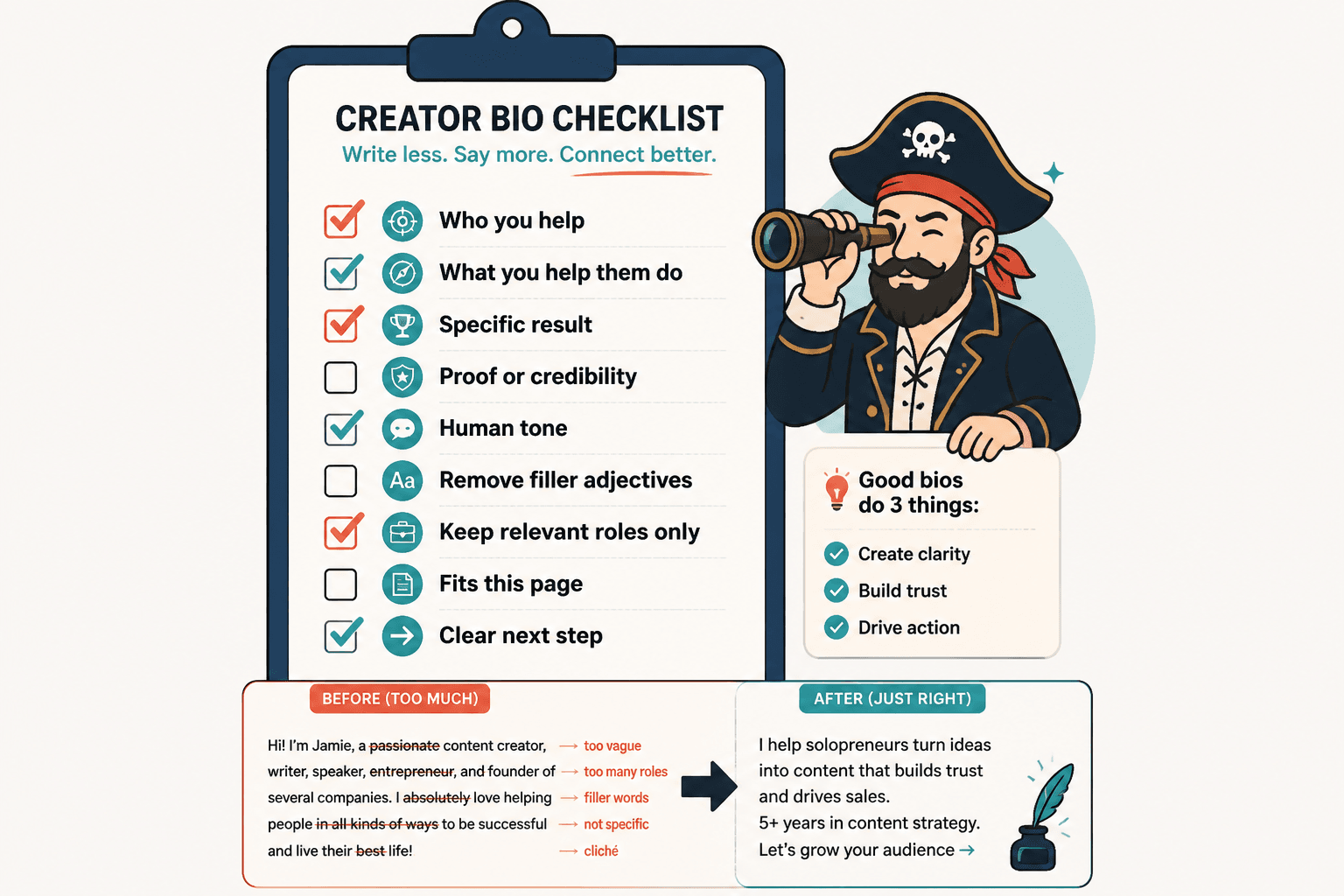
Editing checklist for website bio and profile copy
Before you publish, check whether your bio answers these questions cleanly:
- Can a new visitor tell what you do in one pass?
- Does the first sentence say something specific?
- Is the audience visible, not implied?
- Is the proof real, not decorative?
- Does the next step make sense for the page?
- Could you remove five words and make it better?
That last one matters more than people want to admit. The web is full of bios that sound as if they were inflated to protect a self-esteem budget. Clarity tends to beat decoration.
If you want a broader best-practices source for why identity and trust cues matter on websites, HubSpot’s overview of About page purpose is a useful companion reference. Source For a clearer takeaway on first impressions and usability, the Nielsen Norman Group’s work on how people read online remains relevant. Source
Where different bio lengths make sense
Not every site needs the same bio length. Choose based on placement:
- 1 sentence: homepage hero, sidebar, footer, author byline
- 2 to 3 sentences: About page intro, speaker page, profile page
- Short paragraph: full author bio, founder bio, services page intro
- Longer bio: About page, media kit, brand story section
Search engines and readers both benefit when identity is consistent across these placements. Google’s guidance on people-first content and E-E-A-T-style trust signals keeps landing in the same place: be clear about who is behind the content and why the content should be trusted. Source
Quick examples you can adapt right away
Very short
I help creators write clearer website copy and bios that sound like a person, not a placeholder.
Short and practical
I create website bio and profile copy for creators, freelancers, and service providers who want their pages to feel clear, specific, and easy to trust.
More personality
I write website copy for people who want less vagueness, fewer filler phrases, and a page that does not sound like it was assembled during a caffeine emergency.
More proof-oriented
I help founders and independent professionals improve website bios, About pages, and profile copy so the message is easier to understand and the next step feels obvious.
Wrap-up
Good website bio and profile copy does not need to be dramatic. It needs to be legible, relevant, and specific enough that readers know whether they are in the right place. The examples above are meant to be mixed, trimmed, and rewritten until they fit your actual site.
For the full framework behind these examples, return to the bio profile copy for websites guide. If you want tighter formats next, the sibling articles on short bio examples and author bio templates are the natural next stops.