
Website bio copy is usually not weak because the person behind it is uninteresting. It is weak because the writing tries to sound credible before it becomes useful. That is backward. A good bio does not perform competence in a blazer. It helps a visitor understand who you are, who you help, what you help them do, and why they should keep reading.
That shift matters because bio and profile copy is not just identity copy. It is conversion copy with a smaller stage and less patience. On a website, a bio often has one job: turn “who is this?” into “okay, this might be for me.”
If you want the broader system this guide belongs to, start with the parent guide on bio and profile copy for websites. This page goes deeper into the structure, the common mistakes, and the rewrite process.
What good website bio and profile copy is actually supposed to do
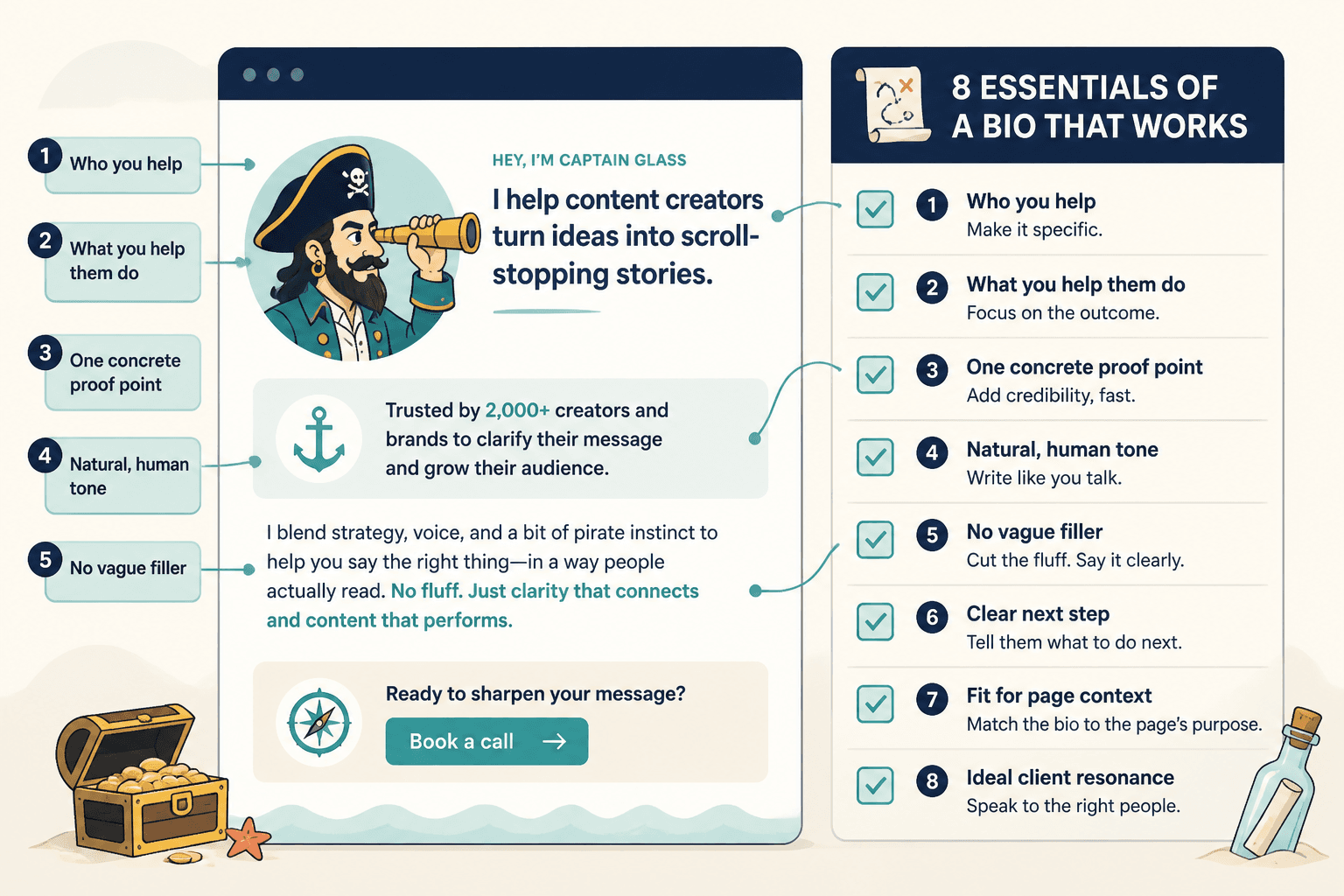
Good bio copy is not there to impress every possible reader. That would be a terrible use of everyone’s afternoon. It is there to do a few specific things quickly:
- Identify the right audience. The reader should know whether the bio is about someone relevant to them.
- Clarify the value. The bio should say what kind of help, result, or perspective you bring.
- Build trust. Not with inflated claims, but with believable proof, context, or specificity.
- Show enough personality to feel human. A bio can be clear without sounding like it was assembled in a compliance department.
- Point to the next step. Readers should know what to do after they finish reading.
That is true whether the bio sits on an About page, homepage, speaker page, services page, team page, or creator profile. The page type changes the emphasis. The job does not.
The biggest mistakes creators make with bio and profile copy for websites
1. Writing for yourself instead of the reader
This is the classic move: the bio becomes a biography instead of a guide. It explains your origin story, your preferences, and your philosophy before it answers the reader’s actual question: why should I care?
A reader does not need every interesting detail. They need the right detail in the right place.
2. Using vague role labels
“Creative strategist,” “multidisciplinary professional,” “storyteller,” and “helping people thrive” are all technically words. They are also slippery little fog machines.
If the role label could describe 200 other people on the internet, it is not doing much work.
3. Trying to sound impressive instead of useful
Bio copy often gets stuffed with polished abstract nouns: visionary, innovative, thought leader, passionate, purpose-driven. That language may feel safe, but safe is not the same as memorable.
Useful copy says what you do, for whom, and why it matters. That is more credible than decorative certainty.
4. Listing too many identities at once
There is a difference between being multi-talented and making the reader do inventory management. If the bio is trying to be coach, consultant, writer, speaker, founder, parent, traveler, and six other things at once, the main point disappears.
The fix is not to erase complexity. It is to organize it around one primary reader need.
5. Forgetting the CTA
A bio without a next step behaves like a polite dead end. The reader learns a little, then gets dropped back into the hallway.
Include one clear action when the page calls for it: contact, book, read more, view services, download, or follow. The best CTA is boring in the way a good door handle is boring.
A simple structure that makes website bios work better
You do not need a clever system. You need a sequence that makes sense.
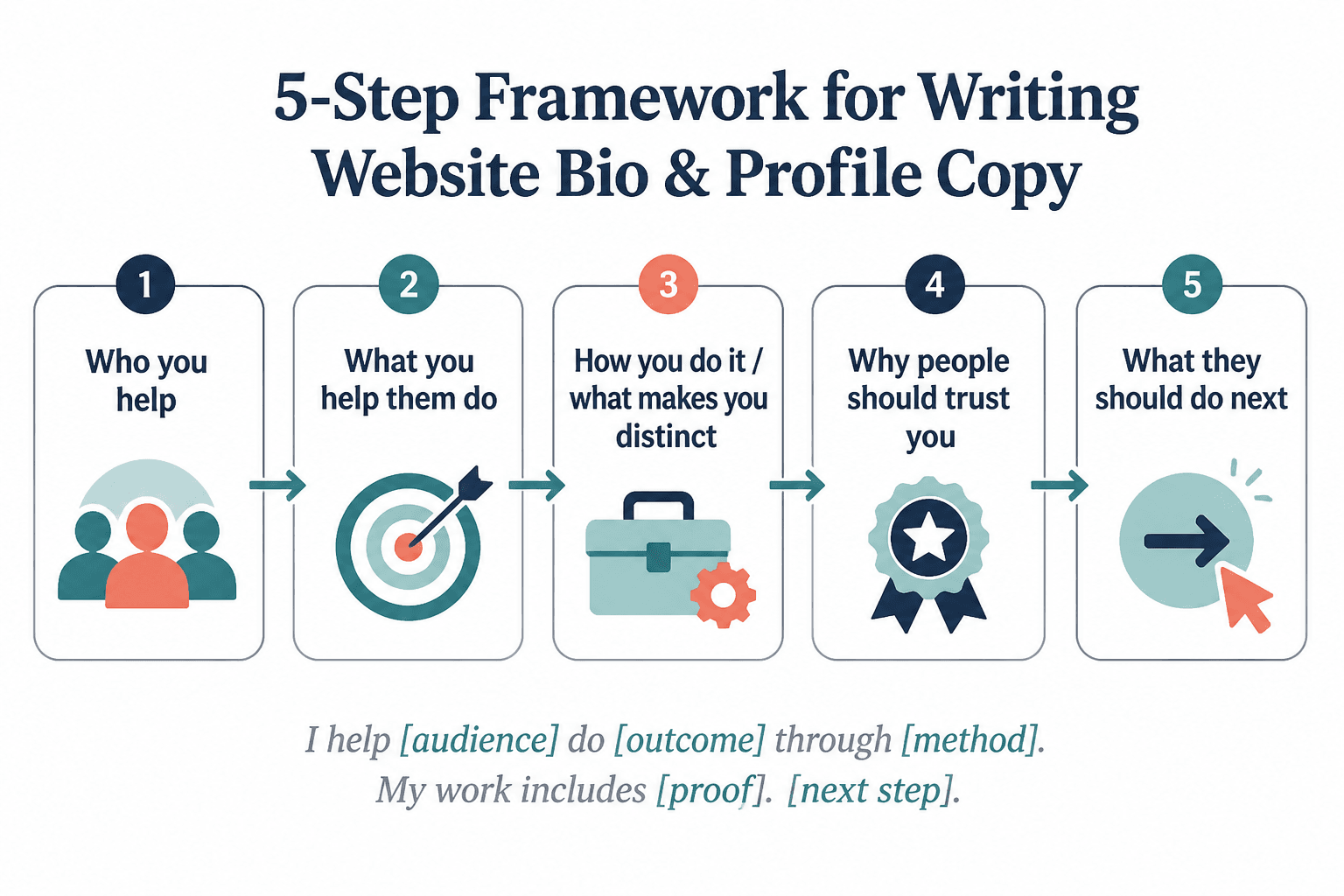
Use this basic structure:
- Who you help
- What you help them do
- Why you are credible or relevant
- What makes your approach distinct
- What to do next
That can be compressed into two sentences or expanded into a full bio, depending on the page.
Fill-in framework:
I help [specific audience] with [specific problem or goal] by [approach, method, or perspective]. I have [proof, experience, or context], and I focus on [what matters most to the reader]. [CTA]
Example:
I help small creative businesses write website copy that sounds human, clears up confusion, and supports sales without turning every page into a speech. My work combines conversion thinking, editorial judgment, and a dislike of fluff that is honestly becoming a lifestyle. If you need a sharper homepage, services page, or bio, start here.
That example is not trying to be poetic. It is trying to be useful. A good bio can be mildly witty, but the wit should help the message, not hide it in a scarf.
How to start website bio and profile copy without a weak opening
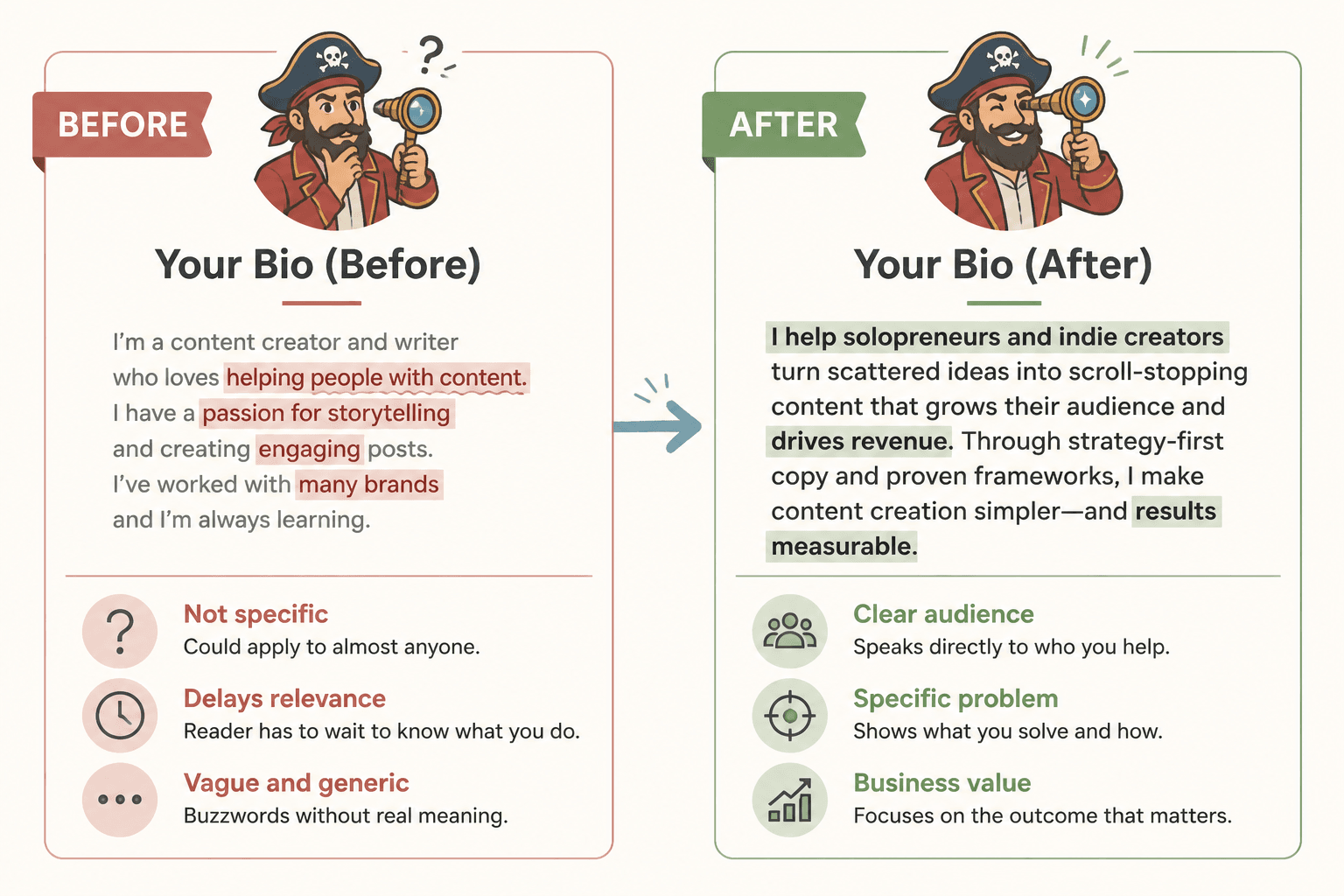
Most weak openings do one of two things: they introduce the person in the most generic way possible, or they start with a cloud of context that delays the point.
A stronger opening usually does one of these:
- names the audience first
- states the problem or outcome first
- opens with the point of view or angle first
- uses the person’s role only if it clarifies something specific
Five opening formulas that work better than “Hi, I’m…”:
- Audience-first: I help [audience]…
- Outcome-first: [Result] is what I help people get…
- Problem-first: When [pain point] keeps showing up, I…
- Angle-first: I believe [specific point of view]…
- Role-plus-value: I’m a [role] who helps [audience]…
The goal is not to sound dramatic. The goal is to make the reader orient fast.
How long should website bio and profile copy be?
The right length depends on the job, not on some mystical universal word count in the sky.
- Short bios work when the page is mainly for orientation, navigation, or fast trust checks.
- Medium bios work when the reader needs a little context, proof, and personality.
- Longer bios work when the page is doing heavier persuasion work or the audience needs more reassurance.
In other words: do not add length because you feel underwritten. Add length only when the page needs more clarity, proof, or decision support.
For a deeper breakdown of page length choices, see how long website bio and profile copy should be once that companion page is live.
How to make bio copy sound human without turning it sloppy
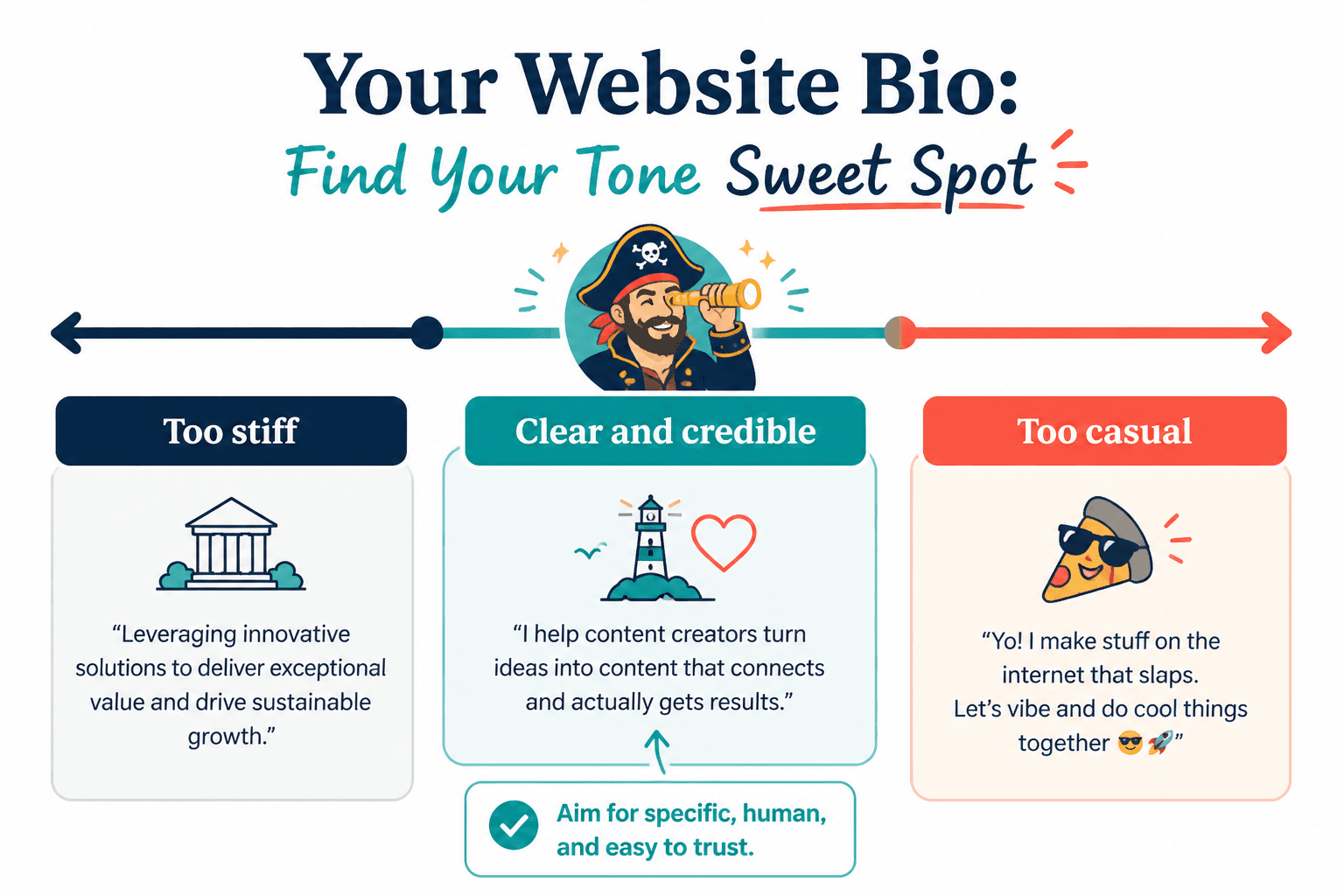
There is a narrow and useful middle between stiff and overfamiliar. That middle is where most strong bio copy lives.
To get there:
- Use specific nouns. “Website copy for service businesses” beats “helping brands grow.”
- Cut empty intensifiers. “Deeply passionate,” “highly experienced,” and “truly unique” rarely improve a sentence.
- Let the tone reflect the person, not the template. A bio can be calm, sharp, warm, dry, or formal. It just needs to be intentional.
- Keep the humor light if you use it. A dry aside can make a bio feel alive. It should not become a stand-up routine with a CTA stapled to it.
- Prefer clarity over cleverness. Clever lines are only useful if they still tell the reader something real.
If you are torn between sounding salesy and sounding robotic, choose the sentence that says the actual thing. Then trim the parts that sound like they were approved by a brand deck.
How to rewrite boring website bio and profile copy
Most boring bios are not broken in exotic ways. They are padded, vague, and overprotective. That means they are fixable.
Use this rewrite process:
- Find the actual point. What should the reader understand in one pass?
- Cut the throat-clearing. Remove warm-up lines that delay the useful part.
- Replace vague claims with specifics. “Experienced” becomes “10 years in B2B editorial strategy,” or whatever the real proof is.
- Add one useful contrast or point of view. What do you do differently, and why does that matter?
- Use believable proof. Credibility can be a role, result, track record, audience fit, or relevant background.
- End with a next step. Tell the reader where to go next.
A simple edit pass can turn a forgettable bio into one that actually does its job. Not glamorous. Very effective. The best kind of boring.
For more rewrite-specific guidance, the companion pieces on rewriting boring website bio and profile copy and writing without sounding salesy or robotic will fit naturally into this cluster once published.
Quick checklist for editing bio and profile copy
- Does the opening say who this is for?
- Is the value specific enough to understand quickly?
- Is there real proof, context, or experience?
- Does the tone sound human instead of templated?
- Is there one clear next step?
- Could any sentence be cut without losing meaning?
If three or more answers are shaky, the bio probably needs a rewrite, not a polish pass.
Final takeaway
Better website bio and profile copy is not about sounding more important. It is about becoming easier to understand. Once the reader can quickly tell who you help, what changes for them, and why they should trust you, the copy stops being decorative and starts doing actual work.
That is the standard. Not “sounds impressive.” Useful, specific, human, and pointed somewhere.
To continue through the cluster, return to the parent guide on bio profile copy for websites.