
Most creator AI research and ideation goes wrong before the writing even starts.
Not because the tool is bad. Not because the prompts are too short. Usually because the process is built like a content vending machine: ask AI for ideas, get a bland list, force those ideas into posts, then wonder why everything sounds like a polite robot trying to book a discovery call.
If you want to know how to write creator AI research and ideation without sounding salesy or robotic, the fix is not “use better adjectives” or “make it more human.” That advice is useless. The fix is to use AI for the parts it’s actually good at, then bring your own judgment, taste, audience context, and point of view back into the process before the content turns into oatmeal.
This article will help you do exactly that: research better topics, shape stronger ideas, prompt AI without getting generic sludge back, and turn rough ideation into content that still sounds like a person with standards. Not a funnel in a trench coat.
To see how this fits into the wider strategy, open the parent guide.
Why creator AI research and ideation sounds robotic in the first place
AI usually sounds robotic for one simple reason: people ask it to finish the thinking instead of supporting the thinking.
When creators use AI as a substitute for clarity, it fills the gap with generic patterns. It gives you safe angles, broad summaries, empty confidence, and suspiciously polished sentences that feel technically fine and spiritually dead.
And when the goal is monetization, it gets worse. The language starts leaning toward urgency, authority posturing, and tidy little sales phrases that don’t match how real people talk. Suddenly your “research” turns into a preloaded pitch deck with line breaks.
- Asking for ideas before defining the audience
- Prompting for “viral content” instead of useful angles
- Using broad inputs like “give me 20 post ideas for coaches”
- Keeping AI’s first draft logic instead of reshaping it
- Confusing polished wording with strong positioning
- Letting every idea drift toward a CTA too early
So no, the problem usually isn’t that AI made it weird. The problem is that the workflow invited weird.
What AI should actually do in your ideation workflow
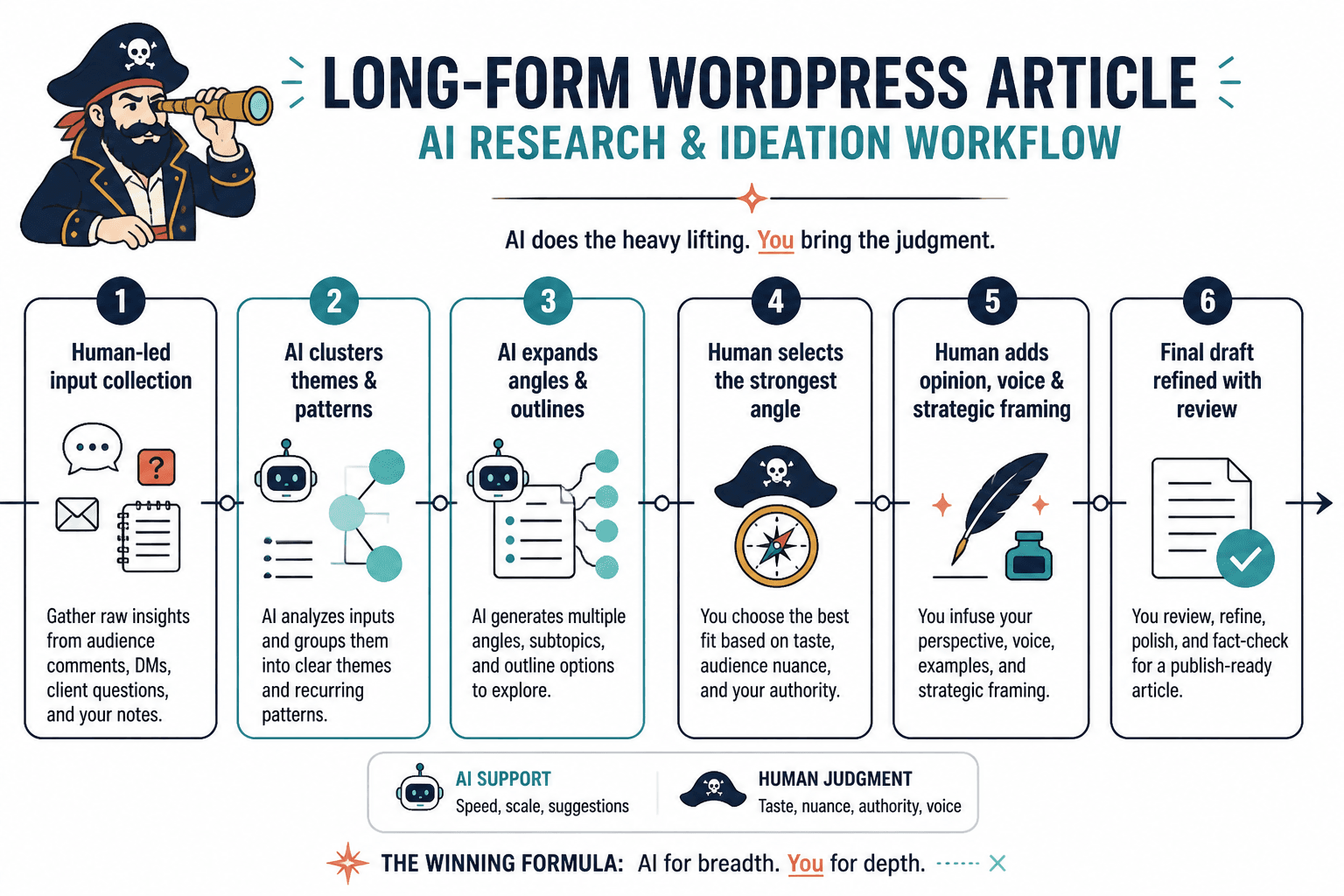
AI is useful in creator research and ideation when it behaves like a fast pattern assistant, not your replacement personality.
It can help you process more material, spot recurring themes, compare angles, stress-test an idea, group audience pain points, summarize source material, and generate multiple structures quickly. That’s valuable. It saves time and gives you range.
But it cannot decide what’s worth saying to your audience in your voice with your level of credibility. That still belongs to you. Which is good, because if AI could do that perfectly, every creator would sound identical by Thursday.
- Use AI for: research clustering, idea expansion, angle generation, outlining, reframing, summarizing, contrast, and pattern spotting
- Do not use AI for: your final opinion, your authority, your taste, your audience nuance, or your conversion strategy without review
If you want a broader workflow foundation, this guide on AI writing tools and workflows and the related creator AI research and ideation hub are useful places to keep nearby.
Start with inputs that do not suck
Bad inputs create bland outputs. This is not mysterious. If your prompt says, “Give me content ideas for personal branding,” you’re going to get the same warmed-over nonsense everyone else gets: consistency, authenticity, storytelling, and a few phrases that should be taken outside and retired.
Good creator AI research starts with raw material that actually has edges.
Use real source material, not just vague requests
- Client questions you hear repeatedly
- DMs, comments, objections, and sales call notes
- Your existing posts that got strong replies, not just likes
- Newsletters or articles you already wrote
- Competitor patterns you disagree with
- Common myths in your niche
- Mistakes buyers make before hiring someone like you
Give AI something to work with that contains tension, specificity, and context. Otherwise it will produce content for a fictional average audience that does not exist and would not buy anything anyway.
Define the audience before asking for ideas
Do not prompt for ideas aimed at “creators,” “founders,” or “coaches” unless you enjoy reading generic lists that could apply to half the internet.
Instead, define the audience in a way that affects the language and the problem. For example:
- Solo consultants trying to turn LinkedIn content into inbound leads
- Writers building a paid newsletter without sounding smug
- Coaches with expertise but weak positioning on profile pages
- Creators selling services who need better trust-building content
That level of precision helps AI produce ideas with actual relevance. It also keeps you from accidentally writing to everybody, which is one of the fastest ways to become forgettable.
If your openings are weak before the ideation even gets moving, read how to start creator AI research and ideation without a weak opening. A limp start tends to infect the whole process.
Use AI to find angles, not just topics
A topic is “AI for creators.” An angle is “why creators sound robotic when they use AI for idea generation and how to stop turning research into a hidden sales pitch.”
The topic gets you into the room. The angle gives the content a pulse.
One reason creator AI research feels stale is that people ask for topic lists when what they really need is angle variation. You do not need 50 disconnected ideas. You need 5 ideas with tension, usefulness, and a reason to exist.
A better prompt structure for angle generation
Instead of this:
Give me 25 content ideas about AI writing for creators.
Try this:
I help solo creators and consultants use AI to improve research and ideation without losing trust or sounding generic. Based on these audience frustrations: [insert real pains], give me 10 content angles that challenge common bad advice, expose one mistake, or offer a practical improvement. For each angle, include the mistaken belief, the stronger viewpoint, and what kind of post this could become.
That structure forces the output toward conflict, specificity, and utility. Which is where stronger content usually lives.
Ask for contrast
One of the easiest ways to make AI-generated ideation less robotic is to ask it for contrast.
- What people think works vs what actually works
- What beginners copy vs what experienced creators do differently
- What sounds smart vs what builds trust
- What gets attention vs what gets qualified leads
Contrast creates tension. Tension creates interest. Interest is helpful if you want anyone to keep reading past line three.
How to keep AI ideation from getting salesy too early
This is where a lot of creators quietly wreck the process. They ask AI for content ideas and conversion ideas at the same time, so every topic starts leaning toward persuasion before trust has been earned.
That is how you end up with content that reads like it was built by a copywriting bot with a quota.
Research and ideation should first answer:
- What does my audience care about right now?
- What do they misunderstand?
- What language do they use?
- What would make them think, “finally, someone said it properly”?
- What proof, examples, or frameworks would help?
Only after that should you ask:
- What is the right next step?
- Should this point to a resource, article, newsletter, or offer?
- Is this a trust post, a lead post, or a sales-adjacent post?
That separation matters. If every idea is born with a CTA attached, it starts life slightly desperate. People can feel that. Even when the wording is subtle.
If monetization is part of the goal, pair this with how to monetize creator AI research and ideation without wrecking trust. Useful content can lead to revenue. It just should not smell like a trap.
A practical workflow for creator AI research and ideation
Here is a cleaner way to do this without handing the whole job to the machine.
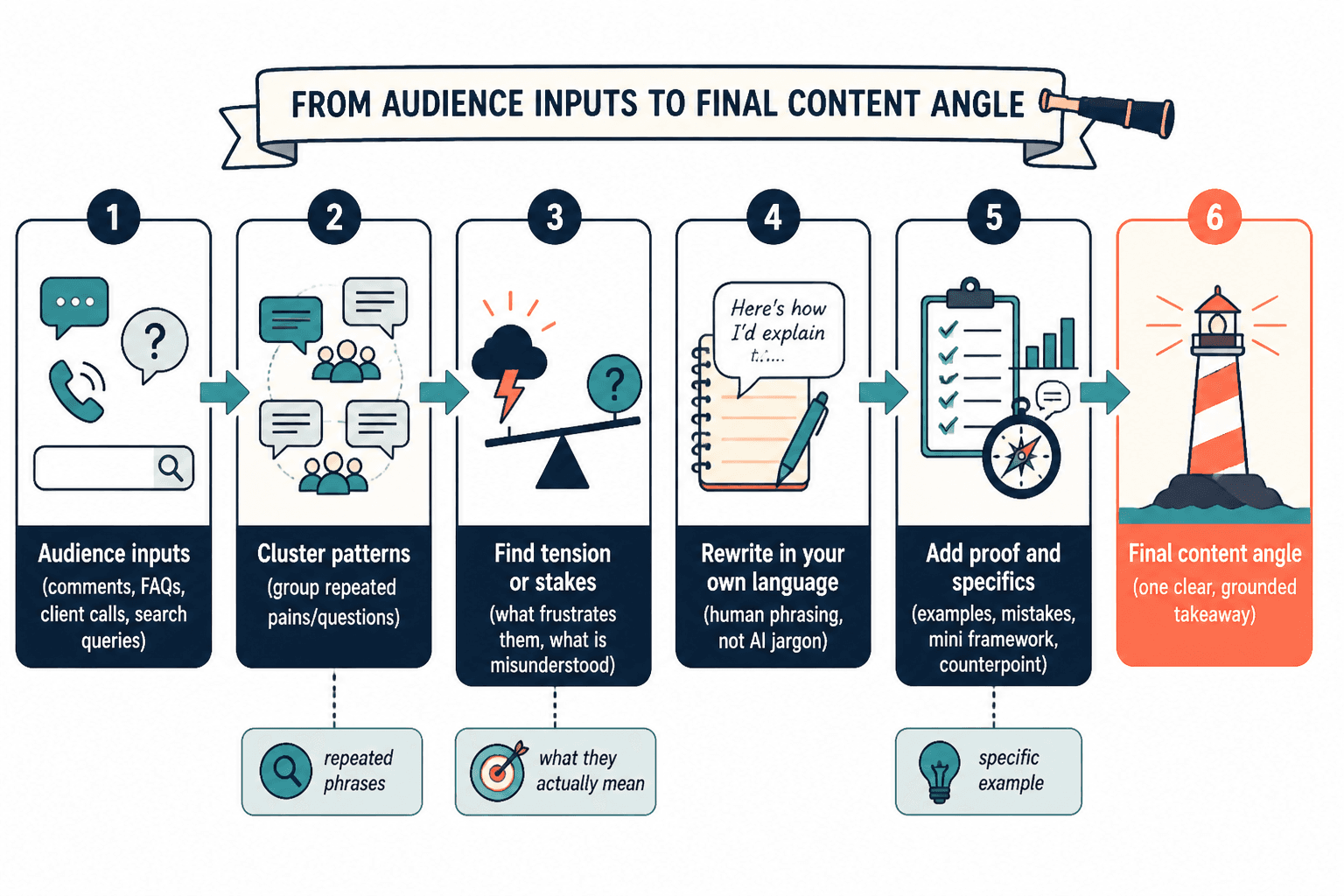
1. Gather raw audience material
Pull together questions, objections, content themes, notes, transcripts, comments, old drafts, and recurring problems. Messy is fine. Real is better than tidy here.
2. Ask AI to cluster patterns
Have AI group the material into themes:
- repeated questions
- objections
- misunderstandings
- desires
- phrases people use
- content opportunities
This is where AI is genuinely useful. It can help you sort noise faster than doing it manually.
3. Pick the themes with business relevance
Not every interesting theme matters commercially. Some topics get engagement from the wrong people. Some are too broad. Some are fun to talk about but useless for trust or conversion.
Pick themes that connect to your expertise, your audience’s actual decisions, and the kind of work or offer you want to be known for.
4. Ask AI for angle variations
Now ask for multiple angles on one theme:
- myth-busting
- mistake-focused
- opinion-led
- how-to
- before/after
- framework
- contrarian but practical
5. Rewrite the strongest angle in your own language
This is the part people skip. They keep AI’s framing, then try to “humanize” it later with a few contractions and a joke. That does not work. If the thinking is generic, the tone will still feel generic.
Take the angle and restate it how you’d actually say it to a client, reader, or smart colleague. If you wouldn’t say it out loud, don’t publish it.
6. Build the content piece around proof and specifics
Add examples, mistakes, mini frameworks, counterpoints, audience language, and one clear takeaway. This is where trust gets built. Not from sounding polished. From sounding grounded.
What robotic AI ideation usually looks like, and how to fix it
Here is the pattern to watch for.
| Robotic version | Better version |
|---|---|
| AI can help creators streamline their content process. | AI is great at speeding up research and terrible at knowing which ideas are worth your audience’s time. |
| Consistency is key when building a personal brand with AI. | Consistent posting won’t save vague content. AI just helps you publish bland ideas faster if your positioning is weak. |
| Use AI to generate content ideas that resonate with your audience. | Use AI to sort audience questions and uncover angles. Do not ask it to manufacture resonance from thin air. |
| Creators can leverage AI to scale authentic communication. | You can use AI to do more. You cannot outsource your actual voice and call it authenticity. |
See the difference? The stronger versions have a viewpoint. They make a claim. They contain tension. They sound like someone who has noticed what keeps going wrong.
That is usually what your ideation is missing. Not polish. Not productivity hacks. A point.
Prompting techniques that produce better creator ideas
You do not need 400-line mega prompts. You need cleaner thinking inside the prompt.
Ask AI to sound less certain
Oddly enough, one reason AI sounds robotic is that it is too clean and too definitive. Ask it to give options, tensions, tradeoffs, and likely objections instead of one “best” answer.
Give me three possible angles for this topic: one practical, one contrarian, and one trust-building. For each, include what might make the angle feel generic or too salesy.
Ask for audience language
Generic output often comes from generic phrasing. Tell AI to mirror how your audience talks about the problem, not how marketers package it.
Based on these notes, pull out phrases my audience would actually use when describing their frustration. Avoid polished marketing language.
Ask what to cut
This one is underrated. AI is often better at expansion than restraint, so make it help with editing decisions too.
Review these five content angles and tell me which ones feel broad, predictable, or disconnected from a specific buyer problem. Explain why.
If you want to improve your prompts and outlines more directly, read how to improve creator AI research and ideation outline prompts without sounding generic and how to write better creator AI research and ideation.
How to add humanity back into AI-generated ideas
This is the part people keep trying to fake with tone tweaks. Real humanity in content does not come from sprinkling in casual phrases. It comes from judgment.
Before you turn an AI-assisted idea into a post, article, thread, or script, run it through a few human filters:
- Do I actually believe this?
- Would I say this to a paying client?
- Is this too broad to be useful?
- What is the specific mistake, tension, or payoff?
- What would make a smart reader push back?
- What proof or example makes this less airy?
Those questions do more for your voice than “make it sound more human” ever will.
And yes, sometimes the best move is to throw out the AI angle entirely and keep only the underlying pattern it surfaced. That is not wasted effort. That is you using the tool properly.
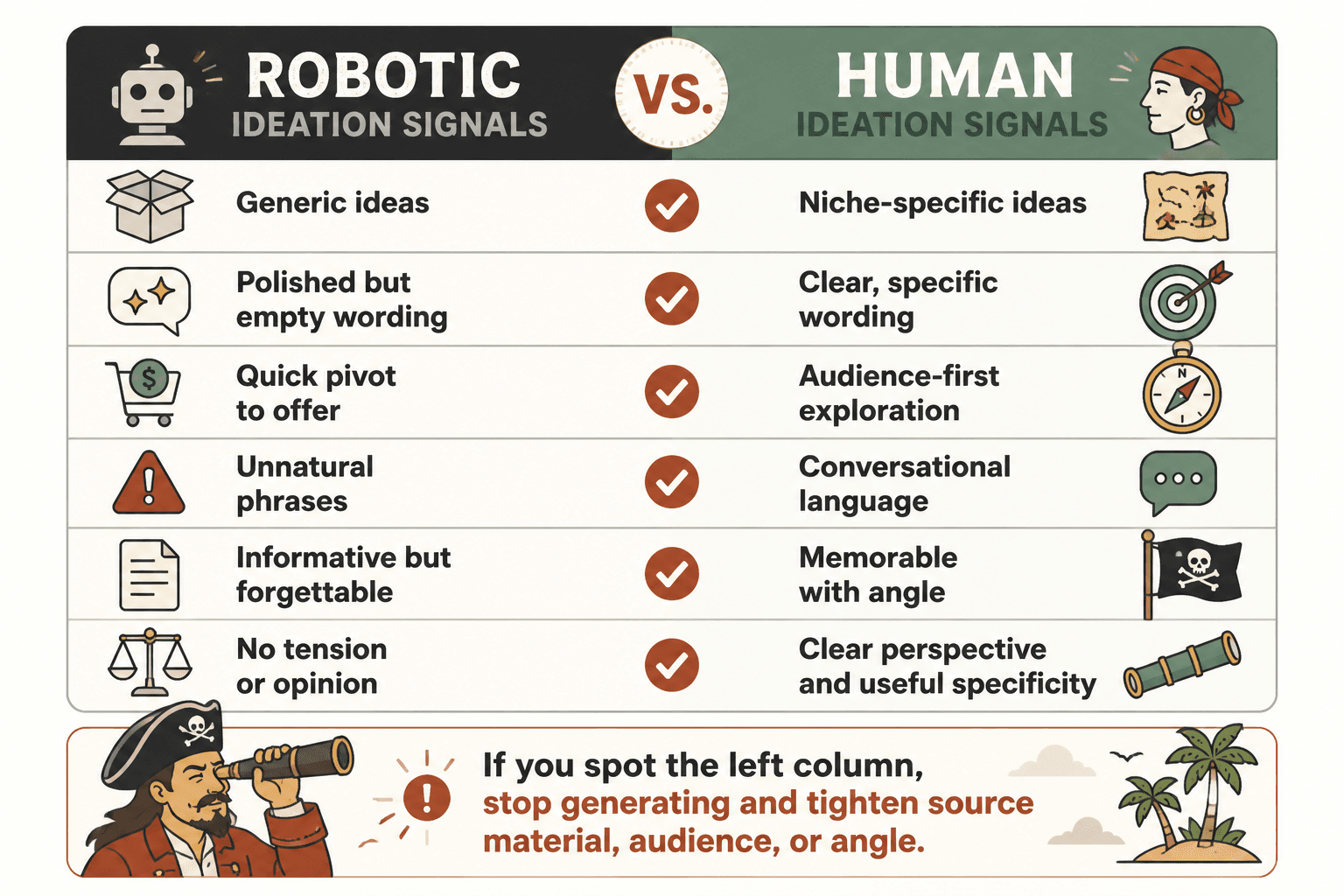
Signs your AI research and ideation is drifting into beige sludge
- Every idea could apply to any niche
- The wording sounds polished but says almost nothing
- The content keeps circling back to your offer too quickly
- You keep seeing phrases you would never use in conversation
- The ideas sound informative but not memorable
- There is no tension, opinion, or useful specificity
- You could swap your audience for “entrepreneurs” and nothing changes
When that happens, do not keep generating more. Stop and tighten the source material, the audience definition, or the angle request. More bad output is still bad. Just louder.
A simple framework for non-robotic AI ideation
If you want something easy to remember, use this:
- Collect: real audience inputs
- Cluster: use AI to group themes and patterns
- Choose: pick ideas with audience relevance and business fit
- Challenge: ask for contrast, objections, and sharper angles
- Convert: rewrite in your own language with proof and specifics
That workflow keeps AI in a useful role without putting it in charge of your personality, your positioning, or your trust. Which is where things usually go off the rails.
FAQ
Should I use AI for content ideation at all?
Yes, if you use it to sort, expand, and test ideas. No, if you expect it to hand you original positioning on command.
Why does AI-generated ideation sound salesy?
Usually because the prompts mix audience research with conversion goals too early, so every idea starts leaning toward a pitch.
How do I make AI-generated ideas sound more human?
Do not just edit the wording. Change the thinking: add specificity, a real viewpoint, audience language, tension, and proof.
What is AI best at in creator research?
Clustering patterns, summarizing raw material, generating angle options, and helping you compare structures fast.
What should AI not control?
Your final opinion, your trust-building strategy, your audience nuance, and the parts of the content that need real judgment.
Use AI to sharpen the work, not flatten the voice
The bigger point is simple: clearer structure and clearer writing make the piece more useful. That is usually what makes the ending land better too.
The bigger point is simple: clearer structure and clearer writing make the piece more useful. That is usually what makes the ending land better too.