
Most creators do not wreck trust when they monetize AI research and ideation because they charge money. They wreck it because they start acting like every half-baked prompt is a premium insight product.
That is the trap. AI makes research faster. Ideation gets easier. Pattern-spotting scales. Suddenly you can produce more angles, more outlines, more content ideas, more swipe files, more “strategy” than you could a year ago. And then the temptation shows up: package all of it, sell all of it, and hope nobody notices the difference between useful thinking and dressed-up autocomplete.
How to Monetize Creator AI Research and Ideation Without Wrecking Trust comes down to one simple rule: sell judgment, not just output. People are not paying because you asked a tool to generate options. They are paying because you know which options are smart, which ones are risky, which ones fit their audience, and which ones should be thrown directly into the sea.
If you want to make money from creator AI research and ideation without sounding shady, lazy, or weirdly overconfident, this is the standard to hold. You need clear use cases, honest positioning, clean boundaries, and offers that actually help people move forward instead of just handing them a pile of machine-made confetti.
For the main guide behind this topic, visit the parent guide.
What people are actually buying from AI-supported creator work
They are not buying “AI research” in the abstract. Nobody wakes up desperate for a folder full of generated notes.
They are buying speed, synthesis, direction, and decision support. More specifically, they are buying a shorter path from messy ideas to useful action.
- A clearer content strategy
- Better angles for posts, newsletters, videos, or offers
- Audience research turned into messaging
- Topic maps and content plans
- Competitive research that saves them time
- Idea validation before they waste a month making the wrong thing
- Prompt-supported brainstorming with actual editorial judgment
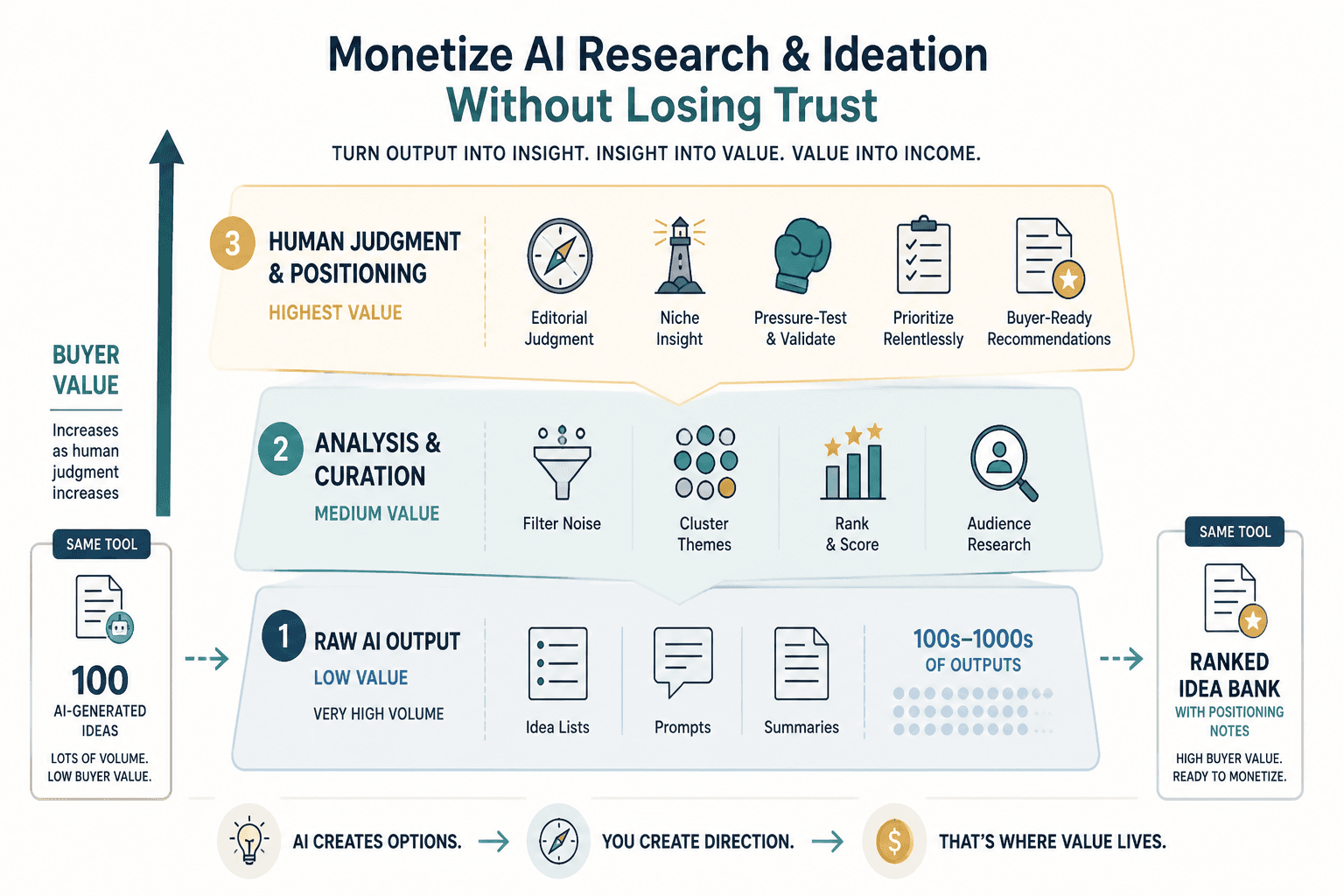
This is why raw output is a weak product and applied thinking is a stronger one.
If your offer sounds like “I use AI to generate 100 ideas for you,” the trust problem is already creeping in. That sounds cheap because it is cheap. If your offer sounds like “I analyze your niche, extract recurring audience themes, pressure-test content angles, and give you a ranked idea bank with positioning notes,” now you are in business. Same tool category. Very different level of value.
AI can help create volume. Your job is to create signal.
The trust-killing ways creators try to monetize AI ideation
Before getting into what works, it helps to name what goes wrong.
1. Selling raw outputs as if they are deep expertise
This is the big one. People package prompts, idea lists, trend summaries, and “content calendars” that have barely been reviewed, then present them like strategic gold. Buyers can feel that thinness fast. Maybe not on day one, but definitely by week two when the ideas start sounding suspiciously generic.
2. Hiding how the work is made
You do not need to narrate every tool in your workflow. But if your marketing implies handcrafted strategic analysis and the client receives lightly edited AI sludge, trust drops hard. The problem is not using AI. The problem is pretending you did something you did not do.
3. Monetizing too early in the trust cycle
If your audience barely understands how you think, they are not going to feel great buying your AI-supported research package. Especially if your content has not shown any proof of taste, reasoning, or results. Asking for money before earning confidence is not bold. It is just awkward.
4. Using AI to accelerate bad positioning
Bad positioning at human speed is still bad. AI just helps you produce more of it. If your niche, offer, audience, or promise is fuzzy, monetizing the output will not fix that. It will simply spread the fog faster.
5. Offering research with no recommendation layer
Dumping findings on clients is not strategy. It is homework reassignment. People want help deciding what matters, what to ignore, and what to do next.
That recommendation layer is where trust often gets earned. It shows that you can think, not just collect.
How to monetize creator AI research and ideation without wrecking trust
The cleaner path is to build offers around curation, interpretation, prioritization, and application. AI supports the work. It should not be the whole pitch.
Sell outcomes, not machine activity
Nobody cares that your workflow includes AI unless they are specifically buying workflow help. What they care about is what they get at the end.
Weak positioning:
- AI-powered content ideation bundle
- 100 AI-generated niche ideas
- Prompt-based trend research package
Stronger positioning:
- Monthly content angle report for coaches who need sharper post ideas
- Audience research and message map for consultants refining their offer
- Idea validation sprint for creators choosing what to build next
- Authority content planning package based on niche research and positioning gaps
The second group sounds more trustworthy because it connects the work to a business or content outcome. It also leaves room for your judgment to matter.
Be honest about the role of AI without making it the headline
You do not need a dramatic disclaimer in every sentence. But your sales page, pitch, onboarding, or scope should make the process clear enough that no one feels tricked.
A simple way to frame it:
I use AI-assisted research and ideation to speed up pattern gathering and option generation, then I refine, prioritize, and adapt everything based on your audience, offer, and goals.
That works because it is honest and calm. No defensive rambling. No fake mystique.
If you need help writing about this kind of work in a way that still sounds human, this guide on writing creator AI research and ideation without sounding salesy or robotic is a useful next read.
Charge for filtering and fit
The most valuable thing you often do is not generating options. It is reducing them.
A client does not need 80 content ideas. They need 12 that match their positioning, sound like them, fit their sales process, and are worth publishing. This is where trust stays intact because they can see that the final product is shaped around them, not spit out from a generic workflow.
This is also why low-end AI packs often disappoint. More volume feels generous, but volume without editorial discipline is just clutter in a nicer folder.
Show your thinking, not just the deliverable
If you want people to buy this category of service, show examples of how you think.
- Break down why one content angle is stronger than another
- Explain how audience language changes the hook
- Compare weak research summaries with sharper strategic takeaways
- Show how a rough topic list turns into a focused content plan
This matters because trust comes from visible judgment. A lot of creators say they offer strategy. Far fewer actually demonstrate it.
That demonstration can happen in posts, short case-study style emails, carousel-style breakdowns repurposed into articles, or examples on your sales page. If you are trying to connect this work to revenue more directly, this article on turning creator AI research and ideation into more leads or sales can help tighten that path.
Offers that monetize well without feeling dodgy
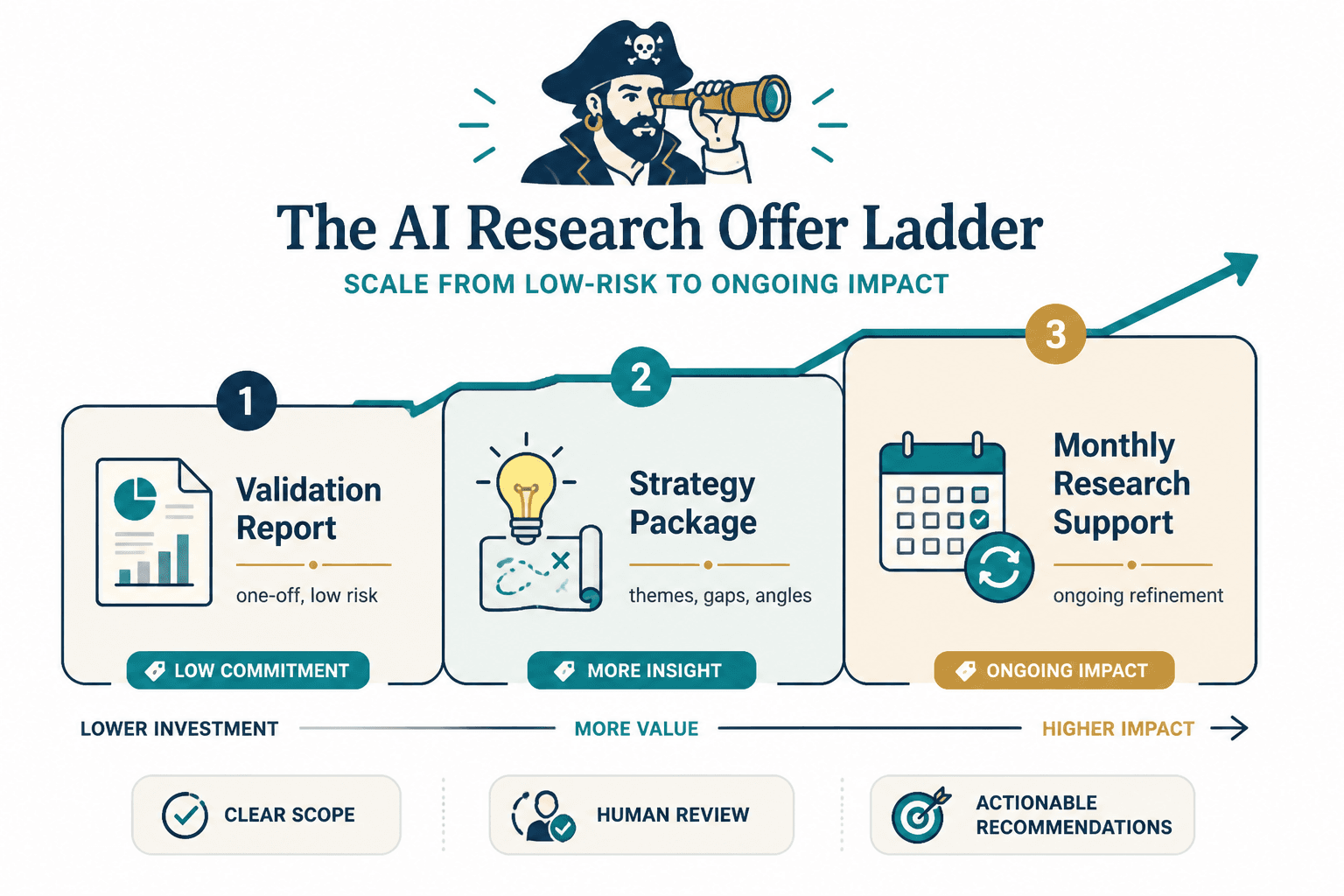
You do not need some giant AI consultancy package to make this useful and sellable. In fact, smaller offers often earn trust faster because they feel easier to understand and lower risk.
1. Research-backed idea banks
This works when the output is curated and strategic.
- 20 ranked content angles
- Why each angle matters
- Best format for each one
- Suggested hooks or framing
- Notes on audience relevance
Do not sell “100 ideas.” Sell “the right ideas, organized for action.”
2. Audience insight reports
This can be a strong offer for coaches, consultants, and solo founders who know their market loosely but need sharper language and themes.
- Common pains and desires
- Repeated objections
- Language patterns
- Content opportunities
- Messaging recommendations
The trust layer comes from showing where conclusions came from and what to do with them.
3. Content planning sprints
A fast-turn package that combines niche research, ideation, prioritization, and publishing direction can work very well. This is often more appealing than a vague “AI strategy session” because it sounds concrete and useful.
- One strategic theme map
- One month of content pillars
- Specific post or article ideas
- Recommended CTA paths
- A short implementation plan
4. Validation sessions for new offers or content directions
People regularly waste time building content around ideas their audience does not care about. AI-supported research can help pressure-test angles faster, but the real value is your interpretation.
A solid validation offer might include:
- Research summary
- Theme clustering
- Market gap notes
- Angle recommendations
- A clear go, no-go, or refine recommendation
5. Subscription research support
For clients publishing consistently, a monthly subscription can be a clean model. But only if it stays useful. If it turns into a repetitive bundle of recycled AI summaries, retention will fall off a cliff.
What keeps it valuable is ongoing adaptation: fresh patterns, better framing, emerging objections, content opportunities tied to the client’s current goals, and visible strategic refinement.
What to include in the offer so buyers feel safe saying yes
A lot of trust is built before the work even starts. The clearer your offer, the less people worry that they are paying for mystery mush.
| Include this | Why it matters |
|---|---|
| Clear scope | Shows what they are actually buying |
| Use-case specificity | Makes the offer feel tailored, not generic |
| Process summary | Builds confidence without oversharing every tool detail |
| Human review and refinement | Signals quality control |
| Recommendations, not just findings | Turns information into action |
| One clear next step | Prevents the deliverable from dying in a Google Drive folder |
| Example output or sample section | Reduces uncertainty fast |
That “one clear next step” part matters more than people think. Research is often sold as if insight alone changes things. It does not. People need a path from information to implementation.
That next step could be:
- Turn the report into a 30-day content plan
- Use the insights to rewrite a landing page
- Build a lead magnet around the strongest problem cluster
- Create a sales call talking-point sheet from objection research
If monetization is part of a broader workflow, the resources in AI writing tools and workflows, creator AI workflows, and creator AI research and ideation are worth keeping nearby.
How to talk about pricing without making people suspicious
Pricing gets weird when the buyer thinks the work was instant, automated, or copied from a prompt template you found in a thread with too much confidence and not enough proof.
The fix is not to apologize for using efficient tools. The fix is to price around the value of the decision support, customization, and business relevance.
You are not charging for keystrokes. You are charging for:
- Research direction
- Better questions
- Pattern recognition
- Editorial selection
- Contextual recommendations
- Time saved
- Mistakes avoided
This is similar to why clients pay experienced editors, strategists, and consultants more than junior executors. The value is not just effort. It is discernment.
That said, do not get cute and charge premium strategy rates for glorified prompt exports. People are getting better at spotting that. Rightly so.
A simple pricing ladder
- Low-ticket: niche idea packs, mini audits, micro research briefs
- Mid-ticket: audience insight reports, content planning sprints, validation packages
- Higher-ticket: recurring strategy support, research plus implementation, integrated messaging and funnel planning
The higher the price, the more your human reasoning needs to be obvious. Nobody minds AI support nearly as much as they mind paying premium prices for thin work.
Good monetization usually follows visible usefulness
If you want trust-preserving sales, earn them in public first.
That does not mean giving away your full process. It means regularly showing useful slices of your thinking so people can understand what they would be paying for.
- Share a content angle teardown
- Post a before-and-after idea refinement example
- Explain how you would research a niche topic fast
- Show how one audience pain point becomes three different content assets
- Break down what makes a research summary actionable versus forgettable
This kind of content builds the exact trust your monetized offer needs. It shows that the AI part is a support layer, not the entire substance.
And once that trust exists, your funnel does not need to be weirdly aggressive. In fact, simple usually works better here. A practical post leads to your profile, your profile points to a focused offer or resource, and that leads to a conversation or low-friction next step. If you want ideas for that structure, these funnel ideas to pair with creator AI research and ideation are a good place to start.
Before and after: weak positioning vs trust-preserving positioning
Example 1: Generic AI ideation service
Before: I use AI to generate custom content ideas for your brand fast.
After: I help coaches and consultants turn scattered expertise into a monthly bank of content angles worth publishing, using AI-supported research plus human refinement to match your audience, offer, and voice.
The second version is better because it names the buyer, the outcome, and the human layer.
Example 2: Thin trend report
Before: Get a full AI trend report for your niche.
After: Get a niche research brief that pulls out the trends, objections, and content gaps most likely to shape your next month of marketing, plus recommendations on what to say and what to skip.
Again, same category. Better framing. Less fluff. More confidence.
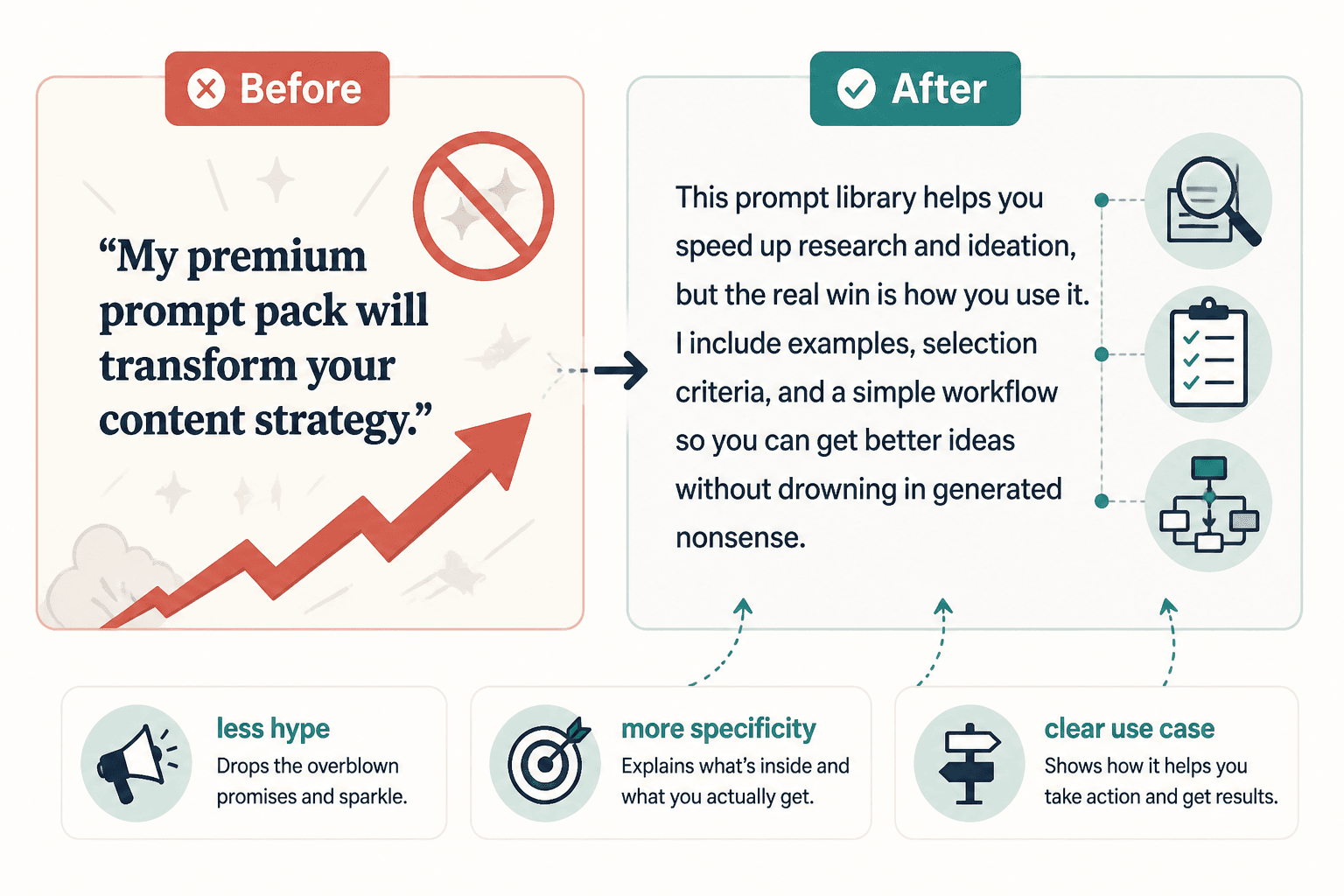
Example 3: Overhyped prompt product
Before: My premium prompt pack will transform your content strategy.
After: This prompt library helps you speed up research and ideation, but the real win is how you use it. I include examples, selection criteria, and a simple workflow so you can get better ideas without drowning in generated nonsense.
Transform your content strategy? Calm down. A prompt pack is not a spiritual event.
Trust boundaries you should state clearly
One underrated way to preserve trust is to say what your offer does not do.
- It does not replace a full brand strategy engagement
- It does not guarantee content performance
- It does not magically fix weak offers or poor positioning
- It does not remove the need for client input
- It does not mean every generated idea is worth using
This kind of clarity makes you sound more trustworthy, not less. Strong buyers usually prefer realistic framing over shiny overpromise. Weak buyers may want the hype. You do not need them.
This principle applies in adjacent areas too. If your business touches visuals as well as words, this article on monetizing AI image use cases without wrecking trust covers similar boundaries from a different angle.
FAQ
Can I say I use AI in my process?
Yes. Just frame it as part of the workflow, not the whole value proposition.
Should I hide AI use if clients might judge it?
No. You do not need to make it the headline, but hiding it creates a bigger trust problem later.
What is the easiest offer to start with?
A focused research brief, idea bank, or content planning sprint is usually easier to sell than a vague ongoing strategy package.
Can prompts be sold on their own?
Yes, but they sell better with examples, context, and a clear workflow. Raw prompts alone are easy to underdeliver.
How do I make the offer feel less generic?
Name the audience, the use case, the output, and the decision it helps them make.
The clean way to monetize this work
If you want to know how to monetize creator AI research and ideation without wrecking trust, the answer is not to hide the tools or pretend speed is the same thing as expertise. It is to make your expertise more visible.
Use AI to gather, expand, organize, and test. Then do the part that actually deserves the money: decide, refine, cut, shape, prioritize, and recommend.
That is the line. Cross it in the right direction and your offers feel useful, clear, and worth paying for. Ignore it and you end up selling polished piles of maybe.
Sell judgment. Keep the process honest. Make the output actionable. Trust usually survives that just fine.
The bigger point is simple: clearer structure and clearer writing make the piece more useful. That is usually what makes the ending land better too.