
Most people do not wreck trust when monetizing AI image use cases because they charge money. They wreck it because they get weird the second money enters the room.
Suddenly every example becomes a pitch. Every use case magically leads to one tool. Every “helpful guide” starts smelling like affiliate breath and urgency cologne. Readers notice. They may not complain out loud, but they absolutely feel it.
If you want to learn how to monetize AI image use cases without wrecking trust, the job is not to hide the monetization. It’s to make the value genuinely useful, the recommendation genuinely earned, and the next step genuinely relevant. That’s the line.
This article will show you how to make money from AI image content without turning your use cases into thinly disguised ads. We’ll cover what to sell, where to place offers, how to disclose incentives without sounding stiff, and how to keep the content good enough that people would still thank you even if they never bought a thing.
To see how this fits into the wider strategy, open the parent guide.
Why trust collapses so fast with AI image content
AI image content sits in a fragile category. People are already skeptical. Some think the tools are overhyped. Some are worried about ethics, quality, sameness, copyright mess, or lazy usage. So if your monetization is clumsy, readers are not starting from neutral. They are starting from “please do not waste my time.”
That means trust is not built by sounding excited. It is built by sounding accurate.
The fastest ways to lose credibility are pretty predictable:
- pretending every AI image tool works equally well for every use case
- forcing a sale into educational content that should have stayed educational
- acting neutral while clearly steering toward the highest-paying tool
- using fake certainty about results you cannot guarantee
- showing polished outputs without explaining the mess required to get them
- burying affiliate intent like readers are too sleepy to notice
A lot of creators do not mean to be dishonest here. They just start optimizing for conversion too early. And once that happens, the content gets flatter, safer, and less useful. Which is ironic, because usefulness is the thing that makes monetization work in the first place.
What readers actually trust in AI image use case content
Readers trust specificity. They trust tradeoffs. They trust someone saying, “This works well for quick concept drafts, but the hands still go strange sometimes and brand consistency takes work.” That kind of sentence does more for credibility than twenty glowing claims.
If your content is built around AI image use cases, the trust comes from helping people decide when these tools are worth using, when they are not, and what the realistic payoff looks like. Not from pretending every workflow is frictionless.
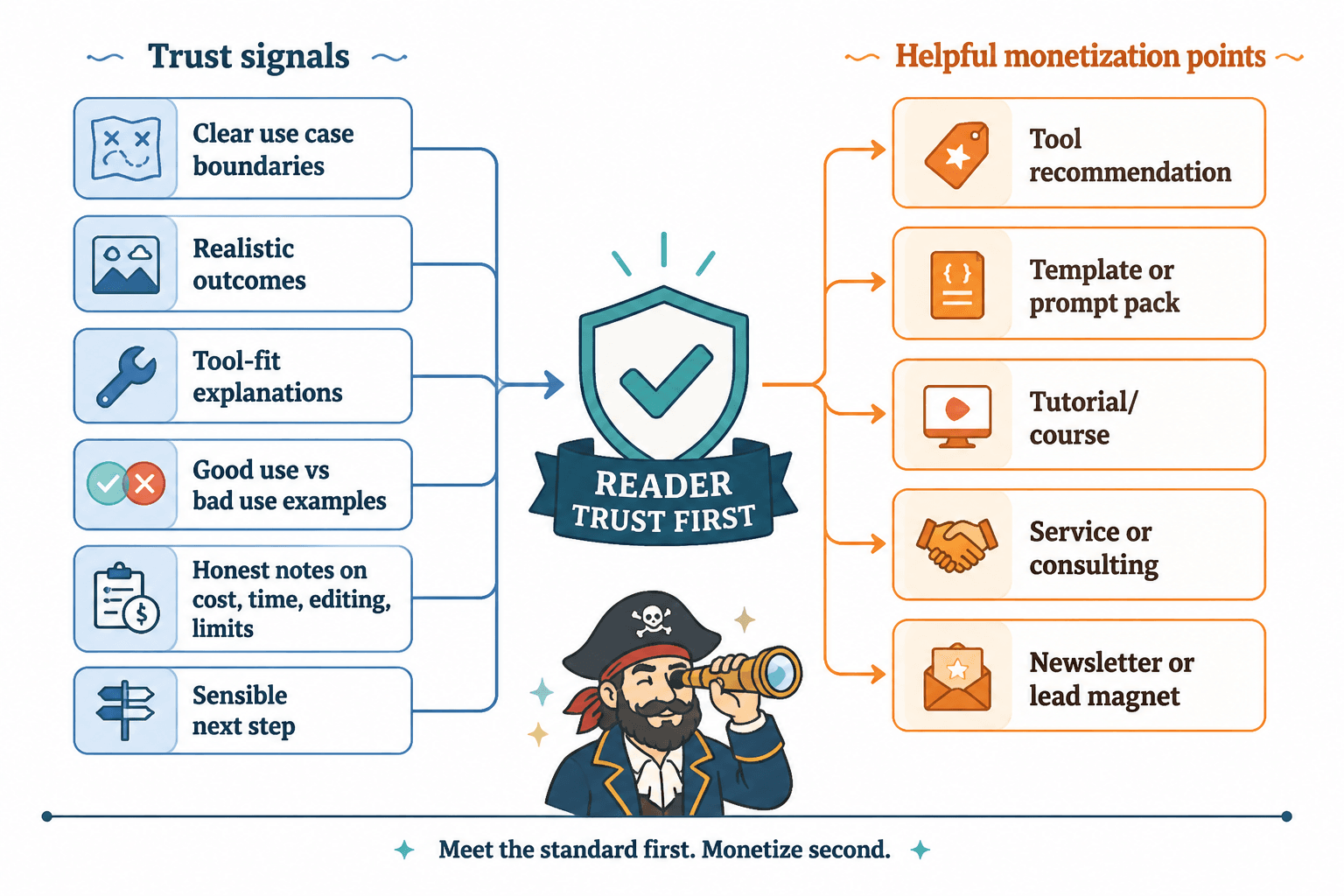
In practical terms, readers tend to trust content that includes:
- clear use case boundaries
- realistic outcomes instead of miracle promises
- tool-fit explanations instead of generic praise
- examples of bad use and good use
- honest notes about cost, time, review, editing, and limitations
- a sensible next step instead of a desperate shove toward checkout
That is the standard. Meet that standard first. Monetize second.
How to monetize AI image use cases without wrecking trust
The short version: match the offer to the reader’s actual stage. Do not slap the same monetization method onto every piece of content and call it strategy.
If someone is reading beginner or mid-level use case content, they usually want one of five things:
- to understand what AI image tools are good for
- to choose a tool or workflow
- to save time on prompt or production work
- to improve outputs for business use
- to turn visuals into leads, sales, or client deliverables
Your monetization should help with one of those jobs. If it does not, it will feel bolted on.
1. Monetize with the next logical step, not the nearest possible offer
A use case article about product mockups should not suddenly hard-pitch a high-ticket consulting package unless the path is obvious and earned. A far better move is something like:
- a prompt pack for product mockups
- a workflow template for brand-safe image generation
- a mini guide on turning mockups into landing page assets
- a newsletter signup for weekly AI image workflows
- a related article on converting image use cases into revenue
That is why a strong internal content path matters. If someone wants to go from ideas to business outcome, point them toward how to turn AI image use cases into more leads or sales. That’s a relevant next move. It respects where they are.
The right monetization often feels less like “buy now” and more like “here is the thing that makes this useful in real life.”
2. Keep the educational part complete
If the free content is suspiciously incomplete, people can tell. You do not need to give away everything, but the reader should be able to make real progress without paying. Otherwise you are not building trust. You are staging a hostage situation with bullet points.
A good rule: the article should solve the core problem conceptually, while the paid thing helps with speed, depth, implementation, or customization.
For example:
- The article explains which AI image use cases are commercially useful and where they fail.
- The lead magnet gives a workflow checklist.
- The paid product gives prompts, templates, review criteria, and reusable assets.
- The service offer helps teams build a tailored workflow around those insights.
That is clean. The value ladder makes sense. Nobody feels tricked.
3. Make your incentives obvious enough to feel adult
You do not need a legalese monologue every three paragraphs. You do need clarity.
If a link is affiliate-based, say so plainly. If a use case article is also designed to support your product, that’s fine. Just don’t posture like a neutral third-party lab if you are very obviously standing inside your own storefront.
Simple works:
- “Some of the tools mentioned here are affiliate links. I only recommend ones that fit the use case.”
- “This guide is educational first, but yes, I also offer templates for teams who want to speed this up.”
- “I use and recommend several tools here. One of them is my preferred option for this specific workflow.”
That tone matters. Calm disclosure tends to build trust. Sneaky disclosure does the opposite.
4. Show tradeoffs, not just winners
This is where a lot of monetized AI content goes off the rails. Every recommendation turns into a coronation. Every tool is “best for” something. Every path conveniently leads to a monetizable conclusion.
Real trust comes from showing tradeoffs.
For example, if you are discussing AI image use cases for social content, you might say one tool is fast for concept visuals, another is stronger for style consistency, and a third is useful if your team needs easier editing rather than prettier generations. That kind of framing helps readers choose. It also makes your monetization feel informed instead of pre-scripted.
If you publish comparison content, this matters even more. If that is your lane, pair this article with how to monetize AI image tool comparisons without fake neutrality. Because fake neutrality is one of the fastest ways to sound polished and untrustworthy at the same time.
5. Sell outcomes, not “AI”
Most readers do not actually want AI image use cases. They want what the use cases help them do.
- create better thumbnails
- mock up product ideas
- produce social graphics faster
- make client presentations less ugly
- test ad concepts cheaply
- illustrate educational content
- build lead magnets without hiring a designer for every asset
If your monetization is framed around “AI images” in the abstract, it often feels flimsy and trend-chasing. If it is framed around speed, clarity, conversion, content production, or workflow efficiency, it feels useful. Because it is.
Best monetization models for AI image use case content
You do not need twenty revenue streams. You need one or two that fit your audience and content style.
| Monetization model | Best when | Trust risk | How to keep it clean |
|---|---|---|---|
| Affiliate links | You help readers choose tools | High if recommendations feel biased | Disclose, compare honestly, explain fit |
| Templates or prompt packs | Your readers want speed and implementation | Low to medium | Make the free content useful on its own |
| Courses or mini-trainings | You teach workflows, teams, or repeatable outcomes | Medium | Teach specifics, not trend fluff |
| Consulting or services | Your audience needs custom systems or brand-safe execution | Medium | Only pitch when the use case naturally leads there |
| Newsletter or lead magnet | You are building longer-term trust before selling | Low | Offer a clear and relevant reason to subscribe |
| Sponsorships | You already have audience attention in this niche | High if forced | Only accept sponsors that actually fit the content |
For most creators, consultants, and educators, the cleanest stack looks something like this:
- Publish useful use case content.
- Offer a related free resource or newsletter.
- Recommend relevant tools where appropriate.
- Sell deeper implementation through templates, products, or services.
That sequence tends to convert better because it does not rush trust. It earns it.
If you need help designing that path, best funnel ideas to pair with AI image use cases is the obvious next read.
Where to place offers without making the article feel contaminated
Offer placement matters more than people think. A decent offer in the wrong place can make the whole article feel sticky.
Here are the placements that usually work best:
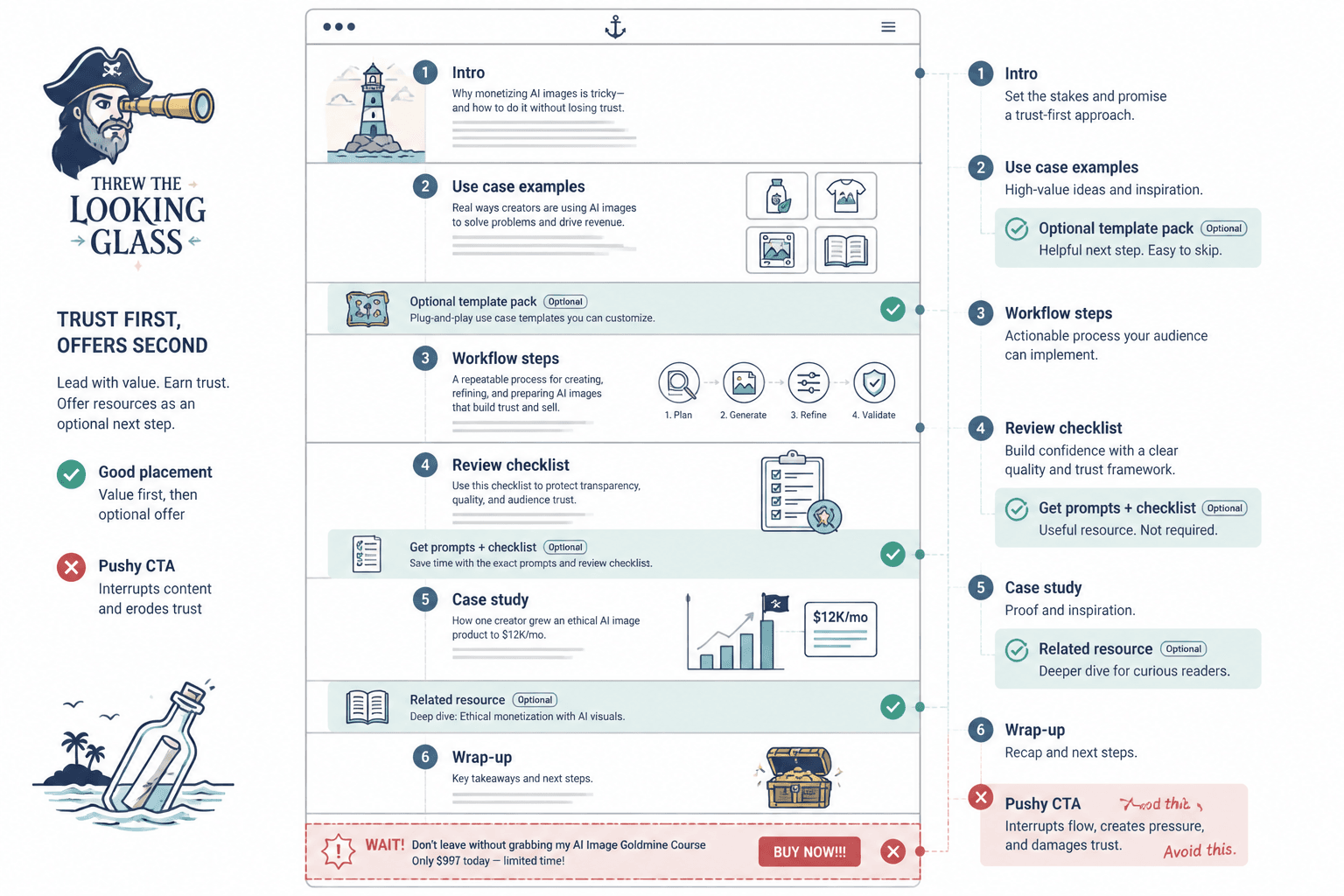
After a useful section
When a reader has just learned something concrete, they are more open to a relevant next step. This is the cleanest place for a CTA because it follows value, not interruption.
Example: after explaining how AI-generated visuals can help with content repurposing, you can mention a prompt library, workflow guide, or related article.
Inside a “if you want help with this” paragraph
This works well for service offers and higher-ticket help. The tone should be low-pressure and specific.
If you are trying to turn AI image workflows into something usable across a team, a simple prompt pack probably will not cut it. That is where consulting, audits, or custom systems make more sense.
That kind of phrasing respects the reader. It is not waving a sales brochure in their face mid-sentence.
At the end, with a clear fit statement
The end is still a good place to sell. It just needs to feel earned.
Bad ending CTA:
Ready to revolutionize your visual strategy? Buy my premium system today.
That sounds like a keynote in a blazer nobody asked for.
Better ending CTA:
If you want the prompts, workflow steps, and review checklist behind these AI image use cases, grab the template pack. If you just needed the strategy, use the article and skip the upsell. You’ll still be fine.
That last sentence does something subtle but powerful. It lowers pressure, which often raises trust, which often helps conversion anyway.
What to avoid when monetizing AI image use cases
Some mistakes are common enough to deserve a public shaming, or at least a firm eyebrow raise.
Turning every use case into a pitch
If every paragraph bends toward your product, the content stops feeling like guidance and starts feeling like bait. Readers do not need every use case to end at your checkout page.
Using examples that only work in ideal conditions
If your examples skip revision time, editing judgment, prompt iteration, brand approval, or legal review, then you are not showing the use case. You are showing a best-case fantasy.
Recommending tools because they pay well
This one should be obvious, but here we are. If a weaker tool pays better and you push it anyway, the short-term gain is not worth the long-term trust damage. You are not building a business. You are renting your credibility by the click.
Writing in that glossy AI-helpful voice nobody believes
If your article sounds like a brochure generated by a productivity intern, trust drops fast. Keep the wording direct. If you need help there, read how to write AI image use cases without sounding salesy or robotic. Good monetization gets much easier when the writing does not sound like reheated template soup.
Acting like monetization and honesty are in conflict
They are not. The real conflict is between honesty and insecurity. People start hiding incentives when they are afraid the content cannot stand on its own. So the fix is not better hiding. It is better content.
A simple trust-first framework you can actually use
If you want a practical way to check your article before publishing, use this five-part filter:
- Usefulness: Would this still help the reader if they never clicked a single offer?
- Fit: Does the offer match the exact use case and reader stage?
- Disclosure: Is the monetization clear enough to feel honest?
- Specificity: Did you explain tradeoffs, context, and realistic outcomes?
- Pressure: Does the CTA sound like an invitation, not a shove?
If you fail two or more of those, the piece probably needs revision.
This is especially useful if you publish a lot of educational content in the broader AI writing tools and workflows space, where the line between useful and salesy gets blurry fast. The more tool-heavy the topic, the more discipline your monetization needs.
Example: weak vs stronger monetization
Here is a quick before-and-after.
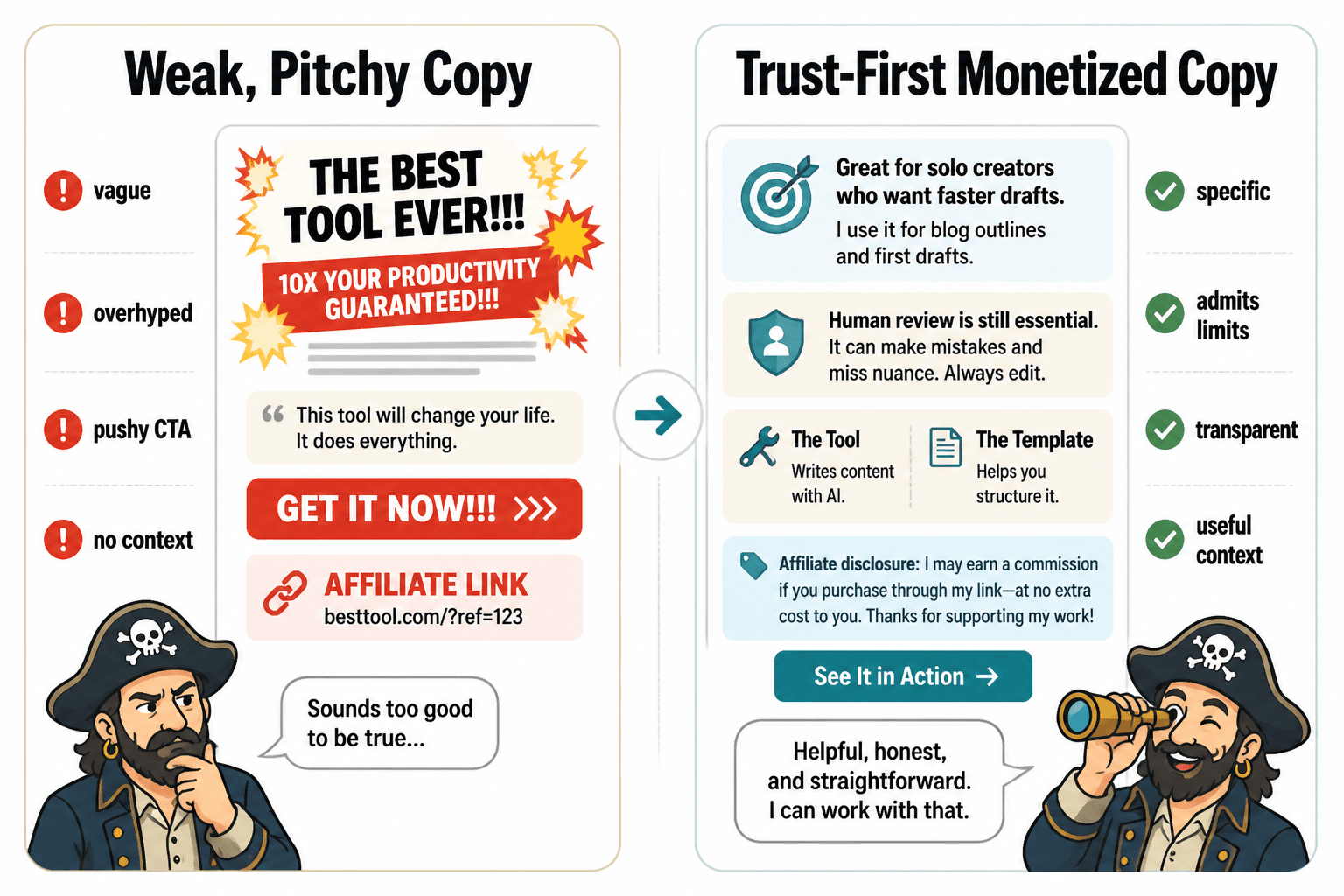
Weak version
AI image generators are transforming business visuals. If you want amazing outputs for ads, blogs, social content, and branding, sign up for Tool X today using my link. It is the best solution for creators and entrepreneurs.
Problems:
- too broad
- no specific use case
- no tradeoffs
- no proof
- obvious affiliate energy
- sounds like every other forgettable recommendation
Stronger version
For quick blog header concepts, AI image tools can save a lot of time, especially when you need custom visuals that are “good enough” and do not justify a full design round. Tool X is one option I recommend for speed here, though you will still want human review for consistency and weird detail cleanup. If you want the prompt structure I use for blog visuals, I’ve included it in the template pack below. The tool link is affiliate-based, so yes, I may earn if you use it.
That version is more believable because it is narrower, clearer, and more honest. It gives context. It admits limits. It separates the tool from the template. It sounds like someone who has actually done the work.
Readers do not need perfection. They need signs of reality.
How to choose the right CTA for this kind of content
The CTA should match the intent of the piece. Not every article deserves a direct sale.
Use this rough guide:
- Top-of-funnel use case article: offer a related guide, newsletter, or simple template
- Comparison article: offer a decision aid, workflow checklist, or affiliate recommendation with clear reasoning
- Implementation article: offer a prompt pack, swipe file, mini-course, or toolkit
- Strategy article: offer consulting, audit, workshop, or a higher-trust next step
If your article is mainly helping readers connect AI visuals to business growth, the best CTA often is not “buy my thing.” It is “here is the next useful asset.” That next asset can absolutely be part of your monetization path. It just should not feel like a trapdoor.
FAQ
Can you monetize AI image use cases with affiliate links only?
Yes, but it is usually fragile. Affiliate-only monetization works better when your recommendations are specific, comparative, and clearly disclosed.
Should you disclose affiliate links in every article?
If they are present, yes. Keep it brief and plain. Readers do not need a courtroom speech.
What is the safest first monetization step?
A relevant lead magnet, newsletter, or low-cost template usually feels cleaner than jumping straight to a hard sale.
Is it okay to promote your own product in use case content?
Absolutely, if the article is still genuinely useful without it and the product clearly fits the problem being discussed.
How do you know if an article feels too salesy?
If the monetization shows up before the reader gets meaningful value, or if every section seems engineered to force one conclusion, it is probably too much.
Trust is the asset, not the obstacle
If you want to know how to monetize AI image use cases without wrecking trust, stop treating trust like the annoying thing standing between you and revenue. Trust is the revenue engine. It is the reason people believe your examples, click your links, buy your templates, and come back when they are ready for more.
So keep the content useful. Keep the incentives clear. Keep the offers relevant. And if a monetization tactic would make the article worse, skip it. There is no prize for squeezing one extra conversion out of a piece that quietly damages your credibility.
Make the article good enough that even the people who do not buy anything still trust you more after reading it. That is usually the version that makes money anyway.
The bigger point is simple: clearer structure and clearer writing make the piece more useful. That is usually what makes the ending land better too.