Most creators do not have an ideation problem. They have a connection problem.
They use AI to find angles, questions, content ideas, objections, talking points, and audience language. Great. Then they post the output, maybe repurpose a few pieces, feel briefly productive, and wonder why none of it turns into leads, calls, subscribers, or sales.
The issue usually is not the research. It is that the research is floating around without a funnel attached to it. Useful ideas with no next step are just organized busyness.
If you want the best funnel ideas to pair with creator AI research and ideation, the goal is simple: build a path from insight to action without making your content feel like a disguised vending machine. That means using AI research to create sharper content, then connecting that content to an offer, email list, booking page, resource, or conversation that actually fits what the reader already cares about.
This article will show you which funnels work best, when to use each one, what they are good for, and where people quietly wreck trust by forcing the sale too early. We will also cover practical funnel structures you can build without needing a whiteboard, a ten-step automation map, and a personality transplant.
If you need a stronger base before building funnels, start with the broader creator AI research and ideation guide for creators who want better results. If you are still refining your process, the hub on creator AI research and ideation is worth bookmarking too.
To see how this fits into the wider strategy, open the parent guide.
Why creator AI research needs a funnel in the first place
AI research is great at surfacing patterns.
- What your audience keeps asking
- What objections show up before they buy
- What myths they believe
- What comparisons they search for
- What language they actually use
- What content formats might earn attention
That is useful, but it is only the top half of the machine. The bottom half is what happens after someone reads, watches, clicks, replies, or gets interested.
A funnel gives your AI-assisted content a job. It tells each piece of research-informed content where it should lead. Not every post needs to sell. Not every article needs a booking link. But every good content system should know what kind of action it is trying to create.
Without that, creators end up doing one of two annoying things:
- Posting endlessly with no conversion path
- Pitching constantly because they are tired of posting endlessly with no conversion path
Neither is elegant. One wastes attention. The other burns it.
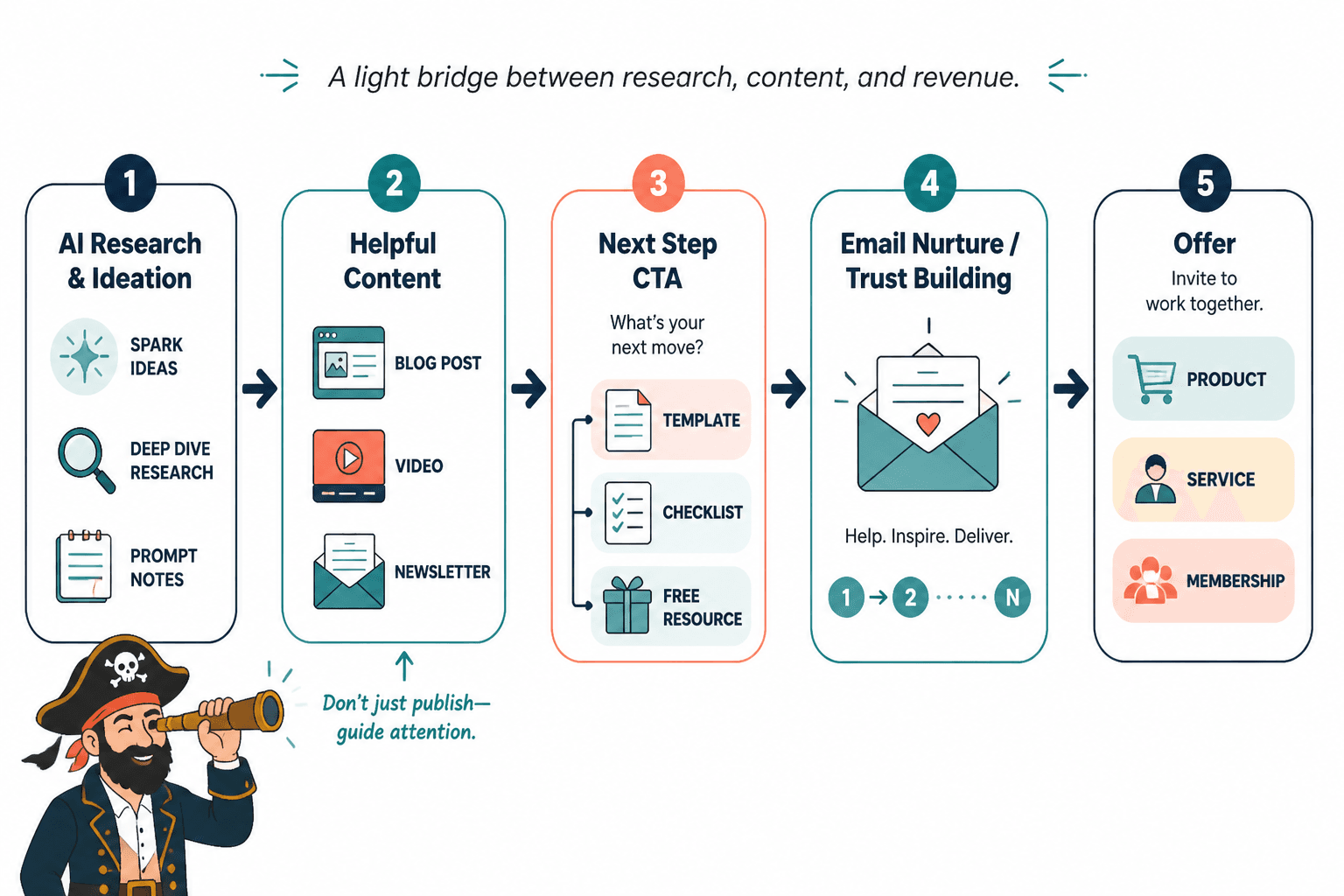
What you want instead is a light, sensible bridge between your research, your content, and your business model.
What makes a good funnel for AI research and ideation content
Before picking a funnel, it helps to know what you are screening for. A good funnel for creator AI research and ideation should do a few things well.
- Match intent: the next step should fit the content someone just consumed
- Feel low-friction: people should not need six leaps of faith to continue
- Preserve trust: the offer should feel like a helpful continuation, not a trap door
- Use what AI is actually good at: patterns, prompts, topic clusters, audience questions, repurposing angles
- Support your business model: audience growth is nice, but rent prefers a plan
If your AI research tells you your audience is confused about strategy, a funnel into a checklist, audit, or workshop can work beautifully. If your research reveals urgent buying questions, a case study or consultation funnel may be better. If your audience needs time to trust you, email nurture is often the sane move.
The trick is not “using AI in your funnel.” The trick is using AI research to make the funnel more relevant, specific, and timely.
The best funnel ideas to pair with creator AI research and ideation
Here are the funnel types that make the most sense for creators, consultants, coaches, writers, solo founders, and personal brands using AI research to sharpen their content strategy.
1. Post to lead magnet
This is the classic for a reason. It works when your AI research helps you identify specific pain points, recurring questions, or patterns worth packaging into a practical free resource.
Best for: growing an email list, warming up future buyers, building trust at scale
Structure: Content post → relevant free resource → email nurture → offer
Examples of lead magnets that fit AI research well:
- Prompt packs with commentary, not just a pile of prompts
- Swipe files based on audience objections
- Content planning templates
- Messaging checklists
- Mini trend reports
- FAQ breakdowns
- Audit sheets
This works especially well because AI can help you spot repeat themes quickly. If your research says your audience keeps asking versions of the same four questions, that is not just content fuel. That is resource fuel.
What people get wrong is making the lead magnet too broad. “The ultimate content guide” sounds ambitious and usually lands like a PDF with good intentions and no pulse. A narrower freebie tends to convert better because it feels immediately useful.
Better: “20 prompts to find stronger client pain points for your content”
Worse: “The complete guide to content success”
2. Post to newsletter
If your ideas are nuanced, layered, or opinion-driven, a newsletter funnel often makes more sense than a generic freebie. You do not always need a downloadable thing. Sometimes the best next step is simply “get more like this, consistently.”
Best for: writers, educators, strategists, niche experts, people with recurring insight
Structure: Social post or article → newsletter signup → recurring insights → soft offer or launch
This works well when your AI ideation process helps you build recurring content themes. Maybe your research regularly pulls audience questions, trend shifts, customer objections, or message gaps. Those can become newsletter pillars.
The big advantage here is rhythm. A newsletter gives your AI-assisted ideation somewhere ongoing to go. Instead of turning every insight into a random post, you can build a more coherent body of work and a stronger habit loop with your readers.
And yes, this is often better than trying to force every interested person onto a sales call. Some people need six smart emails before they want to hear your price. That is normal. Humans are stubborn like that.
3. Article to related service or offer
If you publish deeper articles based on AI research and ideation, pair them with a directly related paid offer. This is one of the cleanest funnels available because the article does the trust-building first.
Best for: consultants, agencies, strategists, editors, coaches, service providers
Structure: Search-friendly article → CTA to service, audit, workshop, or product → application or checkout
For example, if your AI research helps you identify common messaging mistakes among creators, you can write a detailed article diagnosing the issue, then point readers to a paid messaging audit. Clean. Logical. Not weird.
This works because the article attracts people already searching for help. They are not being interrupted. They are already in problem-solving mode.
If you want more on connecting this process to revenue, read how to turn creator AI research and ideation into more leads or sales.
4. Thread or post to booking page
This is the direct-response option, but it only works when the content has enough specificity and credibility to justify the jump.
Best for: high-trust creators, warm audiences, urgent problems, higher-ticket services
Structure: Insight post, teardown, case-study thread, or objection post → booking page → call → offer
The key here is using AI research to identify high-intent topics. Not every idea deserves a consultation CTA. But if your audience keeps asking questions that signal buying readiness, then a booking link can make sense.
High-intent signals often sound like this:
- “How do I fix this fast?”
- “Which option should I choose?”
- “Why is my current system not converting?”
- “What should I change before I launch?”
- “Can someone review this?”
Posts built around these questions can naturally lead to an audit, strategy session, teardown, or consult.
What does not work is attaching “book a call” to every fluffy thought piece. If the content is vague, the CTA feels weirdly ambitious.
5. Content series to low-ticket product
AI research is excellent for identifying clusters of related questions. That makes it useful for planning content series that lead into a workshop, mini-course, template pack, swipe file, or toolkit.
Best for: creators with digital products, educators, niche experts, audience monetization without high pressure
Structure: Multi-post series on one problem → low-ticket product → upsell, bundle, or nurture
Let’s say your AI ideation process reveals a recurring cluster around content hooks. That can become:
- 3-5 posts diagnosing common hook mistakes
- 1 article explaining a better hook framework
- 1 swipe post with examples
- CTA to a low-ticket hook template pack or workshop
This kind of funnel works because the audience has already sampled your thinking. By the time they see the paid offer, it feels like a deeper version of something they already found useful.
That is how you sell without sounding like your content got hijacked by a checkout page.
6. Comment conversation to soft DM funnel
This one is underrated, mostly because it requires actual human interaction, which many people would apparently like to avoid while building a relationship-based business. Tragic.
Best for: coaches, consultants, freelancers, personal brands, service sellers
Structure: Insight post → comments and replies → relevant DM offer or resource → next step
AI research can help you create posts that trigger relevant conversation instead of empty applause. For example, if your audience consistently struggles with a specific bottleneck, write a post that invites concrete responses around that bottleneck.
Then, if someone comments with a clear pain point, you can continue the conversation naturally. Maybe you send a resource. Maybe you offer a quick diagnostic. Maybe you point them to a related service.
The reason this works is context. The DM is not random. It is a continuation of an existing exchange.
The reason people ruin it is obvious: they turn “Thanks for commenting” into a speedrun toward “Want to hop on a quick call?” with all the subtlety of a smoke alarm.
Do not do that. Be useful first.
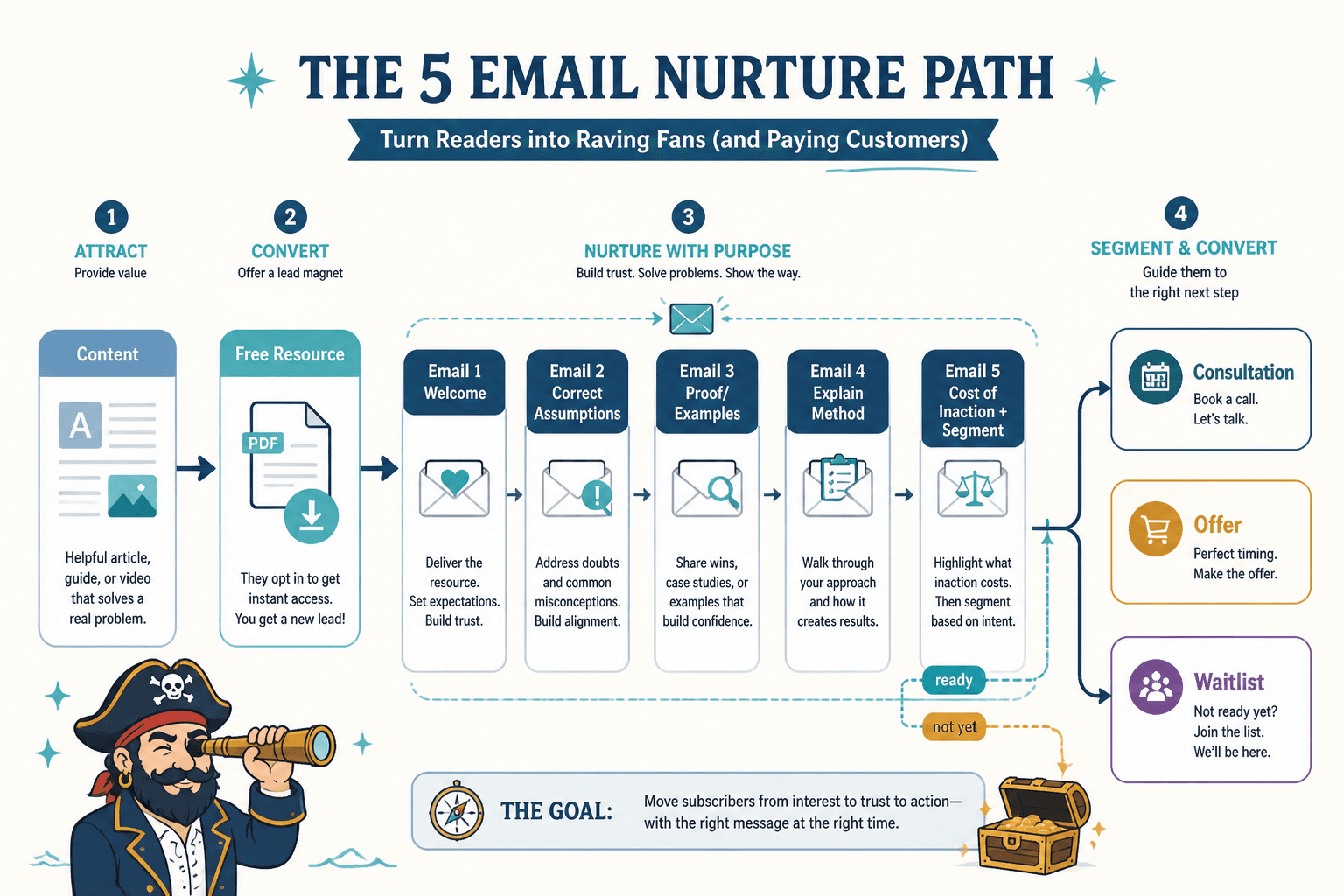
7. Free resource to nurture sequence to consultation or product
This is one of the strongest options if your audience needs education before they buy. AI research often reveals not just what people want, but what they misunderstand. That is perfect fuel for a short nurture sequence.
Best for: offers that require trust, explanation, reframing, or buyer maturity
Structure: Content → free resource → 3-7 email sequence → consultation, offer, or waitlist
Your nurture sequence can do things your social post cannot:
- Correct bad assumptions
- Share proof or examples
- Explain your method
- Show the cost of inaction
- Segment who is ready and who is not
This is especially useful when your offer is not cheap, not instant, or not obvious. AI can help you map common objections and sequence them in a way that feels coherent rather than pushy.
For tooling help with that workflow, see best AI tools for creator AI research and ideation.
8. Case study content to audit or strategy offer
If your AI research helps you identify patterns in what works, turn those patterns into case-study-style content and route readers into a paid audit, teardown, or strategy session.
Best for: service businesses, consultants, specialists, conversion-focused creators
Structure: Case study post or article → “want this reviewed for your business?” CTA → audit/session offer
This is powerful because case studies do two jobs at once: they prove you know what you are doing, and they help the reader see their own gaps more clearly.
The CTA is then obvious. If someone reads a teardown and realizes they have the same problem, an audit is a logical next step.
This works even better when your AI research helps you gather recurring examples, objections, and outcomes from client work, audience calls, support questions, and public conversations.
How to choose the right funnel for your content and offer
Not every funnel fits every creator. A cleaner way to choose is to match funnel type to business goal.
| Goal | Best funnel type | Why it fits |
|---|---|---|
| Grow an owned audience | Post to lead magnet or newsletter | Low friction, trust-building, scalable |
| Sell a service | Article to service or case study to audit | Builds credibility before the ask |
| Book more calls | High-intent post to booking page | Works when the pain is urgent and specific |
| Monetize smaller audiences | Content series to low-ticket product | Easier entry point than a premium offer |
| Build relationships | Comment conversation to soft DM | Human, contextual, high trust |
| Warm up cold leads | Free resource to nurture sequence | Creates education and momentum over time |
If you are still collecting examples and figuring out what your audience actually responds to, this can help: best creator AI research and ideation ideas and examples for creators.
A simple framework for building these funnels from AI research
You do not need a giant automation stack to make this work. You need a repeatable way to move from insight to asset to next step.
The research-to-funnel workflow
- Collect audience signals. Use AI to synthesize audience questions, recurring objections, pain points, and language patterns.
- Sort by intent. Separate awareness questions from buying questions. They should not lead to the same CTA.
- Pick one content angle. Choose a sharp topic, not a vague category.
- Create the right asset. Post, article, thread, checklist, workshop, audit page, newsletter issue, or email sequence.
- Choose one next step. Newsletter, lead magnet, booking page, soft DM, product, or service.
- Align the CTA. Make sure the ask feels like a continuation of the content, not a random business ambition.
- Track response quality. Look at replies, clicks, signups, conversions, and sales conversations, not just vanity metrics.
That is enough to build a content system that actually goes somewhere.
And yes, you can absolutely use AI to speed up pieces of this process. It can help summarize call notes, cluster audience questions, generate angle variations, outline lead magnets, draft nurture email options, and repurpose content into multiple formats. What it cannot do is decide what your audience should care about most or what kind of trust your business still has not earned.
Mistakes that make these funnels feel gross
A decent funnel can still fail if the behavior around it is bad. Here are the common problems.
Using AI outputs as if they are strategy
A list of ideas is not a funnel. A neat prompt response is not positioning. Research helps you see patterns. You still need judgment.
Attaching the same CTA to everything
If every post ends with “book a call,” your content starts to feel like bait. Different content serves different jobs. Match the CTA to the reader’s stage.
Making the next step too big
A reader who just found you through a useful post may subscribe to a newsletter. They may grab a focused resource. They are less likely to immediately commit to a premium engagement unless the pain is urgent and obvious.
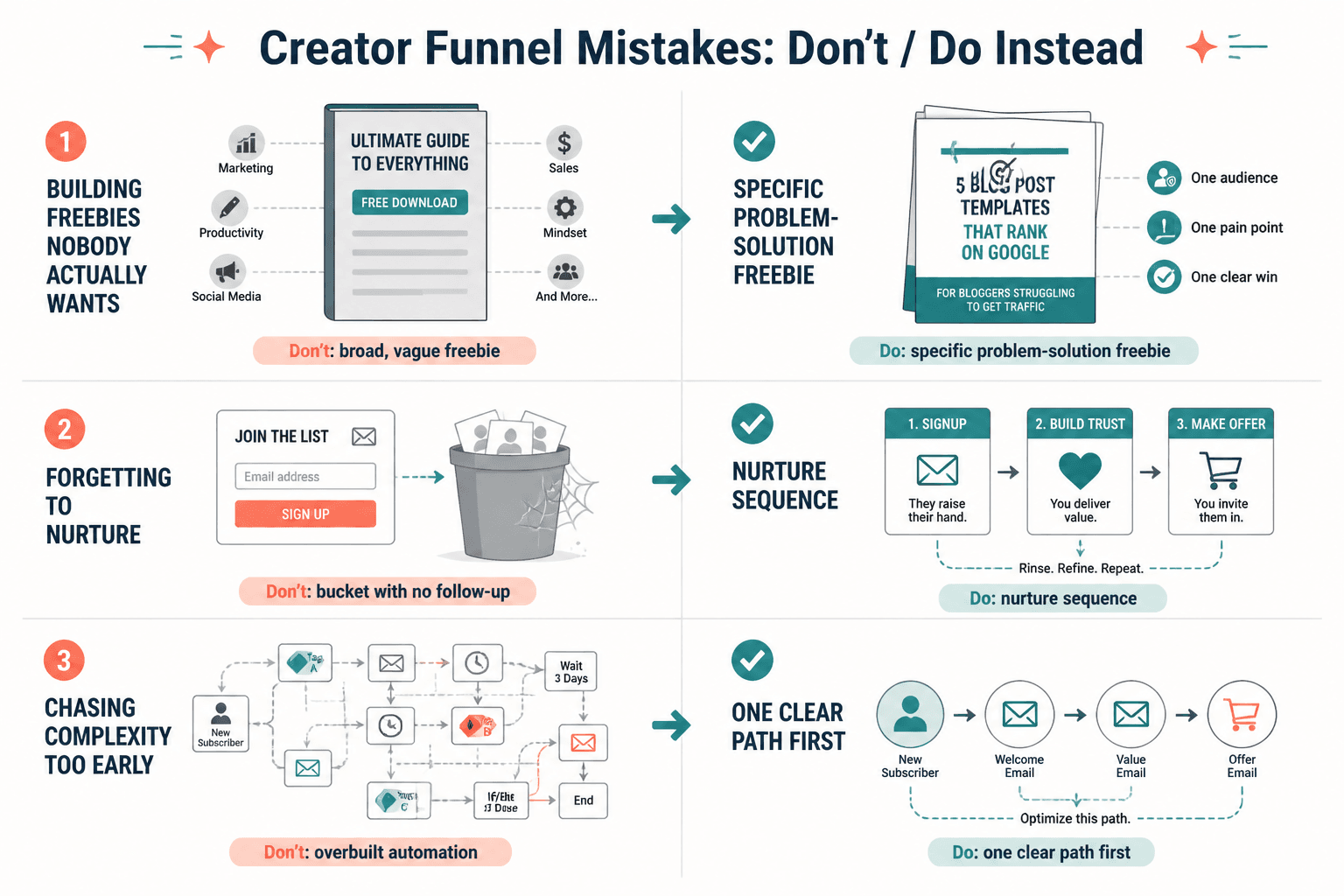
Building freebies nobody actually wants
If the lead magnet is broad, bloated, or unclear, it will not convert. Your AI research should help you get more specific, not produce fancier vagueness.
Forgetting to nurture
A signup is not a sale. A click is not trust. If your funnel ends the second someone joins your list, you do not really have a funnel. You have a collection bucket.
Chasing complexity too early
You do not need three branches, six tags, and an automation that looks like an airport wiring diagram. Start with one clear path. Earn complexity later.
Practical funnel examples creators can adapt
Here are a few practical versions you can steal, tweak, and use without pretending your business is identical to someone else’s.
Example 1: Consultant selling messaging strategy
- AI research finds recurring audience confusion around differentiating their offer
- Creator publishes a post: “Why your content sounds clear to you and vague to buyers”
- CTA points to a free messaging diagnosis checklist
- Email sequence explains three common positioning mistakes
- Final CTA offers a paid messaging audit
Example 2: Coach selling a group program
- AI research clusters frequent objections around consistency and overwhelm
- Coach creates a 4-part content series on simple weekly planning
- Series links to a low-ticket planning workshop
- Workshop leads into the group program waitlist
Example 3: Writer building an audience for future products
- AI research surfaces recurring curiosity around idea generation and content structure
- Writer posts short insights and one longer article each week
- CTA invites people to join a newsletter for deeper breakdowns
- Newsletter later sells a template pack and mini-course
Example 4: Service provider booking discovery calls
- AI research shows high-intent concerns around poor conversion on landing pages
- Provider publishes teardown-style content with before-and-after fixes
- CTA offers a paid landing page audit or strategy call
- Audit converts qualified buyers into retainers or project work
The pattern is not complicated. Research reveals the pain. Content frames the pain clearly. The funnel gives the right people a sane next step.
Where these funnel ideas fit inside a bigger creator workflow
If you are building a full content system, it helps to think of funnels as one layer of a broader workflow, not a separate magic department.
Your larger workflow might look like this:
- AI-assisted research
- Angle selection and idea scoring
- Content creation and repurposing
- Platform distribution
- Funnel entry point
- Nurture, sales, or relationship step
- Review what led to quality leads or conversions
If you want to explore that ecosystem more broadly, you can also browse the main AI writing tools and workflows path. Slightly messy URL, useful destination.
FAQ
Should every AI-generated content idea lead to a funnel?
Not directly. But your overall content system should know which pieces build awareness, which capture interest, and which support conversion.
What is the best funnel if I have a small audience?
Usually post to newsletter, post to focused lead magnet, or comment conversation to soft DM. Small audiences need trust and relevance more than funnel theater.
Can AI write the whole funnel for me?
It can help draft parts of it. It cannot supply judgment, positioning, trust, or a non-boring offer.
Which funnel is best for selling services?
Article to service, case study to audit, and high-intent post to booking page are usually the strongest options.
Which funnel is best for creators selling digital products?
Content series to low-ticket product and post to lead magnet to nurture sequence tend to work well.
Use AI research to make the funnel smarter, not louder
The bigger point is simple: clearer structure and clearer writing make the piece more useful. That is usually what makes the ending land better too.
The bigger point is simple: clearer structure and clearer writing make the piece more useful. That is usually what makes the ending land better too.