
Most creators do not have an ideation problem. They have a filtering problem.
They open ChatGPT or some other AI tool, ask for 50 content ideas, get back a buffet of decent-sounding mush, and then wonder why their posts still feel bland, interchangeable, or weirdly off. The machine gave them volume. It did not give them judgment.
A good creator AI research and ideation guide is not about getting more ideas. You already have access to more ideas than you can publish in a year. The real job is finding stronger angles, spotting useful patterns, testing what your audience actually cares about, and turning fuzzy expertise into content people would willingly read.
That is what this guide is for. You will learn how to use AI to research better, generate sharper content angles, organize ideas without drowning in them, and avoid the very common mistake of publishing polished nonsense. AI can absolutely speed this up. It just cannot replace taste, positioning, or knowing what your audience is sick of hearing.
For the main guide behind this topic, visit the parent guide.
What AI is actually good at in research and ideation
AI is useful when the task is messy, repetitive, or exploratory.
It is especially helpful when you need to turn a vague topic into possible angles, patterns, questions, frameworks, objections, or content formats. It can help you get out of your own head faster. It can also help you stop repeating the same three ideas dressed in slightly different shirts.
- Brainstorming content angles from one core topic
- Finding likely audience questions and objections
- Organizing rough notes into themes
- Turning one idea into multiple formats
- Comparing beginner, intermediate, and advanced takes on a topic
- Creating draft outlines, hooks, and content structures
- Summarizing research you already gathered
- Identifying gaps in your current content library
That is the useful part. The overrated part is asking AI to invent your point of view from scratch. If your positioning is vague, your offer is boring, or your audience is unclear, AI will happily produce polished filler with alarming confidence. It is a very efficient nonsense assistant when used badly.
What AI is not good at, no matter how clean the interface looks
AI cannot tell you what matters most to your buyers unless you feed it real signals. It cannot know which objections show up in your sales calls if you never recorded them. It cannot tell the difference between a spicy take and a dumb one without your standards.
More bluntly: AI cannot save weak thinking. It can only decorate it faster.
- It cannot replace direct audience research
- It cannot create trust from nothing
- It cannot fix unclear positioning
- It cannot know your lived experience unless you supply it
- It cannot reliably separate fresh insight from recycled platform sludge on its own
- It cannot make generic ideas interesting just by rephrasing them
This matters because a lot of creators are using AI like a vending machine. Topic in. Viral post out. That is not how this works. Better results come from using AI as a research assistant, pattern spotter, and rough-draft partner, then applying human judgment where it actually counts.
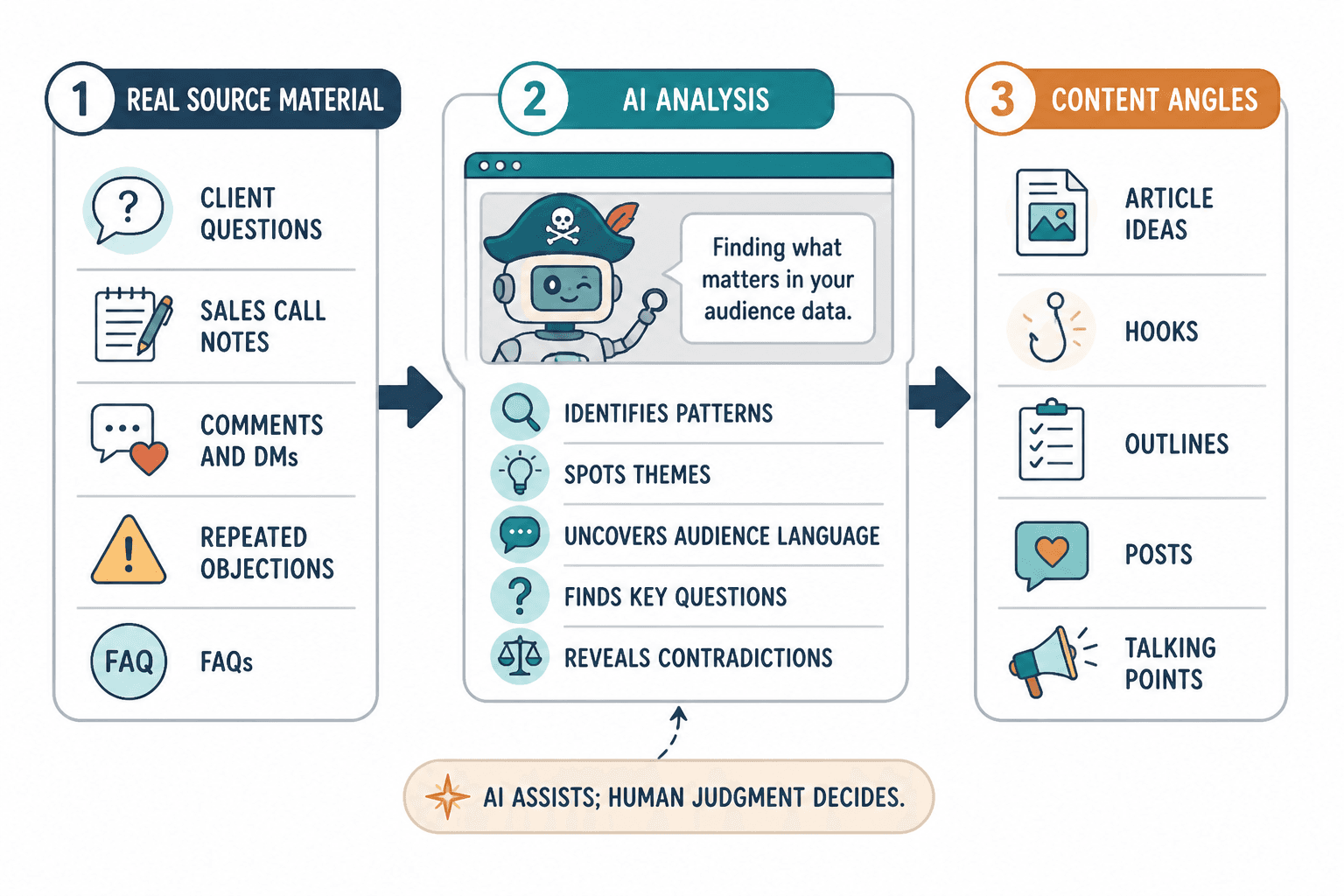
The simplest creator AI research and ideation workflow that actually works
You do not need a giant content operating system with twelve color-coded dashboards and a second brain that now needs its own therapist. You need a process that helps you consistently find useful ideas and turn them into publishable content.
Here is the basic flow.
1. Start with real source material
Before you prompt anything, collect inputs that actually reflect your audience and your expertise.
- Client questions
- Sales call notes
- Comments and DMs
- Objections you hear repeatedly
- FAQs from discovery calls
- Your own frameworks, lessons, mistakes, and contrarian opinions
- Past posts that performed well for the right reasons
- Competitor positioning patterns you keep seeing
If you skip this and jump straight to “give me 100 content ideas for coaches,” you will get exactly the kind of output that makes everyone sound like they are posting from the same beige bunker.
2. Ask AI to analyze, not just generate
Most weak AI usage starts and ends with generation. Better usage starts with analysis.
Instead of asking for random ideas, ask AI to sort your source material into themes, identify recurring pain points, compare beginner versus advanced concerns, or pull out phrases your audience uses repeatedly. This gives you sharper raw material for better content.
- What themes keep appearing across these client questions?
- What objections show up most often?
- Which frustrations suggest a positioning gap in the market?
- What beginner misconceptions are hiding inside these questions?
- Which themes sound emotionally urgent versus merely interesting?
3. Turn themes into angles
Once you have themes, then you generate. But you generate with constraints.
Ask for ideas by format, by audience stage, by content goal, or by level of boldness. A post for lead generation should not sound like a newsletter essay. A trust-building article should not read like a thread stretched beyond mercy.
- Give me 10 post angles on this theme for skeptical consultants
- Turn this pain point into 5 article ideas with practical outcomes
- Generate 12 hook options that challenge lazy assumptions without sounding clickbaity
- Create 8 content angles for people who know the basics but keep getting weak results
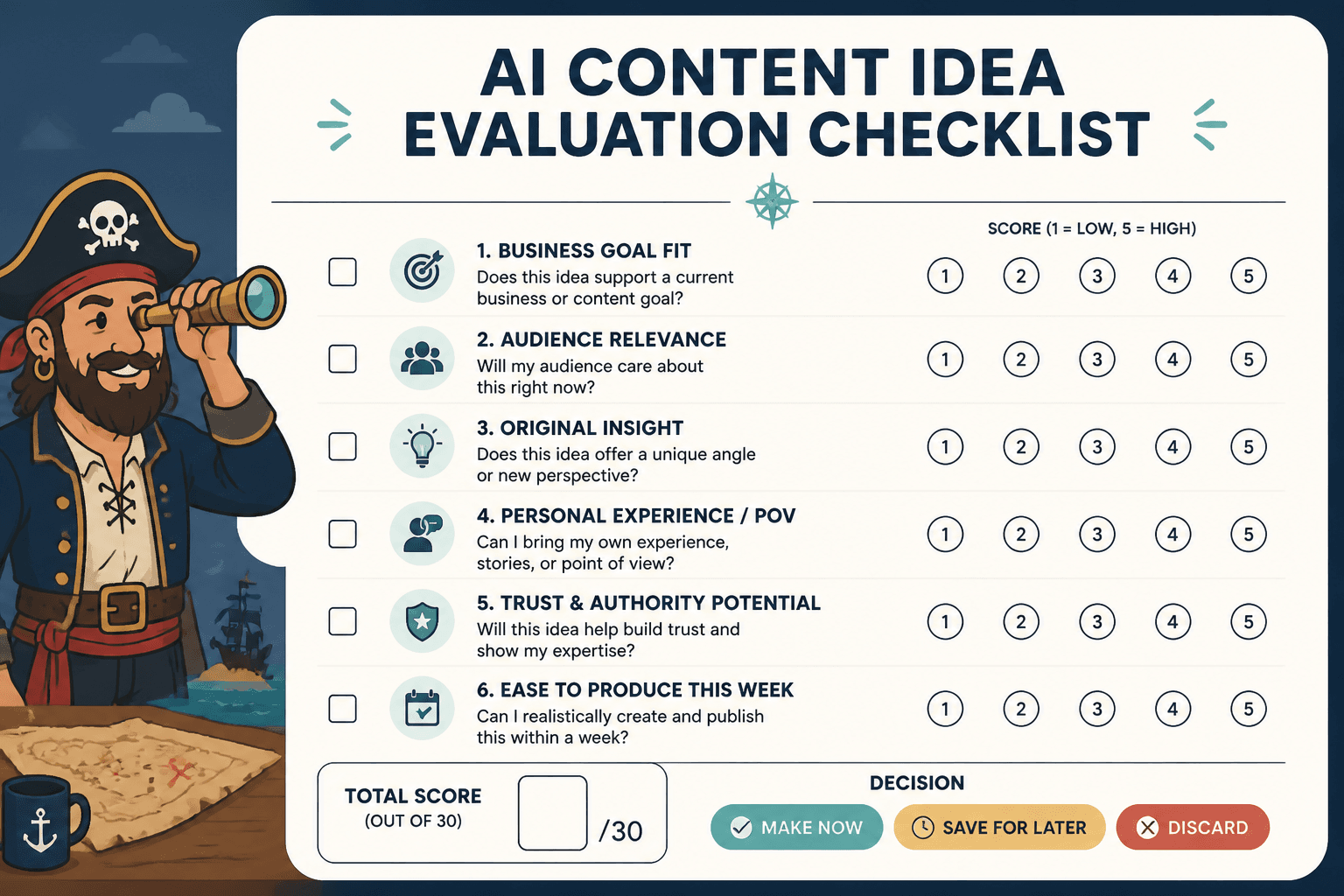
4. Score the ideas before you write anything
Do not publish the first idea that sounds coherent. Score it.
| Question | What you are checking |
|---|---|
| Is this specific? | Would the right reader immediately know it is for them? |
| Is this useful? | Does it help someone think better or do something better? |
| Is this differentiated? | Does it avoid the same tired advice everyone posts? |
| Is this credible? | Can you support it with experience, proof, or a clear argument? |
| Is this aligned? | Does it connect naturally to your offer, audience, or positioning? |
If an idea fails three of those five checks, it is probably not a content idea. It is a sentence fragment wearing confidence.
5. Build an idea bank with tags that matter
Do not dump every AI output into one giant note called “content ideas” and then never look at it again.
Tag ideas by something useful:
- Audience type
- Awareness level
- Platform
- Goal: reach, trust, leads, sales
- Format: post, thread, article, carousel, email
- Theme: pricing, messaging, hooks, funnels, positioning, client acquisition
- Status: raw, validated, drafted, published, repurpose-ready
This is the part people skip because it feels less fun than generating 75 new ideas. But organization is what turns ideation into an actual workflow instead of a dopamine hobby.
How to do better creator research before you ask AI for ideas
If your inputs are weak, your outputs will be weak, just faster and in cleaner formatting. So before the ideation step, do some real research.
Look for language, not just topics
A lot of creators research topics when they should be researching phrasing. The topic might be “content strategy,” but the useful material is in the way people describe the problem.
Compare these:
- “I need help with content strategy”
- “I post useful stuff but it dies quietly”
- “My content sounds smart but nobody DMs me”
- “I know my topic, but my posts still feel generic”
The first one is broad. The others contain tension, emotion, and direction. That is where stronger hooks and sharper content angles come from.
Study what your audience asks before they buy
Pre-sale questions are incredibly useful because they reveal friction. Friction is where content gets interesting.
- What exactly do you help with?
- How is this different from hiring a copywriter?
- Will this work if I have a small audience?
- How long does it take to see results?
- What if I do not want to post every day?
Those are not just objections for a sales page. They are article topics, post angles, FAQ material, and lead magnet building blocks.
Use AI to cluster and prioritize, not replace the research
Once you gather audience language, questions, and objections, feed that into AI and ask it to cluster similar ideas, rank themes by urgency, and suggest content formats that match each theme.
That sequence matters. Research first. AI second. Otherwise you are asking a machine to hallucinate market understanding and then acting surprised when the answer sounds like committee-written oatmeal.
Prompting for ideation without getting generic sludge
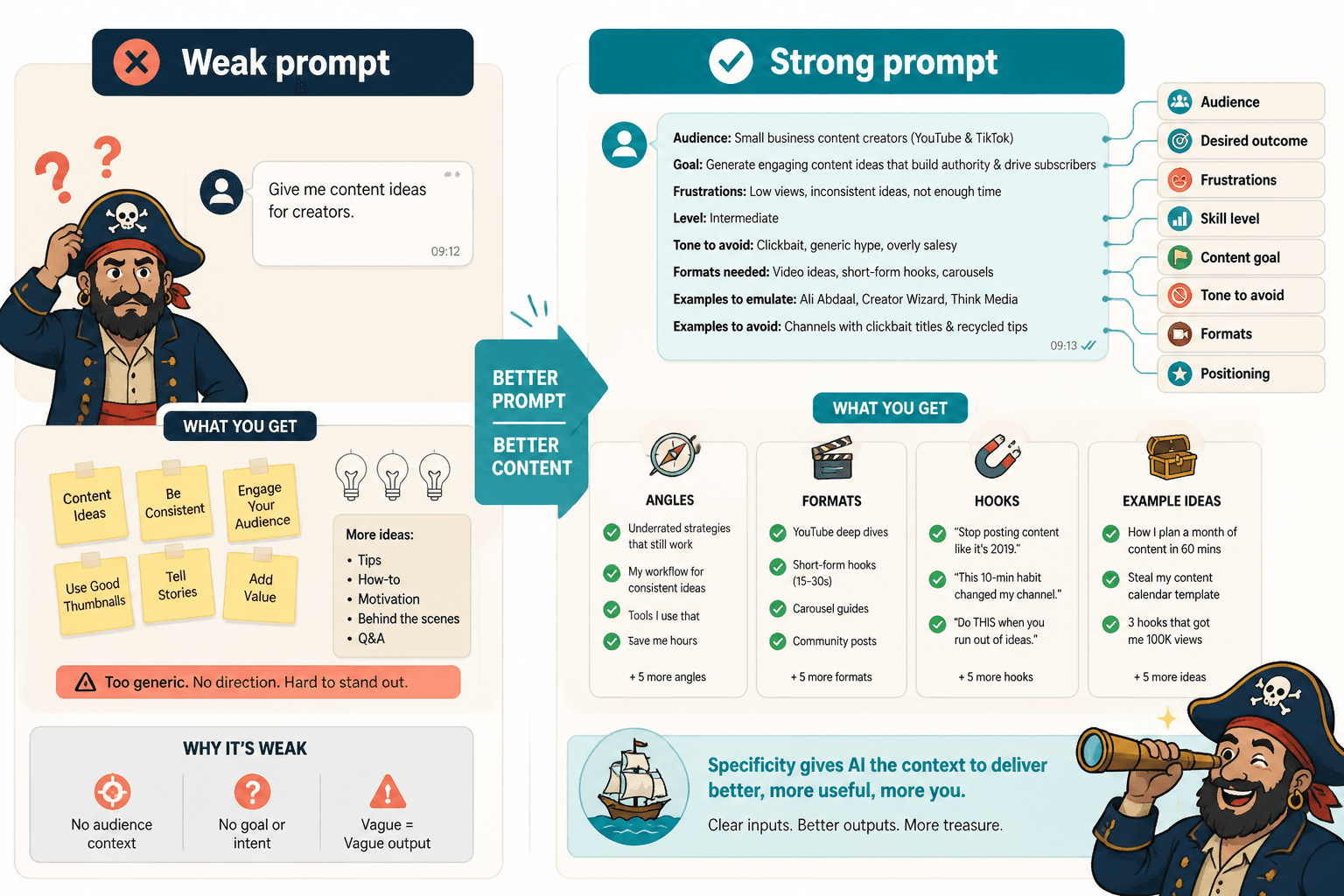
Bad prompts create generic content because they ask for generic content.
If your prompt says, “Give me 20 content ideas for creators,” you are basically requesting mediocrity in list form. Better prompts include audience, context, constraints, tone, and purpose.
A weak prompt
Give me 20 content ideas for creators using AI.
A stronger prompt
I help creators, consultants, and personal brands use AI to improve content strategy without sounding generic. Based on these audience frustrations and objections, generate 15 article ideas and 15 short-form post angles. Focus on practical, opinionated topics that help people get better results from research and ideation. Avoid beginner fluff, hype, and generic productivity tips. Include a one-line angle for each idea and group them by trust-building, lead generation, and authority content.
See the difference? The second prompt gives the tool something to work with besides vibes and a broad noun.
Useful prompt ingredients
- Who the audience is
- What they want
- What they are frustrated by
- What level they are at
- What you want the content to do
- What tone to avoid
- Which formats you need
- Any positioning or beliefs you want reflected
You can get even better results by giving AI examples of content you like and content you absolutely do not want to sound like. “Do more of this, less of that” is strangely effective, because yes, machines also need adult supervision.
For more angle and example ideas, it may help to pair this guide with best creator AI research and ideation ideas and examples for creators.
How to turn one AI-assisted research theme into multiple strong content pieces
One solid theme should not produce one lonely post. It should produce a small content cluster.
Say your research theme is this: creators are posting useful advice, but it does not convert because their positioning is fuzzy.
That one theme could become:
- A LinkedIn post on why useful content still gets ignored
- An article on fixing positioning before writing more content
- An X thread on signs your content problem is really a positioning problem
- A lead magnet on messaging fixes for creators and consultants
- A short email sequence tied to profile clarity and stronger offers
This is where AI becomes genuinely helpful. Once you find a strong idea, it can help stretch that idea across formats without making each piece identical. It can suggest alternate hooks, examples for different audience segments, and supporting subtopics you may have missed.
That said, not every idea deserves to become a content franchise. Some ideas are one sharp post. Some are a deep article. Some should remain in the drafts where they can stop bothering everyone.
A simple expansion prompt
Using this theme and audience, create one short LinkedIn post idea, one article outline, one thread structure, and one lead magnet concept. Keep each format distinct. Do not repeat the same phrasing. Make the angle practical and specific.
How to tell if an AI-generated idea is actually worth keeping
Some ideas sound smart because they are neatly phrased. That is not the same as being useful.
Run promising ideas through this quick filter.
Keep the idea if it does at least three of these well
- Names a clear problem your audience already feels
- Offers a useful distinction or sharper framing
- Connects to your expertise or proof
- Can be explained without five paragraphs of setup
- Has a practical payoff for the reader
- Leads naturally toward your service, offer, or next step
- Feels specific enough that someone might save or share it
Drop the idea if it sounds like this
- “Why consistency matters”
- “How to stay productive as a creator”
- “The future of AI for content marketing”
- “5 tips to build your brand online”
- “Why mindset matters in business”
Could those be made useful? Sure. But in their default form, they are broad, overused, and painfully underpowered. You are not running a content museum for timelessly vague advice.
Best tool categories for creator AI research and ideation
You do not need one perfect tool. You need the right tool for each stage.
| Stage | Helpful tool type | What it helps with |
|---|---|---|
| Capture | Notes app or voice capture tool | Saving raw ideas, audience language, call notes |
| Research | AI chatbot or analysis assistant | Clustering themes, summarizing inputs, spotting patterns |
| Organization | Database or content hub | Tagging ideas, building editorial pipelines |
| Drafting | Writing assistant | Outlines, expansions, rewrites, variants |
| Repurposing | Content transformation tool | Turning articles into posts, threads, emails |
| Workflow | Task or scheduling system | Planning, publishing, tracking what is done |
If you want a more specific breakdown, see best AI tools for creator AI research and ideation and best templates and tools for creator AI research and ideation.
And if you need the broader workflow context, the main hub at creator AI research and ideation is the clean place to keep going.
Mistakes creators make when using AI for research and ideation
Using AI before they know what they are trying to say
If your own thinking is still foggy, AI will usually make it sound smoother, not clearer. That can be dangerous because polished confusion still confuses people.
Generating too much and evaluating too little
Quantity feels productive. It often is not. Twenty strong ideas beat 200 weak ones and a vague sense that you “have a lot to work with.”
Confusing trend-chasing with relevance
Not every trending topic deserves your opinion. Sometimes the highest-value content is not the fastest. It is the clearest and most useful.
Failing to connect ideas to an actual business goal
If an idea cannot support trust, leads, positioning, authority, or sales somewhere in your system, ask why you are making it. Content for the sake of feeding the machine gets old quickly.
Publishing AI voice instead of human judgment
You know the sound. Smooth. Balanced. Correct. Mildly dead behind the eyes.
Use AI to get to the idea faster. Then rewrite like a person with a point of view, a business, and at least some standards.
If that is the part you struggle with, read how to write better creator AI research and ideation.
A practical weekly AI ideation routine for busy creators
You do not need to be in ideation mode every day. A simple weekly rhythm is enough.
- Day 1: Collect source material from calls, comments, notes, and recent conversations
- Day 2: Ask AI to cluster themes, objections, pain points, and possible content gaps
- Day 3: Generate angles for the top 2 to 3 themes only
- Day 4: Score and tag the best ideas, then choose what fits this week’s goals
- Day 5: Draft one article, two to three posts, and one repurposed asset from the strongest theme
That is enough to stay consistent without becoming a full-time curator of your own unfinished thoughts.
You can also build this into a broader system through the AI writing tools and workflows path, especially if your current setup is scattered across six tabs and one deeply concerning Google Doc.
FAQ
Can AI replace audience research for creators?
No. It can organize and analyze research well, but it should not replace direct audience signals like calls, comments, objections, and customer language.
How many AI-generated ideas should I keep?
Fewer than you think. Keep the ones that are specific, useful, credible, and aligned with your business goals. Delete the rest without sentiment.
What is the best format for storing ideas?
Anything searchable and taggable works. The important part is not the app. It is having tags for audience, format, goal, and status.
Should I use AI for hooks too?
Yes, but as a starting point. AI can generate variations quickly. You still need to choose the one that sounds like you and says something worth reading.
How often should creators do AI ideation?
Usually once or twice a week is enough if you are capturing source material regularly and building from real audience input.
Use AI to sharpen your thinking, not replace it
The best creator AI research and ideation guide for better results is not a list of magic prompts or a promise that one tool will save your content strategy. It is a reminder to use AI where it is strong: sorting, clustering, expanding, reframing, and speeding up messy early-stage work.
But the results still depend on you. Your judgment. Your positioning. Your ability to notice what your audience is really asking, then turn that into content with an actual point.
So do not ask AI to be the brain. Ask it to be the assistant. Bring it real inputs, better constraints, and higher standards, and it will help you produce stronger ideas with less waste. Which, frankly, is a much better use of the machine than generating your 47th post about consistency.
The bigger point is simple: clearer structure and clearer writing make the piece more useful. That is usually what makes the ending land better too.