
Most creators do not have an idea problem. They have an idea extraction problem.
You have client questions, half-finished notes, voice memos, comment threads, messy opinions, and things you keep repeating on calls. In other words, you are sitting on usable content. But when it is time to make a post, article, thread, lead magnet, or email, your brain suddenly becomes a blank wall with Wi-Fi.
That is where Creator AI Research and Ideation: Idea Mining Examples Creators Can Adapt Fast becomes useful. Not because AI is magical. It is not. But because it can help you surface patterns, sort chaos, and turn buried expertise into content ideas faster than staring at a blinking cursor and pretending that counts as strategy.
This article will show you how to use AI for idea mining without turning your content into beige robot paste. You will get practical examples, prompt angles, simple workflows, and ways to turn raw source material into content that actually sounds like you and helps the right people.
If you want the bigger picture, start with the parent guide.
What idea mining actually means
Idea mining is not “ask AI for 50 post ideas” and then suffer through a list of lifeless junk like “5 tips for success in your niche.” That is not ideation. That is autocomplete with confidence issues.
Real idea mining means pulling useful content angles out of things you already know, already say, already teach, or already notice. AI helps by spotting themes, reorganizing inputs, suggesting angles, and widening what you can do with one strong idea.
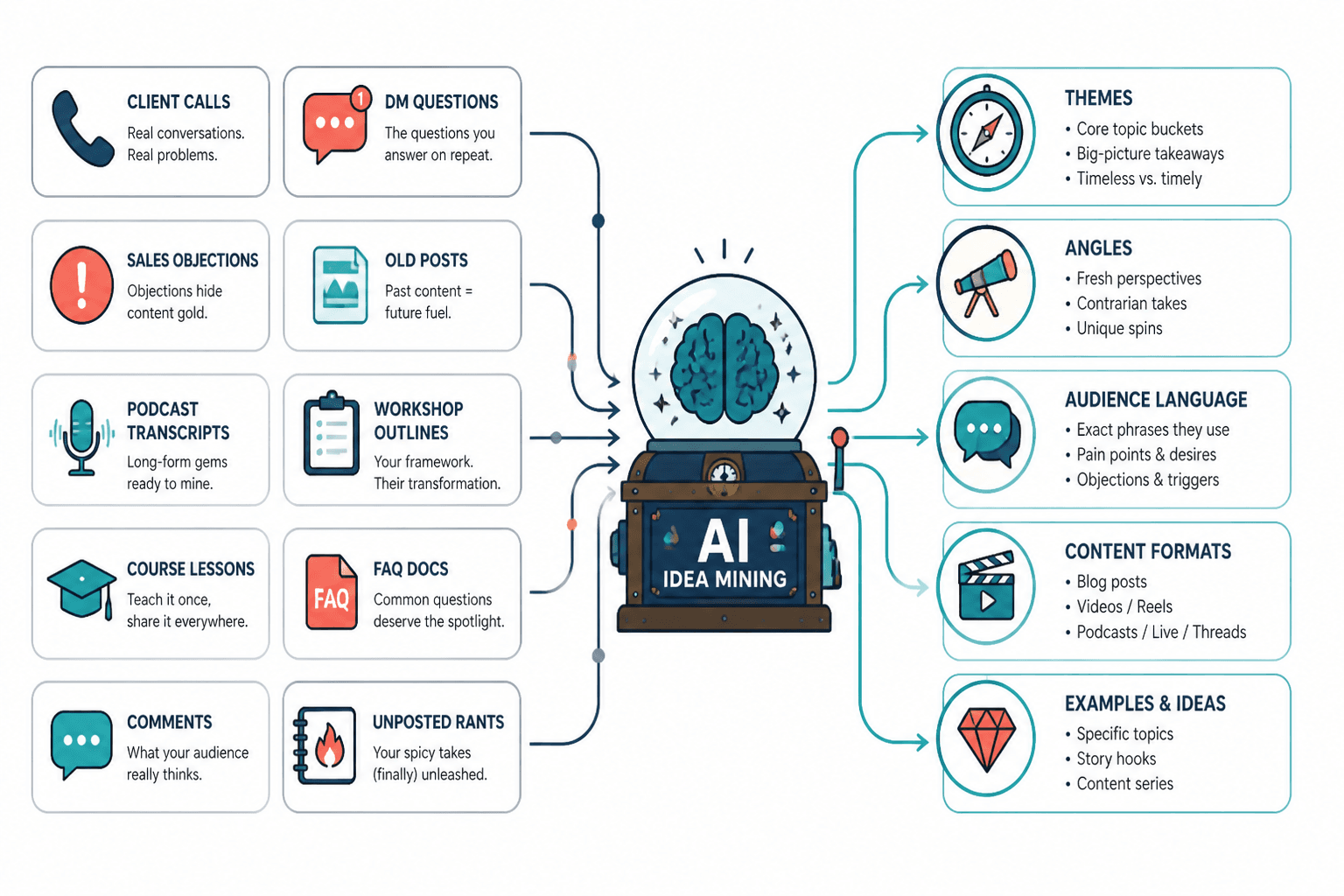
Good inputs for idea mining include:
- Client calls and coaching notes
- DM questions and email replies
- Sales call objections
- Your own old posts and articles
- Podcast transcripts
- Workshop outlines
- Course lessons
- FAQ docs
- Comments people leave on your content
- Rants you have not posted because they still need shape
If you feed AI thin inputs, it gives you thin outputs. If you feed it real material from your business, audience, and brain, it gets much more useful.
What AI is good at in the ideation process
AI is not good at replacing judgment. It is pretty good at speeding up the boring middle.
Here is where it genuinely helps:
- Pattern spotting: finding repeated themes across calls, notes, and questions
- Angle generation: showing different ways to frame the same core idea
- Audience translation: rewriting expert language into language real people use
- Format expansion: turning one idea into a post, thread, article, FAQ, email, or lead magnet
- Prompted recall: helping you remember examples, objections, mistakes, and stories attached to an idea
- Clustering: grouping similar topics so your content is not random
What it cannot do is give you taste, positioning, or original conviction. If your inputs are generic and your point of view is missing, AI will happily produce content that sounds polished and says almost nothing. Which, to be fair, does make it a natural fit for a lot of the internet.
Start with source material, not prompts
The fastest way to get better content ideas from AI is to stop asking for ideas in the abstract.
Instead of this:
Give me 20 content ideas for personal branding.
Use this kind of input:
Here are 15 questions prospects have asked me about personal branding, 8 objections from sales calls, and a rough transcript from a training I gave. Find repeated themes, rank them by buyer relevance, and suggest content angles for short posts, deeper articles, and email topics.
That is a completely different game. You are no longer asking AI to invent expertise. You are asking it to organize and expand expertise you already have.
If you want a broader foundation first, the creator AI research and ideation guide for creators who want better results is a good companion to this approach.
A simple idea mining workflow creators can actually use
You do not need a 14-step content operating system with color-coded dashboards and a Notion shrine. You need a repeatable workflow that is simple enough to keep using.
Step 1: Gather raw inputs
Pull together a small batch of useful source material. This could be:
- 10 recent client questions
- 5 sales objections
- 3 old posts that performed well
- Notes from a workshop or coaching session
- A transcript from a Loom or podcast
Step 2: Ask AI to cluster the inputs
Prompt example:
Review these notes and group them into 5 to 7 recurring themes. For each theme, explain the underlying audience problem, the likely reason it matters, and what kind of content would best address it.
Step 3: Pull out tension points
Good content usually comes from tension, not topic labels. “Email marketing” is a topic. “People say they want a newsletter, but they are really avoiding making sharper offers” is tension.
Prompt example:
For each theme, identify the tension, false assumption, common mistake, or overlooked angle that would make the content sharper and more useful.
Step 4: Turn each theme into multiple formats
Once you have a strong angle, get range from it.
Prompt example:
Take this theme and generate 3 LinkedIn post angles, 2 article outlines, 2 email subject ideas, 1 short thread, and 1 lead magnet concept. Keep the ideas practical and specific to coaches and consultants.
Step 5: Rewrite everything in your voice
Do not publish the raw output. That is how you end up sounding like a management consultant possessed by autocomplete.
Use AI to draft or expand, then edit for:
- Your actual tone
- Specific examples
- Stronger opinions
- Clear audience fit
- Real proof or observations
- Less fluff and fewer fake transitions
5 idea mining examples creators can adapt fast
Here is the part people actually want: practical examples that do not require a full content team, three automations, and a ceremonial template folder.
1. Mine client questions into content themes
If you work with clients, your inbox and calls are already handing you content topics.
Raw input:
- How often should I post on LinkedIn?
- Why are my posts getting likes but no leads?
- Should I write educational posts or personal stories?
- What do I even say in my bio?
- Do I need a lead magnet before I start posting?
What AI can pull from this:
- Content consistency anxiety
- Reach versus conversion confusion
- Authority versus relatability tension
- Profile positioning problems
- Funnel timing uncertainty
Content ideas that come out of that cluster:
- Why posting more often will not fix weak positioning
- The real reason your LinkedIn posts get attention but no business
- Educational posts versus personal stories: when each one actually works
- A creator bio is not a résumé in disguise
- You do not need a full funnel before you start building trust
That is already better than “10 content tips for creators.” It came from live audience friction, so it has a much better chance of feeling relevant.
2. Mine sales call objections into high-conversion angles
Sales objections are content gold because they show where trust breaks down.
Raw objections:
- I am not sure content will bring qualified leads
- I do not have time to post consistently
- I have tried content before and nothing happened
- I do not want to sound cringe or salesy
Ask AI to translate those into belief barriers, then content.
Prompt example:
Analyze these objections and identify the belief barrier behind each one. Then suggest content ideas that would reduce that barrier before a sales call.
Possible outputs:
- Why “content does not work” usually means the offer-path is broken
- A low-time content system for busy consultants
- What to fix before deciding your content strategy failed
- How to market your expertise without sounding like you swallowed a funnel bro
This is especially useful if your goal is not just reach, but leads and sales. If that is your lane, you will probably also want to explore the broader creator AI research and ideation hub for related workflows.
3. Mine old content for stronger second-generation ideas
Most creators underuse their own archive. You posted something once, it did decently, and then you moved on like it expired. Weird habit.
Take 10 old posts, emails, or articles and ask AI to identify:
- Repeated themes
- Unfinished ideas
- Posts that could go deeper
- Arguments that deserve examples
- Topics that could become a series
Prompt example:
Review these past posts and identify ideas that could be expanded, reframed for a different audience awareness level, or turned into a deeper article or lead magnet.
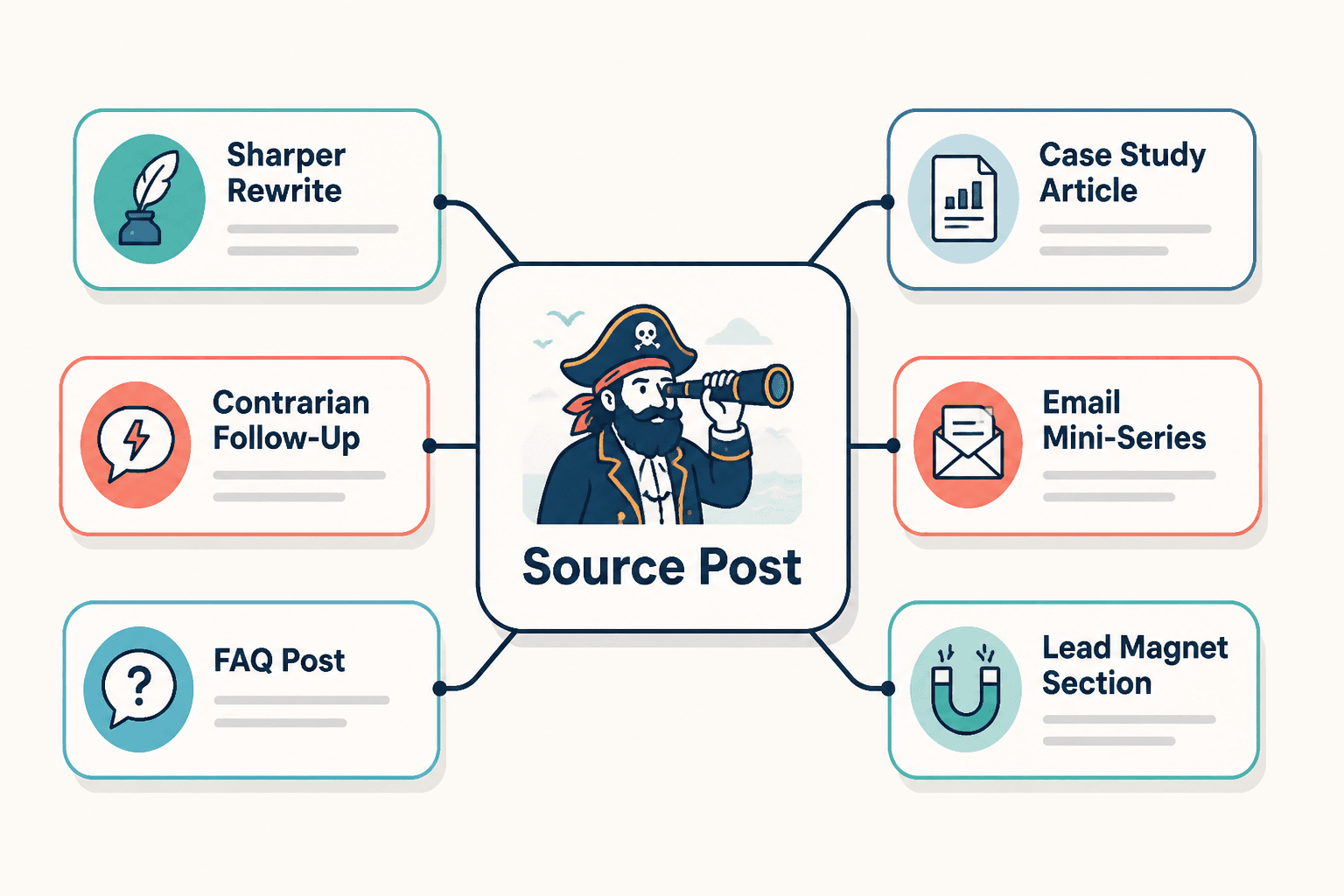
This helps you move from random posting to layered messaging. One post becomes:
- A sharper rewrite
- A contrarian follow-up
- A FAQ post
- A case-study style article
- An email mini-series
- A lead magnet section
That is how creators build depth instead of endlessly inventing disconnected content scraps.
4. Mine comments and DMs for language that sounds human
One of the best uses of AI is feeding it audience language and asking it to surface recurring phrases, concerns, and emotional cues.
This matters because creators often write at the wrong altitude. Too polished. Too abstract. Too “brand strategy for high-performing founders navigating growth.” Sir, no one talks like that at 8:17 p.m. while avoiding their draft folder.
Feed AI comments, DMs, survey answers, or onboarding forms and ask:
- What phrases keep repeating?
- What problem language sounds emotional versus technical?
- What desired outcomes are people really asking for?
- What frustrations should appear in hooks and headlines?
Example:
If your audience says:
- I know what I do, I just cannot explain it clearly
- My content sounds smart but it does not connect
- I keep rewriting my bio and somehow it gets worse
You now have far better hook material than generic “branding tips.” You can build content around clarity, disconnect, and overcomplication because those are the lived pain points.
5. Mine a transcript into a month of usable content
If you are a coach, consultant, teacher, or expert who talks better than you write, transcripts are ridiculously useful.
Take a workshop transcript, podcast episode, client training, or Loom and ask AI to extract:
- Main themes
- Strong quotes
- Objections addressed
- Story moments
- Frameworks mentioned
- Post, thread, and article ideas
Prompt example:
Analyze this transcript and extract the most useful content ideas. Separate them into quick tips, opinion posts, myth-busting posts, deeper article topics, and audience FAQs. Keep the wording natural and specific.
This works well because spoken content often contains stronger rhythm, simpler language, and clearer conviction than written drafts. People usually sound more human before they start trying to sound professional.
How to improve weak AI-generated ideas fast
Sometimes AI gives you the right topic in the most boring possible wrapper. Fine. Fix the wrapper.
| Weak idea | Better version |
|---|---|
| How to improve your personal brand | Your personal brand is probably too broad to be useful |
| Tips for better content marketing | Useful content is not enough if the path to action is foggy |
| Why consistency matters on social media | Posting consistently will not save unclear positioning |
| How to write a compelling bio | If your bio tries to impress everyone, it will help no one |
The pattern is simple. Add tension. Add specificity. Add an opinion. Add a consequence. Most weak ideas are not wrong. They are just too flat to earn attention.
Prompts that are actually useful for creator ideation
You do not need 93 prompts. You need a few good ones that match the stage you are in.
The bigger point is simple: clearer structure and clearer writing make the piece more useful. That is usually what makes the ending land better too.