
Most creator AI research and ideation goes wrong before the “research” part even starts.
The problem is not usually the tool. It is the opening. People sit down with ChatGPT or whatever stack they use, type something limp like “give me content ideas for my brand,” and then act surprised when the machine hands back beige oatmeal with bullet points.
A weak opening gives you weak research, weak angles, weak hooks, and eventually weak content. You do not get sharper ideas by asking softer questions. You get generic answers wrapped in fake confidence.
If you want to know how to start creator AI research and ideation without a weak opening, the fix is pretty simple: start with tension, context, and a real objective. Not vague topic fishing. Not “what should I post today?” panic. Actual direction.
This article will show you how to open your AI research and ideation process in a way that gives you better raw material, stronger angles, and content ideas you might actually want to publish. We’ll cover what weak openings look like, what to use instead, and a few practical prompt structures that do not sound like they were assembled by a bored intern in a prompt marketplace.
Want the broader roadmap? Start with the parent guide.
Why most AI ideation starts badly
Creators often treat AI like a slot machine.
Insert broad topic. Pull lever. Hope for brilliance.
That is not research. That is outsourcing your thinking before you have even decided what needs thinking about.
A bad opening usually has one or more of these problems:
- It is too broad
- It has no audience context
- It asks for ideas before defining the goal
- It gives the AI no tension, no constraints, and no quality bar
- It uses stale prompt language like “generate 20 engaging posts”
So instead of getting useful ideation, you get the usual sludge:
- “5 tips to improve your mindset”
- “Why consistency matters”
- “How to build your personal brand”
- “Mistakes to avoid as an entrepreneur”
None of that is technically wrong. It is just painfully non-specific. It does not sound like you. It does not reflect your audience’s real friction. And it definitely is not strong enough to help you stand out in a feed full of people saying the same thing with different headshots.
What a strong opening actually does
A strong opening for creator AI research and ideation tells the tool three things early:
- Who the thinking is for
- What problem or tension you want to explore
- What kind of output would actually be useful
That sounds obvious, but most people skip at least two of those.
When you start well, AI becomes a research assistant and angle expander. When you start badly, it becomes a generic-content vending machine. Big difference.
Good openings also make your workflow faster. You spend less time swatting away bad ideas and more time developing ones with actual teeth. That matters because creator workflows break down when every session starts with cleanup. If the first output is already muddy, the rest of the process usually follows.
For a broader look at this workflow category, it helps to keep your process connected to the main AI writing tools and workflows hub and the related creator AI research and ideation page, where this piece sits in the larger system.
How to start creator AI research and ideation without a weak opening
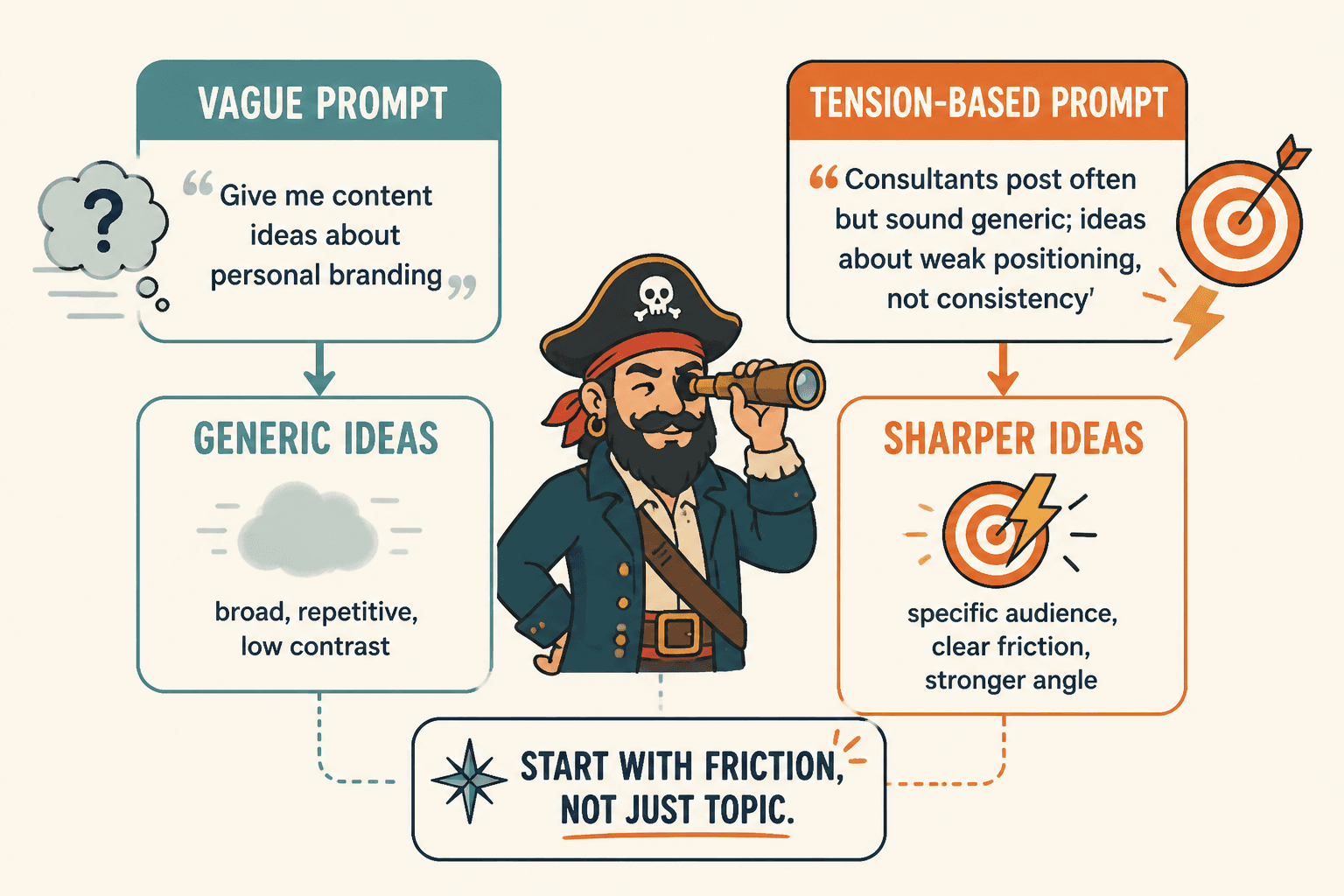
Here is the practical version: do not open with a topic. Open with a friction point.
Topics are flat. Friction has shape.
Compare these:
- Weak: Give me content ideas about personal branding
- Better: I help consultants who post regularly but sound generic. Give me 10 content angles about why their problem is not consistency, but weak positioning and low-contrast ideas.
The second one gives the AI something to work with. It defines the audience, the common mistake, and the angle. Now the tool can help you build around a real problem instead of spraying generic advice in all directions.
If you want stronger output from the first prompt, use this starting structure:
- Who I help
- What they are trying to do
- What keeps going wrong
- What I believe is actually causing it
- What kind of ideas I want from the AI
That is enough to turn random prompting into directed ideation.
A simple opening formula that works
Use this:
I help [specific audience] who want to [specific outcome], but they keep struggling with [specific friction]. I believe the real issue is [your angle or diagnosis]. Help me research strong content angles, objections, examples, and contrarian points I can use to create sharper content.
Example:
I help solo consultants who want to get leads from LinkedIn, but their posts are useful and still ignored. I believe the real issue is not effort. It is weak framing, vague positioning, and soft openings. Help me research content angles, audience objections, hidden frustrations, and useful examples I can turn into posts and articles.
That is already miles better than “give me 20 LinkedIn post ideas.”
Start with diagnosis, not idea generation
One of the easiest ways to avoid a weak opening is to stop asking for ideas too early.
First ask the AI to help diagnose the market, the audience, or the content gap. Then ask for ideas. This keeps the ideation anchored in something real.
Here is the sequence:
- Define the audience
- Name the result they want
- Identify the common mistake or blockage
- Explore objections, frustrations, myths, and failed attempts
- Only then generate content angles
This matters because good content usually starts with insight, not volume. If you skip the diagnosis step, the AI tends to hand you polished versions of the most obvious ideas in your niche. Which is impressive for about seven seconds.
Example: weak start vs strong start
Weak start:
Give me 15 content ideas for creators about AI.
Stronger start:
I create content for creators and solo business owners using AI to speed up research and ideation. Many of them get generic results because they prompt too broadly and start without a clear angle. Help me map the most common ways weak openings ruin their workflow, what misconceptions cause this, and what sharper starting approaches lead to better outputs. Then turn that into 15 content angles with strong editorial tension.
Same general topic. Completely different quality ceiling.
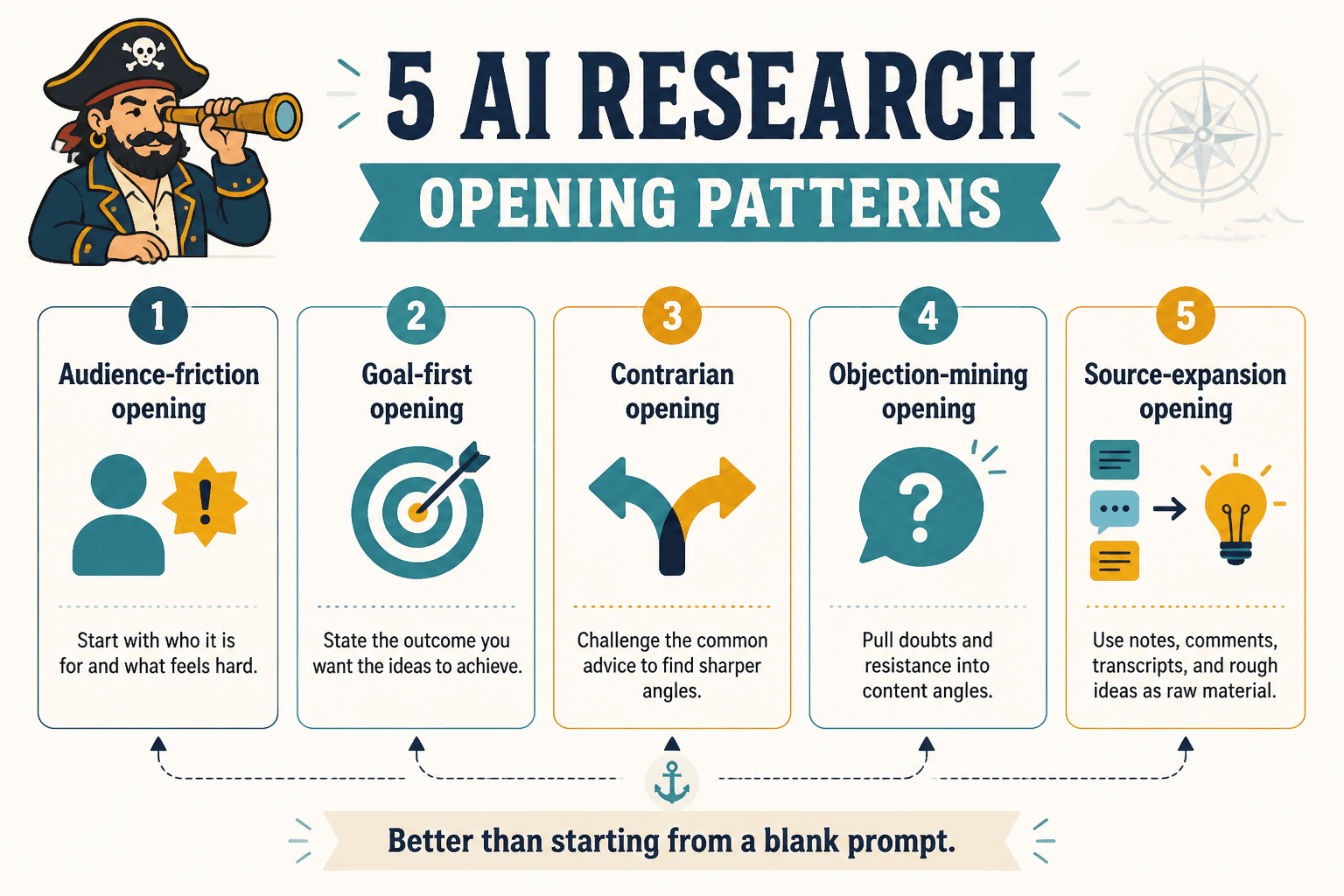
The 5 best ways to open an AI research session
You do not need one magical master prompt. You need a few strong opening patterns you can use on purpose.
1. The audience-friction opening
Use this when you know who you help and what keeps tripping them up.
I help [audience] who want [outcome], but they keep running into [friction]. Help me explore why this happens, what they misunderstand, and what strong content angles could challenge or clarify it.
2. The myth-busting opening
Use this when your best content comes from correcting bad assumptions.
In my niche, people often believe [common belief]. I think that is incomplete or wrong because [reason]. Help me research the strongest arguments, examples, edge cases, and content angles to challenge that belief usefully.
3. The gap-analysis opening
Use this when you want to create content that says something different from the usual recycled advice.
My audience keeps seeing content about [popular topic], but most of it focuses on [surface-level angle]. I want to create more thoughtful content about [deeper angle]. Help me identify what is missing from the usual conversation and generate stronger content directions.
4. The objection-mining opening
Use this when you sell something or want your content to lead naturally into offers.
My audience wants [outcome], but they hesitate because of concerns like [objection 1], [objection 2], and [objection 3]. Help me unpack the emotional and practical reasons behind these objections and turn them into useful content angles.
5. The source-expansion opening
Use this when you already have raw material and want better angles from it.
Here are notes, client questions, comments, transcripts, or rough ideas from my recent work. Analyze them for repeated problems, sharp phrases, hidden themes, and content opportunities. Then suggest stronger angles and opening lines.
This last one is especially useful because AI is usually better at transforming decent source material than inventing brilliance from a blank prompt. A lot of people learn that the expensive way.
What to include in your opening if you want better outputs
If your AI ideation prompts feel flimsy, they probably are missing one of these ingredients.
| Element | Why it matters | Example |
|---|---|---|
| Audience | Keeps the output relevant | Coaches with small audiences trying to get inbound leads |
| Goal | Shapes the kind of ideas you need | Generate article angles that build trust and email signups |
| Friction | Adds tension and specificity | They post useful content but still sound interchangeable |
| Point of view | Makes the output less generic | I believe the issue is weak differentiation, not low volume |
| Output type | Helps the AI structure the result properly | Give me content angles, examples, and three hook options for each |
| Constraints | Raises quality and fit | No hype, no generic productivity advice, no fake urgency |
Adding constraints is underrated. If you do not tell the tool what to avoid, it will happily hand you the exact style you are trying not to publish.
This is also where your voice starts getting protected. You can say things like:
- Avoid generic motivational phrasing
- Do not sound salesy or robotic
- Prioritize practical, opinionated angles
- Give me ideas with clear tension, not bland listicles
If that part matters to you, this related piece on how to write creator AI research and ideation without sounding salesy or robotic is worth reading next.
3 weak openings and how to fix them
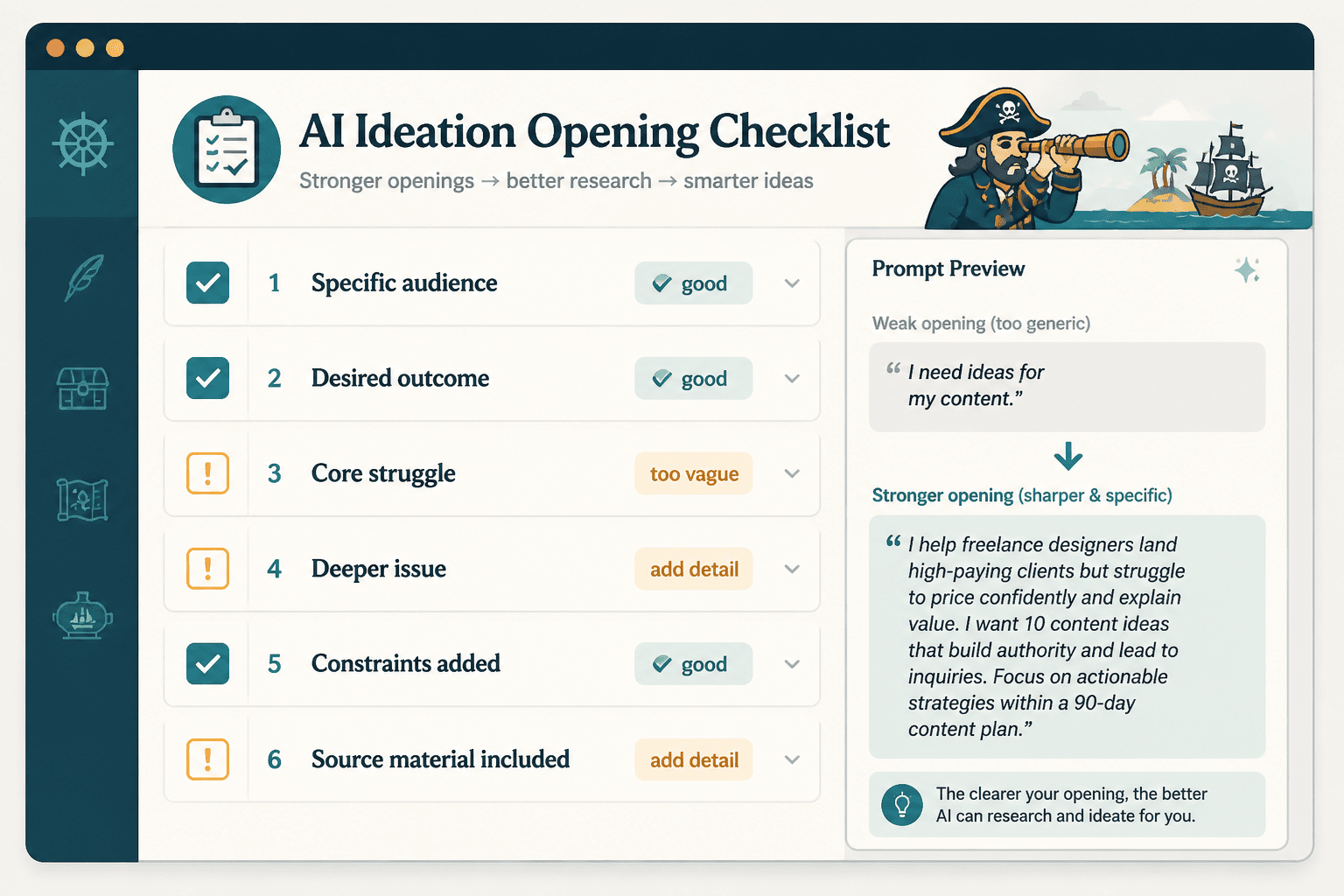
Weak opening 1: “Give me content ideas for my niche”
This is the classic lazy opener. It tells the AI nothing useful.
Better rewrite:
I help freelance designers who want better clients, but their content attracts peers instead of buyers. Help me come up with content angles that shift their messaging from craft talk to buyer-relevant problems, objections, and outcomes.
Weak opening 2: “What should I post this week?”
This is not a strategy prompt. It is content panic in sentence form.
Better rewrite:
I want to publish five posts this week for consultants who need more authority online. My goals are trust, profile clicks, and newsletter signups. Help me choose five distinct angles based on recurring audience frustrations, not generic content themes.
Weak opening 3: “Research my topic”
Research what about it? For whom? To do what? This is how you get broad summaries no one asked for.
Better rewrite:
Research the content gap around AI ideation for creators. Focus on where existing advice stays too generic, what frustrations creators actually have when using AI for ideation, and which undercovered angles would make stronger educational content.
If your drafts still come out flat after this, the problem may be in the wording and structure of your prompts later in the workflow. In that case, read how to improve creator AI research and ideation outline prompts without sounding generic.
A practical workflow for stronger AI research and ideation
If you want something repeatable, use this five-step process at the start of each ideation session.
- Name the content goal
Are you trying to get post ideas, article angles, lead magnet topics, thread structures, or objections to address? - Define the audience clearly
Not “entrepreneurs.” More like “solo consultants with expertise but weak online positioning.” - Choose one friction point
Pick the struggle, misconception, or bottleneck that matters most. - Add your diagnosis
What do you think is really going on beneath the obvious problem? - Ask for structured output
Request angles, hooks, examples, counterpoints, or content outlines instead of “ideas” alone.
Notice what this does: it forces you to think before the AI starts talking. Good. It should. AI can speed up work, but it should not replace judgment. Tools are useful for expanding, sorting, and stress-testing ideas. They are not great at inventing a sharp point of view if you have not brought one to the table.
That is why this topic belongs inside a bigger workflow, not as some isolated prompt trick. If you need the broader category path, keep working through the creator AI research and ideation cluster and the related how to write better creator AI research and ideation guide.
What AI can help with here, and what it cannot
AI is useful for:
- Expanding raw ideas
- Surfacing related objections and subtopics
- Finding angle variations
- Turning rough thoughts into structured directions
- Stress-testing ideas against audience concerns
- Helping you spot patterns in notes, comments, and transcripts
AI is not useful for:
- Replacing your actual point of view
- Knowing your audience better than you do
- Turning a boring topic into a strong one by magic
- Fixing muddy positioning
- Creating trust from generic output
This is where a lot of creators get disappointed. They expect the tool to produce original strategy from vague input. Then they blame AI when the result sounds like a corporate content blender. Fair enough, but also: your prompt opened with absolutely nothing.
When the raw output is boring, do not just generate another batch and pray harder. Rewrite the setup. Change the friction. Sharpen the diagnosis. Add constraints. Feed it better material. If needed, use a rewrite process like the one in how to rewrite boring creator AI research and ideation.
A better starter prompt you can adapt
If you want one reliable base prompt, use this and customize it.
The bigger point is simple: clearer structure and clearer writing make the piece more useful. That is usually what makes the ending land better too.