Most creator AI research and ideation gets bloated for one simple reason: people confuse more input with better thinking.
So they spend 45 minutes prompting, collecting angles, generating outlines, asking for hooks, asking for counterpoints, asking for trend summaries, asking for audience pain points, and basically building a small administrative state around one piece of content.
Then the draft still comes out bland.
If you’re wondering How Long Should Creator AI Research and Ideation Be in 2026?, the useful answer is not one magic number. It depends on what you’re making, how clear your positioning is, how strong your original idea is, and whether AI is helping you think or just helping you procrastinate in a very organized way.
Here’s the practical version: most creator AI research and ideation should be shorter than people think, tighter than people run it, and more structured than the average “brainstorm with the bot” session. You do not need an endless prompt spiral. You need enough material to find a sharp angle, test relevance, and move into writing before the idea goes stale.
If you want the broader workflow context, this fits inside a bigger creator AI research and ideation process, not as a standalone ritual you perform every time you open a tab and feel vaguely productive.
For the full path around this topic, head to the parent guide.
Short answer: aim for 10 to 30 minutes most of the time
For most creators, coaches, consultants, writers, and personal brands, AI research and ideation for a single content asset should usually land somewhere between 10 and 30 minutes.
That range is enough to:
- clarify the real topic
- find the angle
- pressure-test the audience fit
- surface examples, objections, and structure
- avoid writing the same tired post you wrote three weeks ago with different wallpaper
It is usually not enough time to:
- fully research a technical report
- build a genuinely original thought leadership piece from scratch
- develop a multi-asset campaign strategy
- compensate for not knowing your audience at all
That matters because creators often ask the wrong question. They ask how long the AI session should be, when the better question is this: what does this piece need before writing starts?
A quick post may only need one useful tension, one relevant example, and one decent hook direction. A deep article may need a stronger claim, a structure, examples, objections, and a clearer CTA path. Same tool category. Very different job.
What actually determines the right research and ideation length
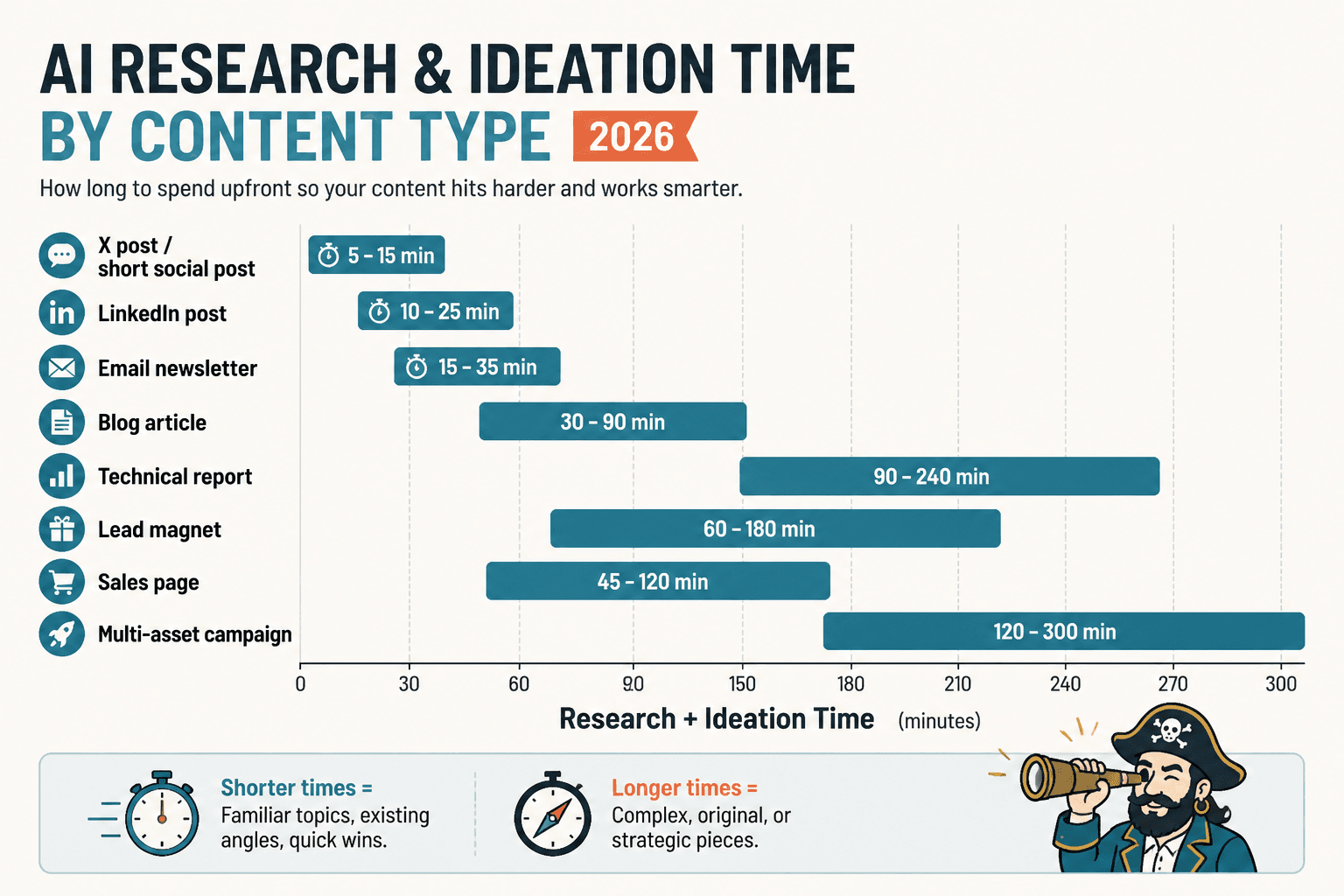
The right answer in 2026 depends less on trends and more on friction. Specifically: where is the friction in your process? If you know your audience well and struggle more with packaging, your ideation can stay short. If your ideas are good but shapeless, you may need longer. If you keep asking AI to rescue a vague point, no time block will save that.
1. Content format
A short LinkedIn post, X post, email, article, lead magnet, and sales page do not need the same amount of ideation. Obvious, yes. Still routinely ignored.
| Content type | Suggested AI research + ideation time | What you need before drafting |
|---|---|---|
| Short social post | 10 to 15 minutes | Angle, hook options, one proof point, CTA direction |
| Thread or carousel | 15 to 25 minutes | Main argument, sequence, examples, payoff |
| Newsletter or email | 15 to 30 minutes | Core point, audience relevance, structure, CTA |
| SEO-aware article | 25 to 45 minutes | Search intent, sections, examples, gaps, internal link ideas |
| Lead magnet or webinar outline | 30 to 60 minutes | Promise, flow, objections, proof, conversion path |
2. Idea clarity
If you already know what you want to say, AI ideation should be short. You’re using it to sharpen, not to invent your brain for you.
If you only know that you “want to post about authenticity” or “should write something about lead generation,” then yes, the process will take longer. Mostly because the starting point is mush.
3. Depth of expertise
Experienced creators can move faster because they already carry a mental library of examples, objections, stories, and pattern recognition. AI just helps sort the shelves.
Less experienced creators often need more time because they are not just ideating. They are also figuring out what matters, what is cliché, what is true, and what might accidentally make them sound like a recycled webinar caption.
4. Stakes
The higher the stakes, the more care you should take. A quick opinion post can survive a rougher ideation pass. A homepage message, signature framework article, launch piece, or authority asset needs more deliberate thinking.
5. Originality requirement
If the goal is basic useful content, AI can help you get there quickly. If the goal is a distinct perspective that actually sounds like you and builds authority, you need a little more room.
Not endless room. Just enough time to push past the first batch of obvious ideas. The first output is often competent. Competent is not the same as memorable.
How Long Should Creator AI Research and Ideation Be in 2026 for different creator goals?
The goal behind the content changes the ideal length more than people expect. Reach content, trust content, authority content, and sales-support content are not built the same way.
For quick reach content: 10 to 15 minutes
If the content is designed to get attention fast, test an idea, or stay top of mind, keep ideation tight.
You usually need:
- one clear point
- 2 to 5 hook variations
- one strong contrast or opinion
- one simple CTA or conversation prompt
Go much longer and you start overengineering a post that should have stayed sharp.
For trust-building content: 15 to 25 minutes
This is where many creators should spend most of their time. Trust content needs more than a hot take. It needs usefulness, proof, examples, and enough specificity that people believe you know what you’re talking about.
That usually means using AI to help you:
- identify the real reader problem
- pull out misconceptions
- organize examples
- find a stronger structure
- tighten the takeaway
For authority content: 25 to 45 minutes
Articles, deep newsletters, signature LinkedIn posts, case-study-style pieces, and strategic threads often need a longer ideation window because the structure matters more. The argument has to hold up. The examples need to be relevant. The framing has to feel intentional.
This is where AI can be genuinely useful, not because it has brilliant opinions, but because it can help you pressure-test your own. It can surface missing sections, likely reader objections, weak transitions, overused framing, and alternate structures. That saves time. It does not replace judgment.
For conversion-focused content: 20 to 40 minutes
If the piece leads toward a lead magnet, consultation, offer page, or newsletter signup, ideation needs enough time to connect the content to the next step naturally.
Many creators rush this, then bolt on a CTA that sounds like it wandered in from a funnel template wearing a fake smile. Not ideal.
You need enough ideation time to answer:
- what problem is this piece solving right now?
- what next step actually fits that problem?
- what resistance will the reader have?
- how can the CTA feel earned instead of stapled on?
Signs your AI ideation is too short
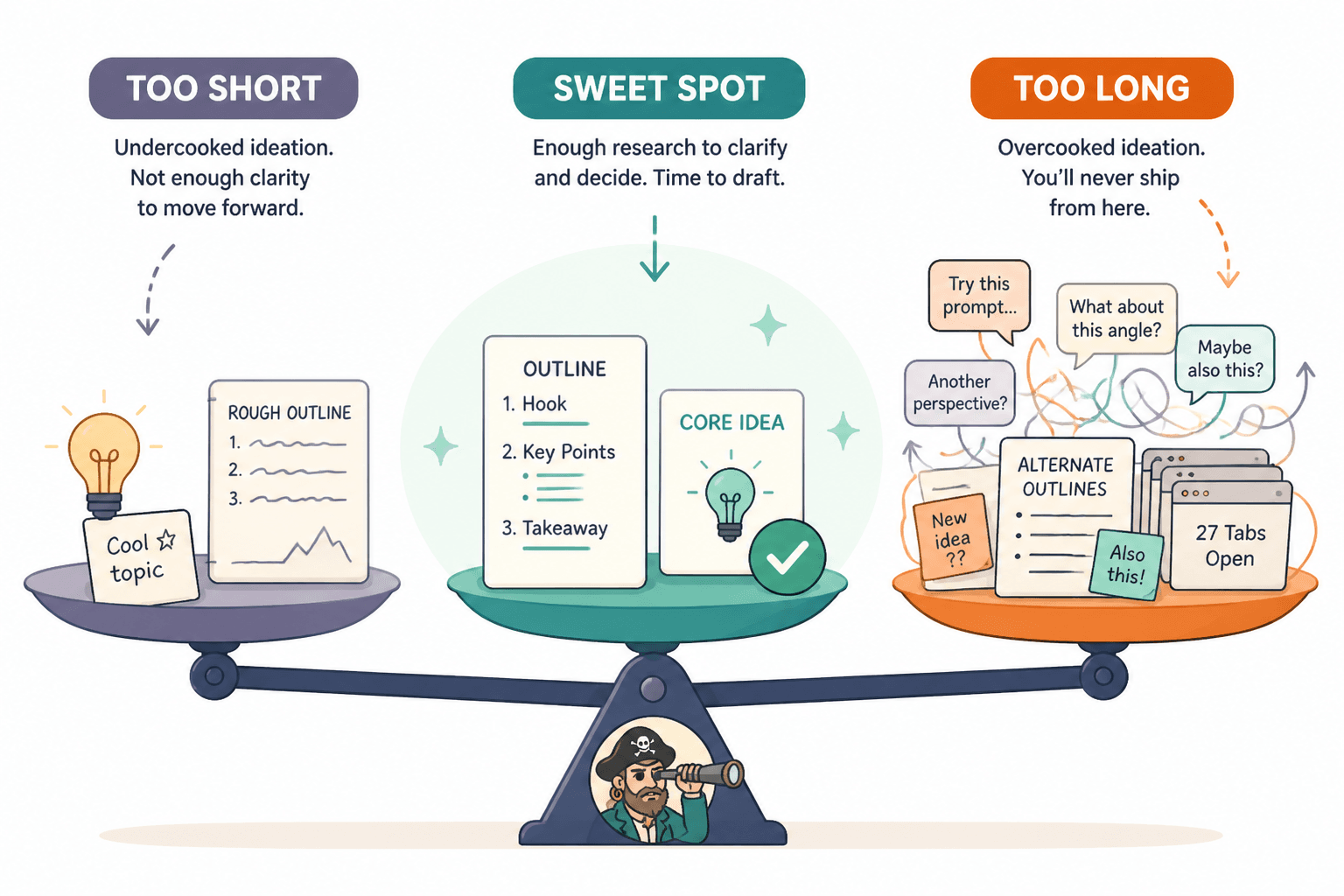
Short is good until it becomes lazy. If your process is too brief, the writing usually gives itself away fast.
- You keep producing generic angles you have seen 400 times.
- Your hooks are broad and forgettable.
- Your draft says the right category of things but makes no real point.
- You have no examples, proof, or useful tension.
- Your CTA feels random because the piece never fully found its purpose.
- You rely on filler phrases because the idea is undercooked.
If that sounds familiar, the answer is not always “write better.” Often it is “spend another 8 minutes making the idea less vague.”
Signs your AI ideation is too long
This one is even more common now. AI makes it absurdly easy to stay in prep mode forever while telling yourself you are being strategic.
- You generate 25 angles and use none of them.
- You ask for more examples when you already have enough to draft.
- You keep refining prompts instead of refining the idea.
- You collect so much material that the final piece loses shape.
- You feel more confused after the session than before it.
- You treat ideation like a substitute for making a decision.
At that point, AI is not helping you think. It is helping you avoid committing to a point of view.
And to be fair, avoiding commitment does feel productive for a while. Right up until you still have no publishable draft.
For a deeper look at when shorter sessions actually work better, see when short creator AI research and ideation beat long ones.
A simple time framework that works in 2026
If you want a clean default, use this 3-part structure. It keeps the session moving and stops AI from turning your content process into a maze.
Phase 1: Clarify the point — 3 to 7 minutes
Figure out:
- who this is for
- what problem it addresses
- what specific angle you want to make
- what kind of content asset you are building
If this phase is muddy, the rest will be too.
Phase 2: Expand and test — 5 to 15 minutes
Use AI to generate and pressure-test:
- angles
- counterarguments
- examples
- hook options
- structures
- common mistakes
- useful contrasts
The goal here is not endless options. It is enough material to find the strongest route.
Phase 3: Lock the direction — 2 to 8 minutes
Before drafting, finalize:
- main claim
- best opening direction
- key supporting points
- one or two examples
- CTA or next step
Then stop ideating and write.
This matters more than it sounds. A lot of weak content is not caused by bad prompts. It is caused by not knowing when the thinking phase is complete enough to move on.
When you should go longer than 30 minutes
There are good reasons to spend more time on AI research and ideation. Just not every Tuesday because the prompt window is there and whispering sweet distractions.
Go longer when:
- you are writing a flagship article or pillar piece
- the topic is nuanced, technical, or easy to oversimplify
- you need original framing, not just competent packaging
- you are connecting the content to a bigger funnel or product path
- you are creating a repeatable series, framework, or signature angle
- you need to synthesize multiple viewpoints into one clean argument
Even then, longer should still mean focused. Not random wandering with 14 side quests and 9 “just one more” prompt branches.
When you should keep it under 15 minutes
Shorter sessions are often better when the content is timely, reactive, simple, or built around a point you already understand well.
- daily social posts
- comment-to-post ideas
- quick thought leadership takes
- repurposed ideas from a larger article
- content built from a client call, note, or obvious lesson
If you already have the point, don’t force a ceremonial ideation process around it. That is how useful creators end up sounding weirdly distant from their own expertise.
You may also want to read how to write better creator AI research and ideation if the issue is not time, but quality.
What AI research and ideation should produce before you start writing
Instead of measuring only by time, measure by output. A solid session should leave you with a small set of usable building blocks.
- a clear audience and problem
- one primary angle
- 3 to 5 possible hooks or opening directions
- a rough structure or sequence
- one or two examples, proofs, or objections
- a defined purpose for the piece
- a next step or CTA that actually fits
If you have those, you are usually ready. If you do not, adding another 20 minutes may help. Or it may just produce more polished clutter. Be honest about which one is happening.
And if the output sounds stiff, generic, or weirdly overprofessional, the fix is not always more time. Often it is better direction. This is where writing creator AI research and ideation without sounding salesy or robotic becomes useful, because plenty of creators are not under-researching. They are just over-automating the wrong parts.
A practical weekly approach for creators
If you publish regularly, doing this piece by piece can get messy. A better move is separating broad research from content-specific ideation.
For example:
- Once per week: 30 to 60 minutes of broader audience, market, objection, and topic research
- Per content piece: 10 to 25 minutes of focused ideation based on that research
That keeps you from re-researching the same topic every single time you want to publish. It also makes your content sharper because each piece starts from a stronger pool of insight, not from zero.
If your openings are where everything starts wobbling, read how to start creator AI research and ideation without a weak opening. Bad starts waste more time than most creators realize because they send the whole ideation session in the wrong direction.
The bigger point is simple: clearer structure and clearer writing make the piece more useful. That is usually what makes the ending land better too.