A profile draft is open in one tab, a social bio is half-finished in another, and the sentence that was supposed to sound sharp now reads like it wandered in from a corporate deck and lost its keys. That is exactly where creator bio examples earn their keep. They do not exist to make the page prettier. They exist to help you say who you are, who you help, and why anyone should care without turning your bio into a tiny autobiography with a punctuation problem.
If you are building out your profile copy, the goal is not to sound grand. It is to sound useful. A good bio does one job fast: it gives the right visitor enough clarity to keep reading, follow, click, or buy. That is the difference between profile copy that sits there and profile copy that pulls weight.
For the broader framework behind this topic, see the creator bios profile copy guide. This page focuses on examples, formulas, and ready-to-adapt structure.
What a creator bio actually needs to do
A creator bio is not there to impress other bios. It is there to help a real person decide whether you are relevant. That means it needs a few essentials:
- Clarity: what you do, in plain language.
- Audience: who it is for.
- Value: what outcome, perspective, or service you provide.
- Proof: why the claim is believable.
- Action: what to do next, when a next step makes sense.
That sounds simple because it is. The hard part is resisting the urge to fill the space with vague status words. “Creative strategist,” “multi-disciplinary storyteller,” and “digital native” are not crimes, but they are also not especially helpful if the reader still has no idea what changes after they follow you.
According to Google’s guidance on writing helpful content, content works better when it is made for people first and not assembled as a keyword-shaped object. Creator bios are not immune to that problem. A bio that reads like it was drafted for a search box instead of a human can be technically fine and still useless.
The 4-part bio structure that works on most platforms
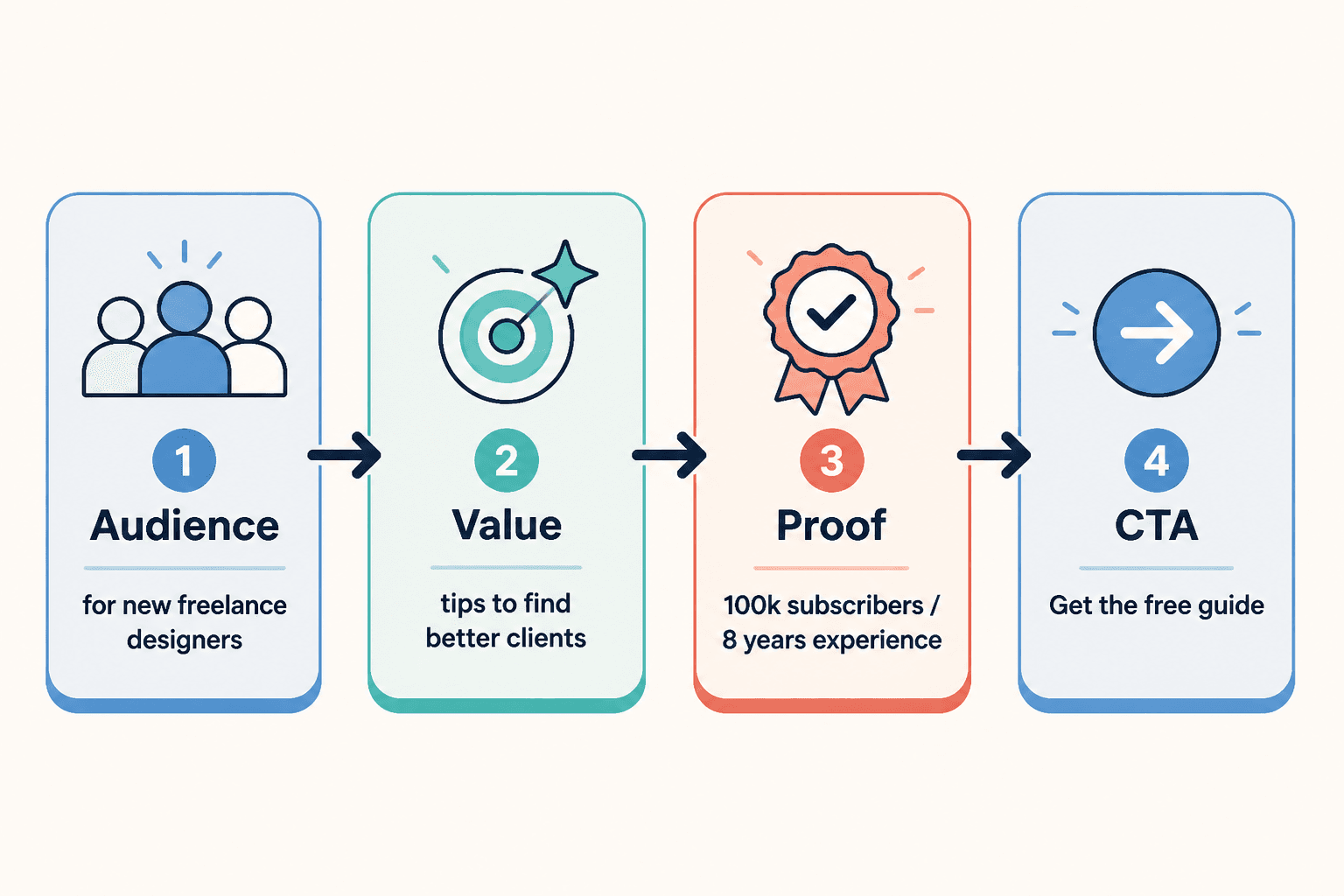
Most strong creator bios can be reduced to four pieces. Not every platform needs all four in full force, but the structure is reliable.
- Audience: who the bio is for.
- Value: what you help with or create.
- Proof: what makes that credible.
- Call to action: where to go next.
Think of it like this: audience tells the reader whether to keep going, value tells them why, proof stops the eye-roll, and the CTA gives the page a job. Leave one out and the copy still functions. Leave out three and you have a decorative label.
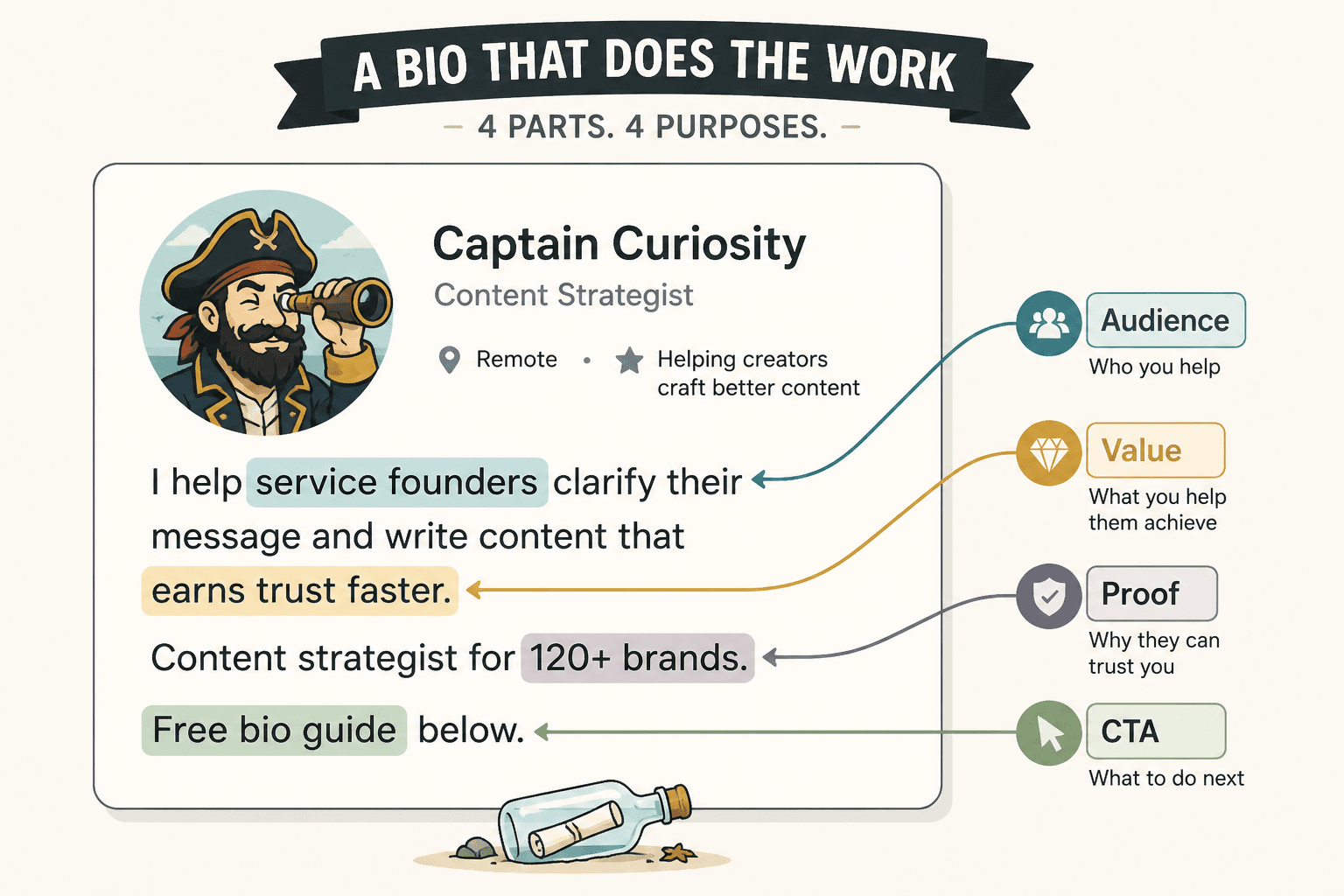
1. Audience
Start with who you help or what kind of creator you are. Specificity matters more than grandeur.
Examples:
- Helping freelance writers build cleaner profile copy
- Content creator for handmade brands
- Educator for solo founders who hate blank pages
2. Value
Say what changes because of your work. That change can be a result, a method, a style, or a subject area.
Examples:
- Profiles that turn casual visits into follows
- Simple writing systems for busy creators
- Clear bio copy that makes your niche easy to understand
3. Proof
Proof can be experience, credentials, audience size, a recognizable body of work, or even a clearly demonstrated specialty. Keep it concrete.
Examples:
- Published bylines in marketing and creator publications
- 10+ years in social media strategy
- Featured by independent brands and startups
4. Call to action
Not every bio needs a CTA, but when the platform allows it, a small next step helps. Keep it natural, not salesy.
Examples:
- Read my latest work below
- Start with the guide linked here
- Follow for weekly profile copy tips
7 creator bio formula examples creators can adapt fast
These are not sacred text. They are reusable structures you can trim, bend, and recycle without making the bio sound like a template collapsed under its own confidence.
1. The straight-to-the-point service bio
Formula: I help [audience] with [specific result] through [service or method].
Example: I help solo creators write profile copy that makes their offer easy to understand through simple, conversion-friendly messaging.
This version works well when the priority is clarity over personality. It is blunt in the useful sense.
2. The niche-and-method bio
Formula: [Niche] creator helping [audience] achieve [result] with [method].
Example: Creator writing coach helping founders sharpen their bios and social profiles with practical templates and no-fluff edits.
This version is strong when your method is part of the value. It tells people not just what you do, but how you approach it.
3. The authority-first bio
Formula: [Role/credential] with experience in [area], helping [audience] with [outcome].
Example: Social copywriter with 8 years of experience helping brands and creators turn vague bios into clear, usable profile messaging.
Use this when proof is a major part of the pitch. It is especially useful if you work in a field where experience matters more than flair.
4. The creator-educator bio
Formula: I teach [audience] how to [skill] so they can [result].
Example: I teach creators how to write profile copy that sounds human, sounds specific, and gives visitors a reason to stick around.
This is a good fit for educators, coaches, and writers whose audience is there to learn.
5. The one-line punch bio
Formula: [Niche] creator making [thing] for [audience] who want [result].
Example: Profile copy creator making bios for creators who want to sound clear instead of vaguely impressive.
Short, direct, and slightly smug in a way that can be charming if the brand allows it. No need to overcook it.
Simple fill-in-the-blank templates
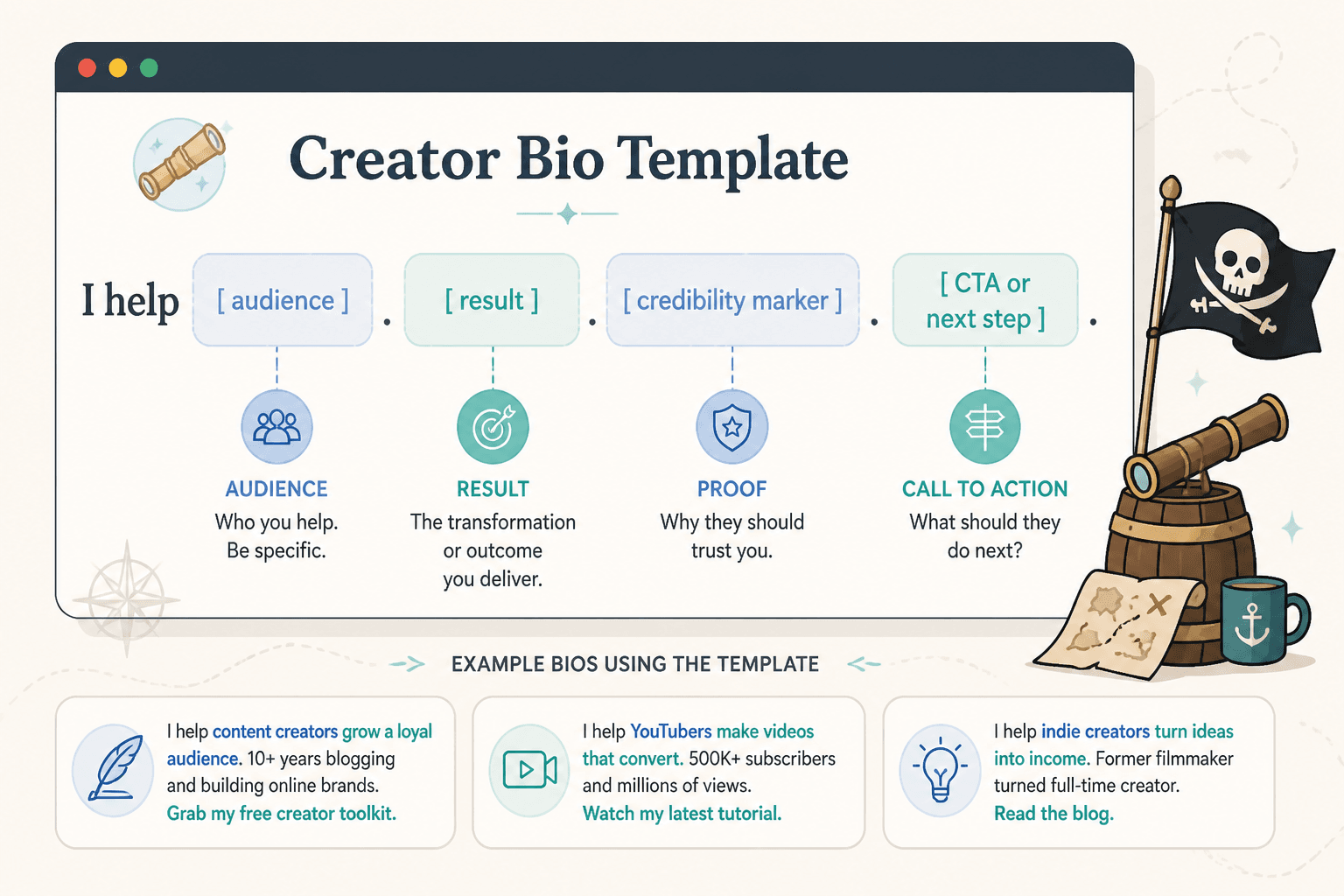
If you want something even easier to work from, start here.
Template 1: basic creator bio
I help [audience] with [result] through [method].
Example: I help creators with clearer profile copy through simple, strategic writing.
Template 2: authority bio
[Role] with [experience], helping [audience] [result].
Example: Content strategist with 10 years of experience helping brands write bios that are clear, useful, and easier to trust.
Template 3: personality-led bio
[What you do] for [audience], because [belief or angle].
Example: I write creator bios for people who would rather be understood than overhyped.
Template 4: creator-educator bio
I teach [audience] how to [skill] so they can [result].
Example: I teach freelancers how to write profile copy that sounds clean, specific, and worth a click.
These work best when you fill the brackets with language a real person would use. The moment you start stuffing in jargon, the copy begins behaving like a conference badge.
How to tighten a creator bio fast
Once you have a draft, edit with a ruthless little checklist:
- Cut words that repeat the same idea.
- Replace vague labels with concrete nouns.
- Move the audience or outcome closer to the front.
- Keep one proof point, not four competing ones.
- Remove filler that sounds polished but says nothing.
A useful rule: if a phrase sounds impressive but would be annoying to explain, it probably needs a rewrite. That is not anti-style. That is just respect for the reader.
Common mistakes in creator bios and profile copy
- Listing roles instead of making a point. A bio is not a job title graveyard.
- Writing for peers instead of buyers. If your audience is confused, the bio is not “subtle.” It is missing the point.
- Sounding professional instead of understandable. Those are not the same thing.
- Leaving out proof. Without proof, the bio can read like a good intention wearing a blazer.
- Trying to say everything. A bio is a filter, not a full archive.
The best creator profile copy is usually not the longest version. It is the one that creates less friction for the right person and less confusion for everyone else.
For related structure and platform-specific guidance, you can also revisit the parent guide. If you are tightening a bio down to one line, the sibling page on one-line formulas pairs well with this one once it is live.
When to keep it short vs. when to add detail
Short bios are better when the platform gives you very little room or when the audience already knows the context. Longer bios work better when you need to clarify a niche, show proof, or direct people to a specific next step.
A practical rule:
- Use short copy when recognition is already high.
- Use medium-length copy when your niche needs a bit of explanation.
- Use fuller copy when the profile itself has to do the selling.
In other words, length should be a function of job-to-do, not anxiety.
Quick examples of stronger rewrites
Vague: Creative professional helping brands grow.
Clear: Creator copywriter helping brands write bios, captions, and profile text that make their offer easier to understand.
Vague: Digital storyteller and content enthusiast.
Clear: Content creator helping solo brands turn messy ideas into usable posts and sharper profiles.
Vague: Passionate about design, media, and marketing.
Clear: Visual creator helping small brands pair strong imagery with profile copy that explains what they actually do.
The second version in each pair does not just sound better. It gives the reader something to respond to.
Wrap-up
Creator bios work best when they are specific, useful, and easy to scan. Start with the audience, add the value, include proof when you can, and leave the reader with a clean next step. If your draft still sounds like it is trying too hard, it probably is.
Use the formulas above as scaffolding, not a costume. The goal is not to sound like every other creator on the platform. The goal is to sound like yourself, but with the unnecessary fog removed.
For the full system behind this topic, return to the creator bios profile copy guide.