Creator bios usually do not fail because they are too short. They fail because they try to sound important before they become useful. That is a tiny but fatal vanity tax. A good bio is not a résumé with better lighting; it is a fast explanation of who you help, what changes, why that claim is credible, and what to do next.
That framing matters because profile copy has a job to do in a very small amount of space. On social platforms, on about pages, and in creator profiles, people are scanning for relevance, not attending a keynote. Clear beats clever. Specific beats grand. And a bio that tells the right reader “yes, this is for me” will usually outperform one that merely sounds polished.
What a creator bio is supposed to do
A creator bio has one basic purpose: reduce uncertainty. It should help a visitor answer four questions quickly:
- Who is this for?
- What do they help with?
- Why should I believe them?
- What should I do next?
If your bio answers those questions without forcing a scavenger hunt, it is doing the job. If it mainly describes your identity, your taste, or your ambition, it is probably making the reader work too hard.
The same principle shows up in broader guidance from platforms and conversion-minded writing advice: profile copy should orient the reader fast and make the next action obvious. For reference, that is a very old internet lesson, still ignored with remarkable energy.
Why most creator bios underperform
There are a few reliable ways creator bios go sideways.
They lead with labels instead of value
“Writer. Strategist. Creator. Storyteller.” Fine. But what does the reader get out of that? A label is not a benefit. It is a filing system.
They use broad promises nobody can picture
Phrases like “helping creators grow” or “building better brands” sound neat and mean almost nothing on their own. Growth how? Brands for what? Better in what way?
They try to sound impressive instead of useful
Jargon is often just panic in formal wear. If the bio feels like it was written for approval, not comprehension, the reader notices.
They skip proof
Proof does not need to be a trophy case. It can be a concrete result, a niche, a body of work, a method, or a recognizable constraint you work within. Anything is better than pure self-declaration.
They have no next step
Even a strong bio can leak attention if it ends in a shrug. Tell the reader what to do: read the guide, book a call, visit the site, sign up, or keep going somewhere specific.
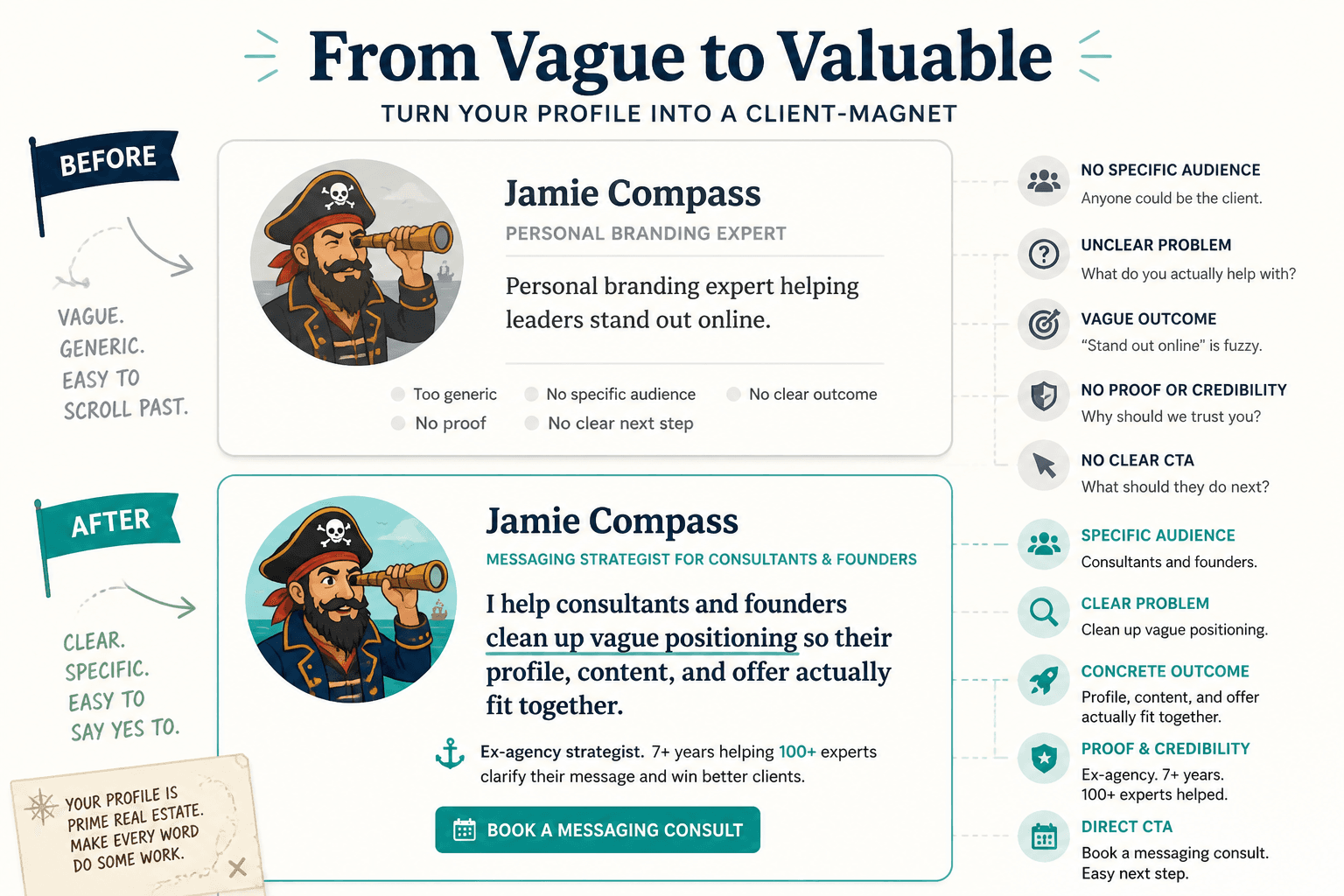
The simple structure of a bio that gets better results
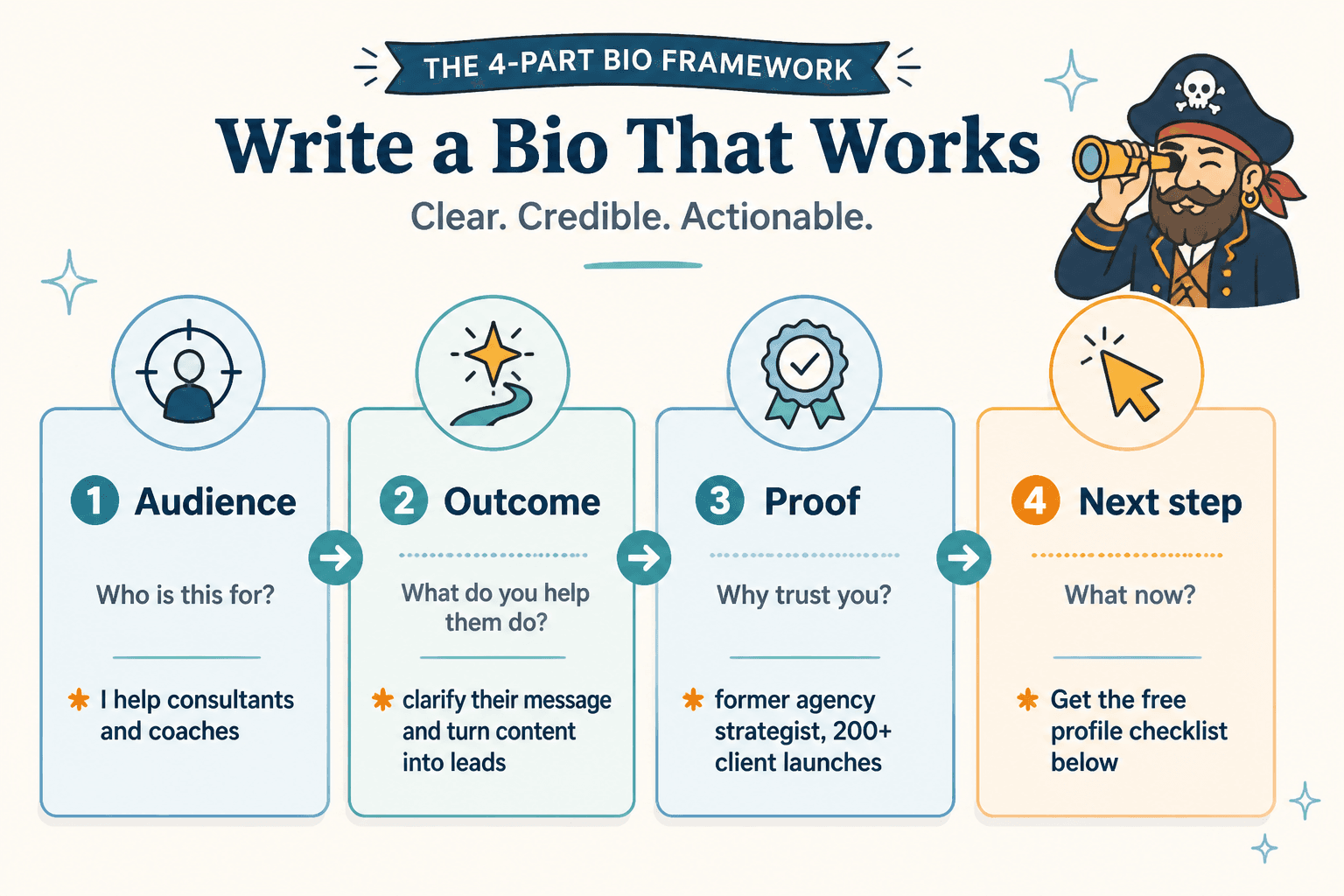
The cleanest version of a creator bio usually follows four parts:
- Audience: who you help
- Outcome: what you help them do
- Proof: why that is believable
- Next step: what action to take
That structure is flexible. It works for short social bios, longer about sections, homepage intros, and profile pages. The wording changes by platform, but the logic stays the same.
Example shape: “I help [audience] do [outcome] using [proof or method]. Start here: [next step].”
You do not have to make it sound like a robot assembled it in a basement. The point is to give the reader a map before you give them a mood board.
How to start creator bios & profile copy without a weak opening
The opening line does a lot of heavy lifting. A weak opener usually does one of these things:
- starts with a job title pile
- opens with vague identity language
- leans on personality before relevance
- sounds broad enough to fit 400 other bios
A stronger opening usually starts with the reader or the result. That does not mean every bio has to begin with “I help…” It means the first line should earn attention fast.
Good openers often do one of the following:
- name the audience early
- state a clear outcome
- add a specific cue that narrows the meaning
- use plain language before style
If the first line could be pasted into almost anyone else’s profile, it is too vague.
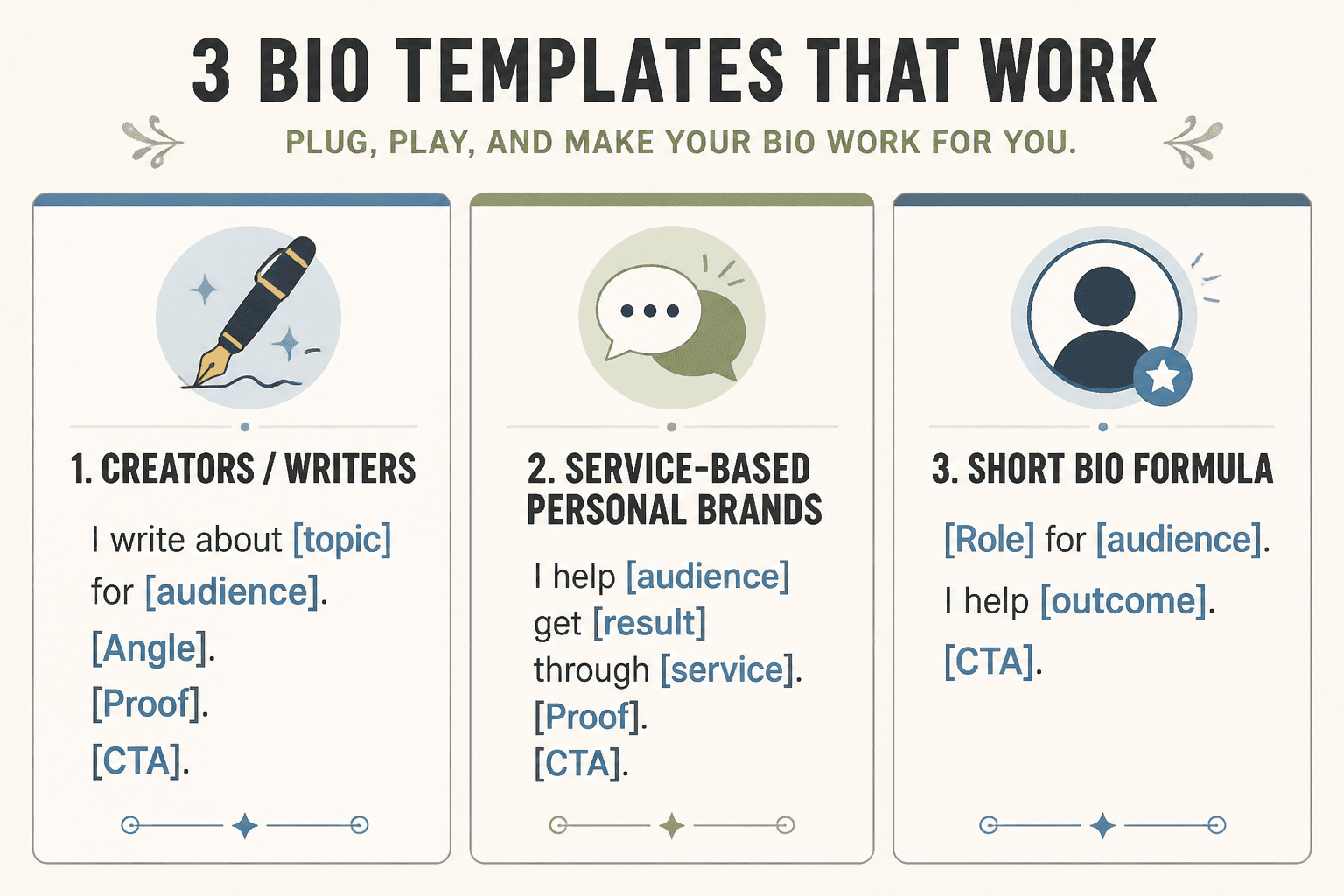
How to write creator bios without sounding salesy or robotic
The trick is not to strip all personality out of the bio. The trick is to stop forcing personality to do the work of clarity.
Here is a practical balance:
- Be specific about who it is for.
- Be concrete about the result.
- Use proof that fits the claim.
- Keep the language human.
A bio can sound warm without becoming fluffy. It can sound confident without sounding like it swallowed a keynote. The best versions usually read like a capable person talking to another capable person, not like a landing page trying to impress a committee.
If you want a quick test, read the bio aloud. If it sounds like it is performing “professional online presence” as a role, trim it back.
How long should creator bios and profile copy be?
There is no magic length. There is only the amount of space available and the amount of work the bio needs to do.
Use a shorter bio when:
- the platform gives you little room
- the offer is simple
- people are arriving cold
- you need fast clarity more than full context
Use longer profile copy when:
- you have an about section or homepage intro with room to explain
- the offer is more nuanced
- you need a little more proof or context
- the page supports deeper reading
Longer copy is not automatically better. It just gives you more room to be precise. And precision, inconveniently, still matters.
For platform-specific context, it helps to think about how bios are displayed. LinkedIn, X, Instagram, YouTube, and website author pages all reward different levels of detail. The copy should fit the surface, not fight it.
When short bios beat long ones
Short bios usually win when attention is thin and the offer is obvious. They are especially useful when:
- the visitor is skimming on mobile
- your audience already knows the category
- the profile snippet is the main thing people will see
- you want more clicks, replies, or profile actions rather than a full narrative
A short bio still needs the same four ingredients: audience, outcome, proof, and next step. It just compresses them into fewer words. There is no prize for adding extra fog.
What small creators should prioritize
If the audience is still small, the bio has a very practical job: make the right person think, “Oh, this is for me.”
That means a small creator bio should focus on:
- clear positioning
- a believable promise
- one or two relevant proof points
- a simple path forward
Small creators often feel pressure to sound bigger than they are. That impulse is understandable and usually counterproductive. If the audience cannot yet point to a pile of fame, then clarity becomes the proof. Not glamorous. Very effective.
How to turn old content into better creator bios
If the blank page is winning, go raid your own archive. Old posts, newsletters, captions, podcast notes, and drafts often contain the raw material for a much better bio.
Look for four kinds of material:
- Audience clues: who keeps showing up in your writing?
- Outcome language: what result do you keep describing?
- Proof points: what do you repeatedly demonstrate?
- Voice lines: what phrasing actually sounds like you?
Then build the bio from the strongest fragments instead of inventing a new persona from scratch. That is usually faster, less awkward, and much less likely to produce something that sounds like a press release with feelings.
A quick editing checklist for creator bios
- Does the first line tell me who this is for?
- Can I tell what the creator helps people do?
- Is there at least one concrete proof point?
- Is the language specific rather than generic?
- Does the bio avoid role-stacking for its own sake?
- Is the next step obvious?
- Would this still make sense if I knew nothing about the creator already?
If the answer to most of those is yes, the bio is probably doing useful work. If not, the fix is usually not more words. It is better ones.
Related guide
For the broader system around profile writing, see the parent guide: Creator Bios & Profile Copy.
You can also use this article as a companion to more specific profile-copy guidance in the same cluster, especially when you are deciding between short, long, salesy, or more personality-driven versions.
Final take
Better creator bios are not built from bigger claims. They are built from clearer ones. Say who it is for, what changes, why it is believable, and what happens next. That is the whole game, minus the dramatic lighting.
When the bio is doing its job, readers do not admire the copy and move on. They recognize themselves and keep reading.