Bold opinions can work beautifully on LinkedIn.
They can also make you sound smug, vague, performative, or weirdly desperate for applause. And that is usually the real problem. Most “bold” LinkedIn posts do not fail because the opinion is too strong. They fail because the hook is lazy, the formatting is annoying, and the point underneath the confidence is paper-thin.
If your hot takes keep getting polite silence, weak engagement, or comments from people you would never want as clients, there is a good chance the issue is not the platform. It is the way the opinion is packaged.
This is where LinkedIn hooks and formatting matter more than people want to admit. A strong opinion needs a strong first line, clean structure, actual reasoning, and enough restraint not to read like somebody yelling through a ring light.
Here’s how to spot the LinkedIn bold opinion mistakes that hurt performance, and how to fix them without sanding your voice into bland corporate paste.
To see how this fits into the wider strategy, open the parent guide.
The biggest mistake: confusing “bold” with “badly written”
A lot of creators think bold means harsh, contrarian, or dramatic. It does not. Bold usually means clear. It means saying something specific enough that people understand what you actually believe, why you believe it, and who that belief is for.
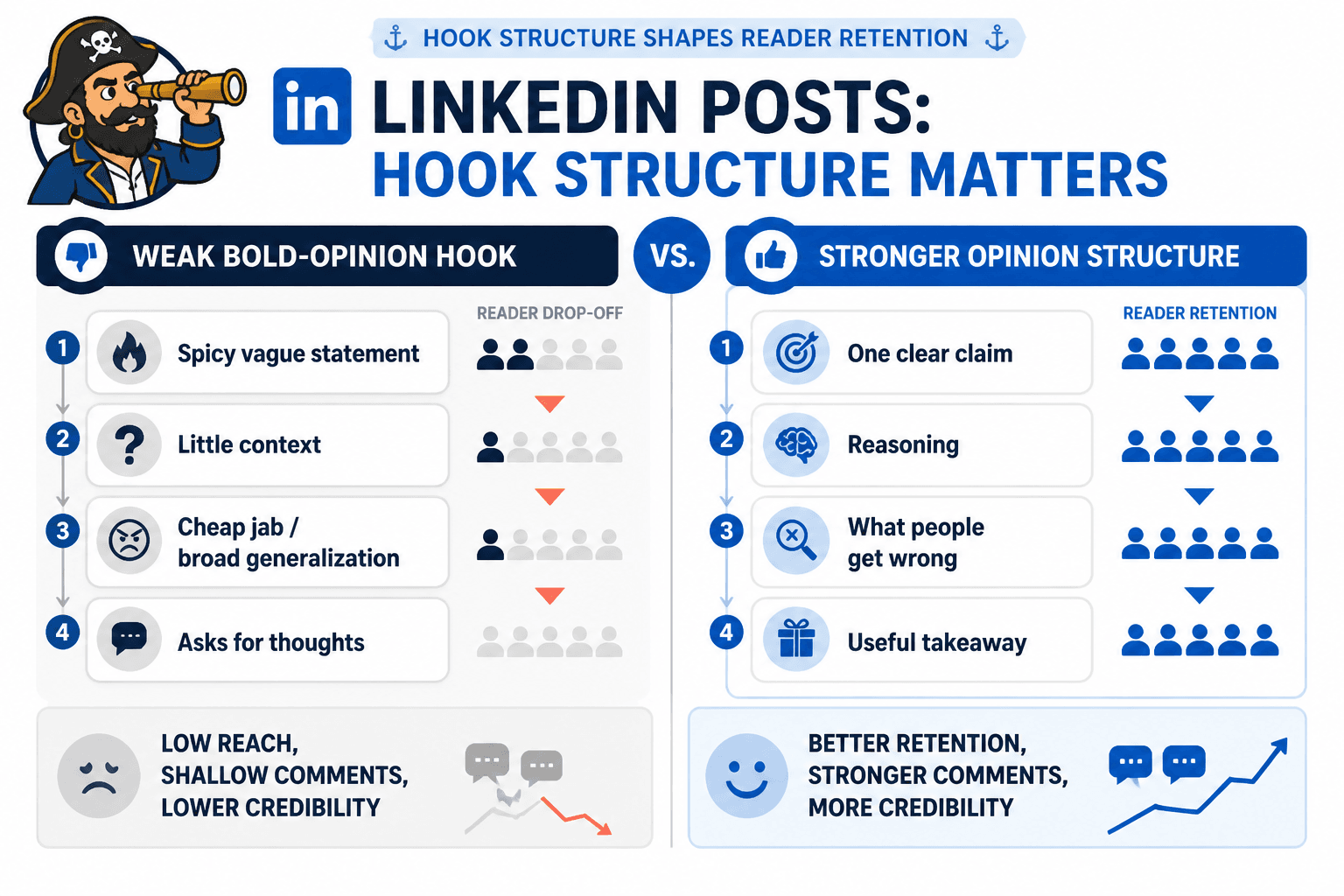
Bad bold-opinion posts usually lean on tone instead of substance. They announce a stance with maximum chest-puffing energy, then never really support it. So the reader gets a loud first line, a few vague claims, maybe a cheap jab at “most people,” and then a CTA asking for thoughts. Which is generous, frankly, because there was not much to think about.
A stronger version is much simpler:
- Make one real claim
- Explain the reasoning
- Show what people get wrong
- Give the reader a useful takeaway
That is opinion with value attached. Much better than posting a spicy sentence and hoping confidence does the heavy lifting.
LinkedIn bold opinion mistakes that hurt performance most
If you want stronger reach, better comments, and more credibility, these are the mistakes worth fixing first.
1. Writing a “bold” hook that says almost nothing
Plenty of LinkedIn hooks sound strong but mean very little.
Unpopular opinion: authenticity is overrated.
Okay. In what context? For whom? Compared to what? Is this about branding, sales calls, founder content, fake vulnerability, or just your mood before coffee?
The problem is not the phrase “unpopular opinion” by itself. The problem is using it as a substitute for precision.
Try this instead:
- Weak: Unpopular opinion: authenticity is overrated.
- Stronger: On LinkedIn, “be authentic” is often terrible advice. Most people use it to justify undercooked posts, vague stories, and zero editing.
Now there is something to react to. The reader knows what you mean, where you stand, and what argument may follow.
2. Starting with vague drama instead of a real point
Some hooks try to manufacture tension with lines like:
- People are not ready for this conversation.
- I said what I said.
- Some of you need to hear this.
- This will upset a lot of people.
These are not hooks. They are theatrical throat-clearing. They ask the reader to care before giving them a reason.
LinkedIn readers are skimming quickly. If the first line only signals attitude, not substance, many will move on. Especially if they have seen that exact move a hundred times from people trying to cosplay authority.
A better opening creates tension through specificity. It shows the clash immediately.
- Weak: This will upset some people, but personal branding is broken.
- Stronger: Most personal branding advice on LinkedIn rewards polish over clarity. That is why so many “professional” posts are forgettable on contact.
3. Making the opinion broader than your evidence can support
This one quietly wrecks credibility.
If your post says “Nobody reads long posts anymore” or “Storytelling does not work on LinkedIn” or “Thought leadership is dead,” the reader has two options:
- agree emotionally because the line sounds punchy
- dismiss you because the claim is obviously too broad
You do not want the second reaction. And the first one is less useful than it looks, because broad dramatic claims attract low-quality agreement fast. People clap. Nobody trusts you more.
Tighter claims perform better because they are easier to believe and easier to use.
- Too broad: Storytelling does not work on LinkedIn anymore.
- Better: On LinkedIn, story posts usually flop when the story exists to flatter the writer instead of teaching the reader something useful.
That is still opinionated. It is just no longer sloppy.
4. Formatting every line like it is gasping for air
LinkedIn formatting matters. But some people learned “use line breaks” and turned it into performance art.
You have seen the posts.
One sentence.
Then another.
Then a dramatic fragment.
Then a fake mic-drop line.
It does create white space. It also creates drag. The post starts feeling manipulative, overacted, and harder to read than a normal paragraph would have been.
Good formatting supports rhythm. It does not replace it. Use short paragraphs, yes. Use line breaks to separate ideas, yes. But if every sentence gets isolated for effect, the effect disappears.
If this is something you tend to overdo, read how to improve LinkedIn hooks and formatting line breaks without sounding generic. It will save your posts from looking like they were edited by an anxious metronome.
5. Posting a hot take with no proof, example, or tension underneath it
Opinion alone is not authority. Anybody can type “Most marketers are doing LinkedIn wrong” and hit publish. The post gets stronger when you earn that statement.
You can do that with:
- a pattern you keep seeing
- a short example
- a before-and-after comparison
- a specific reason the common advice fails
- a clear tradeoff most people ignore
For example:
Weak: Thought leadership is broken on LinkedIn.
Stronger: A lot of “thought leadership” on LinkedIn is just recycled certainty with no proof attached. If your post could be copied by 4,000 other consultants with one word swapped, it is not leadership. It is wallpaper.
That second version has friction, a useful standard, and a line people remember. Much stronger.
6. Trying to sound provocative instead of useful
This is a common trap, especially when people notice that sharp opinions can get attention.
Attention is not the same as useful reach. A post can attract comments and still damage positioning if the readers walk away thinking, “This person likes being loud more than being helpful.”
The best bold posts do not just challenge. They clarify. They help the reader see something more accurately, avoid a common mistake, or make a better decision. The opinion is the vehicle, not the entire product.
So ask:
- Does this post teach anything?
- Does it help the right reader make a smarter move?
- Am I criticizing something real, or just performing disagreement?
If all you have is edge, you do not have much.
7. Aiming the opinion at everyone
Strong posts usually have an implied audience. Weak ones try to address all of LinkedIn at once, which means they end up sounding vague, generic, or weirdly self-important.
Compare these:
- Generic: People need to stop overcomplicating content.
- Targeted: Consultants keep overcomplicating LinkedIn content because they are trying to sound impressive instead of trying to be understood.
The second one has shape. It knows who it is talking to. It also makes the right reader feel seen, which is far more useful than going broad and blurry.
8. Ending with a weak, needy, or mismatched CTA
You do not need to finish every opinion post with “Agree or disagree?”
That line is not evil. It is just overused, often lazy, and usually unnecessary. If your post is interesting, people know they are allowed to react. You do not need to escort them to the comments like a museum docent.
Better endings do one of three things:
- sharpen the point
- give the reader a useful takeaway
- invite a specific kind of response
Examples:
- Weak: Agree or disagree?
- Better: If your “bold” content needs three paragraphs of clarification in the comments, the post was not clear enough.
- Better: Curious where you land on this if you write for founders or consultants specifically.
- Better: Before posting your next hot take, ask if the reader gets a useful insight or just your mood.
What strong LinkedIn hooks and formatting look like in bold opinion posts
A good bold-opinion post usually does not need to be louder. It needs to be tighter.
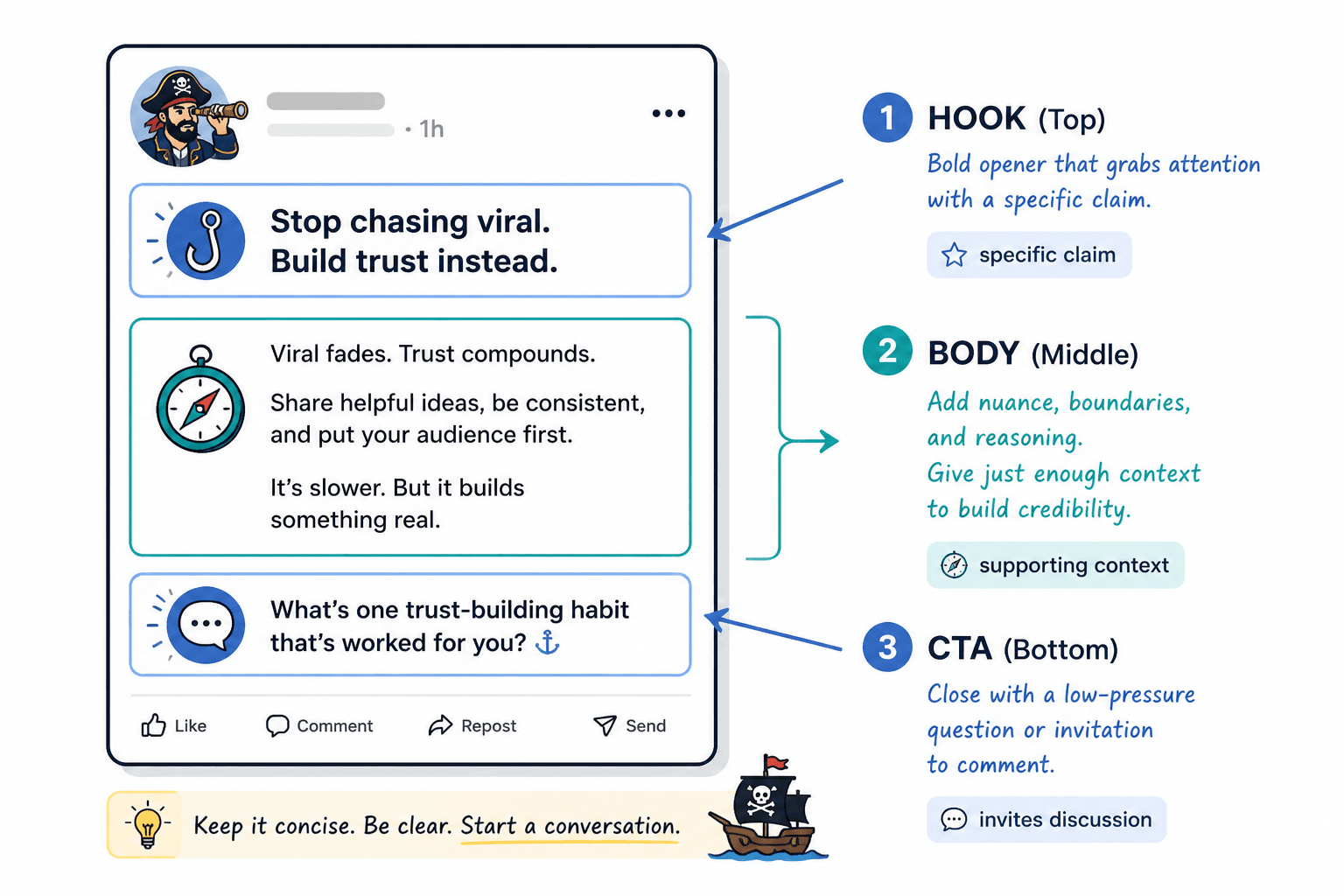
There is a simple structure that works well here:
- Hook: make a clear, specific claim
- Context: name the pattern or mistake
- Reasoning: explain why it fails
- Example: show the contrast
- Landing: end with a clean takeaway or invitation
For example:
Hook: Most “bold” LinkedIn posts are not too controversial. They are too vague.
Context: They announce a hot take with big energy, then spend the rest of the post saying obvious things with extra swagger.
Reasoning: Readers do not reward confidence alone. They reward clear thinking packaged well.
Example: “Personal branding is dead” is a slogan. “Generic personal branding advice creates polished profiles nobody remembers” is a usable point.
Landing: If your opinion cannot survive specificity, it probably is not strong yet.
This is also why it helps to study stronger post construction, not just stronger ideas. If your openings tend to sag, read how to write better LinkedIn hooks and formatting. If your drafts are technically fine but painfully dull, how to rewrite boring LinkedIn hooks and formatting is the more useful next step.
Before-and-after rewrites of common bold opinion mistakes
Sometimes the quickest way to improve is to see the difference on the page.
Example 1: vague contrarian hook
Before: Unpopular opinion: consistency is overrated.
After: On LinkedIn, consistency is overrated if consistency just means posting forgettable content more often. Better positioning beats more output almost every time.
The rewrite keeps the opinion but gives it boundaries and usefulness.
Example 2: overdramatic setup
Before: People are going to hate this, but storytelling is killing your content.
After: Storytelling is not the problem on LinkedIn. Pointless storytelling is. If the story does not sharpen your expertise, it is just content cosplay.
The bigger point is simple: clearer structure and clearer writing make the piece more useful. That is usually what makes the ending land better too.