
The bad assumption is that a LinkedIn post needs a clever first line or clean formatting, as if the two jobs live in separate zip codes. They do not. A hook earns the next line, and formatting decides whether the reader keeps going or quietly drifts off to check messages. The useful framing is simpler: write a first line that creates a reason to continue, then make the rest of the post easy to scan.
If you want the broader cluster map first, start with the parent guide to LinkedIn hooks and formatting. This article is the practical version: how to make the opening stronger and the structure less annoying.
Why LinkedIn hooks matter more than most people think
On LinkedIn, the first line is not decoration. It is the gate. A reader who stops there never sees the rest of your thinking, no matter how good it is. That is why weak hooks are expensive: they waste good ideas before the post has a chance to do anything useful.
A strong hook does not need to be dramatic. It needs to be clear enough to create momentum. The reader should be able to tell, very quickly, what kind of post this is and why it is worth a few more seconds.
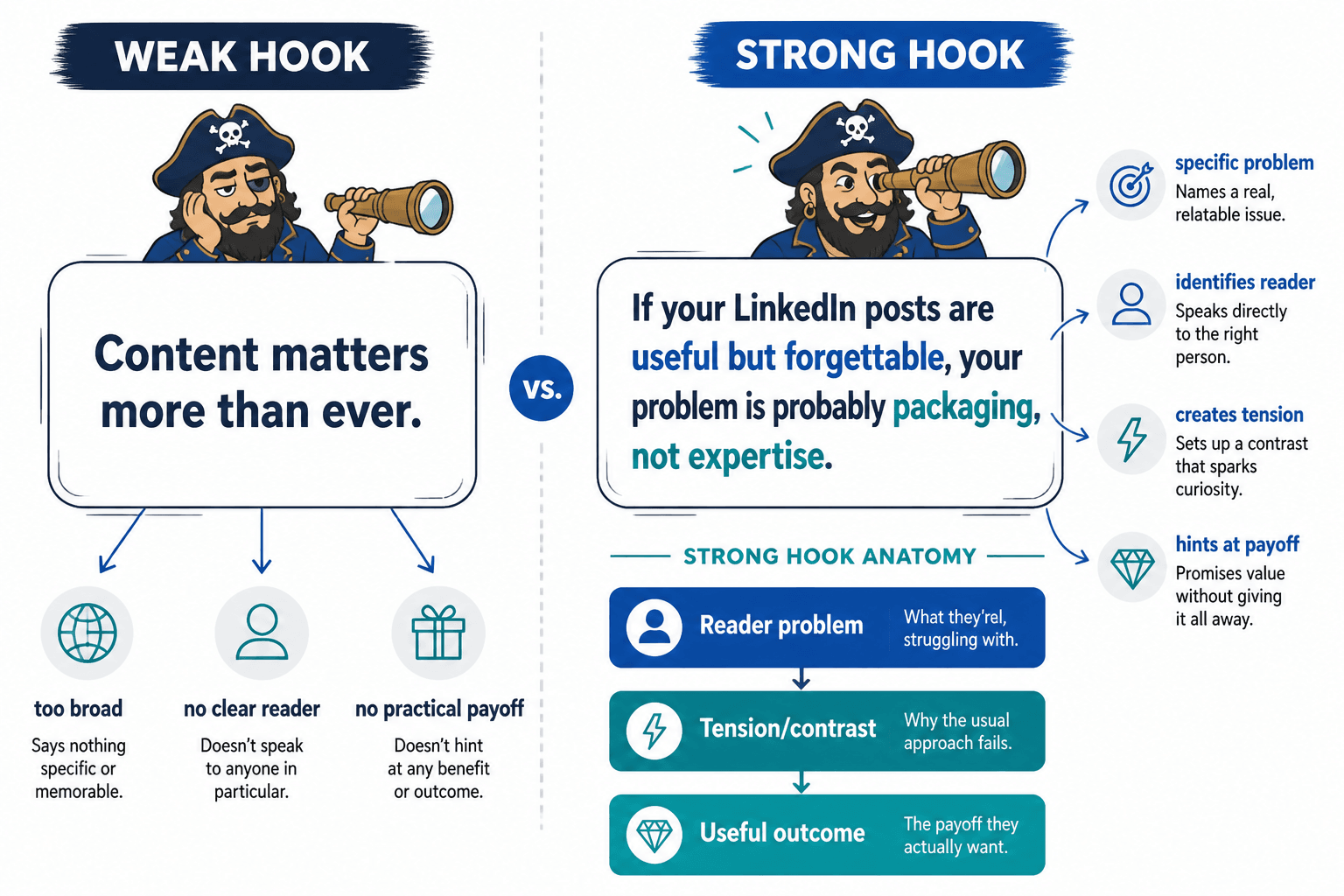
What a strong LinkedIn hook actually does
Good hooks tend to do three things at once:
- They name the point. The reader knows what issue the post is really about.
- They create tension or contrast. There is a small gap between what the reader expects and what the post is going to show.
- They feel specific. The line sounds like it came from a real thought, not a content generator in a blazer.
That is enough. You do not need mystery fog. You do not need a fake question. You do not need to turn every post into a cliffhanger episode about paragraph spacing.
If you want a broader set of angles and examples, the sister piece best LinkedIn hooks and formatting ideas and examples for creators is the right companion.
The LinkedIn hook patterns that usually underperform
Some openings are popular because they are easy, not because they work. They often look active while doing very little.
1. The fake wisdom opener
This is the line that sounds wise in a vacuum and vague in context. It gestures at insight without actually saying anything the reader can use.
2. The vague confession opener
Starting with “I learned something” or “I used to think…” can work, but only when the rest of the line earns it. Otherwise it feels like a setup waiting for a payoff that never arrives.
3. The announcement opener
“I’m excited to share…” is not a hook. It is a calendar update.
4. The abstract opener
Abstract lines drift fast. If the reader has to decode the topic before they can care about it, you have already spent too much of their attention.
The sibling article how to start LinkedIn hooks and formatting without a weak opening goes deeper on fixing the first line itself.
Formatting is not separate from the hook
A good hook can still fail if the body looks like one long gray apology. Formatting is not there to make the post look “designed.” It is there to help the reader move through the thought without friction.
On LinkedIn, that usually means:
- short paragraphs that are easy to scan,
- line breaks that separate ideas instead of decorating them,
- emphasis used sparingly,
- and a structure that makes the post feel intentional rather than spilled onto the page.
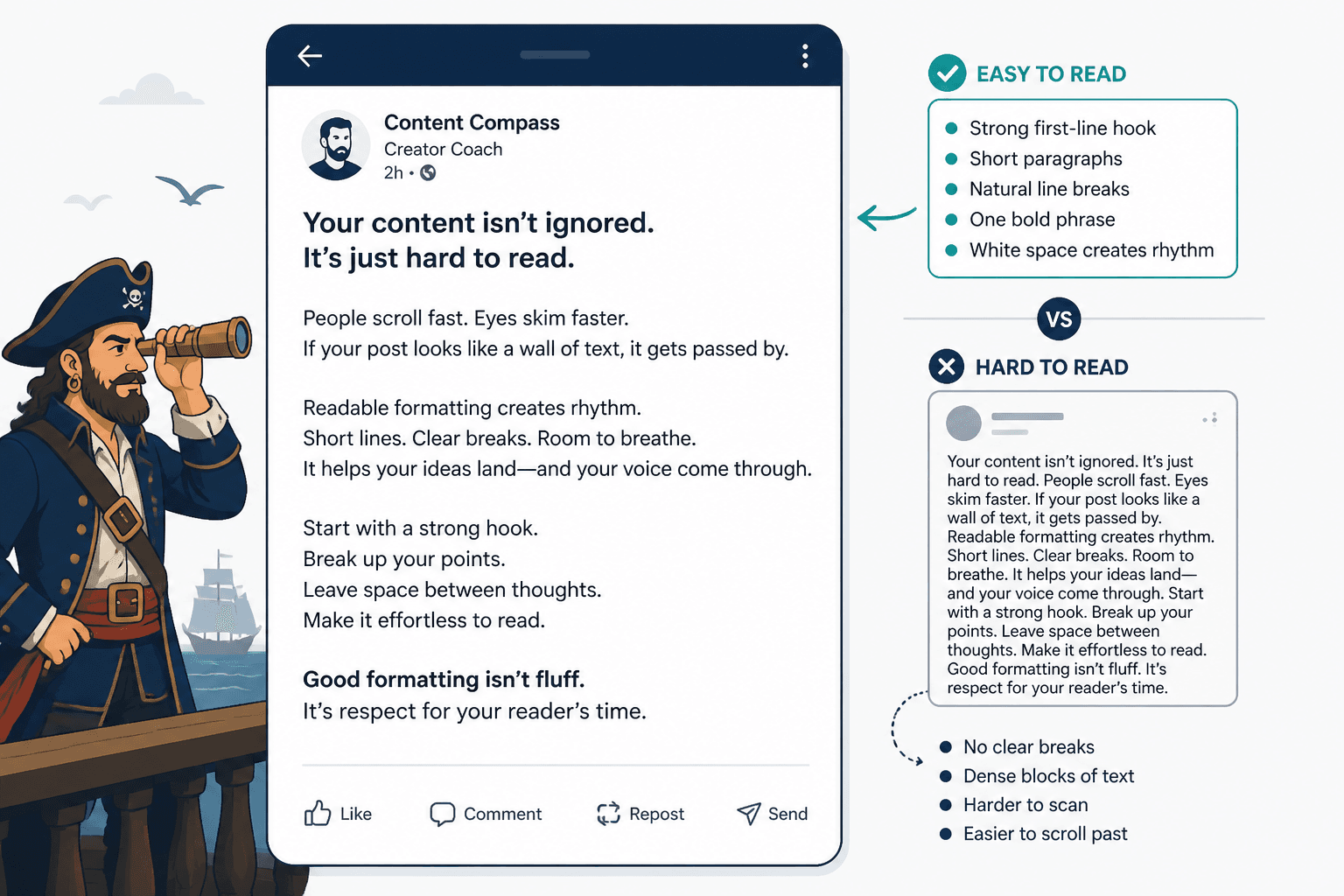
How to improve LinkedIn line breaks without sounding generic
Line breaks are useful when they support meaning. They are useless when they become a personality trait.
Use them to mark shifts:
- from problem to example,
- from claim to explanation,
- from tension to takeaway,
- from body to CTA.
Do not break every sentence just because it looks “social.” A post with too many line breaks starts to feel dramatic in the wrong way, like the text is gasping for air.
A good rule: break before the thought changes, not after every sentence finishes. That keeps the post readable without turning it into visual confetti.
For more on this specific problem, see how to improve LinkedIn line breaks without sounding generic.
A simple LinkedIn structure that usually works
You do not need a complicated template. You need a structure that gives the reader a clear path.
- Hook: say the point clearly.
- Context: give enough setup for the reader to care.
- Proof or example: show the idea in action.
- Takeaway: make the point usable.
- CTA: end with a clean next step, if you want one.
That structure is boring in the best way. It lets the writing carry the weight instead of asking the formatting to cosplay as strategy.
Bold opinions can work, but only if they are real opinions
LinkedIn loves a bold take right up until the take becomes noise. The mistake is not being strong. The mistake is being performatively strong.
A useful bold opinion is specific enough to be defended. A bad one is just volume with punctuation.
- Better: a claim tied to a real problem or tradeoff.
- Worse: drama without evidence.
- Better: tension the reader can recognize.
- Worse: a post that sounds provocative but teaches nothing.
If bold opinion writing is a regular format for you, the sibling guide LinkedIn bold opinion mistakes that hurt performance is worth a look.
Small audiences need clearer hooks, not louder ones
If your audience is still small, the temptation is to overcompensate: bigger claims, fancier wording, more “thought leadership” residue. That usually backfires. Smaller audiences do not need more performance. They need faster clarity.
Lead with the sharpest useful version of the point. Make the first line easy to understand. Make the post easy to skim. A small audience will not reward mystery just because you felt clever while writing it.
The companion piece LinkedIn hooks and formatting for creators with small audiences expands on that point.
How to tighten an old draft into a better LinkedIn post
Old drafts usually are not broken because the idea is bad. They are broken because the opening is too soft and the body wanders.
Try this:
- Find the strongest point. Do not start with the broad topic. Start with the sharpest angle.
- Cut the polite setup. Remove anything that delays the real point.
- Rebuild for skimming. Keep paragraphs short and organized.
- End cleanly. Avoid the limp fade-out that sounds like the post got tired first.
If you are working from old material, the sibling guide how to turn old content into better LinkedIn hooks and formatting is the more direct playbook.
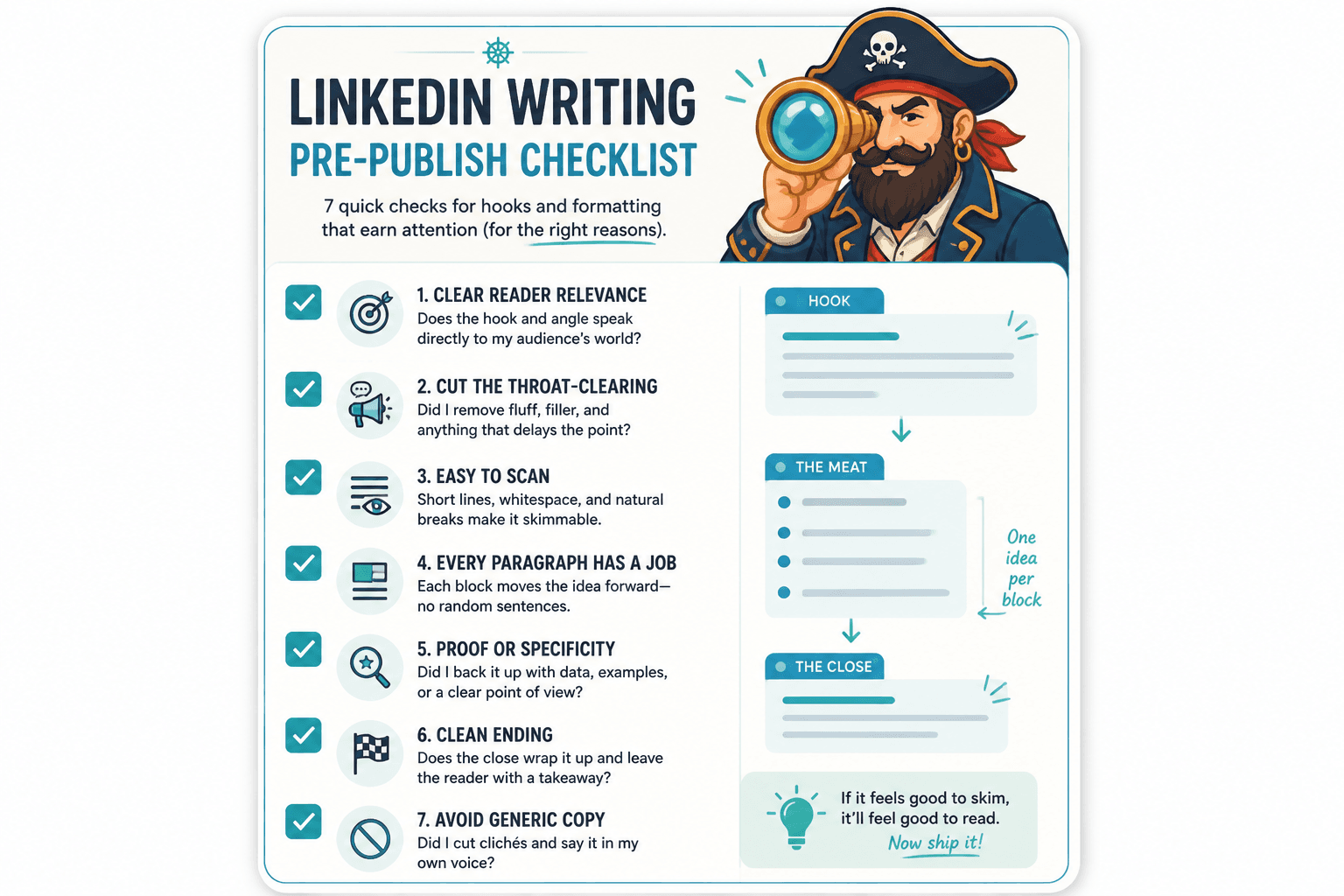
Pre-publish checklist for LinkedIn hooks and formatting
Before you publish, check the post against something less romantic than instinct:
- Does the first line clearly tell the reader what the post is about?
- Does the hook create enough tension, contrast, or payoff to earn the next line?
- Are the paragraphs short enough to scan without feeling chopped up?
- Are line breaks helping the structure, not just decorating it?
- Is emphasis used with restraint?
- Does the CTA sound like a real next step, not a funnel that lost its way?
- Would the post still make sense if the reader skimmed it in half the time?
If the answer to a few of those is no, fix the post before the algorithm gets a vote.
Where this fits in the LinkedIn writing cluster
This guide is the practical middle of the cluster: stronger opening, cleaner formatting, less nonsense. If you want the broader strategy, start with the parent guide. If you want examples and variations, use the ideas page. If you want to improve conversion after the post, move to how to turn LinkedIn hooks and formatting into more leads or sales.
The short version: write the hook so the reader wants the next line, then format the post so nothing stupid gets in the way.