
Most weak LinkedIn posts do not fail because the idea is bad.
They fail because the opening walks in half-asleep, clears its throat, and says something nobody would ever stop scrolling for.
If you want to learn how to start LinkedIn hooks & formatting without a weak opening, the first thing to understand is this: people are not rejecting your expertise. They are rejecting your packaging. Harsh, yes. Also useful.
A weak opening usually sounds safe, vague, overexplained, or painfully familiar. It starts with “I used to think,” “Here’s what I learned,” or “I’m excited to share.” Which is lovely if your goal is to be ignored politely by professionals holding coffee.
Here’s how to make your LinkedIn openings sharper, cleaner, and much harder to scroll past without turning into clickbait soup. We’ll cover what makes a hook weak, what to say instead, how formatting affects whether the first lines land, and how to rewrite openings that sound like they were assembled by a nervous intern and a chatbot.
For the main guide behind this topic, visit the parent guide.
Why most LinkedIn openings feel weak
A weak opening is usually trying too hard to sound professional and not hard enough to say something specific.
That is the core problem.
People often treat the first line like an introduction. On LinkedIn, it is not. It is a test. The reader is deciding, very quickly, whether this post has a clear point, a useful angle, or at least enough tension to justify another three seconds of attention.
Weak openings tend to do one or more of these:
- Start too broadly
- Hide the real point
- Use generic “thought leadership” phrasing
- Sound emotionally flat
- Take too long to create tension
- Lead with context instead of relevance
- Use formatting that makes the post feel limp before it even begins
And yes, formatting matters that early. A strong idea can still underperform if it arrives as a gray slab of text or gets broken into dramatic one-line fragments like it is fighting for breath.
Good hook writing is not just about the words. It is also about rhythm, spacing, and visual friction. If you want a deeper breakdown of that side of things, this guide to LinkedIn hooks and formatting is worth keeping open in another tab.
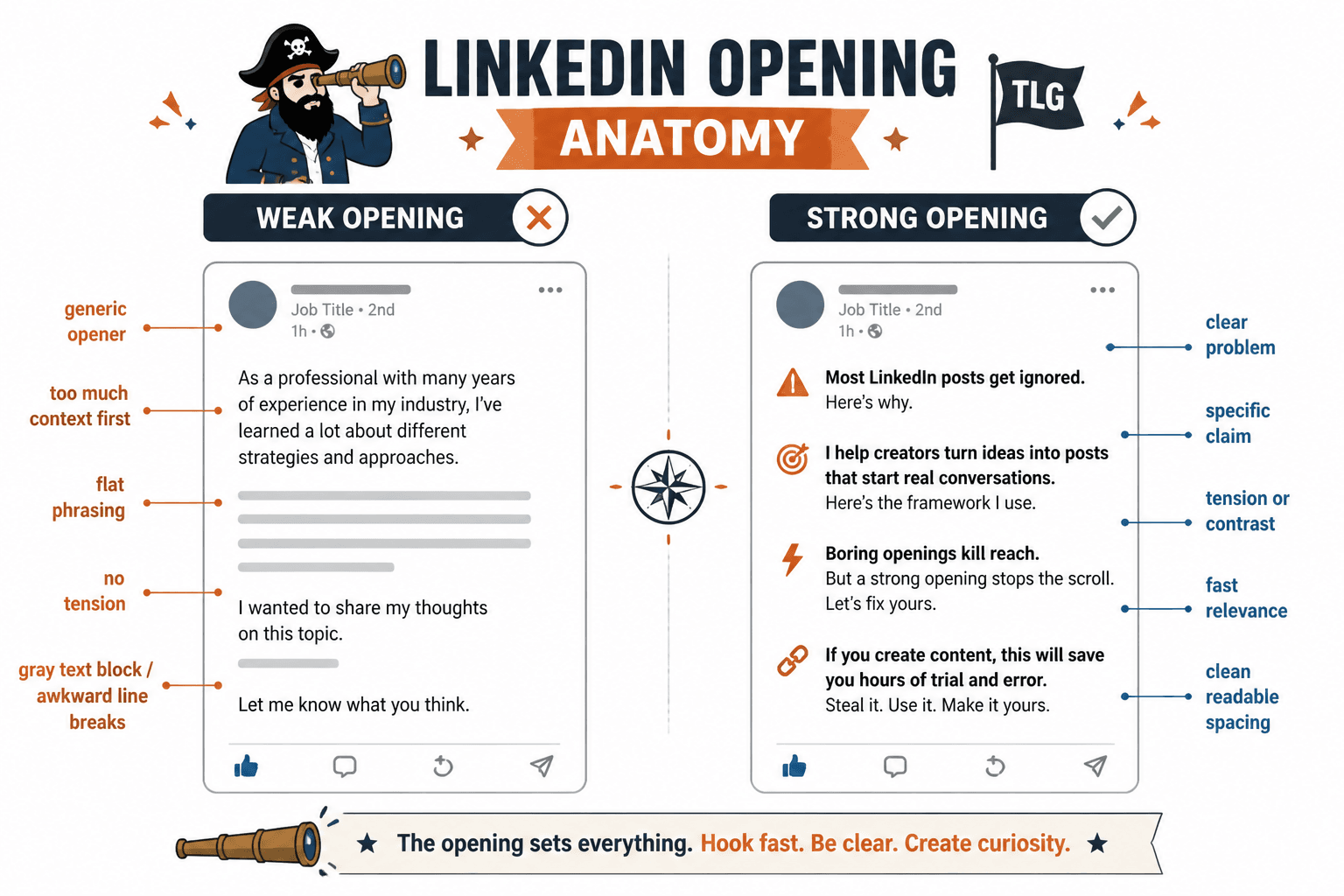
What a strong LinkedIn opening actually needs
You do not need a magic formula. You need an opening that earns the next line.
Strong LinkedIn hooks usually do at least one of these things immediately:
- Name a problem clearly
- Challenge an assumption
- Make a specific claim
- Create tension or contrast
- Offer a useful insight fast
- Speak to a recognizable frustration
Notice what is missing from that list: fake suspense, drama with no substance, and weirdly intense promises. You do not need to perform urgency like a discount funnel. You need clarity with a pulse.
A simple test for your first line
Ask this:
- Would the right reader instantly know what this is about?
- Is there a real point or just atmosphere?
- Would this line sound at home in 400 other posts today?
- Does it create enough curiosity without hiding the subject?
- Is it saying something, or just warming up to maybe eventually say something?
If the opening needs three lines before it becomes interesting, it is not an opening. It is a delay.
How to start LinkedIn hooks & formatting without a weak opening
Here is the practical part. If your openings keep coming out bland, use this process.
1. Find the actual point before you write the hook
A lot of weak openings are not really hook problems. They are clarity problems.
Before writing the first line, force yourself to answer this in one sentence: what is the sharpest useful point in this post?
Not the topic. The point.
For example:
- Topic: LinkedIn posting
- Point: Most LinkedIn posts flop because the opening is vague, not because the advice is bad
Now you have something you can actually lead with.
2. Cut the polite setup
These openings usually weaken a post fast:
- I wanted to share something I’ve been thinking about
- I’ve had a lot of conversations lately about
- I used to think
- Here are a few lessons I learned
- I’m excited to announce
- Something I see a lot is
None of these are automatically illegal. They are just usually weak because they put the writer’s process ahead of the reader’s interest.
The reader does not need your runway. They need the plane in the air.
3. Start with tension, not biography
The easiest way to make an opening stronger is to create a useful contrast.
Examples:
- Most LinkedIn hooks are not too short. They are too empty.
- Your first line does not need to be clever. It needs to be clear enough to survive contact with a scrolling thumb.
- If your post needs eight lines to get interesting, the problem is not the algorithm.
- Good formatting helps. It cannot save a weak opening with no point.
These work because they say something direct, slightly charged, and relevant. They move.
4. Make the formatting support the hook
Formatting is not decoration. It changes whether the opening feels readable, punchy, and worth continuing.
A few practical rules:
- Keep the first 2–3 lines clean and easy to scan
- Do not stack five tiny one-line fragments unless the rhythm really earns it
- Do not bury the point inside a dense paragraph
- Use line breaks to control pace, not to manufacture fake drama
- Let stronger sentences stand together when they reinforce each other
If your formatting feels generic, breathless, or overstyled, it can make a decent hook sound weaker than it is. For more on that, read how to improve LinkedIn hooks and formatting line breaks without sounding generic.
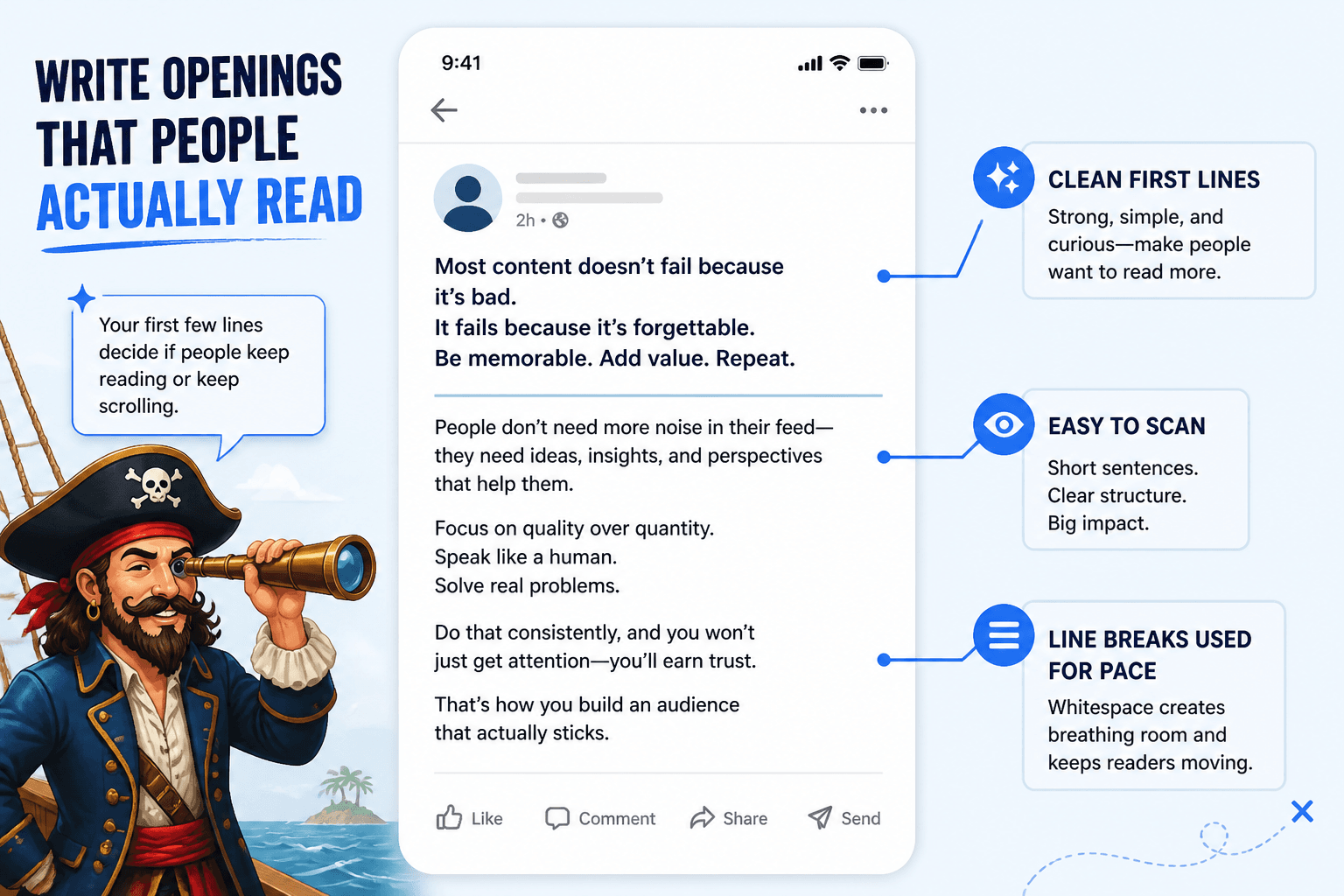
Weak LinkedIn openings vs stronger rewrites
This is where things usually click. Most people do not need more theory. They need to see the rewrite.
Example 1
Weak: I’ve been reflecting a lot on content creation lately, and I wanted to share a few lessons.
Stronger: Most content advice fails for one boring reason: it is technically fine and strategically useless.
Why it works better: it leads with a claim, not a diary entry.
Example 2
Weak: Here’s what nobody tells you about LinkedIn posting.
Stronger: LinkedIn posts do not die because they are too short. They die because the opening says nothing worth stopping for.
Why it works better: it swaps fake mystery for actual specificity.
Example 3
Weak: I used to think formatting did not matter, but I was wrong.
Stronger: Bad formatting can make a smart LinkedIn post feel dead on arrival.
Why it works better: it removes throat-clearing and gets to the point people care about.
Example 4
Weak: Excited to share some thoughts on writing hooks that convert.
Stronger: If your hook sounds like everyone else’s, the rest of the post barely matters.
Why it works better: it creates stakes immediately.
Example 5
Weak: There are many ways to write a good LinkedIn post, but here are some things to keep in mind.
Stronger: The fastest way to weaken a LinkedIn post is to make the opening sound careful.
Why it works better: it is tighter, more opinionated, and more memorable.
Hook types that work better on LinkedIn
You do not need to use the same style every time. In fact, you shouldn’t. Different ideas want different openings.
The direct problem hook
Use this when the reader has a clear frustration.
- Your LinkedIn posts are probably too vague to earn attention.
- If your content gets polite silence, the opening may be doing the damage.
- Most “valuable” posts fail before the second line.
The sharp opinion hook
Use this when you want contrast and authority.
- Good hooks do not tease endlessly. They land a point fast.
- Professional does not have to mean lifeless.
- LinkedIn formatting is useful. Over-formatting is content cosplay.
The mistake hook
Use this when people are doing something common and unhelpful.
- The biggest hook mistake is not being too bold. It is being too blurry.
- Most people do not need a better topic. They need a better first line.
- If your opening starts with context, it is probably already weaker than it should be.
The proof-and-point hook
Use this when you have evidence, a result, or a pattern you can state clearly.
- I rewrote 20 LinkedIn openings. The strongest ones all did one thing first: they made a real claim.
- The posts that got the best responses were not longer. They were clearer in the first two lines.
- Every weak hook in this batch had the same problem: too much setup, not enough point.
If you want more examples to model from, these LinkedIn hooks and formatting ideas and examples for creators will help.
Formatting mistakes that quietly weaken the opening
Sometimes the hook itself is fine. The formatting just makes it feel weaker.
- Too many line breaks: This can make a post feel melodramatic or slow.
- No line breaks at all: Dense opening paragraphs are easy to skip.
- Every sentence isolated: This kills flow and makes the post feel artificially intense.
- The key line buried in the middle: Put the strongest line first or second, not fifth.
- Weak opening followed by filler: If the first lines are generic and the next lines are context, the reader is gone.
A clean opening often looks like this:
Most LinkedIn hooks fail for a simple reason:
they do not say anything clearly enough to stop the scroll.
That gives the eye room without trying to turn every word into a dramatic reveal.
If your hooks also sound a bit stiff or salesy, read how to write LinkedIn hooks and formatting without sounding salesy or robotic. A lot of weak openings are really tone problems wearing formatting clothes.
A simple formula for stronger LinkedIn openings
If you want a repeatable structure, use this:
The bigger point is simple: clearer structure and clearer writing make the piece more useful. That is usually what makes the ending land better too.