
If you have a small audience on LinkedIn, your hook and formatting matter more, not less.
That is the part people get backwards. They assume low reach means they need to post more often, sound more impressive, or stretch a weak idea into a long “thought leadership” monologue. Usually, the problem is simpler: the first line is vague, the structure is annoying to read, and the post gives nobody a reason to care.
Small creators do not have the luxury of lazy packaging. Big accounts can get attention with mediocre posts because they already own attention. You do not. Yet. So your opening has to earn the stop, and your formatting has to make the post feel easy to read instead of weirdly exhausting.
Here is how to make LinkedIn Hooks & Formatting for Creators With Small Audiences work in your favor: sharper first lines, cleaner structure, better rhythm, less filler, and posts that actually invite the right people to keep reading.
To see how this fits into the wider strategy, open the parent guide.
Why hooks matter more when your audience is small
When you have a small audience, you cannot rely on familiarity. Most people seeing your post do not know your name, do not care about your latest insight yet, and definitely do not owe you three paragraphs of patience.
Your hook does one job: it gives a stranger a reason to stay.
Not by being dramatic. Not by sounding mysterious for no reason. Not by writing “Nobody talks about this” and then talking about something everybody has heard 400 times.
A good hook tells the reader, fast, that this post is relevant to them. It signals one of a few things:
- A clear problem they recognize
- A sharp opinion they want to evaluate
- A useful lesson they can apply
- A mistake they might be making
- A result or contrast that creates curiosity
If your audience is small, relevance beats cleverness. Every time.
That does not mean your posts need to be boring and functional like office furniture. It means the first line should say something real. Too many creators try to sound important before they sound useful. LinkedIn punishes that socially, even if not technically. People scroll right past it because it smells like effort without substance.
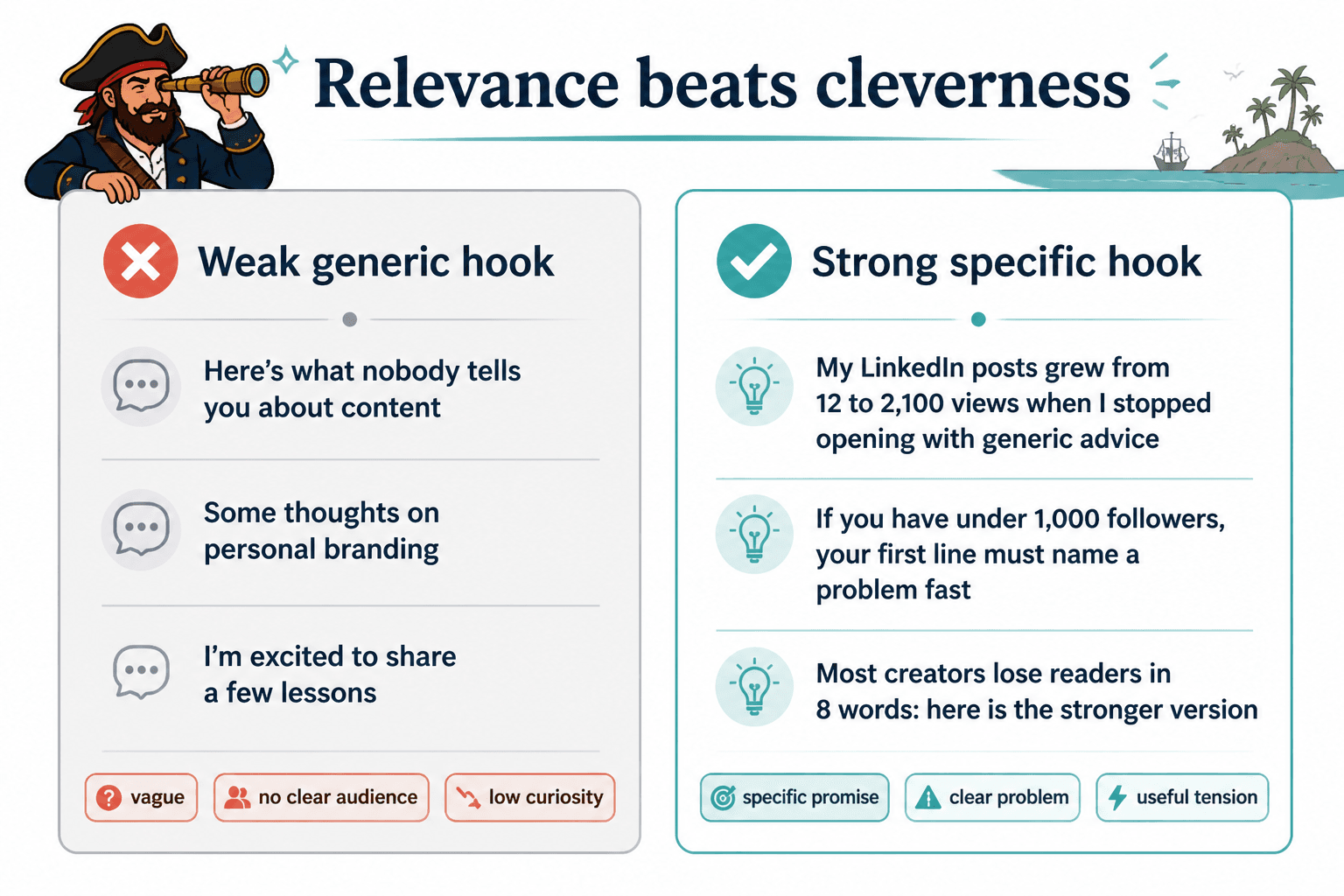
What a strong LinkedIn hook actually does
The best LinkedIn hooks usually do at least two things at once:
- They make a specific promise
- They create tension, contrast, or curiosity
For example, these are weak:
- Here’s what nobody tells you about content
- I used to think consistency was the key
- Some thoughts on personal branding
- I’m excited to share a few lessons
They are not failing because they are short. They are failing because they say almost nothing.
Now compare them with stronger versions:
- Most creators do not need better content ideas. They need stronger first lines.
- Posting consistently did not grow my LinkedIn. Writing less vague hooks did.
- Your personal brand is probably not weak. It is just hard to understand in 5 seconds.
- Three formatting fixes made my posts easier to read and much easier to finish.
See the difference? Each one gives the reader a reason to continue. There is a claim. A problem. A payoff. A little edge. Not a lot of fog.
Five hook types that work especially well for small creators
- The mistake hook: “Most LinkedIn posts do not flop because the idea is bad. They flop because the opening is asleep.”
- The contrast hook: “I stopped trying to sound smart on LinkedIn. My posts got better immediately.”
- The specificity hook: “If your first line could apply to a coach, copywriter, founder, and yoga retreat, it is too vague.”
- The useful promise hook: “A simple formatting rule made my posts easier to read without making them look gimmicky.”
- The opinion hook: “Short LinkedIn posts are not better. Sharp ones are.”
You do not need all of these in rotation every week like some content calendar spreadsheet goblin. But it helps to know the basic shapes that tend to hold attention.
How to write first lines that earn the click
On LinkedIn, the first line carries stupid amounts of weight. It is not just the start of the post. It is the decision point.
If the first line is bland, the rest of the post rarely gets a fair shot. That is why creators with small audiences should spend more time on the first line than on decorative phrasing in paragraph six.
Here is a practical way to build stronger first lines.
Step 1: Find the real point of the post
Before you write the hook, answer this:
- What is the actual takeaway?
- What mistake am I correcting?
- What useful shift am I giving the reader?
If you cannot answer that clearly, the hook will get vague because the idea itself is vague.
Step 2: Lead with the sharpest version of that point
Do not warm up. Do not preamble. Do not spend the first line clearing your throat in public.
Weak:
I’ve been thinking a lot lately about how creators approach LinkedIn content.
Better:
Most creators on LinkedIn are not under-posting. They are under-editing their openings.
Step 3: Add tension, proof, or contrast
A strong first line often works because it contains friction. Something the reader wants to resolve.
- Tension: “Your post can be useful and still get ignored.”
- Proof: “One formatting change doubled how many people finished reading my post.”
- Contrast: “Long posts are not the problem. Bloated ones are.”
Step 4: Make it specific enough to feel true
Specificity is one of the easiest ways to stand out when your audience is small. Generic hooks blend in because they could belong to anybody.
Weak:
Consistency matters on LinkedIn.
Better:
Posting 5 times a week will not save a LinkedIn post that says nothing in the first line.
Formatting that makes people actually read
Formatting is not decoration. It is reading psychology.
People on LinkedIn scan first, then commit. Your formatting should help them understand the shape of the post quickly. If it looks dense, shapeless, or weirdly choppy, they leave.
Good formatting does three things:
- Reduces visual friction
- Controls pace
- Highlights the important parts without acting desperate
Use short paragraphs, but do not break every sentence
This is where a lot of LinkedIn formatting goes off the rails.
Some creators write giant blocks of text. Others swing to the opposite extreme and format every sentence like it is emotionally recovering from a sprint.
Both are annoying.
A good default is 1 to 3 sentences per paragraph, with occasional one-line paragraphs for emphasis. That creates rhythm without making the post look like a dramatic screenplay.
Front-load clarity before detail
Your early paragraphs should make the point readable even for skimmers. Then you can add examples, nuance, or a short story.
If the post only makes sense by paragraph seven, you have hidden the value under too much setup.
Use line breaks to control pace, not fake drama
Line breaks help the eye move. They also help ideas land. But if every line break is trying to manufacture suspense, the post starts sounding like a teenager subtweeting a group project.
Use line breaks when:
- You are shifting to a new point
- You want to emphasize one sentence
- You are moving from setup to example
- You are making a CTA easier to spot
Do not use them just because “that’s how LinkedIn works.” That is how bad formatting spreads.
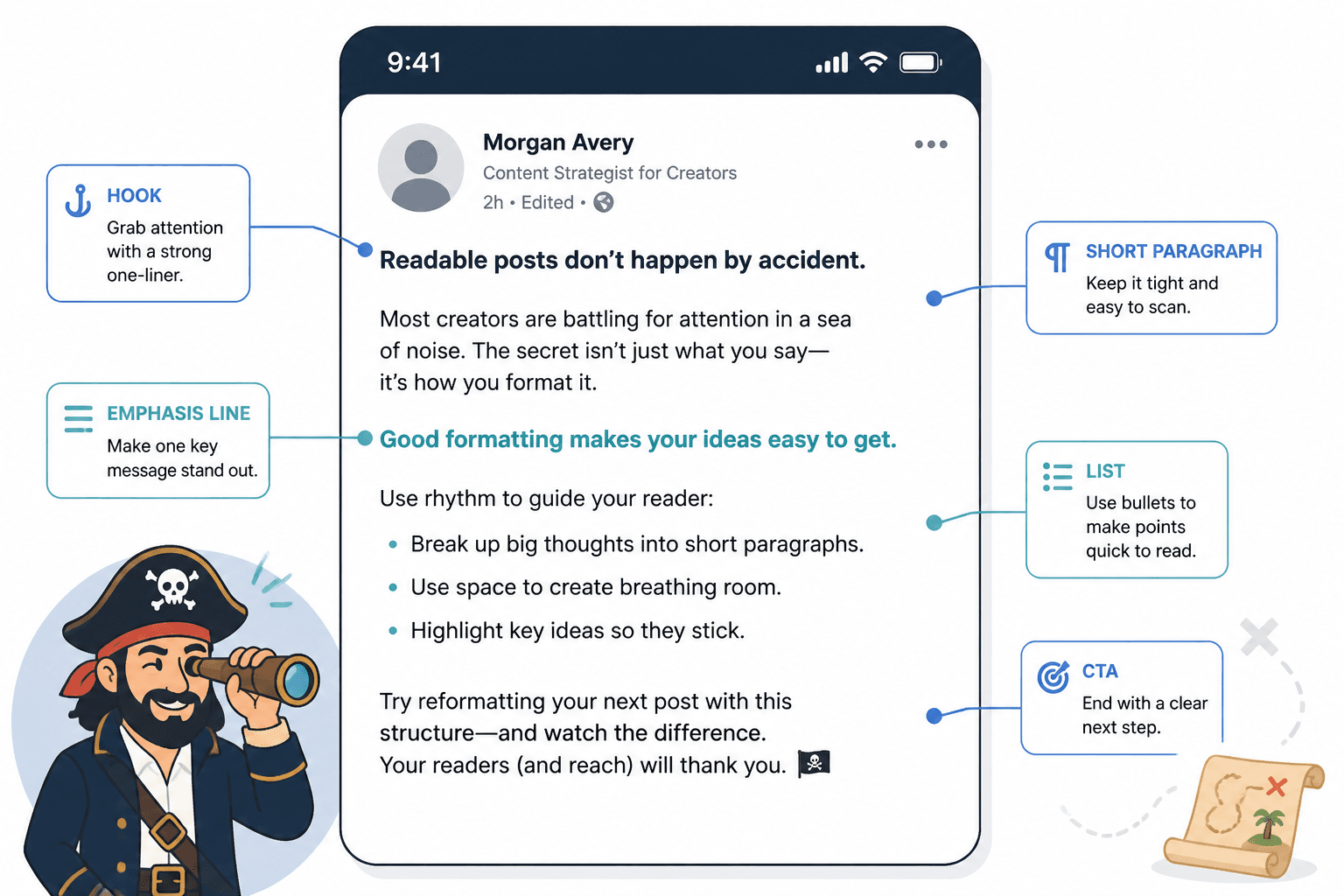
Keep list posts clean and fast
If your post includes tips, examples, or steps, make them easy to scan. Numbered points work well when each one adds something distinct.
Bad list formatting looks like this:
Here are 5 tips for better content: 1. Be authentic 2. Add value 3. Stay consistent 4. Know your audience 5. Keep learning
That is not a post. That is a stale conference tote bag.
Better:
- 1. Fix the first line first. Most weak posts die before the useful part arrives.
- 2. Cut one-third of your setup. Readers do not need your internal weather report.
- 3. Keep each point distinct. If tips 2, 3, and 4 are the same idea wearing different hats, merge them.
Common LinkedIn hook mistakes small creators should stop making
1. Writing vague “thought leadership” openings
Examples:
- Some thoughts on growth
- A lesson I learned recently
- Building a personal brand takes time
These are too broad to earn interest. The reader has no clue what they are getting.
2. Opening with autobiography nobody asked for
Your life story is not the hook unless the story itself is the value. Starting with “When I was reflecting this morning…” usually means the real point has not shown up yet.
3. Using fake curiosity lines
“You will never believe…” energy does not suddenly become classy because it is posted on LinkedIn.
If curiosity is all you have, the post usually disappoints. Better to make a useful claim and then support it.
4. Formatting every line like a dramatic reveal
This:
I posted every day.
Nothing changed.
Then I realized something.
Everything was wrong.
It feels performative because it is. Calm down and write the point.
5. Trying to sound big when you should sound clear
Small creators often overcompensate. The post starts sounding polished in the worst way: abstract, inflated, and weirdly bloodless. You do not need bigger language. You need stronger packaging.
A simple LinkedIn hook and formatting framework
If you want a repeatable structure, use this:
- Hook: Make a clear, specific claim
- Context: Explain why it matters
- Value: Give 2 to 5 useful points, examples, or steps
- Close: End with a simple takeaway or CTA
Example:
The bigger point is simple: clearer structure and clearer writing make the piece more useful. That is usually what makes the ending land better too.