
Most LinkedIn hooks do not fail because they are too short, too long, or missing some secret algorithm seasoning.
They fail because they sound like a stiff business robot trying very hard to seem human. You’ve seen them. “I’m excited to share…” “Here’s what nobody tells you…” “After 10 years in business, I learned…” Technically acceptable. Spiritually dead.
If you want to know how to write LinkedIn hooks & formatting without sounding salesy or robotic, the fix is not more hype. It’s better judgment. Better first lines. Better pacing. Better structure. And a little less trying to sound like “a professional thought leader” who just swallowed a webinar funnel.
This piece will help you write LinkedIn openings people actually want to read, format posts so they feel clean instead of frantic, and avoid the kind of fake-polished tone that makes smart readers scroll on instinct.
If you want more LinkedIn writing help after this, the main hub at LinkedIn hooks and formatting is a good next stop, along with the broader social media writing and LinkedIn writing collection.
For the main guide behind this topic, visit the parent guide.
What makes a LinkedIn hook sound robotic
Usually, it is not one horrible sentence. It is a stack of small bad choices.
The writer wants to sound credible, so they become stiff. They want attention, so they force drama. They want leads, so they hint at a pitch too early. Then they format the post like every line is gasping for air and call it optimization.
That is how you end up with a post that says something like this:
I used to think content was about consistency.
But then I realized something shocking.
It is really about connection.
Here are 3 lessons I learned on my journey.
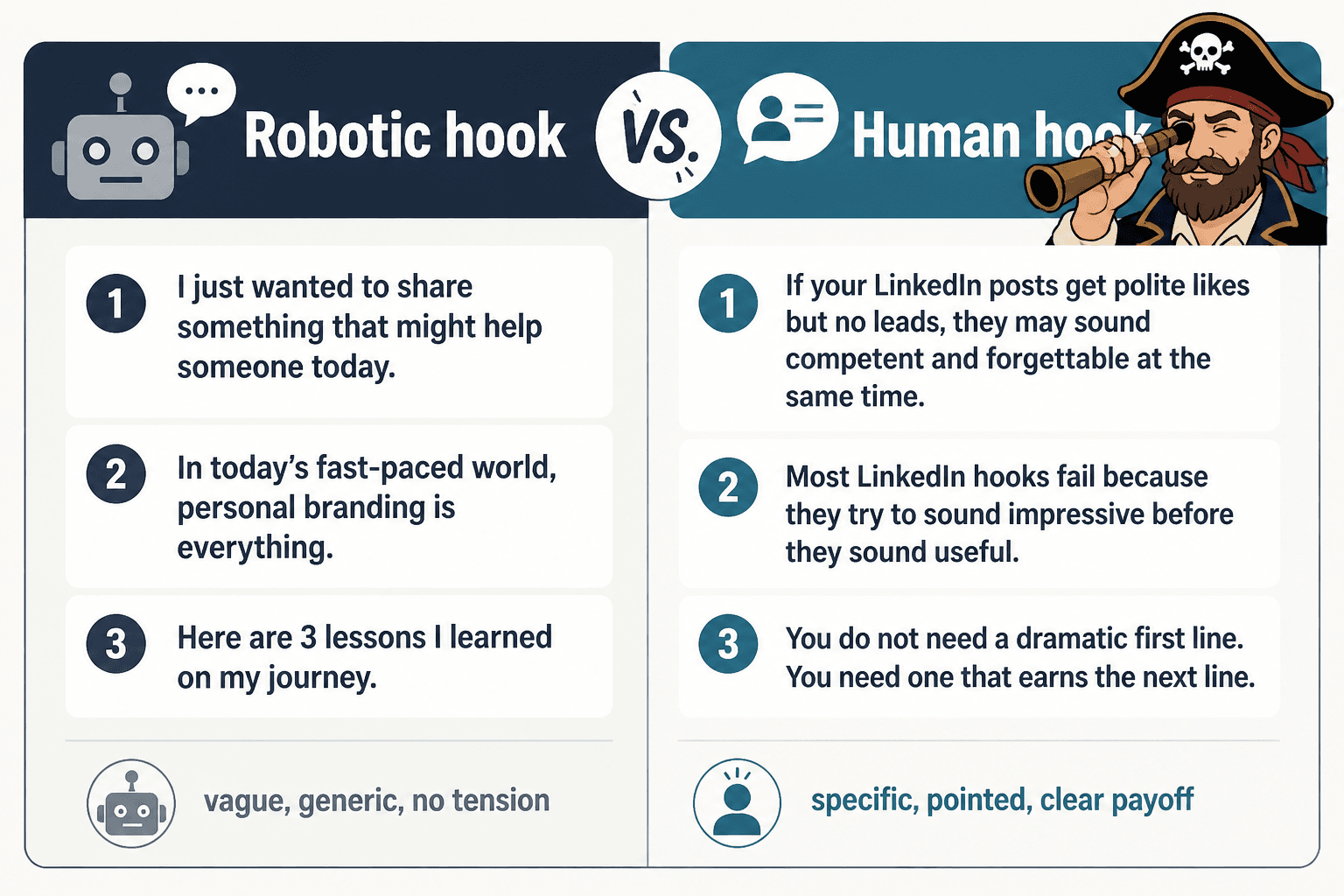
Nothing here is technically illegal. It is just vague, overfamiliar, and empty. There is no clear point, no tension with teeth, and no reason for the right reader to care.
A stronger hook does not need more drama. It needs more meaning.
If your LinkedIn posts get polite likes but no leads, the problem is usually not consistency. It is that your posts sound competent and forgettable at the same time.
That line has a reader, a problem, and a little bite. It feels like a person talking to another person, not a networking bot in loafers.
A good LinkedIn hook does 3 jobs fast
Your first line does not need to be clever. It needs to earn the next line.
Strong hooks usually do three things quickly:
- Name a real problem the reader recognizes
- Create useful tension by challenging a bad assumption or pointing at a missed opportunity
- Signal a worthwhile payoff without sounding like clickbait in a blazer
That’s it. You are not trying to write the most dramatic line on LinkedIn. You are trying to make the right person think, “Yes, this is for me. Keep going.”
Weak vs strong hook logic
| Weak hook | Why it flops | Stronger direction |
|---|---|---|
| I’m excited to share my thoughts on LinkedIn writing | Nobody was waiting for your excitement | Most LinkedIn writing advice makes posts sound cleaner and less readable |
| Here’s what nobody tells you about content | Overused and usually false | Useful content often fails because the packaging is bland |
| I used to think consistency was key | Generic and predictable | Consistency helps, but it won’t save weak positioning or weak hooks |
| 3 tips to improve your posts | No tension, no specificity | 3 formatting fixes that make LinkedIn posts easier to read without looking try-hard |
How to write LinkedIn hooks & formatting without sounding salesy or robotic
Let’s make this practical.
If your hooks feel stiff or salesy, there is a decent chance you are doing at least one of these things:
- Leading with yourself instead of the reader’s problem
- Using fake intrigue instead of clear tension
- Writing vague claims with no concrete angle
- Formatting for attention in a way that screams “please engage”
- Trying to warm up the sale before you’ve earned trust
Fix those, and the whole post gets better.
1. Start with a problem, not an announcement
Announcements are rarely interesting unless the reader already cares about you. Most people on LinkedIn do not wake up hoping to hear that you are thrilled to share a lesson.
They care about friction they already feel.
Instead of this:
I’m excited to share 5 lessons from writing on LinkedIn
Try this:
If your LinkedIn posts sound smart but get ignored, your opening is probably too polite to compete
The second version starts where the reader already is. That matters.
2. Use tension, not cheap mystery
Curiosity is useful. Manufactured suspense is exhausting.
Too many writers confuse “open loop” with “say almost nothing.” So they write hooks like:
I almost quit posting on LinkedIn last week.
Then something happened.
That might work if you are already famous, chaotic, or both. For most people, it reads like borrowed drama.
Better tension comes from contrast, surprise, or a clean challenge to a bad assumption:
- Helpful posts often fail because they explain too much before making a point
- Most weak LinkedIn hooks are not too short. They are too vague
- You do not need better insights. You need stronger packaging for the ones you already have
See the difference? There is curiosity, but it comes from substance.
3. Be specific enough to sound real
Robotic writing often hides behind broad, respectable words: growth, value, authenticity, leadership, strategy, mindset. These words are not evil. They are just often asked to do too much heavy lifting.
Specificity gives your hook traction. Compare these:
- Vague: Authentic content builds trust
- Better: Posts that sound a little less polished often get more trust than posts that read like approval-seeking brochures
- Vague: Good formatting improves readability
- Better: If every sentence gets its own line, your post starts to look less readable, not more
The more your line sounds like something an actual person would notice in the wild, the less robotic it feels.
4. Stop trying to sneak the pitch into the first breath
Salesy hooks usually smell salesy because they are built to qualify, pre-sell, and steer toward an offer before they have earned basic interest.
You can feel it in lines like:
If you’re a founder struggling to grow your brand, here’s why you need a content strategy that converts
That is not a hook. That is a brochure in sentence form.
A better move is to lead with a useful observation, then let the post create demand naturally:
A lot of founder content sounds informed, polished, and completely interchangeable. That’s usually a positioning problem long before it’s a posting-frequency problem.
That kind of opening builds trust because it sounds like you are trying to help, not lunge.
Formatting that helps instead of begging for attention
LinkedIn formatting matters, but not in the goofy way people talk about it. You do not need to chop every phrase into dramatic fragments or make the post look like it survived a formatting accident.
Good formatting does three things:
- Makes the post easy to scan
- Controls pace and emphasis
- Supports the idea instead of distracting from it
Use line breaks with intent
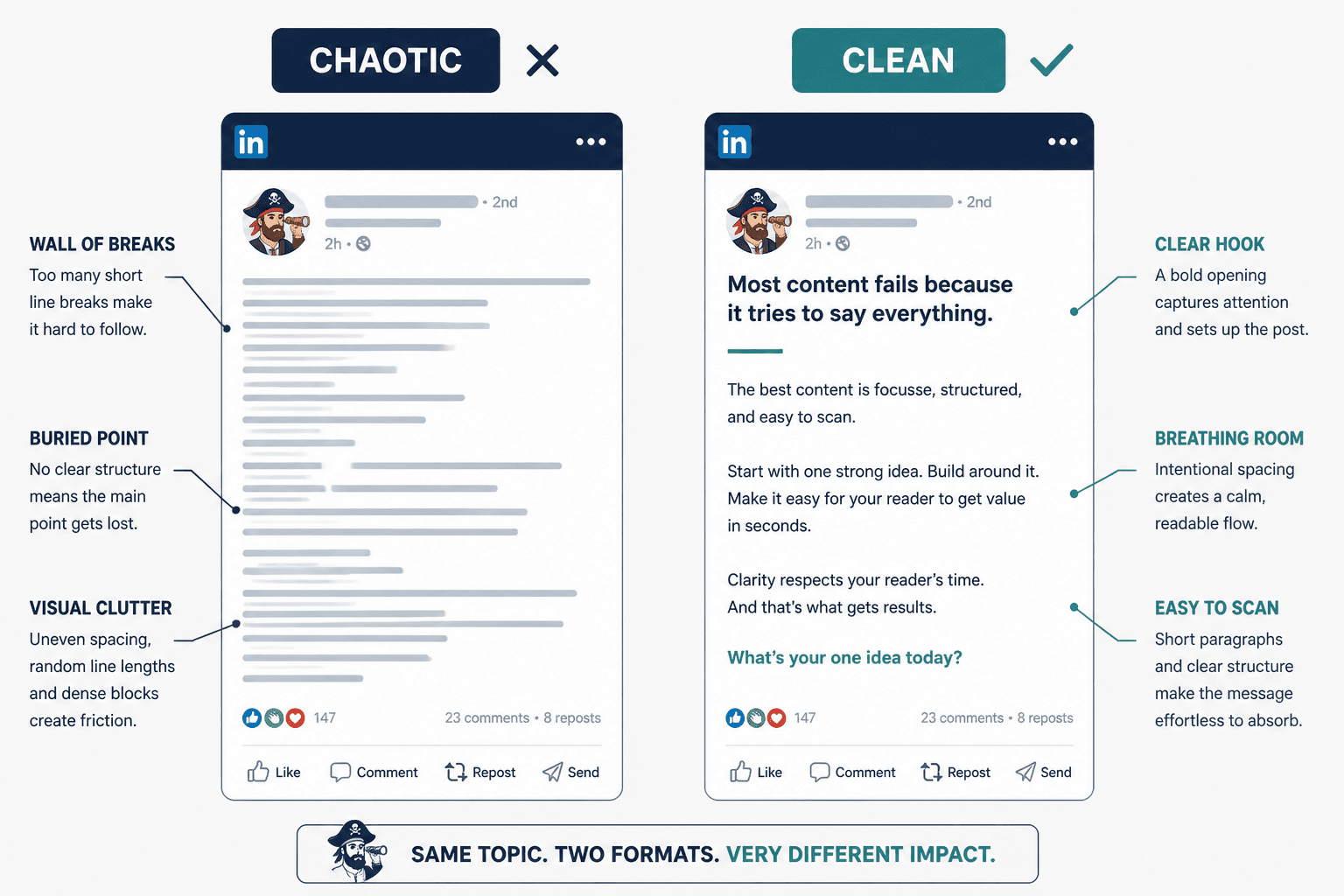
A clean LinkedIn post usually works well with short paragraphs of one to three lines. That gives the eye some room without turning the post into artificial spoken-word theater.
Too dense:
Most people think better LinkedIn posts come from more consistent publishing, but in practice a lot of posts underperform because they are badly packaged, have weak first lines, and bury the useful part under three sentences of setup that nobody needed.
Too choppy:
Most people think better LinkedIn posts
come from consistency.
But that is not really the problem.
The real problem?
Packaging.
Better:
Most people think better LinkedIn posts come from consistency.
That helps.
But a lot of underperforming posts have a simpler problem: weak packaging.
The hook is bland. The structure rambles. The useful point shows up too late.
Clean. Readable. Human.
If you want to go deeper on this piece alone, this guide on improving LinkedIn line breaks without sounding generic is worth reading next.
Front-load the interesting part
A lot of LinkedIn posts waste the top third on scene-setting. By the time the actual point arrives, the reader is gone.
Move the interesting sentence earlier.
Instead of:
I’ve been reflecting lately on what makes content really connect with audiences, and after writing for a while, I’ve come to realize something important about hooks and formatting.
Try:
Most bad LinkedIn hooks do not fail because they are too short. They fail because they say absolutely nothing with confidence.
That is the point. Start there.
If weak openings are your recurring problem, read how to start LinkedIn hooks and formatting without a weak opening.
Use emphasis sparingly
Not every sentence deserves a spotlight.
If you bold too much, break too much, tease too much, and stack one-line paragraphs for every thought, your post starts to look needy. A good post has rhythm. It does not keep grabbing your sleeve.
Use emphasis for:
- The main claim
- A sharp contrast
- A practical takeaway
- A short CTA at the end
Not for every sentence you happen to like.
5 hook formats that usually work on LinkedIn
You do not need one signature hook formula forever. But a few reliable patterns make writing easier and faster.
1. The sharp observation
A lot of LinkedIn advice helps people sound polished and less worth reading.
Good for opinion posts, content critiques, and authority building.
The bigger point is simple: clearer structure and clearer writing make the piece more useful. That is usually what makes the ending land better too.