Most old content does not fail on LinkedIn because the ideas are bad. It fails because the packaging is sleepy.
You already wrote the article, the email, the podcast outline, the client note, the webinar rant, or the decent post nobody saw. The problem is not “I need more ideas.” The problem is “I keep reposting solid thinking with weak first lines and formatting that makes people scroll past like they are avoiding eye contact at the grocery store.”
If you want to learn how to turn old content into better LinkedIn hooks & formatting, the job is not to recycle harder. It is to extract the sharpest angle, rebuild the opening, and format the post so the point actually lands. That is where most repurposing goes off the rails. People reuse the content but keep the original structure, which was built for a different platform, a different pace, and often a different level of reader commitment.
Here’s how to take what you already have and turn it into LinkedIn posts that are easier to read, more likely to get attention, and much less likely to sound like recycled content wearing a fresh blazer.
To see how this fits into the wider strategy, open the parent guide.
Why old content usually becomes bad LinkedIn posts
LinkedIn punishes lazy repurposing in a very boring way: people ignore it.
A blog intro is usually too slow. A webinar transcript is usually too wordy. A newsletter paragraph often assumes too much context. A podcast clip may have energy but no structure. And a thoughtful article headline can still become a useless LinkedIn hook if the first line sounds like it was cleared by six committee members and a timid intern.
The platform is faster than your long-form content. People are deciding in seconds whether your first line earns attention. Then they are judging the formatting almost as quickly. If it looks dense, vague, self-important, or weirdly polished, they move on.
So before you repurpose anything, accept this: old content is raw material, not a finished LinkedIn post.
Repurposing is not copy-paste with better spacing. It is extraction, reframing, and cleanup.
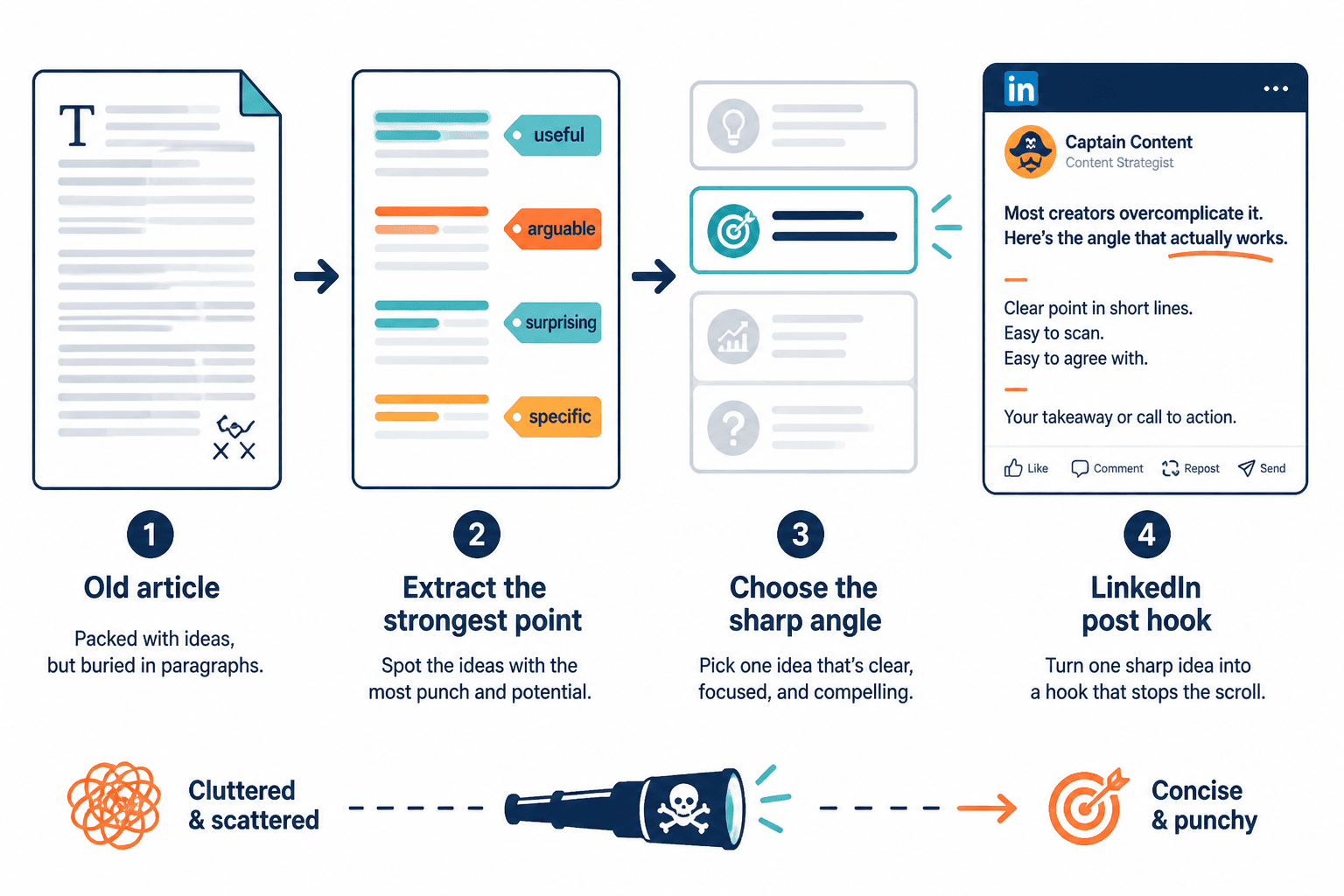
The 4-step process to turn old content into better LinkedIn hooks & formatting
You do not need a giant content system for this. You need a repeatable filter.
- Find the strongest point in the original content
- Choose the best hook angle for LinkedIn
- Rebuild the body for skim-reading
- Tighten the ending so it earns the next step
That’s it. Not glamorous. Very effective.
1. Find the strongest point, not the broad topic
This is where people get lazy. They take a broad topic like “content strategy” or “personal branding” and try to make that the post. That usually creates vague sludge.
Instead, pull out one sharp, usable point from the original content. Something with tension. Something that can stand on its own. Something a reader can react to, learn from, or disagree with.
For example, if your old article is about content repurposing, the LinkedIn post probably should not be “Here are 7 ways to repurpose content.” That is broad and familiar. A stronger extracted point might be:
- Most repurposed LinkedIn posts fail because the hook still sounds like a blog title
- Good LinkedIn formatting is not aesthetic, it is pacing
- One old article can produce 10 posts if you split the arguments correctly
- If the first two lines do not create tension, the rest barely matters
Now you have something with edges.
A simple extraction prompt for yourself:
What is the most useful, arguable, surprising, or specific thing inside this old content?
Start there. Not with the headline. Not with the summary. With the point that actually has teeth.
2. Pick a hook angle that fits LinkedIn
Once you have the point, you need a hook angle. Not every strong idea needs the same kind of opening.
LinkedIn hooks tend to work best when they do one of a few things well: challenge an assumption, expose a common mistake, make a specific promise, or create useful tension.
| Hook angle | What it does | Example |
|---|---|---|
| Contrarian | Pushes against a lazy default | Most repurposed LinkedIn posts fail before the second line. |
| Mistake-based | Calls out what people do wrong | If you are turning blog posts into LinkedIn posts by copying the intro, that is probably the problem. |
| Specific promise | Tells the reader what they will get | Here’s how to turn one old article into three stronger LinkedIn posts. |
| Observation | Names a pattern people recognize | A lot of smart people write weak LinkedIn posts because they refuse to cut context. |
| Proof-led | Leads with evidence or result | The highest-performing post in this batch came from a paragraph buried halfway through an old article. |
Notice what these examples are not doing:
- They are not throat-clearing
- They are not setting up a fake story
- They are not trying to sound profound
- They are not using vague drama like “Nobody tells you this”
If your old content starts with three paragraphs of context, your LinkedIn hook should probably start around paragraph four.
3. Rebuild the body for skimming, not deep reading
This is where formatting matters.
Good LinkedIn formatting is not about hitting enter after every sentence because somebody on the internet said that boosts reach. It is about controlling pace, emphasis, and readability. There is a difference.
When you turn old content into a LinkedIn post, compress the body so the reader can follow the point quickly.
- Keep paragraphs short
- Group related lines together
- Break before an important contrast or payoff
- Remove background details the post does not need
- Use bullets only when they actually improve clarity
Bad LinkedIn formatting often has one of two problems:
- A wall of text that feels like homework
- Overformatted line-by-line spacing that feels twitchy and artificial
You want a middle ground. Enough breathing room to read easily. Enough structure to feel intentional. Not enough line breaks to make it look like your post is gasping for air.
4. End with a clear finish, not a limp fade-out
A lot of repurposed posts just stop. They explain something decently, then wander into a flat ending like “Just some thoughts” or “What do you think?”
That is not a finish. That is abandonment.
Your ending should do one of three things:
- Drive the core point home
- Invite a relevant response
- Point to a useful next step
Examples:
- Drive it home: If your repurposed content still sounds like the original format, you did not adapt it. You reposted it.
- Invite response: What part of your old content usually produces the best LinkedIn posts: stories, opinions, examples, or rants?
- Next step: If you want stronger first lines, read this guide on writing better LinkedIn hooks and formatting.
How to rewrite old content into stronger LinkedIn hooks
Let’s make this less abstract.
Here are a few common old-content openings and what they should become instead on LinkedIn.
Example 1: Blog intro to LinkedIn hook
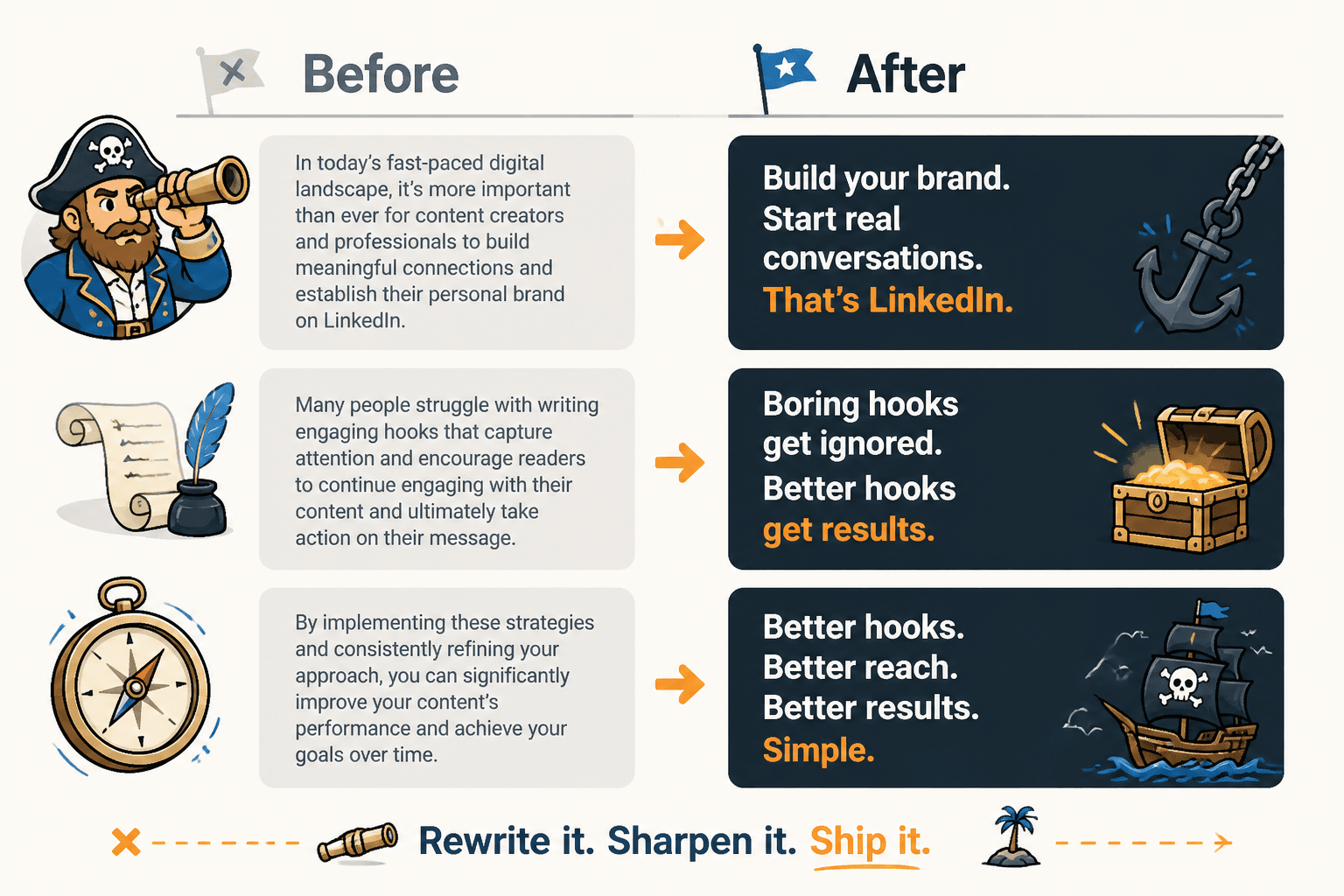
Before: “Repurposing content is one of the most effective ways to maximize your content strategy and extend the life of your ideas across multiple channels.”
After: “Most repurposed LinkedIn posts fail because they still sound like blog intros.”
The second version is better because it actually says something. It has tension. It creates an immediate reason to keep reading. It does not sound like a beige workshop handout.
Example 2: Newsletter paragraph to LinkedIn hook
Before: “This week I’ve been thinking about how creators can get more value from the content they have already published, especially on professional platforms.”
After: “You probably do not need more LinkedIn ideas. You need better extraction from the content you already wrote.”
This version is more direct and more useful. It skips the diary entry setup.
Example 3: Webinar teaching point to LinkedIn hook
Before: “During a recent client training, I explained that creating platform-native content often requires structural adjustments and thoughtful presentation choices.”
After: “If you paste webinar language into LinkedIn, it usually dies there.”
A little blunt? Sure. But now we have a hook people might actually read.
How to format repurposed LinkedIn posts so they do not look recycled
Formatting is where a good idea either becomes readable or becomes a chore.
When you reuse old content, the structure often carries too much baggage from the original format. Articles have intros and transitions. Emails have warmth and continuity. Podcasts ramble before they get somewhere. LinkedIn needs a cleaner rhythm.
Here is a simple formatting approach that works for many repurposed posts:
- Lead with one sharp line. Not two setup lines. Not “I’ve been reflecting.” One real opening.
- Add one or two lines that deepen the problem. Show the mistake, cost, or contrast.
- Deliver the useful part fast. A lesson, framework, example, or mini breakdown.
- Use spacing to separate ideas, not every sentence.
- End with a clean takeaway or CTA.
Here is a rough template:
[Hook]
[Why this matters / what people get wrong]
[1-3 short sections or examples]
[Clear takeaway]
[Optional comment prompt or next step]
That structure works because it respects how people read on the platform. It gives them momentum.
If you want more help on the visual side of readability, this piece on improving LinkedIn line breaks without sounding generic will help you clean up the pacing.
What kinds of old content make the best LinkedIn posts?
Not all old content repurposes equally well.
The best source material usually contains one or more of these:
- A strong opinion
- A practical lesson
- A clear mistake people make
- A useful contrast
- A client insight or pattern
- A process that can be compressed
- A line that already sounds quotable
The worst source material for LinkedIn repurposing is usually broad, padded, or too dependent on deep context. If the original content takes 800 words to warm up, your repurposed post should probably skip the first 600.
Good places to mine:
- Old blog posts
- Newsletters
- Workshop notes
- Sales call notes
- Client FAQs
- Podcast transcripts
- Webinar outlines
- Comments you left on other posts
That last one gets ignored a lot. Some of your best future posts are hiding inside comments where you were more natural, more direct, and less tempted to sound “professional.” Funny how that works.
A quick framework for turning one old piece into three LinkedIn posts
If you want more mileage from one source, stop trying to compress the whole thing into one post.
Instead, split it into three post angles:
The bigger point is simple: clearer structure and clearer writing make the piece more useful. That is usually what makes the ending land better too.