
Most welcome emails are bad in one of two ways.
They either sound like a corporate intern stitched them together from three abandoned SaaS templates, or they come in way too hot and start pitching before the reader has even finished deciding if they like you.
That is the real problem behind how to write welcome emails without sounding salesy or robotic. It is not just a tone issue. It is a trust issue. Your welcome email is often the first real conversation after someone says, “Fine, I’ll hear you out.” If you waste that moment on stiff copy or immediate selling, you are teaching people to tune you out early.
A good welcome email does three jobs at once: it makes the subscriber feel like they made a smart choice, it orients them to what happens next, and it starts building the kind of trust that makes future emails easier to open, read, and act on.
Here is how to write one that sounds human, useful, and confident without sliding into fake friendliness or funnel goblin behavior.
For the full path around this topic, head to the parent guide.
Why welcome emails go wrong so fast
People usually overcomplicate welcome emails because they treat them like a tiny sales page, a brand manifesto, and an onboarding flow all at once.
So the email ends up bloated. It thanks the subscriber five times. It uses phrases like “I’m thrilled to have you in my community.” It lists every possible thing the brand does. It adds three links, two offers, a calendar invite, and a soft pitch dressed up as a gift. Then it closes with something painfully polished like, “We look forward to supporting your journey.”
No one talks like that unless they are trapped inside a webinar platform from 2018.
The fix is not making the email “warmer” by sprinkling smiley faces on top. The fix is understanding what the reader actually needs in the first welcome email:
- confirmation that signing up was worth it
- a clear sense of what they will get
- proof that a real person or real point of view is behind the emails
- one simple next step, not seven
That is it. If you do those four things well, your welcome email already beats a depressing amount of what is out there.
The best welcome emails sound like a person with a point
You do not need to sound casual just for the sake of sounding human. You need to sound specific. Robotic emails usually are not robotic because the writer forgot contractions. They are robotic because they say generic things in polished language.
Compare these:
Welcome to our newsletter. We are excited to share valuable insights, updates, and resources to help you succeed.
You’re in. Expect practical emails about writing sharper content, building trust faster, and making your marketing sound less like it was approved by six nervous managers.
Both are technically clear. Only one sounds like somebody worth reading.
If your welcome email feels bland, do not ask, “How can I make this more engaging?” Ask, “What am I actually promising here, and can I say it like a normal person?”
That shift matters. It gets you out of performance mode and back into communication.
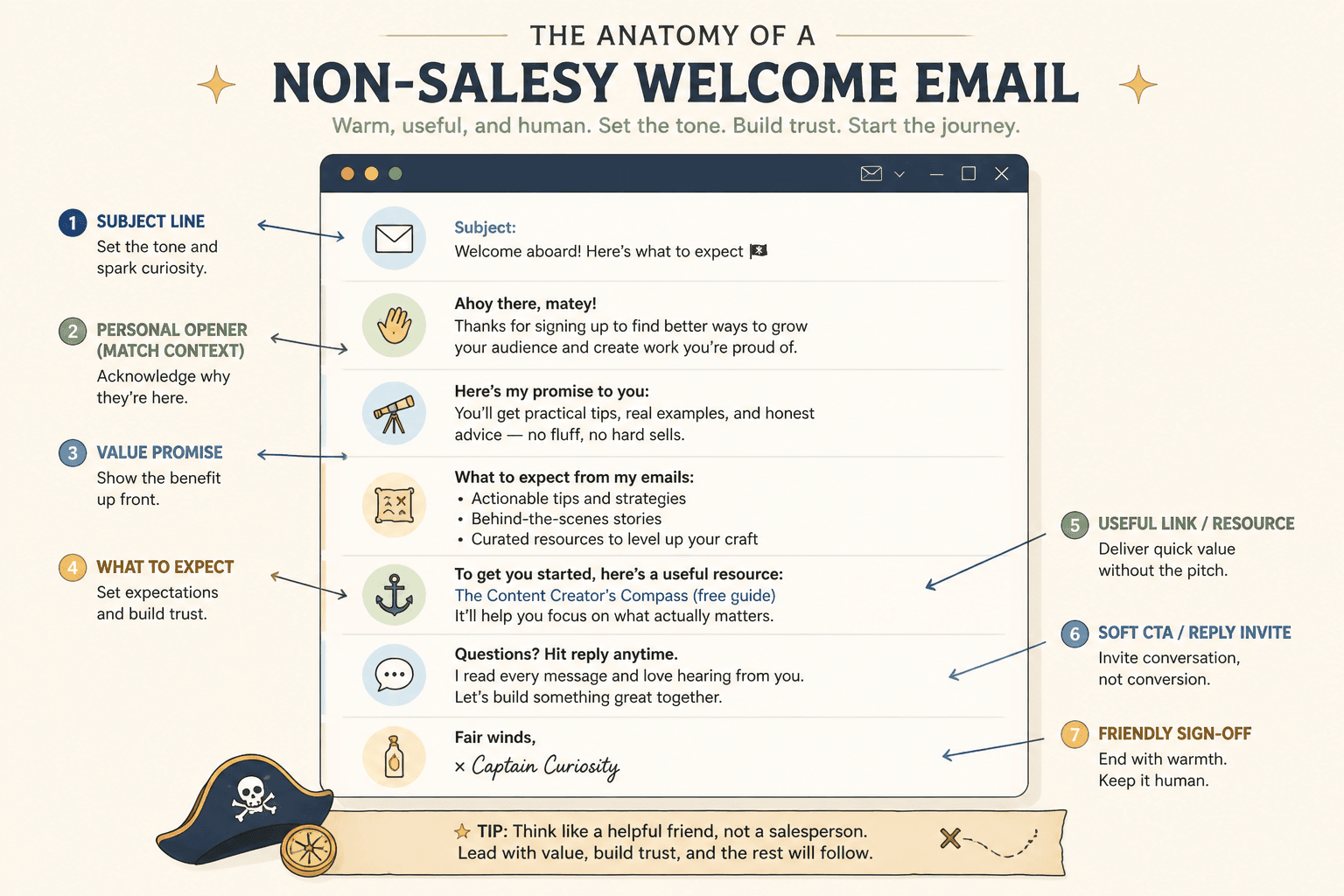
How to write welcome emails without sounding salesy or robotic
Here is a simple structure that works for most creators, consultants, coaches, freelancers, and service businesses.
1. Open like you know why they signed up
The first lines should match the context of the signup.
If they joined for a guide, mention the guide. If they signed up after reading your posts, mention what kind of emails they can expect. If they subscribed from a workshop or lead magnet, acknowledge the specific thing that brought them in.
Weak opening:
Welcome to the newsletter. I’m so excited you’re here.
Stronger opening:
You grabbed the guide on writing better welcome emails, so this is your official hello. Over the next few emails, I’ll help you make your onboarding sound sharper, clearer, and a lot less template-generated.
The second version works because it is grounded in context. It tells the reader, quickly, “Yes, this is the thing you signed up for. You are in the right place.”
If your openings tend to wobble, this is also where a stronger first line helps. If you want to tighten that piece specifically, read how to start welcome emails without a weak opening.
2. Set expectations without turning it into a brochure
Your subscriber wants to know what kind of emails you send, how often, and why they should care. They do not need your entire content ecosystem explained in bullet-point museum format.
A clean expectation-setting paragraph usually covers:
- what topics you email about
- what style or angle makes your emails different
- how often they will hear from you
Example:
I send one or two emails a week on email writing, welcome sequences, and the small messaging fixes that make more people read, trust, and reply. No bloated “nurture” fluff. Just practical stuff that helps your emails do their job.
Notice what this does not do. It does not oversell. It does not pretend every email will change their life. It simply tells the truth in a way that sounds crisp and intentional.
3. Give them one reason to trust you
This is where many people either brag too hard or avoid credibility entirely.
You do not need a chest-thumping bio paragraph. But you do need a sentence or two that answers the silent question: “Why should I listen to you?”
This can be:
- a specific kind of work you do
- who you help
- what you are known for
- a measurable or observable result
- a clear point of view developed through experience
Example:
I help creators and service businesses write emails that sound like real people and still sell. Most of my work lives in that awkward gap between “too stiff to connect” and “too pushy to trust.”
That line gives credibility without sounding like a résumé in a blazer.
4. Make the first step easy and low-pressure
A welcome email should usually include a next step. But “next step” does not automatically mean “pitch.”
Good welcome email next steps include:
- download the resource they requested
- read one related article
- hit reply with a relevant answer
- save your email address to their contacts
- check out a curated getting-started page
What you want is movement, not pressure.
Example:
If you want, hit reply and tell me what your current welcome email sounds like: too stiff, too vague, or too salesy. I read replies, and it helps me send more useful stuff.
That CTA works because it feels like a conversation, not a conversion ambush.
If you are building a fuller sequence, it is worth also looking at how to improve welcome emails and mini onboarding flows without sounding generic.
5. Keep the selling light, earned, or delayed
You can mention an offer in a welcome email. The problem is not mention. The problem is timing, weight, and tone.
If someone signed up specifically because they were interested in a service or product, a soft mention can make sense. But if they joined for a free resource and your first email immediately lunges into “book a call,” do not act surprised when your unsubscribes start doing cardio.
If you do include an offer, keep it brief and secondary:
If you’re already looking for hands-on help, I also work with clients on email strategy and welcome sequences. No pressure. You can check that out here if and when it makes sense.
That is enough. No countdown timers. No fake urgency. No “spots are filling fast” unless you enjoy sounding suspicious.
What makes a welcome email feel robotic
Usually, it is not one huge mistake. It is a pile of smaller ones.
| Robotic move | Better move |
|---|---|
| Generic gratitude | Reference the signup context |
| Corporate-sounding phrases | Use plain language with a point of view |
| Too much brand summary | Tell them only what they need next |
| Instant hard pitch | Offer a low-pressure next step |
| Over-polished tone | Write like a competent human, not a committee |
| Long list of links | Choose one main action |
One more thing: robotic writing often comes from fear. People are trying so hard to sound professional that they strip out all specificity, opinion, and rhythm. What remains is technically clean but emotionally dead.
Professional does not mean bloodless. It means clear, intentional, and trustworthy.
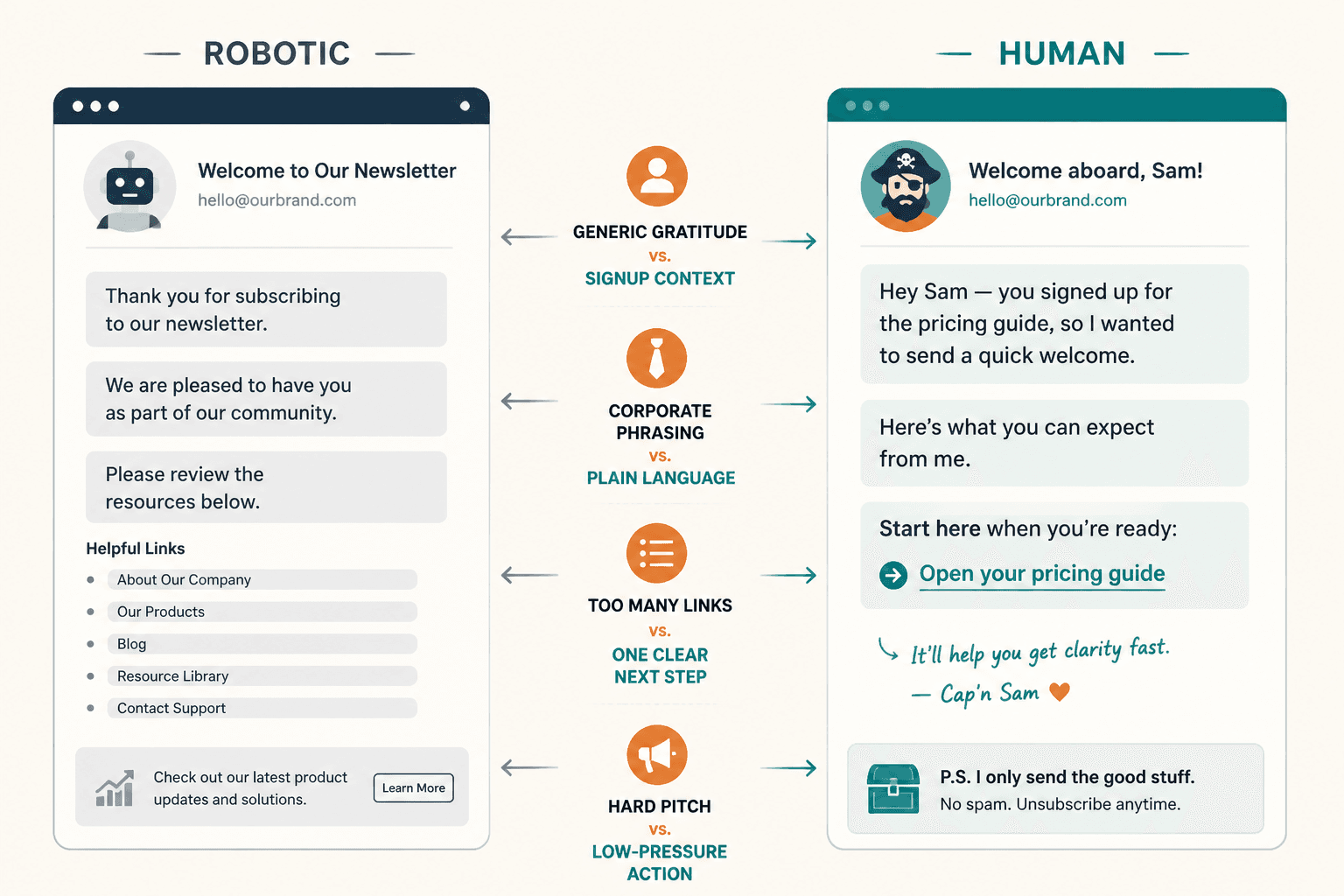
A simple welcome email template that does not sound canned
Use this as a structure, not a script to copy word-for-word.
Subject line: You’re in
Email body:
Hey [First Name],
You signed up for [specific thing], so I wanted to send a quick proper welcome.
From here, you can expect [type of emails] about [topics]. I usually send [frequency], and I try to keep them [tone/style benefit].
A bit about me: [one or two lines of relevant credibility or point of view].
Your next step is simple: [one clear action].
And if you ever want to reply and tell me what you’re working on or where you’re stuck, go for it. I read replies.
— [Name]
Now here is a filled-in version for a consultant or creator:
Hey Sam,
You signed up for the welcome email guide, so here’s your proper hello.
I send one or two emails a week about email strategy, onboarding flows, and the small writing tweaks that make people trust you faster instead of tuning out. They are practical, occasionally opinionated, and usually shorter than the average internet sermon.
I help creators and service businesses fix email copy that sounds stiff, generic, or quietly desperate.
If you want a good place to start, read this next: [link/article].
And if your current welcome email is a mess, reply with it. I can’t rewrite everyone’s whole sequence in my inbox, but I do read replies and they help me send better stuff.
— Jane
That template works because it does not try to do too much. It welcomes, orients, positions, and nudges. Clean job. No theatre.
Before-and-after rewrite: from stiff to readable
Here is the kind of welcome email that sounds polished in the wrong way.
Before:
Hello and welcome to our community. We are delighted to have you here. Our mission is to empower professionals with valuable insights, actionable resources, and innovative strategies to support their success. Be sure to explore our website and follow us for additional updates. If you are ready to take the next step, schedule a consultation today.
This email has a few problems:
- it sounds interchangeable with a hundred other brands
- it says “valuable” and “actionable” without proving either
- it gives no real sense of what the emails are about
- it jumps to the sale too quickly
After:
The bigger point is simple: clearer structure and clearer writing make the piece more useful. That is usually what makes the ending land better too.