
Most tool reviews get bloated for one simple reason: people confuse “more options” with “more value.” They pack in 17 tools, 9 subcategories, 4 pricing tiers, and a partridge in a comparison table, then wonder why the piece feels exhausting instead of useful.
If you’re wondering How Many Tools Belong in Tool Reviews?, the short answer is this: fewer than most people think. The right number depends on the review’s job. Some reviews should cover one tool. Some should compare three. A few deserve a bigger roundup. But once the list gets too long, the review stops helping people choose and starts making them tired.
That matters if you’re using tool reviews for traffic, affiliate income, authority, or sales support. Good reviews reduce friction. Bad ones create it. Here’s how to choose the right number of tools, keep your review useful, and avoid writing a giant beige list nobody finishes.
For the broader learning path, visit our parent guide.
Start with the real job of the review
Before you decide how many tools to include, decide what the review is supposed to do.
This is where a lot of creators go off the rails. They start with, “I should make a big roundup because it looks comprehensive.” That sounds sensible right up until the article turns into a swamp of tiny summaries and recycled feature lists.
A better question is: what decision is the reader trying to make?
- If they’re choosing between two or three obvious options, keep the review tight.
- If they’re new and need a shortlist, give them a curated set.
- If they need a directory-style scan of the market, a larger roundup can work.
- If your goal is to make a case for one tool, do a focused single-tool review.
Tool reviews work best when they reduce confusion, not perform research theater.
The right number of tools is the number that helps the reader make a decision without opening six extra tabs and forgetting why they came in the first place.
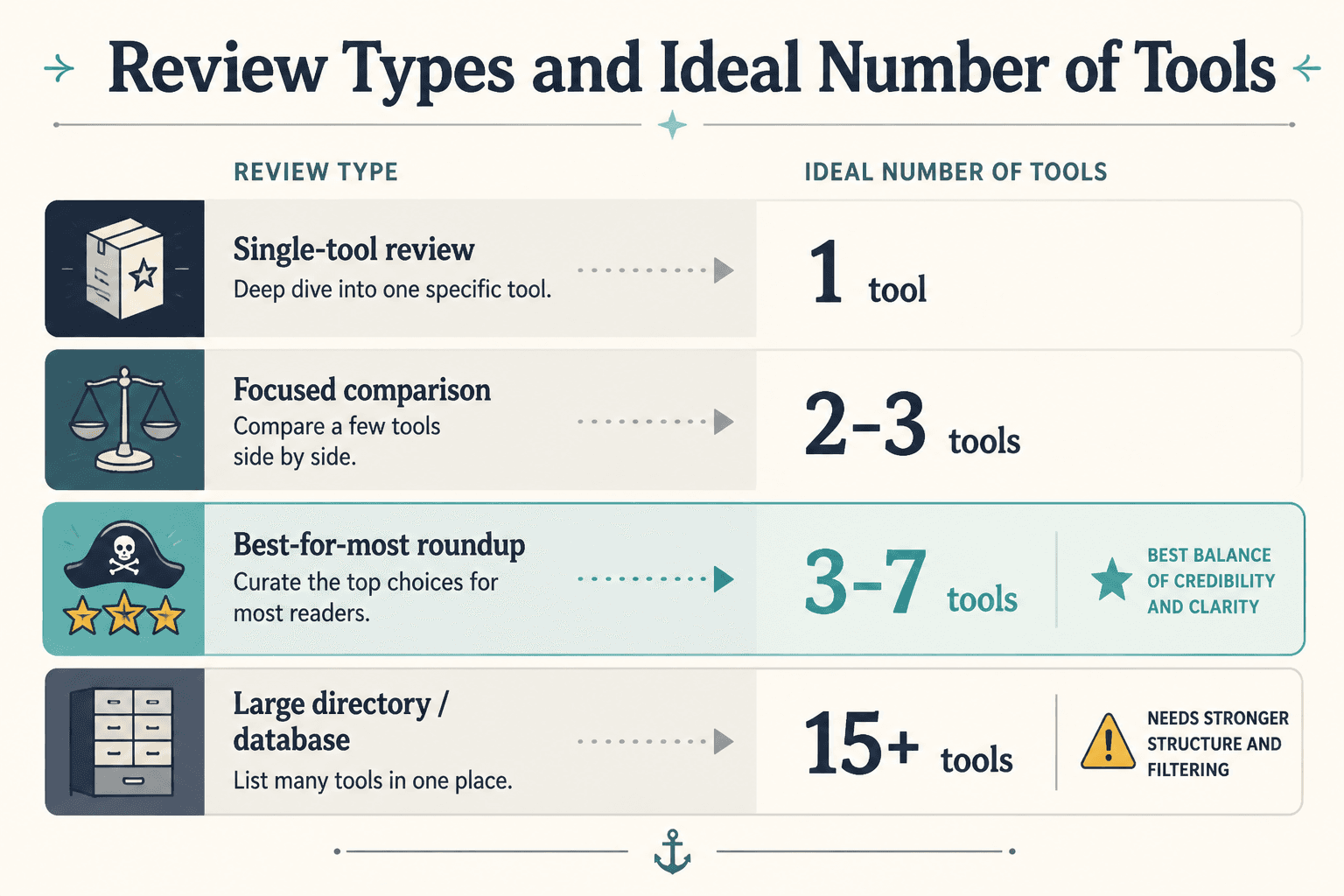
How many tools belong in tool reviews? Use this practical range
If you want a useful rule of thumb, here it is.
| Review type | Best tool count | What it’s good for |
|---|---|---|
| Single-tool review | 1 | Deep evaluation, affiliate conversions, proving fit |
| Head-to-head comparison | 2–3 | Helping readers choose between close alternatives |
| Curated shortlist | 4–7 | Giving readers enough options without overload |
| Large roundup | 8–12 | Search coverage, broad discovery, category overviews |
| Massive list post | 13+ | Usually too many unless the article is a directory |
For most creators, consultants, and niche publishers, the sweet spot is usually 3 to 7 tools. That is enough variety to feel credible, but not so much that the article turns into a spreadsheet wearing a fake smile.
If you regularly publish reviews with 15, 20, or 30 tools, ask yourself something slightly uncomfortable: are you helping people choose, or just trying to rank for every variation of the keyword at once?
There’s a place for bigger roundups, sure. But they need a different structure, a stronger filter, and a very clear reason to exist. If you’re better at making recommendations than assembling giant directories, that is not a flaw. That’s taste.
When one tool is enough
Single-tool reviews are underrated. People act like they need a full market roundup to be useful, but often the reader already knows what tool they’re considering. They just want to know if it’s worth the money, who it’s actually for, what it does well, and where it falls apart.
One-tool reviews work especially well when:
- The tool has strong search demand on its own
- You’ve actually used it enough to say something real
- The product solves a clear problem
- The reader is close to buying and needs confidence
- You can include examples, screenshots later, or honest pros and cons
The upside is depth. You can explain setup friction, pricing traps, best-fit users, weird limitations, and actual use cases. That’s hard to do inside a bloated roundup where each tool gets three polite paragraphs and a list of features copied from the homepage.
If your review can genuinely answer, “Should I use this?” then one tool is not too few. It’s probably exactly right.
When to compare 2 to 3 tools
This is often the strongest format for conversion-focused reviews.
Why? Because people don’t usually choose from 19 serious contenders. They narrow things down fast. Once they’re deciding, they want contrast. Not volume. A sharp comparison between two or three tools is easier to trust because it feels like an actual recommendation, not a content farm trying to inhale affiliate clicks through a paper straw.
Use a 2-to-3-tool format when:
- The tools serve the same main use case
- The audience is likely deciding between recognizable alternatives
- You can explain meaningful differences in workflow, pricing, simplicity, or results
- The decision comes down to fit, not just features
For example, if you’re reviewing writing tools, “best writing tools” may be too broad. But “which writing assistant is better for solo creators” gives you something useful to compare. That’s the difference between content and clutter.
Why 4 to 7 tools is often the sweet spot
If you’re creating a roundup rather than a deep review, 4 to 7 tools is usually the healthiest range.
It gives you enough room to cover different reader needs without forcing the article into bloat. You can include a best overall option, a budget pick, a beginner-friendly tool, a power-user choice, and maybe one or two niche alternatives. That’s useful curation. It respects the reader’s time and still gives them options.
More importantly, this range forces you to make choices. And good review content needs choices. If every tool is included, then inclusion itself means nothing. Readers can tell when you have a point of view and when you’re just afraid to leave anything out.
A strong shortlist article usually has:
- A clear category and audience
- A reason each tool made the list
- A distinct best-for label
- A quick “skip this if…” note where relevant
- A closing recommendation for different buyer types
If you want examples of stronger roundup formats, simple tool reviews often beat giant roundups for exactly this reason. Tighter scope usually means better decisions.
When large roundups actually make sense
Big roundups are not automatically bad. They are just easier to mess up.
A large roundup can work if the search intent is broad, the category is crowded, and the reader genuinely wants to scan a market. In that case, 8 to 12 tools can be reasonable. But only if the structure is strong enough to stop the piece from becoming a scrolling punishment.
Large roundups need:
- Clear filtering criteria
- Useful categories or use cases
- Fast summaries before deeper notes
- A comparison table that actually helps
- Recommendations based on reader type
- Honest exclusions and tradeoffs
If you cannot explain why tool number 11 is there, it probably shouldn’t be.
And if all 12 tools somehow end up being “great for everyone,” congratulations, you have written a brochure.
For broader category work, the parent tool reviews hub is the kind of place where larger coverage can make sense because the structure supports exploration across multiple articles, not one giant overloaded page.
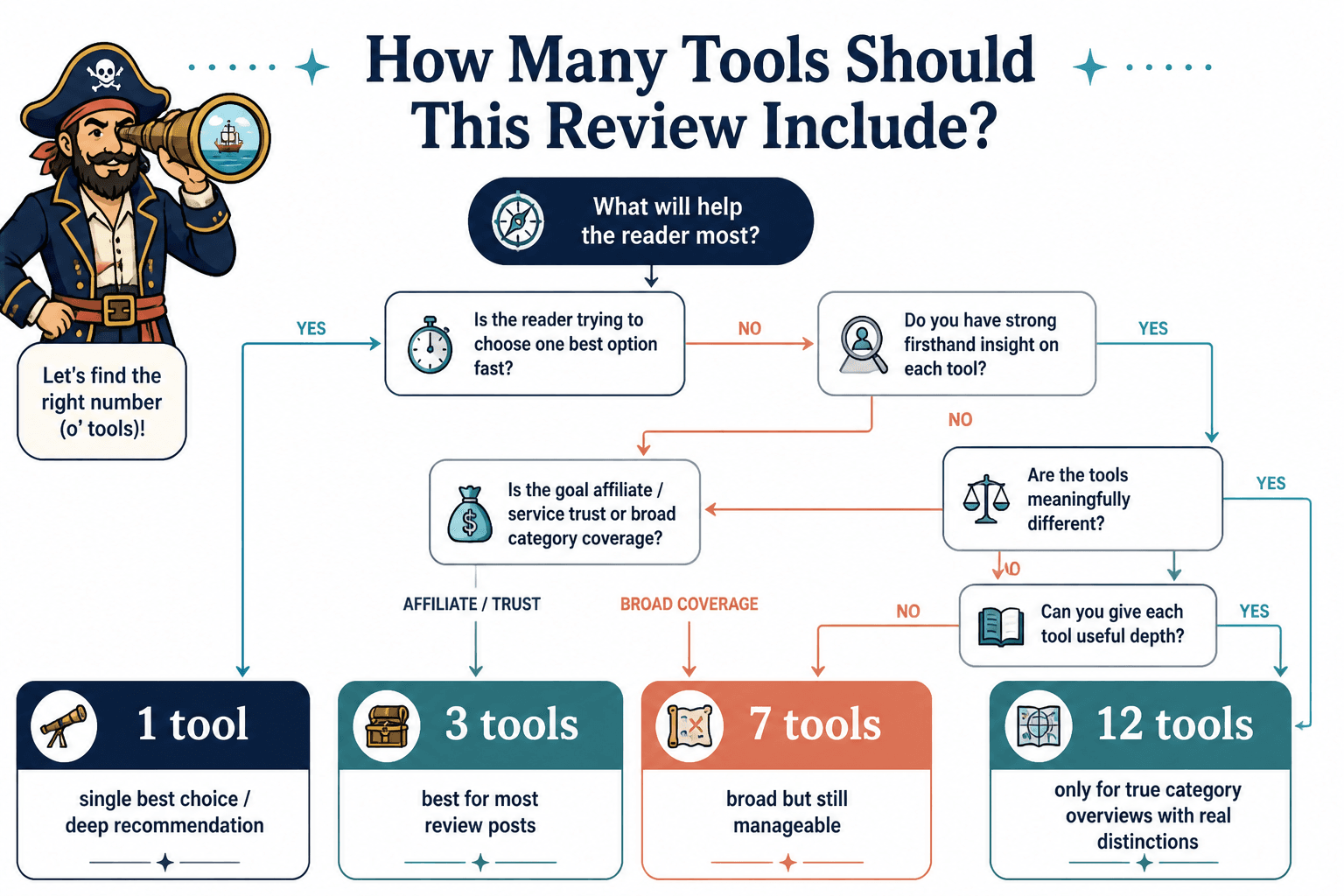
What decides the right number of tools
If you want to choose the right review size on purpose, use these factors.
1. Reader intent
Are they browsing, comparing, or trying to buy? Browsers can handle a larger list. Buyers usually want fewer options and stronger guidance.
2. Tool category complexity
Some categories are simple. Some are messy. Reviewing three newsletter tools is not the same as reviewing creator CRMs, editing suites, or all-in-one business platforms. The more overlap and nuance, the fewer tools you should include unless you’re building a real directory.
3. How much firsthand insight you have
This one gets ignored constantly. If you’ve deeply used three tools and vaguely researched twelve, the three-tool review will usually be better. Readers are not starving for more shallow summaries. They are starving for somebody to say something real.
4. Your monetization goal
If the article supports affiliate conversions or service trust, narrower often works better. If the goal is search visibility and category coverage, broader can make sense. Just do not use “SEO” as a permission slip for making the article worse.
5. The amount of meaningful difference between tools
If the tools are barely different, adding more does not add value. It adds noise. A review should help the reader understand distinctions that matter in practice, not just tiny feature variations no sane buyer actually cares about.
Signs your tool review includes too many tools
- Each tool gets less than a useful paragraph or two
- The summaries all sound interchangeable
- You rely heavily on feature lists instead of judgment
- The article has no clear recommendation
- The comparison table is doing all the work
- The reader still cannot tell which tool fits them best
- You included tools mainly because competitors did
That last one is sneaky. A lot of review content gets built backwards: “I saw another article include 14 tools, so I should too.” That is not strategy. That is copying somebody else’s mess with better formatting.
How to structure reviews based on tool count
The number of tools should shape the article structure. If it doesn’t, the piece gets awkward fast.
For 1 tool
- Who it’s for
- What problem it solves
- What it does well
- What it does poorly
- Pricing reality
- Best use cases
- Verdict
For 2 to 3 tools
- Quick winner summary
- Comparison table
- Tool-by-tool analysis
- Best for different buyer types
- Final pick by use case
For 4 to 7 tools
- How you chose the tools
- Best overall and category winners up top
- Short comparison table
- Brief but distinct writeups
- Who should choose what
For 8 to 12 tools
- Category segmentation
- Fast summaries for scanners
- Expandable-feeling progression through the list
- Clear tradeoffs
- A recommendation shortcut for overwhelmed readers
The structure should get more selective as the list gets longer. Otherwise, the review becomes a parade of mini blurbs with no logic holding them together.
Better review strategy for creators and affiliate writers
If you publish tool reviews regularly, you do not need every article to do everything.
In fact, a smarter content strategy is usually a mix:
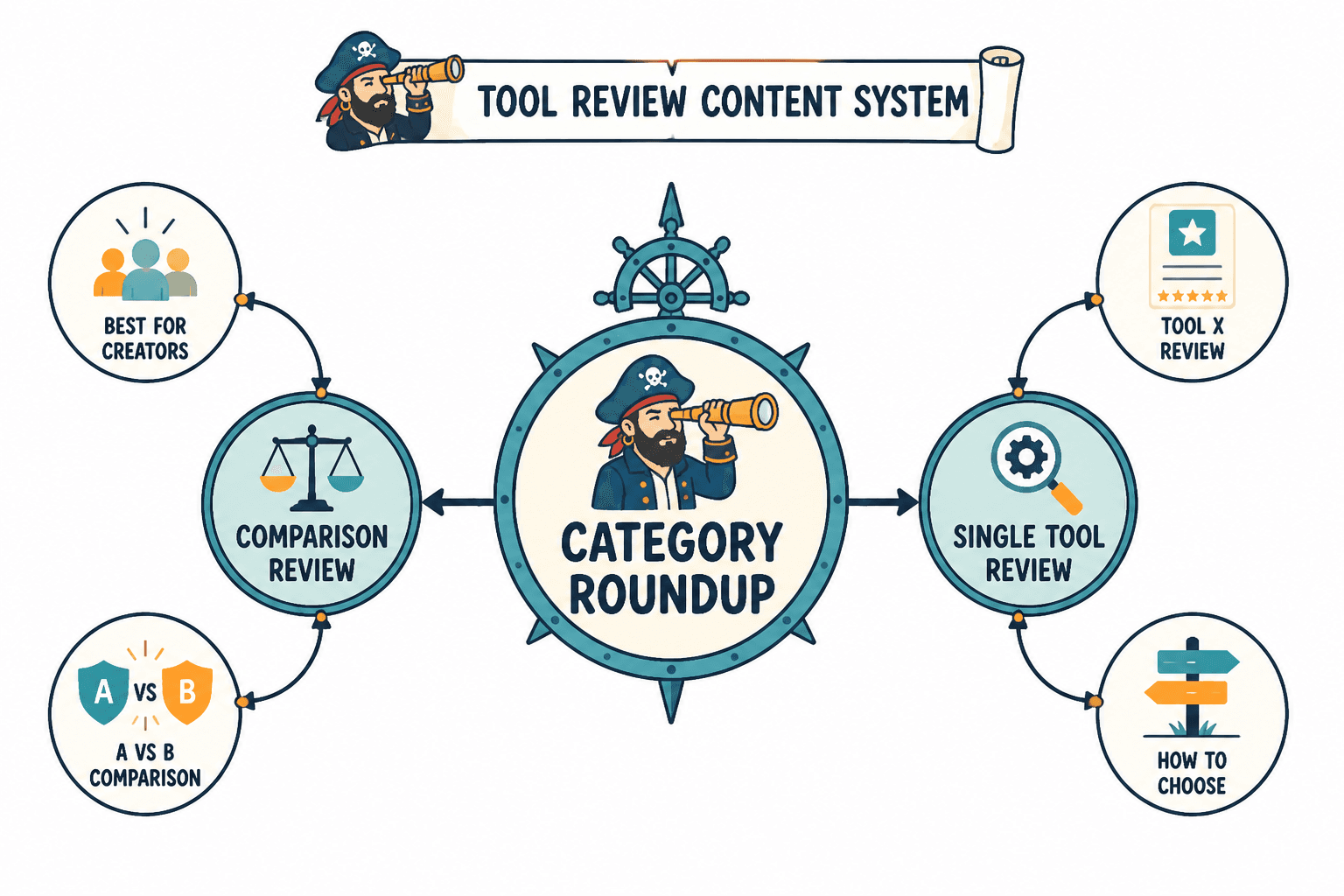
- One broad category roundup
- Several tighter comparison posts
- A few deep single-tool reviews
- Articles that help readers avoid bad-fit purchases
That approach gives you both breadth and depth. It also creates cleaner internal linking. A broader roundup can link out to focused reviews, while focused reviews can link back to broader decision pages.
For example, a category roundup can point readers toward the best tool reviews for creators in 2026, while decision-stage content can connect naturally to how to choose tool reviews without wasting money. You are not forcing one article to carry the entire content system on its back like an exhausted intern.
If you’re building out a monetization content stack, it also helps to anchor reviews inside broader topic paths such as tool reviews and related money-content sections. That way, each review has a job inside the funnel instead of floating around hoping Google adopts it.
A simple framework for choosing the right tool count
If you want a fast decision method, use this.
- Use 1 tool when the article is about evaluation.
- Use 2 to 3 tools when the article is about decision-making.
- Use 4 to 7 tools when the article is about curated recommendations.
- Use 8 to 12 tools when the article is about market scanning.
- Go past 12 only when you are intentionally building a directory-style resource.
That’s it. Not mystical. Not algorithmic. Just useful.
FAQ
Is 10 tools too many for a review?
Not always. It’s too many for a focused buying decision, but fine for a category roundup if the structure is tight and the differences are meaningful.
The bigger point is simple: clearer structure and clearer writing make the piece more useful. That is usually what makes the ending land better too.