
Most Facebook posts sound salesy or robotic for the same reason bad networking does: the person writing them is trying to get something before they’ve sounded like someone worth listening to.
You can feel it immediately. The over-polished “value” post. The fake conversational question. The weirdly formal story that ends in a pitch doing finger guns. It’s not that the writer is evil. It’s that the post was built backwards.
If you want to learn How to Write Facebook Posts Without Sounding Salesy or Robotic, the fix is not “be more authentic” and other fluffy nonsense. The fix is simpler: write like a person, lead with something worth saying, and stop treating every post like a disguised landing page.
This article will show you how to make your Facebook posts sound more natural, more readable, and more trusted, without turning them into vague diary entries or accidental sales copy. You’ll get practical rules, examples, rewrites, and a few things to stop doing immediately.
To see how this fits into the wider strategy, open the parent guide.
Why Facebook posts get weird so fast
Facebook is a conversational platform pretending to be many things at once. It can handle business content, but it punishes stiffness fast. People scroll Facebook expecting human texture. Not corporate throat-clearing. Not “I help purpose-driven founders unlock scalable alignment.” Not a post that reads like it was assembled by a content intern trapped in a webinar funnel.
A lot of creators make the mistake of importing their LinkedIn voice straight onto Facebook. That usually means the post becomes too polished, too tidy, too eager to prove expertise. Facebook tends to work better when the writing feels like it came from an actual person with an actual point, not a brand mascot with a quarterly content calendar.
The goal is not to sound casual for the sake of it. The goal is to sound believable. Believable wins attention. Believable earns replies. Believable sells later.
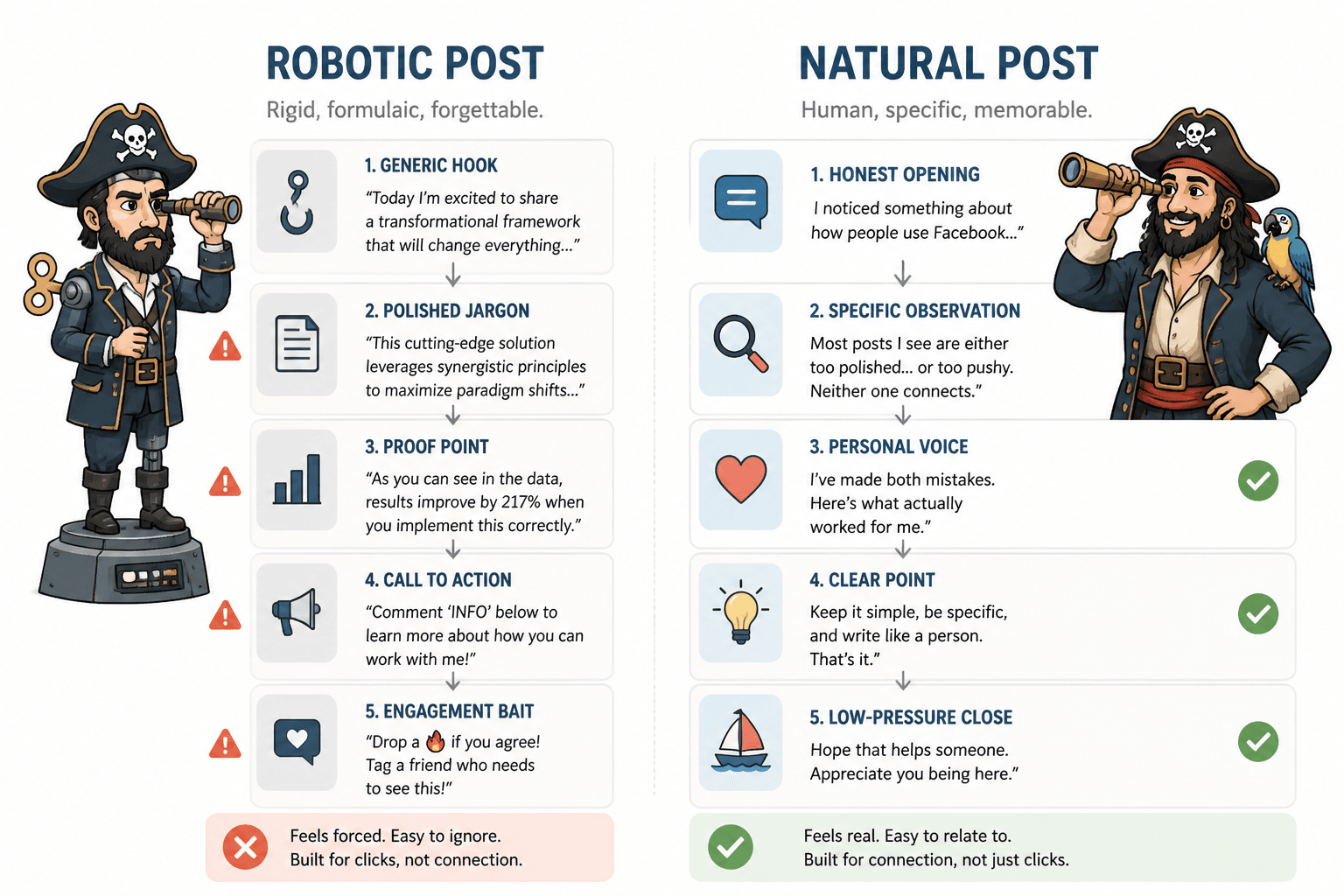
What “salesy” and “robotic” usually look like
Before fixing the problem, it helps to name it properly.
Salesy posts usually do one or more of these
- Push toward an offer too quickly
- Frame every story as a setup for a pitch
- Use needy engagement bait before trust exists
- Sound like they were written to “convert” rather than connect
- Treat the audience like leads first, humans second
Robotic posts usually do one or more of these
- Use stiff, over-edited language
- Hide the real point under generic fluff
- Follow a template so hard that all personality disappears
- Sound weirdly formal, especially in the opening
- Use vague business phrases instead of specific observations
The overlap is obvious. When a post sounds robotic, people trust it less. When they trust it less, even a mild CTA feels salesy. So the real job is not just softening the pitch. It’s improving the whole reading experience.
Start with a point, not a performance
A strong Facebook post usually begins with one clear thing you want to say. Not five. Not a broad topic. One point.
That point might be an observation, a frustration, a lesson, a small story, a pattern you keep seeing, or a question people actually want to answer. What matters is that you know the point before you start writing. Otherwise the post gets padded with filler, then “saved” with a CTA taped on the end. Classic mess.
Weak writers often begin with the performance of posting. Strong writers begin with the substance.
If your post has no real point, sounding human won’t save it. It will just be human-sounding drift.
A simple test: can you explain the post in one sentence before writing it?
- “People trust specific stories more than polished advice.”
- “Most low-engagement Facebook posts die in the first line.”
- “The reason your posts feel salesy is that they’re trying to close before they’ve connected.”
That sentence becomes your anchor. Everything in the post should serve it.
Write like you talk, but cleaner
“Write like you talk” is decent advice until people use it as permission to ramble for 700 words with no structure and three fake epiphanies. So here’s the better version: write like you talk when you actually know what you mean.
Natural writing has rhythm. It uses contractions. It doesn’t overstate. It doesn’t keep reaching for impressive words when normal ones are doing the job just fine. It also doesn’t dump every half-formed thought into the post because “that’s authentic.”
Good Facebook writing tends to sound like a sharp voice note that got edited. Not like an essay. Not like a brochure. Not like a chatbot trying to be your business bestie.
Quick ways to sound more natural
- Use contractions when they fit
- Prefer plain words over abstract ones
- Cut filler like “I wanted to come on here and say”
- Replace “valuable insights” with the actual insight
- Use one strong phrase instead of three weak sentences
- Keep some sentence fragments if they improve rhythm
Example:
Robotic: “I have been reflecting on the importance of consistency in content creation and how it can support long-term brand visibility.”
Better: “Consistency matters, but not in the way people keep pretending it does. Posting daily won’t save boring content.”
Same topic. Very different pulse.
The easiest way to sound less salesy: stop circling your offer in every post
One of the fastest ways to make your Facebook posts feel strained is to write every post with the hidden agenda glowing through the drywall.
People are not stupid. They can tell when the story exists only to force an offer mention. They can tell when the “lesson” was reverse-engineered from your service page. They can tell when the “question” is just a clumsy path into your DMs.
That doesn’t mean never selling. It means not making every post do the full job of awareness, trust, persuasion, and conversion in one breathless block of text.
Better approach:
- Post something genuinely useful, interesting, or discussion-worthy.
- Make the reader feel understood or informed.
- Only add a CTA when it actually fits the post.
- Keep the CTA proportionate.
That last part matters. A gentle CTA attached to a strong post feels fine. A hard CTA attached to a thin post feels desperate.
Examples of salesy CTAs versus better ones
| Too salesy | Better |
|---|---|
| DM me “GROWTH” if you’re serious about scaling your brand | If this is something you’re working on, happy to talk it through |
| I have 3 spots left for my coaching offer | I help clients fix this exact issue, so if you want help, that’s what I do |
| Comment YES and I’ll send details | If you want the framework, I can send it over |
You’ll notice the better versions don’t perform urgency unless urgency is real. They don’t shout. They don’t lunge. They leave room for the reader to be an adult.
Use openings that sound like a person had a thought
The opening line sets the tone for everything after it. If the first line sounds stiff, generic, or obviously strategic, the whole post has to fight uphill.
This is why so many Facebook posts die before the second sentence. The opening is usually some version of:
- “A reminder that consistency is key”
- “Just wanted to share a thought”
- “As entrepreneurs, we all know…”
- “One thing I’ve learned on my journey…”
Those aren’t openings. They’re throat-clearing in a blazer.
A stronger Facebook opening tends to do one of these:
- Make a clear observation
- Say something slightly surprising but true
- Name a tension people recognize
- Start mid-thought in a way that feels alive
- Present a specific scenario
Examples:
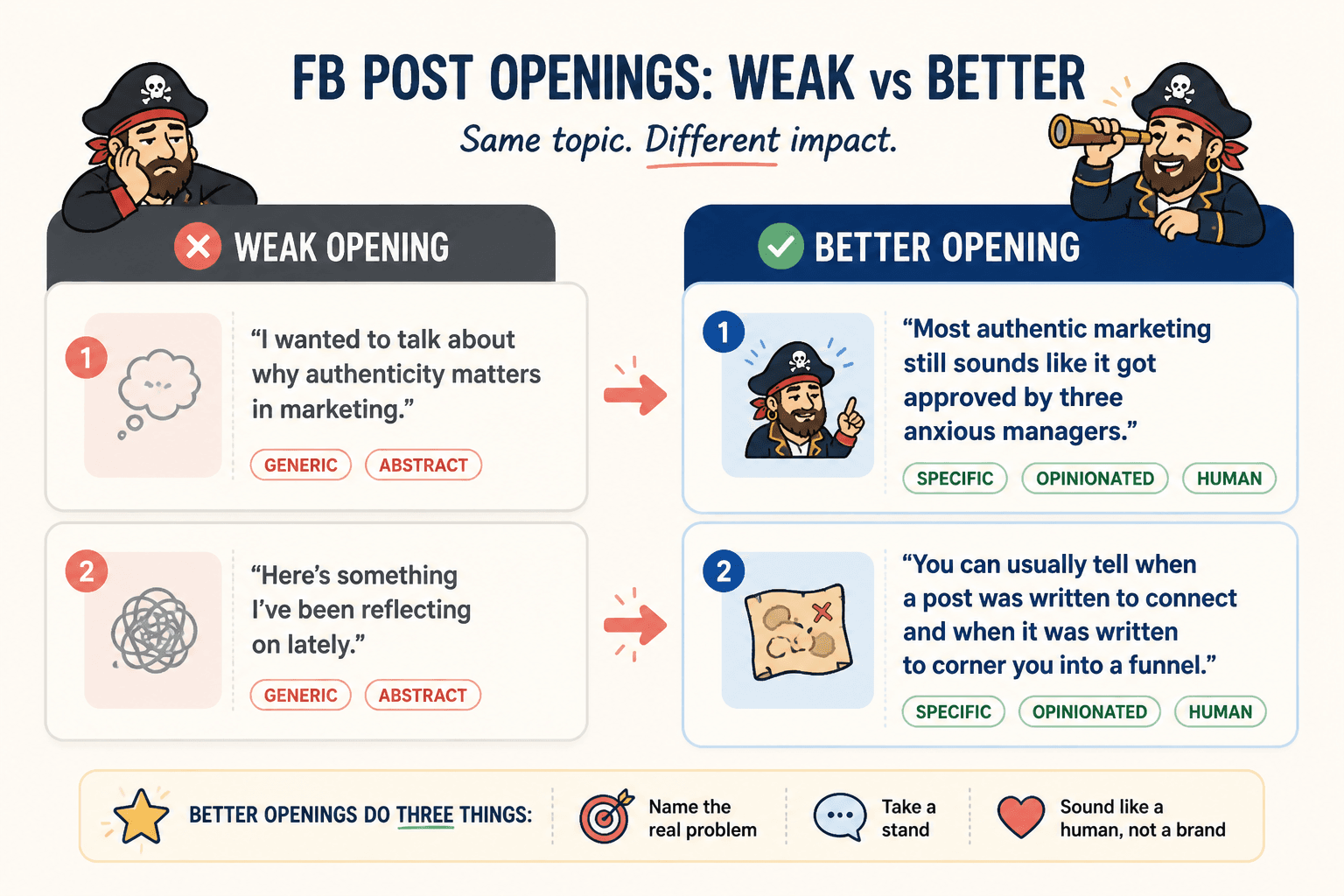
Weak: “I wanted to talk about why authenticity matters in marketing.”
Better: “Most ‘authentic’ marketing still sounds like it got approved by three anxious managers.”
Weak: “Here’s something I’ve been reflecting on lately.”
Better: “You can usually tell when a post was written to connect and when it was written to corner you into a funnel.”
If you want to sharpen that first line further, this will help: how to start Facebook posts without a weak opening.
Specificity makes posts feel human
Generic writing feels robotic because nobody actually talks in generic summaries unless they’re stalling. Specificity is what makes a post sound lived-in.
Compare these:
Generic: “Many business owners struggle with content creation and consistency.”
Specific: “A lot of business owners don’t have a consistency problem. They have a ‘every post sounds like HR wrote it’ problem.”
The second one works because it says something people can picture. It also has texture. That matters more than people think.
When your posts feel vague, add one of these:
- A concrete example
- A real pattern you keep noticing
- A line someone actually said
- A sharper contrast
- A tiny scene
Not every post needs a story. But most posts do need something more tangible than “success requires mindset and intention.” That sentence has never rescued anybody.
Don’t over-brand the post
Facebook usually responds better when the post feels social first, brand-aware second. That does not mean sloppy. It means the brand should be present in the voice, point of view, and quality of thinking, not jammed into every line like a nervous sponsor mention.
If your post keeps mentioning your framework, your method, your company, your clients, and your offer by paragraph three, there is a good chance the post is doing too much self-announcing and not enough communicating.
Trust often grows faster when the branding is lighter and the usefulness is stronger. Readers should remember the thought and the voice first. Your business can come through naturally.
A simple structure for Facebook posts that feel natural
If you want a shape to follow without sounding templated, use this:
- Open with the real point. Not a warm-up lap.
- Add context or a quick example. Give the idea some weight.
- Expand with a useful observation, contrast, or takeaway.
- End cleanly. Optional CTA, but only if it belongs.
Here’s a filled-in version:
Most Facebook posts don’t sound salesy because they mention an offer.
They sound salesy because the whole post is leaning toward the offer from line one.
People can feel when they’re being warmed up for a pitch.
That’s usually when they stop trusting the post, even if the advice itself is fine.
A better move is to write something complete on its own.
Useful thought. Real point. No weird pressure.
Then, if there’s a relevant next step, mention it like a normal person.
That structure is simple enough to repeat, but flexible enough not to make everything sound cloned.
For broader post strategy, you can also explore Facebook posts guidance here and the wider social media writing section.
Before and after: rewriting a robotic Facebook post
Here’s a typical robotic post:
The bigger point is simple: clearer structure and clearer writing make the piece more useful. That is usually what makes the ending land better too.
Facebook posts work best when the point is easy to follow and worth reacting to. Clearer structure usually beats longer wandering.