
Weak Facebook post openings usually fail before the rest of the post even gets a chance. Not because your idea is bad. Not because the algorithm is personally offended. Because the first line feels soft, generic, or weirdly apologetic.
Facebook is not the place for limp openings like “Just wanted to share something” or “Not sure who needs to hear this, but…” That kind of start tells people there is probably nothing worth stopping for. And on a platform full of family updates, group posts, memes, sales pitches, and mild chaos, weak openings get buried fast.
If you want to learn How to Start Facebook Posts Without a Weak Opening, the fix is not “be more dramatic.” It is to start with something clearer, more specific, and more alive. Something that creates immediate interest without sounding like a recycled copywriting template in a blazer.
Here’s how to write Facebook openings that actually pull people in, match the tone of the platform, and give your post a better chance of getting read, remembered, and responded to.
To see how this fits into the wider strategy, open the parent guide.
Why most Facebook post openings feel weak
A weak opening usually has one of four problems:
- It takes too long to get to the point
- It says something vague instead of something interesting
- It sounds like polished “content” instead of a human saying something worth hearing
- It asks for attention before earning it
Facebook is conversational. People scroll it differently than LinkedIn. They are not looking for “thought leadership” wrapped in twelve layers of posture. They are looking for something that feels relevant, surprising, relatable, useful, or emotionally true.
That means your opening needs to do one job well: make the next line feel worth reading.
Not impress. Not perform. Not clear its throat for three sentences.
A strong Facebook opening does not need to be clever. It needs to make the reader care what comes next.
If your posts already have decent ideas but they keep dying quietly, the opening is often the first thing to fix. And if your overall writing still feels stiff, it’s worth reading how to write better Facebook posts alongside this.
What a strong Facebook opening actually does
Good Facebook openings tend to create one of these reactions very quickly:
- Recognition: “Oh, I’ve done that.”
- Curiosity: “Wait, what happened?”
- Tension: “That sounds wrong. Keep going.”
- Relatability: “Yep, this is painfully familiar.”
- Usefulness: “This might actually help me.”
That reaction can come from a short sentence, a strong opinion, a sharp observation, a story beat, or a direct statement of the problem. It does not need tricks. It needs intent.
And yes, there is a difference between hooks and openings. Hooks are about grabbing interest. Openings are broader. They set tone, direction, and momentum. On Facebook, the best openings usually feel less like bait and more like a live wire. There’s energy in them. A pulse.
How to Start Facebook Posts Without a Weak Opening: 7 better ways
You do not need one formula. You need a small set of opening styles you can use on purpose.
1. Start with the sharpest version of the problem
This works well when the post is useful, educational, or aimed at a shared frustration.
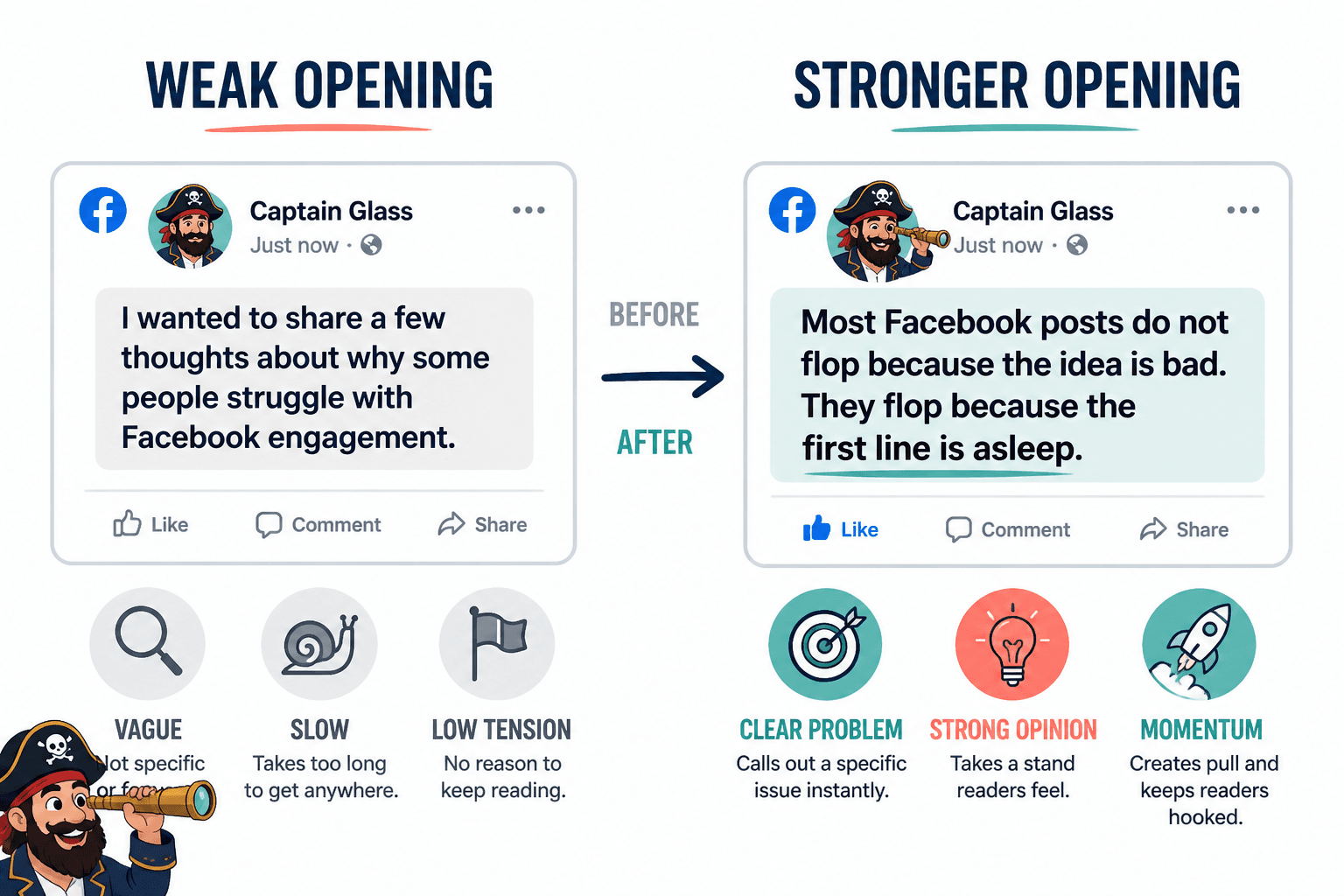
Weak: I wanted to share a few thoughts about why some people struggle with Facebook engagement.
Stronger: Most Facebook posts do not flop because the idea is bad. They flop because the first line is asleep.
See the difference? The second one has a point. It introduces tension immediately. It also sounds like someone who knows what they’re trying to say.
Use this opening when you want the reader to instantly recognize the issue and keep reading for the fix.
2. Start with a specific observation people recognize
Facebook responds well to posts that feel socially accurate. If you can name something people have seen, felt, or done, you earn attention fast.
Example: You can almost always tell when a Facebook post was written to “build a brand” instead of say something real.
Example: The fastest way to make a Facebook post feel dead is to make the first line sound like an email newsletter from a consultant who just discovered beige.
This approach works because it sounds observant, not manufactured. It gives the reader a little jolt of recognition.
3. Start in the middle of something
If you are telling a story, do not spend four lines warming up. Drop readers into a moment.
Weak: I had an interesting experience today that taught me something important about marketing.
Stronger: Halfway through writing the post, I realized I was trying to sound impressive instead of useful.
Or:
Stronger: I deleted the first seven lines because they sounded like a brochure with anxiety.
Stories move better when they begin with motion, not setup. On Facebook especially, people will give you a few seconds. Use them.
4. Start with a clean opinion
Opinionated openings work well on Facebook because they invite reaction without begging for it. The trick is to make the opinion specific enough to be interesting.
Weak: I think authenticity matters in social media.
Stronger: “Authentic” Facebook posts are often just underedited posts with good lighting.
Stronger: You do not need a stronger personal brand. You probably need a less forgettable first sentence.
That kind of opening gives the post shape immediately. It signals point of view. It gives people something to agree with, disagree with, or think about.
5. Start with contrast
Contrast is one of the easiest ways to make a first line more compelling. Show the gap between what people think and what actually happens.
Example: The best Facebook posts often sound less polished, not more.
Example: People do not ignore your posts because they hate long content. They ignore them because the opening gives them nothing to hold onto.
Contrast creates friction. Friction creates interest. Interest buys you the next line.
6. Start with a line that sounds like a real person would say it
Some openings fail because they are technically fine but emotionally dead. They sound like they were approved by a committee of moderately successful clones.
Try writing your first line the way you would actually say it to a smart friend.
Weak: I have been reflecting lately on some important lessons around communication.
Stronger: I keep seeing smart people ruin good posts with openings that sound weirdly nervous.
That does not mean sloppy. It means alive.
If your Facebook writing keeps sounding too polished or too “professional,” read how to write Facebook posts without sounding salesy or robotic. It will help you strip the plastic coating off your sentences.
7. Start with the line people usually bury in the middle
This is one of the simplest fixes and one of the most useful.
Many posts hide the most interesting sentence halfway down because the writer starts with warmup fluff. Read your draft and ask: What is the first line that actually has some life in it? Move that line to the top.
Original opening: I have been thinking a lot about content lately and how many people struggle to get traction on Facebook. There are a lot of factors involved, but one thing I keep noticing is that people do not always know how to begin. Most readers decide quickly if they want to continue.
Better opening: Most readers decide in seconds if your Facebook post is worth continuing.
That sentence should have been first all along.
Openings to stop using on Facebook
Some post starters are weak so often that they are almost a warning sign.
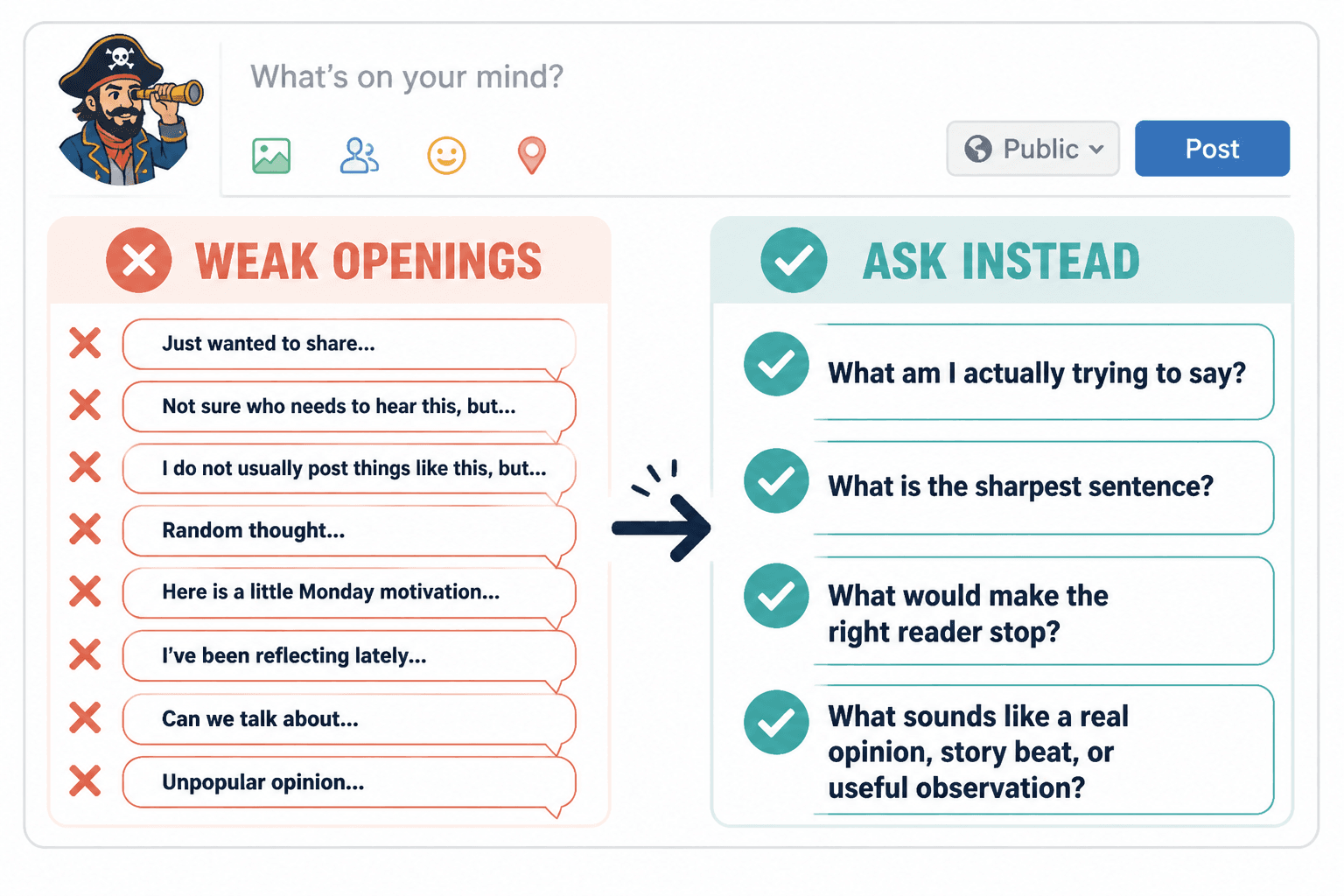
- Just wanted to share…
- Not sure who needs to hear this, but…
- I do not usually post things like this, but…
- Random thought…
- Here is a little Monday motivation…
- I’ve been reflecting lately…
- Can we talk about…
- Unpopular opinion…
These are not banned by law. They are just tired, soft, and usually followed by something even softer.
If you catch yourself using one, pause and ask:
- What am I actually trying to say?
- What is the sharpest sentence in this post?
- What would make the right reader stop?
- What part sounds most like a real opinion, story beat, or useful observation?
Start there instead.
A simple 4-step test for stronger Facebook openings
Before you publish, run your first line through this quick filter.
- Is it specific?
If you could paste it onto almost any post, it is too vague. - Does it create a reaction?
Recognition, curiosity, tension, amusement, agreement, disagreement. Something. - Does it sound human?
If it sounds like a brand intern trying to manufacture relevance, rewrite it. - Does it lead naturally into the next line?
A strong opening creates momentum. It should pull, not just sit there.
This is also a good editing process if you want to rewrite boring Facebook posts without changing the entire idea. Often the biggest lift comes from fixing the first two lines and tightening the rest around them.
Before-and-after Facebook opening rewrites
Here are a few examples to make this more concrete.
| Weak opening | Stronger opening |
|---|---|
| I wanted to share a quick lesson about posting on Facebook. | Most Facebook posts lose people before the second sentence. |
| I have been thinking a lot about authenticity online. | People can smell a performative Facebook post in about three lines. |
| Not sure who needs to hear this, but consistency matters. | Consistency helps, but repeating forgettable posts does not magically become strategy. |
| Random thought: people should be more themselves online. | “Be yourself” is useless advice if your posts still sound like assembled furniture instructions. |
| I do not usually post like this, but here goes. | If you have to apologize in the first line, the opening is probably wrong. |
Notice what changed. The stronger versions are clearer, more specific, and more willing to actually say something.
How opening style should match the kind of Facebook post you are writing
Not every post should open the same way. A story post, a useful tip post, and a lightly spicy opinion post need different energy.
For story posts
- Start with a moment
- Use action, tension, or a revealing line
- Avoid long setup
Example: I knew the post was dead the moment I read the first sentence out loud.
For useful advice posts
- Start with the actual problem
- Name the mistake or gap
- Make the usefulness obvious fast
Example: If your Facebook posts sound fine but get ignored, the opening is probably too polite.
For opinion posts
The bigger point is simple: clearer structure and clearer writing make the piece more useful. That is usually what makes the ending land better too.
Facebook posts work best when the point is easy to follow and worth reacting to. Clearer structure usually beats longer wandering.