
Most boring Facebook posts are not boring because the topic is bad. They are boring because the writing arrives pre-drained of pulse, personality, and point.
You see it all the time: a decent idea buried under throat-clearing, polite filler, generic advice, and an ending that lands with the force of wet cardboard. The post is technically fine. It is also extremely ignorable.
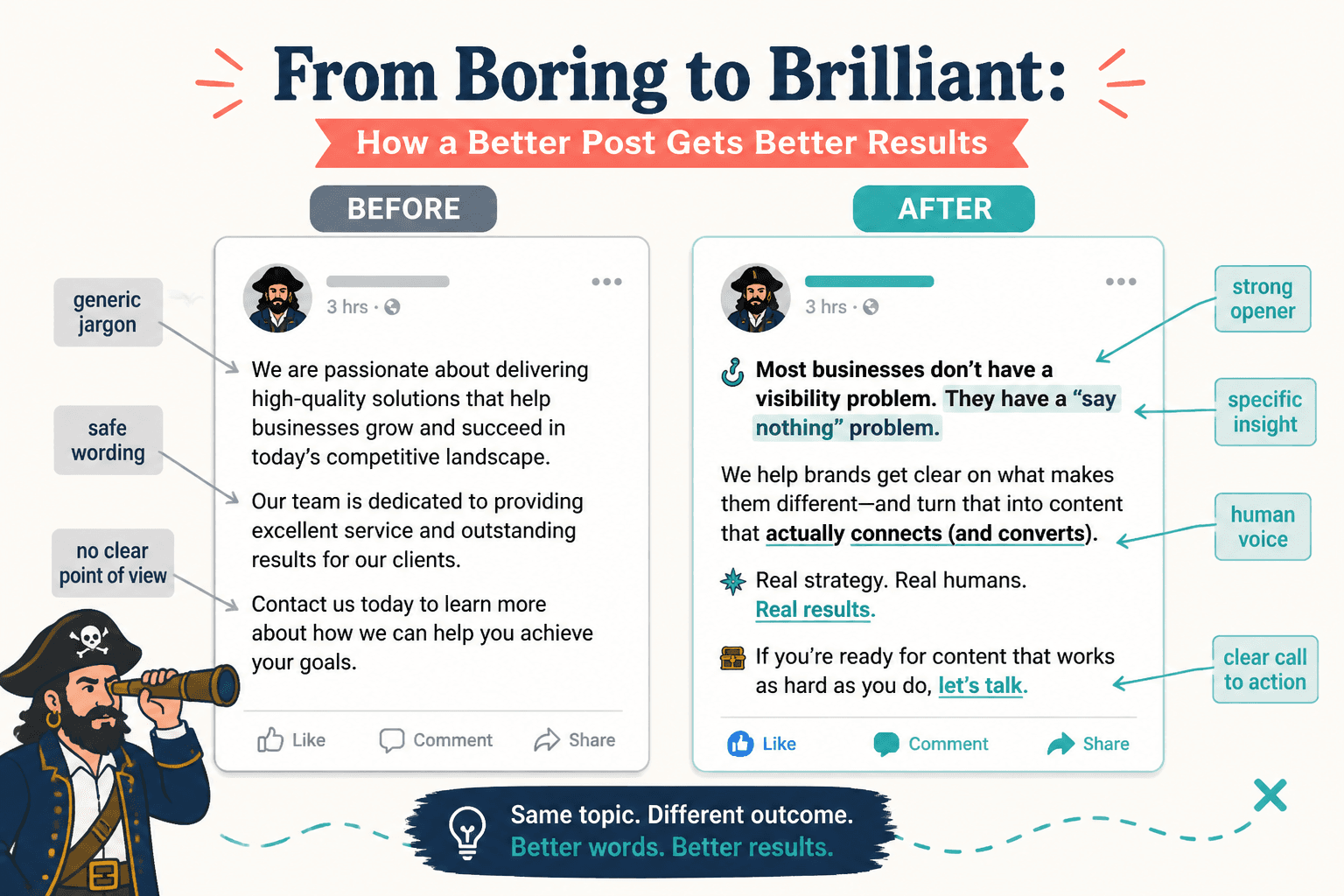
If you want to know how to rewrite boring Facebook posts, the fix usually is not “be more creative.” It is much simpler than that. Find the real point. Lead with it faster. Make the post sound like a person with a brain and a reason for speaking.
Here’s how to do that without turning every post into fake controversy, weird hype, or LinkedIn cosplay wearing a Facebook mask.
For the main guide behind this topic, visit the parent guide.
Why Facebook posts go dull so fast
Facebook is a conversational platform. People are not opening the app hoping to consume “valuable content” written like a laminated workshop handout. They want something that feels alive enough to react to, useful enough to keep reading, or specific enough to make them think, “Yep, that’s exactly what I’ve been noticing too.”
A lot of creators miss that and post like they are filing a report. The result is content that is not offensive, not risky, not confusing, and not memorable either.
The usual reasons a Facebook post feels flat:
- The opening takes too long to get anywhere
- The point is too vague
- The tone is over-polished
- There is no tension, contrast, or opinion
- The post sounds like content instead of conversation
- The ending asks for engagement in a needy, generic way
That is good news, actually. These are rewrite problems, not talent problems.
The quickest way to rewrite boring Facebook posts
Before you rewrite anything, answer one question:
What is the one thing this post is actually trying to say?
If you cannot answer that in one clean sentence, the reader definitely cannot feel it in the post.
A strong rewrite usually follows this sequence:
- Find the actual point
- Cut the slow opening
- Add specificity
- Increase contrast or tension
- Make it sound more human
- End with a cleaner next step
Simple. Not always easy, but simple.

Step 1: Find the real point hiding under the fluff
A boring post often contains a decent idea wrapped in mush. Your job is to strip away everything that does not serve the core message.
Here is a typical dull version:
I’ve been reflecting lately on how important consistency is in business. It’s something many people overlook, but over time I’ve come to realize that showing up regularly really does matter. Success does not happen overnight, and staying committed to the process is key.
Nothing in there is wrong. It is also saying almost nothing.
The real point might be:
- People quit too early because consistency feels invisible before it pays off
- Consistency matters more than intensity for most creators
- Showing up regularly builds trust before it builds results
Now we have something to work with.
Rewrite:
The annoying thing about consistency is that it looks useless right before it starts working.
That is why so many people quit too early.
Not because they are lazy. Because the early signals are quiet.
No big spike. No dramatic payoff. Just repeated effort that seems to disappear into the floorboards.
But on Facebook especially, trust usually builds like that first. Slow, then obvious.
Same general topic. Much stronger post.
A fast test for weak points
If the post could apply to almost everyone, it probably needs sharpening. “Consistency matters” is true. “People mistake invisible progress for no progress, so they stop posting too soon” is useful.
Step 2: Cut the throat-clearing at the top
This is where a lot of Facebook posts die.
Writers often spend the first few lines warming themselves up instead of earning the reader’s attention. You do not need a runway. You need a start.
Weak openings often sound like this:
- I wanted to share a quick thought today
- I’ve been thinking a lot about this lately
- Not sure who needs to hear this, but
- One thing I’ve learned on my journey
- Just a reminder that
Most of those are content mothballs. They smell old because they are old.
Instead, start with one of these:
- A sharp observation
- A friction point
- A surprising truth
- A specific mistake
- A direct opinion
For deeper help on this, it makes sense to read how to start Facebook posts without a weak opening.
Before:
I wanted to share something I’ve been noticing about content creation.
After:
A lot of “educational” content is just vague advice wearing a confident face.
Before:
I’ve been thinking lately about how important community is.
After:
People say they want community, but many of them really want an audience that claps on cue.
That second version may not be right for every brand, but it has a pulse. That matters.
Step 3: Replace vague claims with concrete detail
Vagueness is one of the fastest routes to a forgettable post.
Readers do not connect with broad statements nearly as much as they connect with recognizable specifics. The more they can picture the thing, the more they can feel the truth of it.
Here is a vague sentence:
Many business owners struggle with social media.
Here is the same idea with detail:
A lot of business owners are not struggling because they lack expertise. They are struggling because every post starts with “Happy Monday” and ends with “What do you think?” like they are being held hostage by a content calendar.
Specificity does three useful things:
- It makes the post more believable
- It creates stronger mental pictures
- It helps the right readers recognize themselves
When rewriting, look for abstract words and ask, “Can I show this more clearly?”
- Bad: be authentic
- Better: stop sanding every opinion into polite mush
- Bad: create value
- Better: share something a client could use before booking you
- Bad: build trust
- Better: say something precise enough that the right person thinks, “Okay, they actually understand this”
Step 4: Add tension, contrast, or a real opinion
Boring posts often read like they are trying not to upset anyone, disagree with anyone, or commit to anything. That usually makes them smooth, harmless, and forgettable.
You do not need to become a rage merchant. You do need a point of view.
One easy rewrite move is to add contrast:
- What people think vs what actually happens
- What sounds smart vs what works
- What beginners copy vs what experienced people know
- What gets attention vs what builds trust
Example:
People think their Facebook posts are underperforming because the algorithm is cruel.
Sometimes that’s just a comforting story.
A lot of posts flop because they open weak, say little, and ask strangers to care anyway.
That works because it introduces tension. It gives the reader something to push against or agree with. That is how conversation starts.
If your post feels limp, ask:
- What is the false assumption here?
- What do people keep getting wrong?
- What am I willing to say plainly?
Step 5: Make the tone sound like a person, not a panel discussion
Facebook rewards voice better than many platforms do. Not cartoonish voice. Not forced quirk. Just writing that sounds like a human with preferences, experience, and some level of emotional range.
A lot of boring posts are boring because the writer has edited out every trace of themselves. They are so afraid of sounding messy that they end up sounding manufactured.
That does not mean rambling. It means allowing texture into the language.
Before:
It is important to understand your audience and tailor your messaging accordingly.
After:
If your posts could speak to everyone, they usually connect with no one.
“Tailor your messaging” sounds clever.
Actually knowing what your audience is tired of, worried about, and sick of hearing? That helps.
See the difference? The rewrite is still useful. It just no longer sounds like it was approved by a committee of cautious interns.
For broader help, you can also read how to write better Facebook posts and browse the main Facebook posts guide.
Step 6: Give the post shape instead of dumping thoughts in a pile
Even short Facebook posts need structure. Not formal structure. Just enough shape that the reader can follow the movement.
A simple structure that works well for rewrites:
- Open with the strongest line
- Expand with one specific insight or example
- Add contrast, implication, or consequence
- End with a clean question, observation, or invitation
Example rewrite:
Not every Facebook post needs to teach.
Some of the strongest ones just articulate something your audience has been feeling but not saying.
That is often more useful than another 7-step mini lecture nobody asked for.
People respond to clarity. Not just information.
Have you noticed that too?
The post moves. That matters more than stuffing it with “value.”
Step 7: Rewrite the ending so it does not beg for engagement
A weak ending can undo a solid post. Especially on Facebook, where people can smell formula from several scrolls away.
Bad endings usually fall into one of these traps:
- Generic engagement bait
- Overly abrupt stop
- Awkward sales pitch
- Question that nobody wants to answer
Examples of weak endings:
- Thoughts?
- Can anyone relate?
- Do you agree yes or no?
- DM me if you need help with your content
Better options:
- End with a sharper observation
- Ask a specific question with real texture
- Invite stories, not one-word replies
- Point naturally to the next step if the post earned it
Before:
Consistency matters. Thoughts?
After:
The hard part is not posting consistently.
It is posting consistently before the feedback gets flattering.
That is the stretch where most people disappear.
The bigger point is simple: clearer structure and clearer writing make the piece more useful. That is usually what makes the ending land better too.