
Most Facebook post advice for business owners is painfully off. It either sounds like recycled LinkedIn fluff in a different shirt, or it tells you to “just be authentic” as if that clears anything up.
If you’re a coach, consultant, or personal brand, the problem usually is not that you have nothing to say. It is that your posts are too polished, too vague, too teachy, or too obviously trying to lead to a sale. Facebook can smell that from across the room.
Good Facebook Posts Examples for Coaches, Consultants, and Personal Brands do a few simple things well: they sound human, they give people something to react to, and they make expertise feel conversational instead of packaged.
This article will show you what that looks like in practice. You’ll get post examples, why they work, what to avoid, and a few flexible templates you can actually use without sounding like you bought your personality in a funnel bundle.
To see how this fits into the wider strategy, open the parent guide.
What makes a Facebook post work for this kind of business?
Facebook is still one of the better platforms for relationship-based content. Not because the algorithm is magical. Because people are more willing to comment, ramble, disagree, tell stories, and respond like actual humans there.
That means the best posts for coaches, consultants, and personal brands usually do not read like mini white papers. They feel more like a useful thought dropped into a conversation.
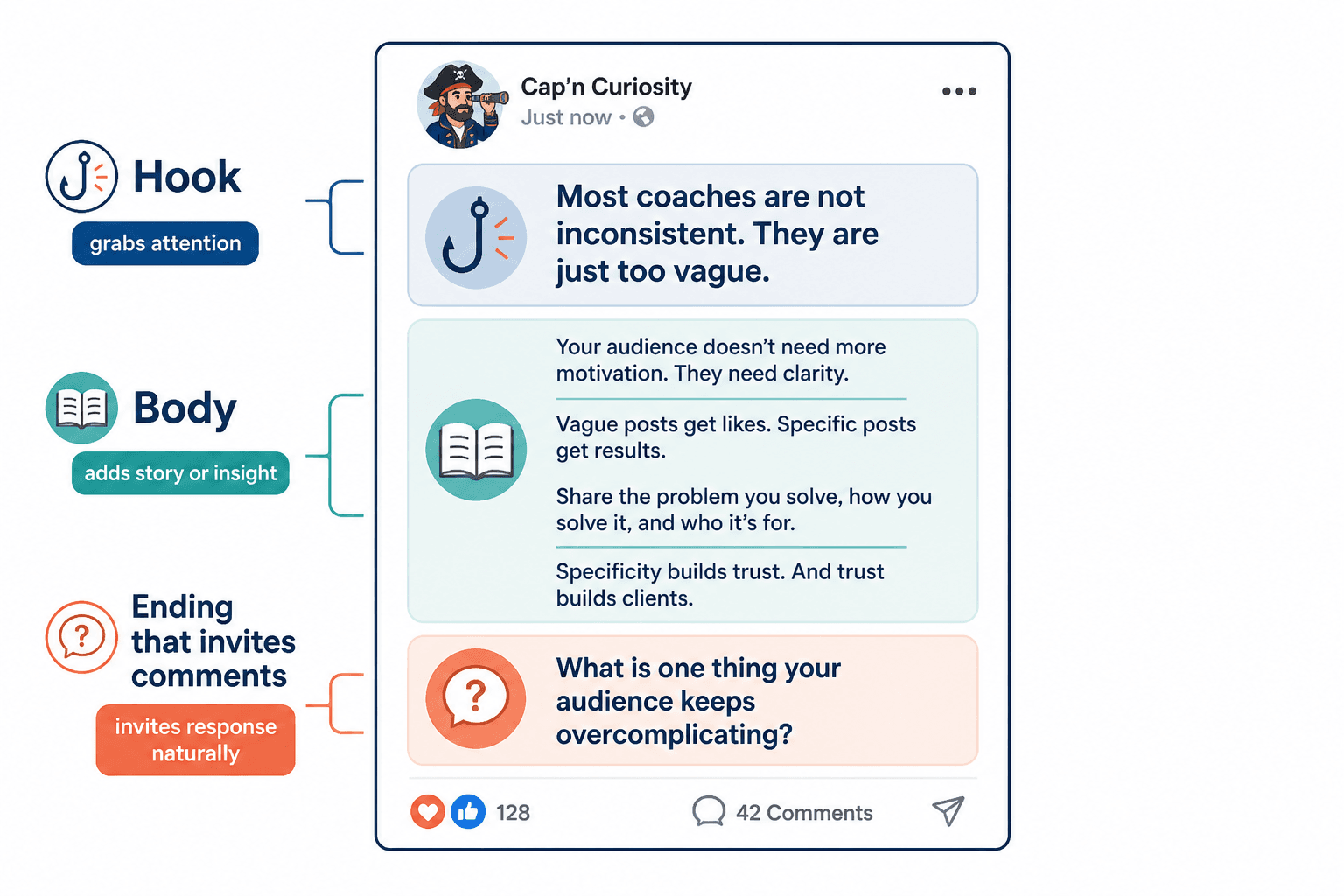
Strong Facebook posts often include:
- a clear opinion, observation, or story
- a relatable tension or problem
- specific language instead of vague “success mindset” fog
- enough personality to feel real
- a natural ending that invites response without begging for engagement
Weak posts usually fail because they are trying too hard to sound important. Facebook is not impressed by content that looks like it came from a leadership retreat PowerPoint.
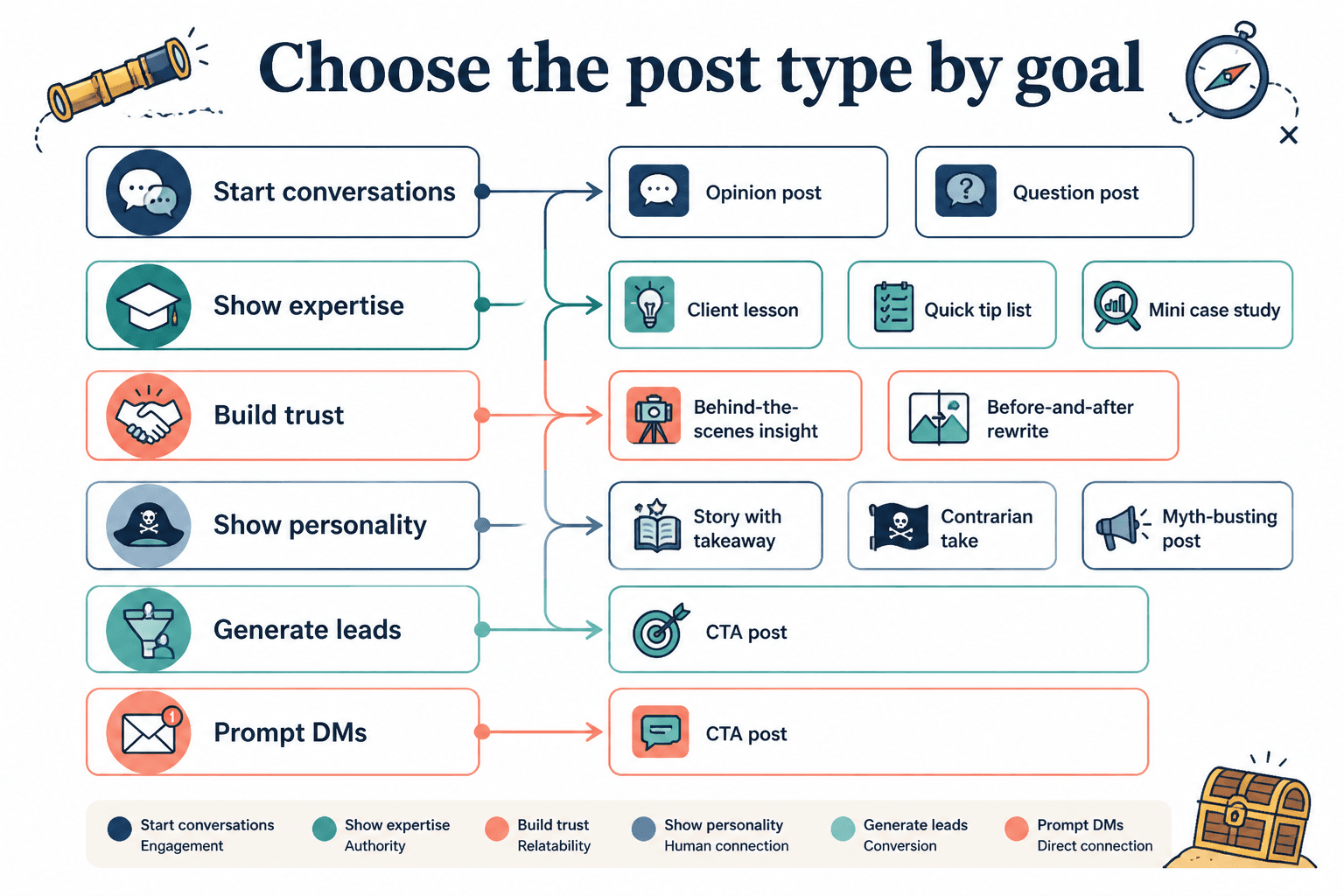
7 Facebook post types that tend to work well
You do not need 49 content pillars and a color-coded spreadsheet to post well on Facebook. You need a few reliable post types that suit your voice and your business.
1. The sharp observation post
This is where you point out something your audience keeps doing wrong, misunderstanding, or overcomplicating.
Most people do not have a consistency problem.
They have a “posting things nobody cares about” problem.
That sounds rude, but it is useful.
If your content is too broad, too safe, and too interchangeable, posting more often just gives the problem better attendance.
Better strategy:
Create fewer posts with a clearer point.
Say one useful thing with actual conviction.
Make it easier for the right people to recognize themselves in it.
Volume helps.
But not when you are mass-producing wallpaper.
Why it works: It opens with contrast, has a point of view, and gives the reader something to agree with, disagree with, or reflect on.
2. The short story with a business lesson
This works especially well for coaches and consultants because it lets you show how you think without lecturing the room.
I talked to someone recently who kept saying they wanted “better clients.”
What they actually needed was better positioning.
Their content said they helped everyone.
Their profile said three different things.
Their offer was useful but described in the most forgettable way possible.
So yes, the leads were bad.
Because the signal was bad.
People usually blame the audience too early.
Sometimes the real issue is that your business is dressed like a general store and hoping premium buyers somehow wander in anyway.
Why it works: It gives just enough narrative to hold attention, then lands on a practical takeaway.
3. The myth-busting post
People share and comment on posts that challenge lazy assumptions, especially when the point is explained clearly instead of screamed.
Hot take: being “valuable” is not enough.
I see plenty of smart people posting useful advice and getting polite silence.
Not because the advice is bad.
Because it is packaged like furniture instructions.
Useful content still needs:
an angle
a point of tension
a reason to care now
a voice people can recognize
Value matters.
But value without shape does not travel very far.
Why it works: It takes a familiar idea and makes it more precise. That tends to earn attention.
4. The behind-the-scenes process post
This is useful if your business depends on trust. People like seeing how you think, what you prioritize, and what you notice that others miss.
When I review someone’s content, I usually look at these 4 things first:
1. Is the positioning clear in under 10 seconds?
2. Does the content sound like a human or a compliance-approved brochure?
3. Are the hooks saying anything specific?
4. Is there a clear path from post to next step?
A lot of content does not need a full rebrand.
It needs sharper decisions.
The small things stack up fast.
Why it works: It demonstrates expertise without yelling “look at my expertise.” Much better move.
5. The opinion post with controlled edge
Facebook rewards conversation, and conversation often starts with a real opinion. Not fake rage. Not cartoon controversy. Just a clear take with enough backbone to be interesting.
Unpopular opinion: not every business needs a content calendar packed 30 days in advance.
Some of you need better thinking, not better batching.
If your ideas are thin, scheduling them earlier does not help.
It just gets mediocre content ready on time.
Planning is useful.
But freshness matters too, especially on a platform built for reaction and conversation.
Structure is great.
Over-structuring is how content starts sounding embalmed.
Why it works: It takes a stance, but it still explains the reasoning. That is the difference between an opinion and a performance.
6. The client-pattern post
This is one of the best post formats if you want to attract qualified leads without sounding pushy. You describe a pattern you see in clients or prospects, then unpack it.
A pattern I keep seeing:
smart service businesses creating content that sounds too generic for the people they actually want to hire them.
They are trying to stay broad enough to attract everyone.
But broad content usually attracts two things:
low-fit attention
and people who like your posts but never buy anything
Specificity feels risky until you realize vague content is quietly costing you better opportunities every week.
Why it works: The right readers think, “That might be me,” without feeling directly attacked. Useful sweet spot.
7. The low-pressure invitation post
Sometimes you do want a post to lead somewhere. Fine. Just do not turn the whole thing into a fake story whose only purpose is to shove people into a DM funnel.
I’ve been helping a few clients tighten their content positioning lately, and the same issues keep showing up:
unclear audience
bland profile copy
posts with useful ideas but weak packaging
I’m thinking about putting together a short breakdown on how to fix those without rewriting your whole brand from scratch.
If that would be useful, say “breakdown” below and I’ll post it here.
Why it works: It is clear, relevant, and low pressure. It also invites the audience into the next piece of content instead of leaping straight to “book a call.” If you want help with that last line in particular, this guide on better Facebook posts CTA endings for personal brands is worth reading.
Facebook Posts Examples for Coaches, Consultants, and Personal Brands by goal
Not every post should do the same job. Some posts are for attention. Some build trust. Some start conversations. Some gently move people toward an offer. If you treat every post like a direct sales tool, the whole thing gets weird fast.
If your goal is more comments
What is one piece of advice in your industry that sounds smart but falls apart in real life?
I’ll start:
“Just be consistent” is often lazy advice when the real issue is weak messaging.
Why this works: it asks a question people can answer with an opinion, not just a yes or no. That matters.
If your goal is trust and credibility
A quick thing I wish more people knew about content strategy:
you do not need more topics nearly as often as you need stronger angles.
Most businesses are sitting on enough material already.
What they are missing is better framing, sharper hooks, and more relevance to the buyer they actually want.
Why this works: it teaches something clear and believable without overexplaining.
If your goal is warmer leads
The fastest way to make your business look harder to buy from:
unclear offer
unclear audience
unclear next step
A lot of marketing problems are really clarity problems wearing sunglasses.
If your content is getting attention but not turning into conversations, start there.
Why this works: it speaks to a buying problem the right prospect likely recognizes in their own business.
If your goal is personality without oversharing
I have a low tolerance for content that takes 11 lines to say “be specific.”
Maybe that makes me impatient.
Maybe it makes editing easier.
Either way, if a post can be sharper, I think it should be.
Why this works: you reveal tone and standards without turning the post into a diary entry.
3 before-and-after rewrites
Sometimes the easiest way to understand better Facebook content is to look at what not to do, then fix it.
Rewrite 1: vague expertise post
Before:
Success in business comes from consistency, hard work, and showing up every day. Keep going and trust the process.
After:
A lot of people are “showing up consistently” with content that is too vague to do anything useful.
Consistency matters.
But if the message is blurry, all you’re doing is repeating the problem on schedule.
What changed: More specificity, more tension, less poster-on-a-wall energy.
Rewrite 2: boring promotional post
Before:
I’m excited to announce that I have spots available for coaching this month. Message me if interested.
After:
I’ve got room for 2 more coaching clients this month.
Best fit is someone who already has expertise and an offer, but their content still sounds too broad, too safe, or too forgettable.
If that is you, message me and I’ll tell you if it makes sense.
What changed: Clearer fit, stronger positioning, less generic announcement language.
Rewrite 3: lifeless “engagement” question
Before:
What are your goals for this week?
After:
What is one thing in your business you know you’re overcomplicating right now?
Mine: trying to make some posts too complete when they would work better if they just made one clean point.
What changed: The question is sharper, easier to answer, and grounded in a real tension.
A simple Facebook post template you can adapt
You do not need to write every post from scratch like you are chiseling marble. A light structure helps, especially if you tend to overthink openings or drift into rambling.
Try this:
- Start with a sharp observation, opinion, or tension
- Explain why it matters in plain English
- Add an example, pattern, or quick story
- Land on a useful point
- End with a light prompt, question, or next step
The bigger point is simple: clearer structure and clearer writing make the piece more useful. That is usually what makes the ending land better too.