
Most AI image tool comparisons make the same mistake: they pretend to be neutral, then quietly shove readers toward the tool the writer wants to monetize.
Readers can smell that from across the internet.
The result is usually bad for everyone. The content feels slippery. Trust drops. Conversions get worse. And the writer ends up with a comparison piece that is technically “commercial” but not actually persuasive.
If you want to know how to monetize AI image tool comparisons without fake neutrality, the answer is not to hide your opinion better. It is to structure your opinion properly. Be clear about who each tool is for, where each one wins, where each one annoys people, and why your recommendation makes sense for a specific use case.
That is what sells now. Not bland objectivity theater. Useful judgment.
This article will show you how to make AI image comparison content earn affiliate clicks, leads, and downstream sales without sounding like you were paid in vague adjectives. We’ll cover positioning, trust, conversion structure, and the line between honest recommendation and dressed-up shilling.
For the broader learning path, visit our parent guide.
Fake neutrality is not credibility
A lot of creators think monetized comparison content has to sound detached to be believable.
It does not.
What readers actually want is a reviewer who has a point of view and makes that point of view legible. If you say one tool is better for product mockups, another is stronger for cinematic concept art, and a third is the least annoying option for fast team workflows, that feels useful. If you say all three are “powerful solutions depending on your needs,” that feels like AI oatmeal in a blazer.
Neutrality is often just cowardice wearing a lab coat.
Real credibility comes from fair specificity:
- What did you test?
- What criteria actually matter?
- Who is each tool best for?
- What tradeoffs should buyers expect?
- What would make someone regret choosing it?
- When would you recommend something else instead?
That kind of clarity builds trust fast because it sounds like someone who has used the tools, not someone trying not to upset affiliate links.
What monetization should actually look like in comparison content
Monetizing AI image tool comparisons does not mean cramming buttons under every subheading and pretending your “top pick” emerged from divine truth.
It means matching recommendation style to buyer intent. Some readers want the best tool for their exact use case. Some want a fast shortlist. Some are one click away from signing up. Some are still trying to understand why image generators produce six fingers and emotional damage.
Your comparison should help all of them move one step closer to a confident decision.
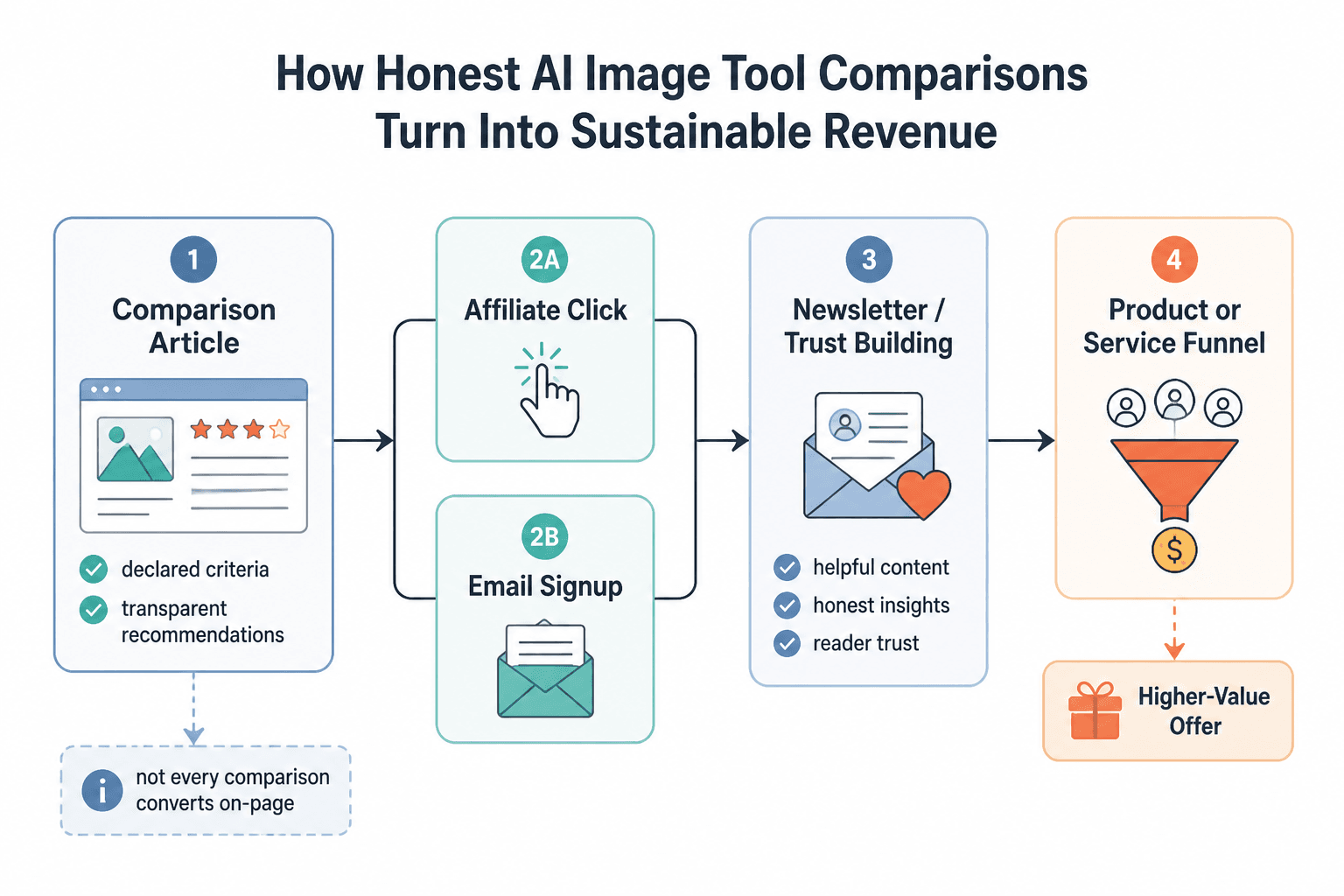
The money usually comes from one or more of these paths:
- Affiliate links to the tools you recommend
- Email signups tied to a buyer guide, prompt pack, or workflow resource
- Consulting or implementation help for teams choosing a tool stack
- Templates, prompt systems, or training products that support tool usage
- Indirect trust-building that leads to higher-value offers later
That matters because not every comparison has to convert directly on-page. Some articles are built to close a click. Others are built to earn trust with the kind of buyer who converts two weeks later through your newsletter, product, or service funnel.
If you need the broader strategy around turning comparisons into traffic and commercial action, pair this with how to turn AI image tool comparisons into buyer-intent traffic and how to use AI image tool comparisons in a creator funnel.
Start with declared criteria, not vague “best overall” claims
If you want to monetize without fake neutrality, your comparison needs a spine.
That spine is your evaluation criteria. Not generic fluff. Real factors that buyers care about.
For AI image tools, that often includes:
- Image quality and consistency
- Prompt responsiveness
- Style range
- Speed
- Editing controls
- Commercial usage terms
- Ease of use
- Pricing and credit model
- Workflow fit for solo creators or teams
- Output quality for specific use cases like ads, thumbnails, concept art, product visuals, or social posts
Notice what this does. It moves the comparison away from “Which tool is best?” and toward “Which tool is best for this job?” That makes your recommendations sharper and more monetizable because people buy when they see fit, not when they see a fake crown.
And yes, sometimes one tool really is your strongest recommendation. That is fine. Just earn it with visible reasoning.
A better way to frame recommendations
Instead of this:
Tool X is the best AI image generator overall.
Try this:
Tool X is the strongest pick for creators who care most about fast, polished outputs with minimal prompt tinkering. If you want deeper control or more experimental styles, Tool Y may suit you better.
That second version still recommends. It just does not insult the reader’s intelligence on the way there.
Be openly biased toward usefulness, not secretly biased toward payout
Every review has bias. The question is whether your bias helps the reader make a better decision.
You are allowed to care about things. In fact, you should. Maybe you prioritize commercial usability, speed, realistic outputs, cleaner interfaces, or fewer prompt gymnastics. Say that. Frame the review through those priorities.
What you do not want is hidden bias driven entirely by:
- Higher affiliate payouts
- Brand relationships you barely disclose
- Cherry-picked tests that flatter one tool
- Ignoring flaws because the conversion rate is nice
- Ranking a weak tool highly because it monetizes well
That kind of content tends to perform well right up until readers have enough alternatives to compare your comparison against. Then trust erodes, and trust is harder to rebuild than a commission click is to lose.
If you want a cleaner editorial approach, read how to write AI image tool comparisons that do not feel biased. It pairs very well with monetization because the less defensive your review feels, the easier it is to persuade.
Use a recommendation model that feels honest
One of the simplest ways to monetize AI image comparisons without sounding dodgy is to stop forcing a single winner.
Use a category-based recommendation model instead.
- Best for beginners: the tool with the easiest path to decent results
- Best for control: the tool with stronger prompt precision or editing
- Best for speed: the tool that gets usable outputs fastest
- Best for commercial creators: the tool with better output consistency and licensing confidence
- Best for experimentation: the tool that rewards prompt play and style exploration
- Best budget option: the tool with the least painful pricing for regular use
This approach works because it mirrors how buyers think. Very few people want “the best AI image tool” in the abstract. They want the best one for their actual constraints.
It also gives you more than one monetization entry point. You can attach affiliate links or CTAs to each category recommendation without making the article feel like a rigged horse race.
Example structure
- Explain the comparison criteria
- Briefly define the reader types
- Compare the tools by important features
- Name category winners
- Give “choose this if” summaries
- Add a practical next step with relevant links
Write commercial CTAs like a recommender, not a hype intern
A lot of monetized comparison articles fall apart at the CTA.
The review sounds reasonably sane, then suddenly the call to action reads like a sales page escaped into the article.
Bad:
Get started with the ultimate AI image solution today and transform your creative workflow.
Come on.
Better:
- Try Tool X if you want fast, polished outputs without much prompt tweaking.
- Choose Tool Y if style control matters more than speed.
- If you are comparing pricing closely, start with Tool Z before committing to a bigger plan.
These CTAs convert better because they continue the logic of the article. They help the reader decide. They do not suddenly become a carnival barker.
If affiliate monetization is part of your plan, it also helps to vary your affiliate angles. Do not always push “best overall.” Sometimes “best for consistency,” “best for client work,” or “least annoying for non-designers” is more believable and more clickable. For more on that, see best affiliate angles for AI image tool comparisons.
Show the tradeoffs plainly
This is where a lot of comparison content gets weird. Writers think mentioning downsides will hurt conversions.
Usually, it does the opposite.
When you tell readers where a tool falls short, your positive points become more believable. More importantly, you help the right people click and the wrong people opt out. That means fewer disappointed users and stronger long-term trust.
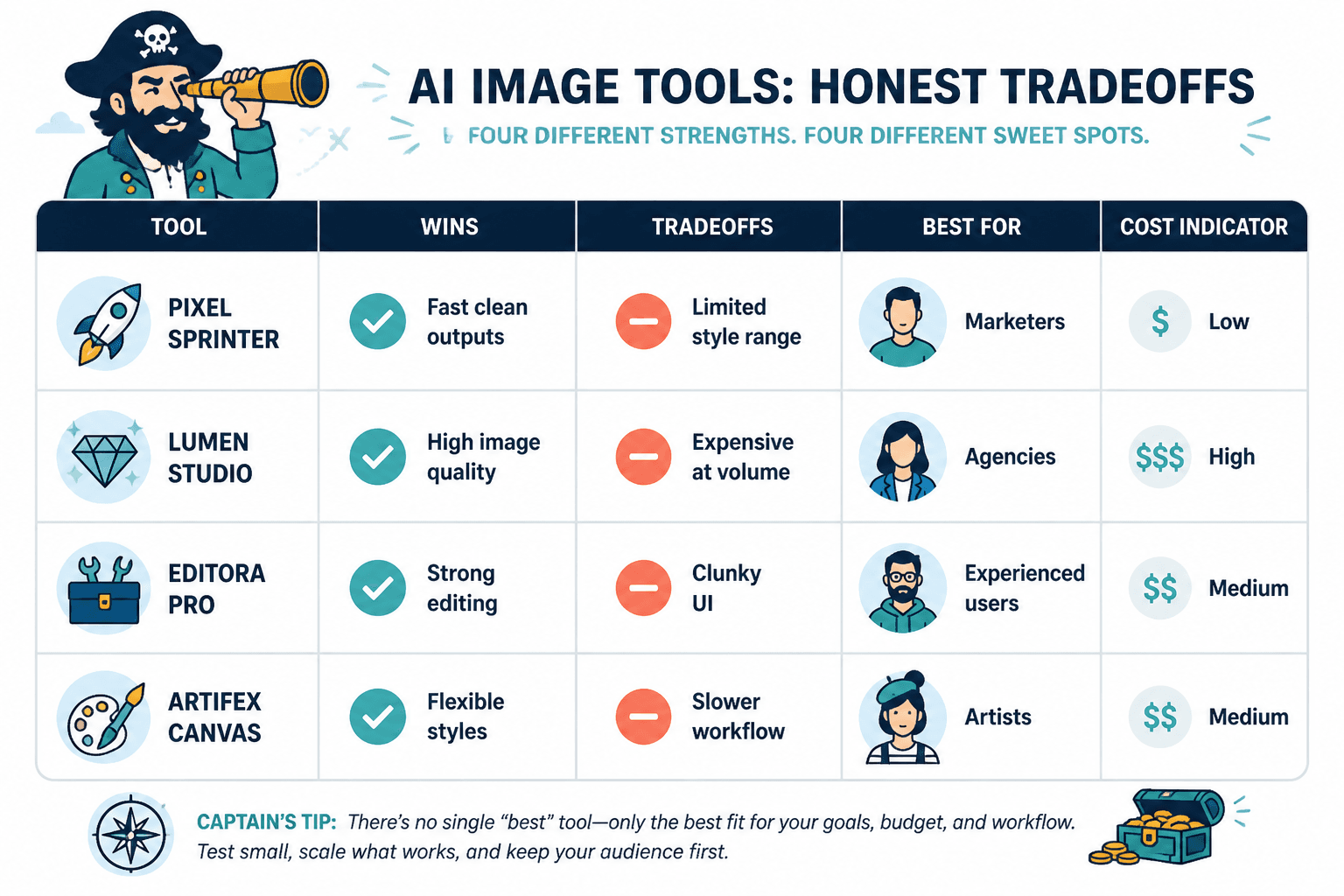
A useful tradeoff section might include lines like:
- This tool gives cleaner outputs quickly, but it can feel limiting if you want heavy stylistic experimentation.
- The image quality is strong, but the credit system gets expensive if you generate at high volume.
- The editing tools are solid, though the interface is clunkier than most beginners will enjoy.
- This is a good pick for marketing visuals, less so for detailed artistic control.
That kind of writing makes readers think, “Okay, this person is actually helping me choose.” Which is the whole job.
Build your comparison around buyer intent, not curiosity traffic
If your article gets tons of clicks from people idly browsing AI tools but very little monetization, there is a good chance your structure is attracting curiosity instead of purchase intent.
That usually happens when the article leans too hard on novelty and not enough on decision-making.
For example, these angles often bring weaker commercial intent:
- “Look what this AI image tool can do”
- “I tested 10 image generators for fun”
- “The wildest AI art tools right now”
These usually bring stronger intent:
- Best AI image tool for product mockups
- Tool A vs Tool B for ad creatives
- Which AI image generator is easiest for beginners?
- Best AI image tool for commercial use
- What to choose if you need speed over style control
The closer your article is to an actual buying decision, the easier it is to monetize honestly. Readers are already trying to choose. Your job is to help them choose well.
Use comparison tables carefully
Tables are useful. They are also one of the fastest ways to flatten nuance into fake certainty.
A good table helps readers scan. It does not replace analysis.
| Tool | Best for | Main strength | Main drawback |
|---|---|---|---|
| Tool A | Fast commercial visuals | Quick polished outputs | Less creative flexibility |
| Tool B | Style exploration | More artistic range | Steeper learning curve |
| Tool C | Budget-conscious users | Lower entry cost | Less consistency at scale |
That works because it summarizes. It does not pretend a buyer can choose well from one grid alone.
After a table, add commentary. Explain who should care about each tradeoff. Interpretation is the monetizable part. Raw feature comparison is easy to copy and weirdly hard to trust.
Disclose monetization without making it awkward
You do need to disclose affiliate relationships where relevant. But the tone matters.
Simple is best:
Some links in this comparison may be affiliate links, which means I may earn a commission if you choose a tool through them. I only recommend tools that make sense for the use cases discussed here.
That is enough for most content. Clear, calm, not melodramatic.
What you should not do is write a disclosure so aggressive and defensive that it feels like a hostage note. Mention it, be transparent, then get on with helping the reader.
Turn comparisons into a trust-first monetization system
The smartest creators do not treat a comparison article like a one-shot commission page. They treat it like one asset inside a larger content system.
For example:
- A broad comparison article captures search traffic
- A narrower use-case article helps the reader self-select
- An email opt-in offers prompts, workflow tips, or a buying checklist
- A follow-up sequence nudges the reader toward the best-fit tool
- Related posts handle objections, setup, and alternatives
This is where monetization gets cleaner. You do not have to force every article to close immediately. You can let the article do what it is best at: helping readers narrow the field and trust your judgment.
If you are building around this topic cluster, it makes sense to connect your article to the broader hub on AI image tool comparisons as well as the wider AI writing tools and workflows / AI image tools / AI image tool comparisons path. Not because internal links are magical, but because readers often need a few adjacent pieces before they are ready to click with confidence.
The bigger point is simple: clearer structure and clearer writing make the piece more useful. That is usually what makes the ending land better too.