
Most creators use AI editing and repurposing to make more content faster. Fine. Useful. But speed alone does not pay especially well.
The real question is what that repurposed content is actually feeding. If your workflow ends at “posted in more places,” you do not have a funnel. You have distribution with good lighting.
The best funnel ideas to pair with creator AI editing and repurposing are the ones that turn one solid core idea into multiple trust-building touchpoints, then give people a clear next step that matches their level of intent. Not every post should sell. Not every article needs a lead magnet. And not every piece of content deserves to become a 14-step nurture maze built by someone who recently discovered automation and got a bit too excited.
This is about building simpler, smarter funnels around the content you are already creating. The kind that help you get more leads, more email subscribers, more booked calls, and more sales without making your content sound like it was designed by a spreadsheet with a trauma-hook addiction.
If you are still refining the content side first, it helps to start with this creator AI editing and repurposing guide for creators who want better results. You can also browse the broader AI writing tools and workflows category and the main creator AI editing and repurposing hub if you want the bigger system.
For the full path around this topic, head to the parent guide.
Why funnels matter more once AI editing and repurposing enter the picture
AI editing and repurposing are useful because they reduce friction. One podcast becomes clips, a thread, an article, an email, a carousel, a short post, maybe a lead magnet draft. Great.
But lower friction creates a new problem: volume hides weak strategy. You can now produce ten pieces of content from one idea and still get underwhelming results because none of them point anywhere meaningful.
A good funnel fixes that. It gives your repurposed content a job.
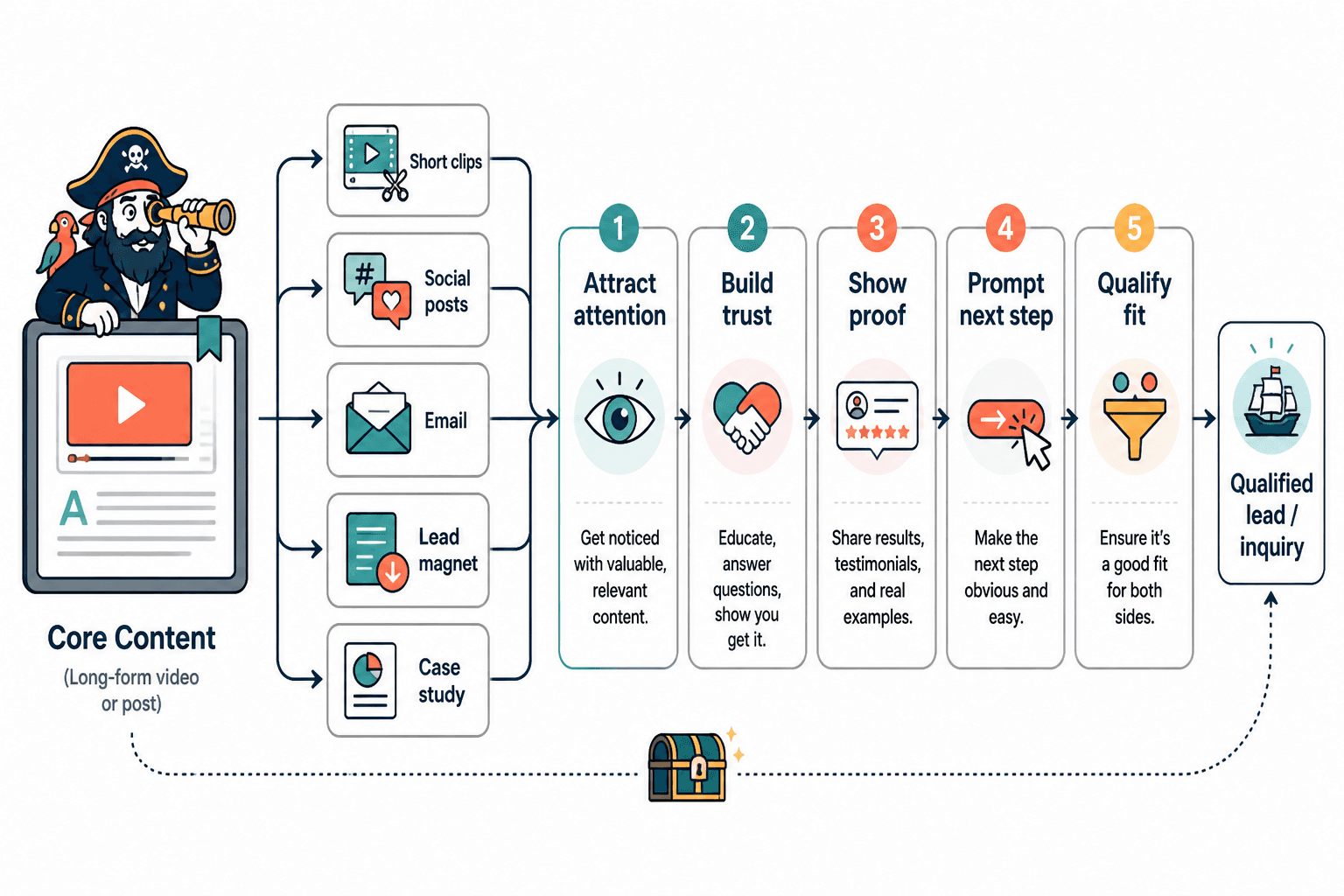
- Some pieces should attract attention.
- Some should build trust.
- Some should demonstrate proof.
- Some should move people to a next step.
- Some should qualify who is actually a fit.
That is why the best funnel ideas to pair with creator AI editing and repurposing are not about stacking software. They are about matching content formats to buyer intent.
What AI editing and repurposing can do well in a funnel
Before getting into funnel ideas, it helps to be honest about what AI is good at here.
- Turning one long-form asset into several shorter assets
- Rewriting content for different platforms and formats
- Drafting lead magnet outlines from existing material
- Pulling quotes, key lessons, objections, and CTA variations
- Helping you build nurture-email first drafts faster
- Creating multiple hooks, intros, and summaries to test
What it cannot do for you is the part people keep trying to outsource anyway:
- Choose the right offer for your audience
- Create trust where none exists
- Fix weak positioning
- Make boring ideas feel urgent
- Know which next step makes sense unless you do
So the workflow is not “AI makes content, content makes money.” Nice fantasy. The real workflow is “AI helps package and distribute good ideas, and your funnel gives those ideas somewhere useful to go.”
The best funnel ideas to pair with creator AI editing and repurposing
Here are the funnel models that tend to work best for creators, coaches, consultants, solo founders, and personal brands who are repurposing content across platforms.
1. Post to lead magnet to email nurture
This is one of the cleanest options because repurposing naturally supports it. You create one useful core piece of content, break it into platform-native posts, then direct interested readers to a resource that goes deeper.
Example flow:
- Original asset: podcast, article, training, long video, or workshop
- Repurposed assets: LinkedIn posts, X posts, email teaser, short clips
- Next step: free checklist, template, swipe file, mini guide, or workbook
- Follow-up: short email nurture sequence
- Offer: consultation, service, product, paid workshop, membership, or newsletter upgrade
This works best when the lead magnet solves a specific problem that your repurposed content already introduced. Not a vague “free resource.” Something tight.
Strong: “I turned one webinar into 19 content assets. Here is the repurposing checklist I used.”
Weak: “Comment GUIDE and I’ll send you my free value-packed framework.”
The first one feels useful. The second one feels like it escaped from a funnel template pack built in 2021.
2. Post to profile to booking page
If you sell services, strategy calls, audits, or consulting, this can be a very effective low-friction funnel. It is especially strong when your repurposed content clearly demonstrates expertise instead of just spraying “tips” around the internet.
Example flow:
- Repurpose one expert insight into several short posts
- Use each post to highlight a specific problem, mistake, or opportunity
- Send interested readers to a profile that explains who you help and how
- Profile CTA leads to a booking page
This funnel works when all three parts are aligned:
- The content proves you understand the problem
- The profile makes your positioning clear
- The booking page makes the next step feel sensible, not weirdly intense
If your repurposed content is good but your profile is mush, people stall. If your content is educational but your booking page jumps straight to “book a high-ticket clarity accelerator,” people leave. Fair enough.
3. Article to related offer
This is great for creators with deeper expertise, especially if AI repurposing helps you turn one big topic into supporting posts and newsletter content.
The structure is simple:
- Write a strong article answering a specific problem
- Repurpose sections into social posts, emails, and threads
- Link the article to a relevant service, product, workshop, or paid resource
The article does the authority work. The repurposed content brings people into it from multiple angles. Then the CTA is a natural continuation of the topic, not a random jump.
For example, an article on repurposing creator content could lead to:
- A paid content system template
- A content repurposing service
- An audit offer
- A workshop on AI-assisted editing workflows
- A private consulting package
If you need examples of what to create from one source asset, this roundup of creator AI editing and repurposing ideas and examples will help.
4. Thread or short-post series to newsletter
This is ideal if your business grows through repeated exposure and trust rather than immediate calls. Coaches, writers, educators, strategists, and niche consultants often do well with this model.
You use AI repurposing to break a longer asset into:
- A short thread
- A few standalone insight posts
- A newsletter intro
- A follow-up email angle
Then your CTA is not “buy now.” It is “get the deeper version by email.”
This works because newsletters are better for depth, sequence, and relationship-building than most social feeds. Social gets attention. Email handles context. Very different jobs.
Use this when your offer needs more trust before conversion, or when your audience prefers to think before buying instead of impulse-clicking a post.
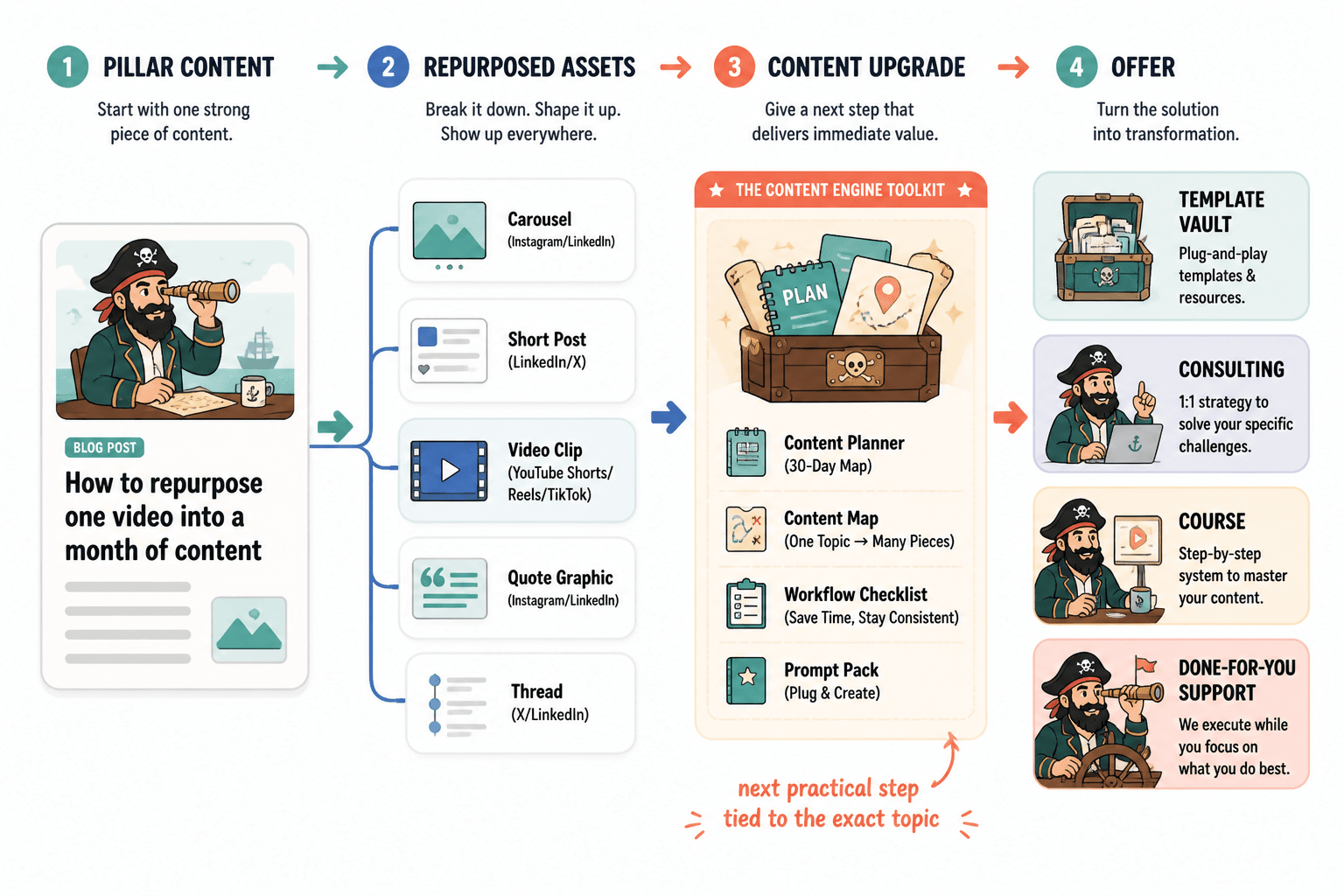
5. Content upgrade funnel from core pillar content
This one is underrated.
You create one substantial piece of pillar content around a high-intent topic. Then AI helps you repurpose it into multiple platform assets and spin out a content upgrade directly tied to that exact topic.
Example:
- Pillar article: how creators can use AI to repurpose one video into a month of content
- Repurposed assets: carousels, short posts, clips, quote graphics, thread
- Upgrade: repurposing planner, content map, workflow checklist, prompt pack
- Offer: paid template vault, consulting, course, or done-for-you support
The advantage here is relevance. People do not need a broad generic freebie. They need the next practical thing that helps them act on what they just read.
That jump from content to upgrade should feel obvious. Almost boringly obvious, honestly. That is usually a good sign.
6. Case study content to consultation funnel
If you sell services or strategy, this is one of the strongest ways to use repurposed content without sounding pushy.
Take one client result, project breakdown, or internal process example. Use AI to repurpose it into:
- A short story post
- A lesson-focused thread
- An article section
- A carousel of key takeaways
- An email breakdown
Then point interested readers to a consultation, audit, or strategy call.
This works because proof reduces friction. People do not just hear what you believe. They see how you think and what happened when the approach was applied. That makes the funnel feel less like a pitch and more like a logical next conversation.
7. Comment conversation to soft DM to offer
This one needs restraint, which is why so many people ruin it.
A healthy version looks like this:
- You publish a useful repurposed post with a clear point
- Someone comments with a relevant problem or follow-up question
- You reply publicly first
- If there is real fit, you continue in DM
- You share a resource, answer a question, or suggest the next step
An unhealthy version is “comment CHECKLIST” and then everybody gets dragged into a robotic DM funnel written by a bot that sounds like it wears a lanyard to bed.
Use soft DM funnels when your service is nuanced, your buyers need a bit of conversation, and you can genuinely help in a message exchange without instantly lunging at the sale.
8. Free resource to nurture sequence to low-ticket offer
This is a strong model if you have a digital product or want to qualify buyers before introducing a bigger offer.
AI editing and repurposing help because one source topic can feed:
- Awareness posts
- Lead magnet copy
- Nurture emails
- Sales emails
- FAQ content
- Objection-handling snippets
The sequence matters here. A decent structure might be:
- Give them the free resource
- Help them use it
- Show common mistakes
- Share an example or mini case study
- Introduce a low-ticket product that helps them go faster or deeper
This works well for templates, prompt packs, workshops, mini-courses, swipe files, and starter kits.
How to choose the right funnel for your content and business model
Not every funnel fits every creator. The right one depends on what you sell, how much trust the sale requires, and what your content already does well.
| If you sell… | Best funnel fit | Why it works |
|---|---|---|
| Consulting or strategy | Post to profile to booking page | Shortens the path from expertise to call |
| Done-for-you services | Case study to consultation | Proof does the heavy lifting |
| Newsletter-led business | Thread or post series to newsletter | Builds trust over time |
| Digital products | Free resource to nurture to low-ticket offer | Warms people up before the sale |
| Education or workshops | Post to lead magnet to email nurture | Lets you teach before pitching |
| Authority-based offers | Article to related offer | Depth supports credibility |
If your audience is cold, choose a funnel with more trust-building. If your audience already knows you, a shorter path can work. And if your content gets attention but not action, the issue may not be reach at all. It may be that your next step is vague, mismatched, or too big too soon.
A simple framework for pairing repurposed content with funnel stages
One of the easiest ways to keep your system clean is to map repurposed content by funnel stage.
Top of funnel: attention
- Short posts
- Hooks
- Clips
- Contrarian takes
- Useful threads
- Quick insights from longer assets
Goal: earn interest, not force conversion.
Middle of funnel: trust and qualification
- Articles
- Case studies
- Email sequences
- Deeper educational posts
- Mini guides
- FAQs
Goal: show depth, usefulness, and fit.
Bottom of funnel: action
- Booking page CTAs
- Product pages
- Consultation invites
- Workshop registration
- Sales emails
- Soft DM follow-up
Goal: give qualified people a clear next step.
When you use AI repurposing with this structure, you stop publishing random fragments and start building a content system with sequence. Much better.
What people keep getting wrong
A few mistakes show up constantly when creators try to pair AI editing and repurposing with funnels.
They repurpose formats, not intent
Turning a video into ten posts is not strategy by itself. Ask what each asset is supposed to do. Attract? Educate? Qualify? Convert? If you cannot answer that, the funnel will feel blurry.
They ask for too much too early
A cold social post does not usually deserve a hard sales CTA unless the offer is extremely low-friction and obvious. Most creators would do better with a softer next step first.
They make the CTA generic
“Learn more” is rarely compelling. “Get the repurposing checklist” is better. “Book a content workflow audit” is better. Specific CTAs convert better because they remove guesswork.
They automate away the human part
You can automate drafting, organizing, tagging, scheduling, and first-pass repurposing. You probably should. But if every touchpoint feels sterile, over-polished, and suspiciously generic, trust drops. People can tolerate AI assistance. What they hate is dead-eyed sameness.
They build a funnel that does not match the offer
A $29 template pack and a $5,000 consulting offer do not need the same path. One can convert fast. The other usually needs more proof, nuance, and trust. Design accordingly.
A practical setup you can steal
If you want a simple weekly system, here is a clean one.
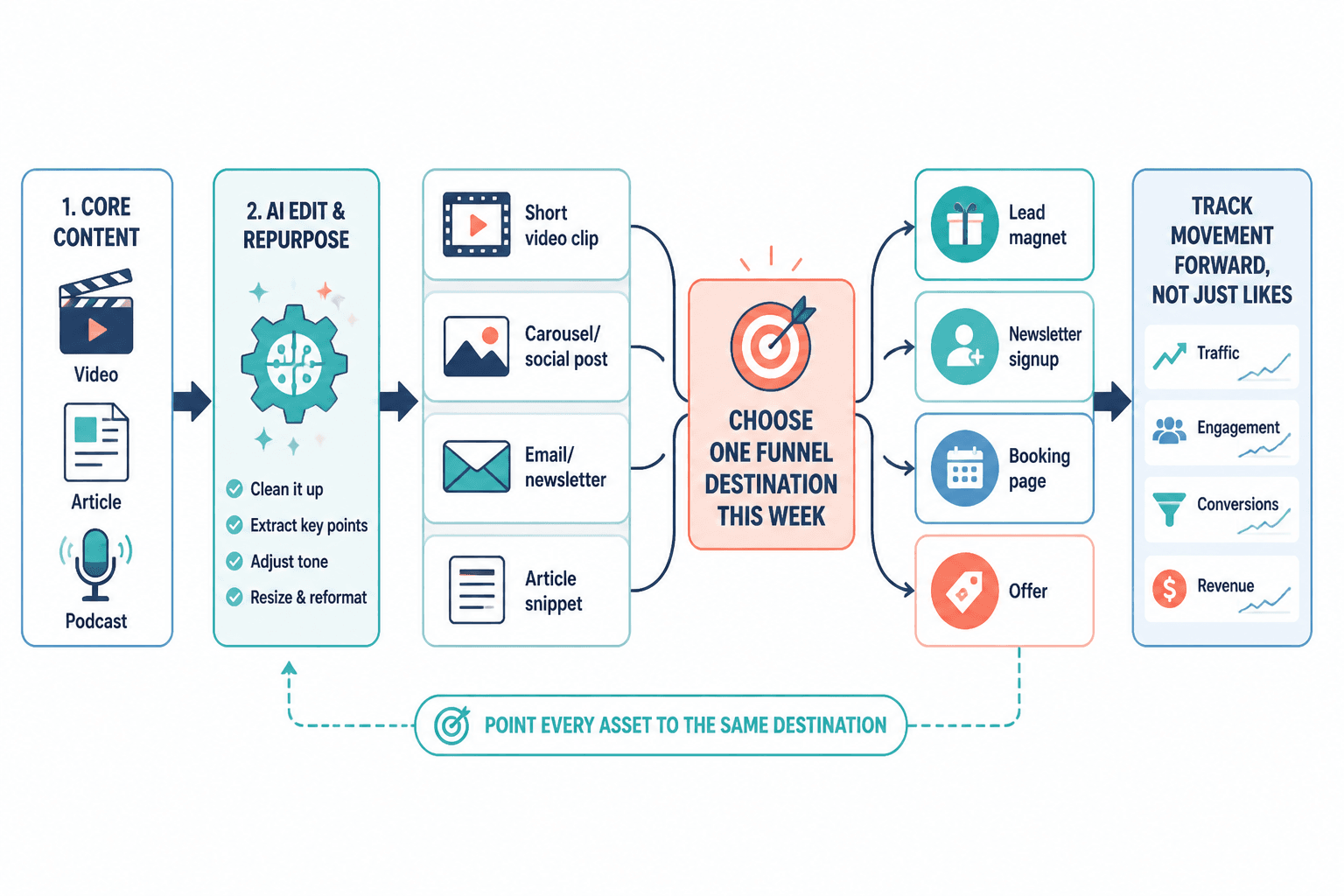
- Create one core asset each week: video, podcast, webinar, article, or training.
- Use AI to extract 5 to 10 strong sub-ideas.
- Turn those into short posts, threads, clips, and email angles.
- Choose one funnel destination for that week’s topic: lead magnet, newsletter, booking page, or offer.
- Make sure all repurposed assets point naturally toward that destination.
- Track which asset types actually move people forward, not just which ones get polite engagement.
That last part matters. Likes are not useless, but they are not your business model either.
If you want the tools side of this process, see best AI tools for creator AI editing and repurposing. And if your main goal is conversion, this guide on how to turn creator AI editing and repurposing into more leads or sales is the obvious next read.
Best funnel ideas to pair with creator AI editing and repurposing if you want simplicity
If you are overwhelmed by options, start with one of these three:
- Service business: post to profile to booking page
- Audience-building business: post to lead magnet to email nurture
- Authority business: article to related offer
That is enough to build around for quite a while.
You do not need five funnels, twelve automations, and a dashboard that looks like an aircraft panel. You need one content workflow that produces useful assets, and one funnel path that makes sense for your offer.
Keep it tight. Keep it relevant. Keep the next step obvious.
FAQ
What is the best funnel for repurposed creator content?
Usually the one that matches your offer and audience intent. For many creators, post to lead magnet to email nurture is the most flexible starting point.
Can AI build the whole funnel for me?
It can help draft assets, emails, CTAs, and repurposed content. It cannot choose strong positioning, create trust, or fix a weak offer.
Should every repurposed post have a CTA?
No. Some posts should simply build attention or trust. Forcing a CTA into everything makes content feel needy fast.
What is the simplest creator funnel to start with?
One core content asset, several repurposed posts, one lead magnet or booking link, and a short follow-up sequence. Start there before adding complexity.
How do I know if my funnel is working?
Track movement, not vanity. Look at clicks, signups, replies, booked calls, conversions, and which content formats actually lead to those actions.
The best funnel ideas to pair with creator AI editing and repurposing are not the fanciest ones. They are the ones that make your content more useful, your next step more relevant, and your business easier to understand. That is the whole game.